Кой е тиранинът на 2021 година?

Представете си, че живеете в 21-век, където технологиите, науката, здравеопазването, медиите, изкуството и образованието се развиват, а вие сте в затвора, защото изразявате мнението си и защитавате правата си. За съжаление, в момента това се случва в много страни по света.

Въпреки, че лидерите на някои страни се опитват да развиват и прилагат демокрацията заедно с правата на човека, има други, които напротив, вкарват гражданите си в затвора, които изискват основни човешки права.

Миналата година много журналисти и активисти за човешките права, бяха вкарани в затвора за изразяване на мнение и защитаването на основни човешки права като равенство в образованието и равни условия за жените. Правата на тези журналисти са отнети от управниците на техните страни, а извиненията, за да оправдаят действията си са лъжливи абсурдни.

Индекс на цензурата са подготвили списък със световните лидери, които са се отличили с жестоки нарушения на човешките права.


Александър Лукашенко

Познат като „последният диктатор на Европа“, както той гордо се самоопределя, периодът на управление на Лукашенко е един от най-пагубните в историята на страната. Хвърлил е в затвора стотици протестиращи, както и журналисти на опозицията и активисти за човешките права. В допълнение на това, той подписа закон, който позволява на полицаите да стрелят по протестиращите, без да бъдат държани за отговорност, предоставяйки на полицията огромна власт да извършва „полицейска бруталност“ спрямо протестиращите. Тъй като медиите са конторлирани от правителството, има нулева обективност в репортажите на новините, а медиите, които говорят неблагоприятно за президента са подложени на постоянни заплахи.

Образованието трябва да бъде осигурено за всички еднакво, но при сегашното управление на Лукашенко, това изглежда невъзможно. Причината е най-новото нарушение на човешките права в образователната сфера, на президента на Беларус, което забранява на млади граждани, които не подкрепят управлението му, да учат в университет. Също така десетки учители, които не вярват в идеологията на държавата са уволнени.


Жаир Болсонаро

Откакто Болсонаро поема властта през 2019 година, Бразилия се сблъсква с проблеми в много области. Медийната цензура се поставя на критиците на Болсонаро и неговия режим, а журналистите са атакувани и хвърлени в затвора за критика на крайнодесните му идеологии. Избирането на Болсонаро за президент облагодетелства хора с крайнодесни идеологии, което води до увеличаване на хомофобските и атаки срещу  „ЛГБТК+“ общността и жените. Болсонаро е известен със своите хомофобски и женомразки изявления.

Бразилия преживя един от най-тежките си периоди, откакто Ковид-19 удари страната, тъй като лошата преценка на Болсонаро доведе до огромното разпространение на вируса в цялата страна. Болсонаро е обвинен, че контролира образованието и атакува теми, занимаващи се с расизъм, жени и история на „ЛГБТК+“ обществото и равенството между половете.

Повечето от държавните университети в Бразилия зависят от държавно финансиране, но имаше предложение от Министерството на образованието да се намали финансирането на държавните университети с 30% като се премахнат катедрите по философия и социология. Настоящият режим в Бразилия също така насърчава да се разобличават и уволняват учители с леви идеиологии и да се изключват ученици, които критикуват управлението на Болсонаро.


Си Дзинпин

Един от най-опасните владетели на Китай, известен със своите брутални, крайнодесни и ревизионистки идеологии, също така отговорен за геноцида, който в момента заличава уйгурското общество в Синдзян. Както всички други крайно десни управници по света, които се забавляват като слагат в затвора журналисти и активисти, не е изненада, Си Дзинпин е един от тези владетели. Той е отговорен за ареста на много журналисти и правозащитници, които разобличиха него и неговата политическа партия. Дзинпин и неговата партия контролират образованието в страната и в чужбина, заплашвайки всеки, който говори против него или „ККП“ (Китайска комунистическа партия). Бившият министър на образованието Юан Гуйрен публично заяви, че западните учебници трябва да бъде забранено да влизат в образователната система, особено тези, които критикуват „ККП“ и нейните лидери. Това изявление е с цел ограничаване на информацията към студентите и опит за намаляване на атаките срещу „ККП“.

Очаква се от населението на Китай да следват управлението на „ККП“ и всеки, който се осмели да ги критикува бива обявен в държавна измяна и чужд шпионаж и ще бъде обвинен в нарушаване на закона. Това означава, че всеки учител или ученик, който си позволи открито да критикува Дзинпин и управлението му, ще бъде осъден и вкаран в затвор.
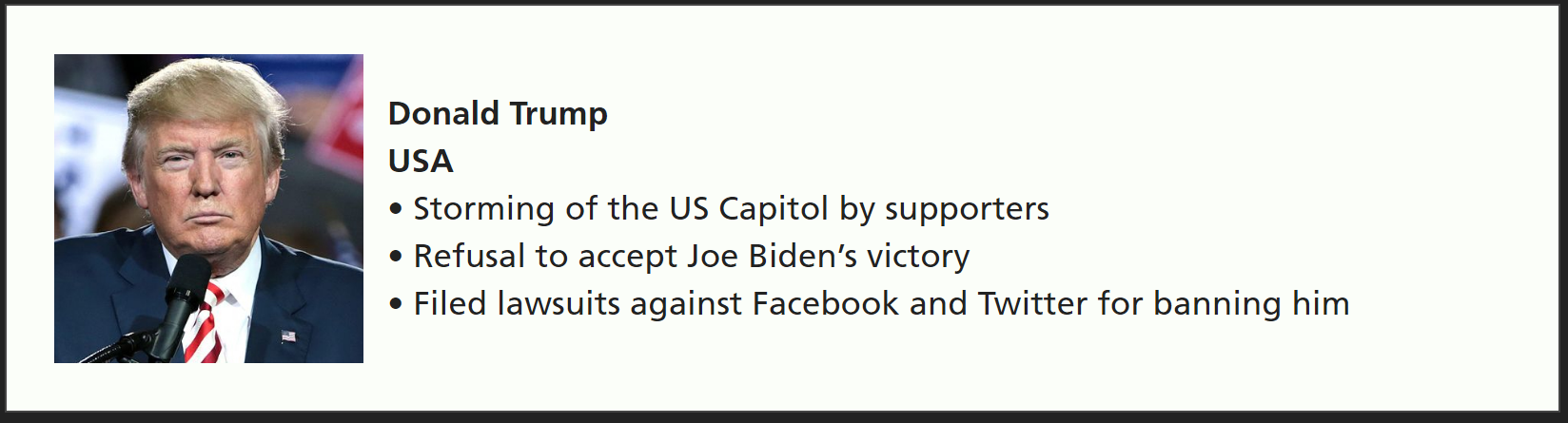
 

Доналд Тръмп

Тръмп създаде един от най-лошите периоди на САЩ като президент. Тръмп е исвестен със своите крайнодесни идеали, анти бежански изказвания, ислямофобски виждания и популяризиране на конспиративни теории.

Неговите закони за борба с бежанците включват изграждането на стена между САЩ и Мексико с цел да намали идването на бежанци от южната съседка. Заповед наречена „Защита на нацията от терористични атаки на чужди граждани“ включва забрана на граждани от 7 държави с мюсюлманско мнозинство да влизат в САЩ. Тази заповед е насочена към мюсюлманските имигранти, особено към тези с ниски доходи, тъй като законът предполага, че гражданите от тези държави са терористи и носят заплаха за безпоастността на САЩ.

Крайно десните изявления на Тръмп насърчиха привърженици на бялата раса да атакуват другите раси, мигранти и хора от религиозни малцинства. Учениците и студентите, които са част от малцинство, ставаха обект на расистки атаки, тъй като през 2018 г. администрацията на Тръмп отмени въведената от Обама кампания насочена към прекратяване на расовата дискриминация в училищата. Министърът на образованието Бетси ДеВос заяви, че „дисциплината е въпрос по, който учителите в класната стая и местните училищни ръководители заслужават автономия“. Министерството на образованието също така отмени друга инициатива започната при Обама, а именно по-строги мерки за справяне със сексуалните посегателства в кампусите и защита на транссексуалните ученици от всякаква форма на атака.


Реджеп Ердоган

Ердоган е един от противоречивите управници на Турция, известен със силните си религиозно-консервативни идеологии и крайно-десни възгледи. Противопоставянето му срещу „ЛГБТК+“ общността и женомразки изявления са част от неговата пропаганда към създаването на ислямски халифат и възстановяването на Османската империя.

Турция се оттегли от Истанбулската конвенция, която имаше за цел да защити жените и „ЛГБТК+“ общността от насилие и злоупотреби и да гарантира правата им. Това предизвика сериозни притеснения за това как Ердоган и неговият режим управляват страната на фона на нарастващия процент на фемицид и хомофобски атаки, като не осигуряват защита за жертвите на тези атаки.

Сектантството и религиозната нетолерантност са се увеличили значително в Турция след идването на Ердоган на власт. Бежанците и етническите малцинства, особено кюрдите, страдат най-много от неговия режим. ООН съобщава, че през 2016 г. турските военни и полицейски сили са убили хиляди хора по време на операция срещу кюрдските бунтовници в Югоизточна Турция. Докладът от ООН обобщава всички убийства, изтезания, изнасилвания и унищожаване на имуществото.

Мирни протести избухнаха в университет „Boğaziçi” след назначаването от Ердоган на академик Мелих Булу за ректор на университета. Булу е известен с близките си отношения с Партията на справедливостта и развитието (ПСР) ръководена от Ердоган. Студентите, които протестираха бяха арестувани и обвинени, заплашвани и малтретирани, докато Ердоган ги наричаше „мързеливи и тесногръди“. Той ги обвини във връзки с тероризъм, което той често използва като обвинения за неговите противници и всеки, който критикува режима му.

Над 100 000 професори, правителствени служители и журналисти бяха хвърлени в затвора от режима на Ердоган след неуспешният опит за преврат през 2016 г. Голяма част от задържаните са членове на движението Хизмет, създадено от турския проповедник Фетхула Гюлен, който бе посочен от Ердоган като основен виновник за преврата. Членовете на движението Хизмет отричат тези обвинения и теърдят, че Ердоган сам е организирал преврата, за да може да подсигури своята позиция и власт. Репресията след преврата води до затварянето на гюленистки училища, отстраняването на хиляди последователи на Гюлен от държавните им позиции, и ареста на повече от 150 000 образовани цивилни, обвинени във връзка с Гюлен.


Хасан Акхунд

Афганистан е център на внимание откакто талибаните си възвърнаха контрола на страната след десетилетие. Оттогава страната изпадна в икономическа, образователна и хуманитарна рецесия, засягаща особено правата на жените.

Мохамед Хасан Акхунд е един от основателите на талибаните и е ултраконсервативен религиозен учен, назначен за министър председател на Афганистан. Тяхното управление води до тежки нарушения на човешките права.

Откакто Акхунд е министър председател, жените, журналистите и активистите за човешките права страдат най-много. Момичетата нямат право да посещават училища и университет без специално религиозно облекло, а на жените е забранено да напускат домовете си без придружител мъж. Талибаните наложиха закони, които насърчават дискриминацията по пол, което води до загуба на кариерата и открита атака срещу правата на жените.

Завръщането на талибаните на власт оказва дълбоко влияние върху образованието. Въпреки, че е позволил на момичетата и жените да посещават училища и университети, министърът на образованието заяви, че на жените ще бъде разрешено да посещават институциите само с мъжкия си придружител и, че обучението им ще е в съответствие с талибанското тълкуване на ислямското право. Министърът на образованието Хакани, също заяви, че няма да има паралелки със смесени полове и ще се прилага законът на шериата в училищата и университетите.


Башар Асад

Башар Асад е синоним на диктатура. Диктаторът на Сирия е отговорен за клането на милиони цивилни, които се противопоставят на режима му, и е ползвал химически оръжия, изтезания и екзекуция като методи на защита. Той арестува и убива журналисти, които разкриват военните му престъплениям както и бомбардира гъсто населени цивилни райони. Това доведе до бежанска криза при, която 9 милиона души бяха принудени да избягат в съседни държави, търсейки убежище в бежански лагери и живеейки при тежки условия. Световната хранителна програма на ООН съобщи, че близо 6 милиона сирийци разчитат на нейните програми, за да оцелеят.

При сегашната ситуация в Сирия, много ученици и студенти се страхуват за живота си и дори много родители отказват да изпратят децата си на училище, тъй като те са се превърнали във военна подготовка. Ако се разбере, че тези семейства са част от антиправителствени протести или се противопоставят на режима на Асад, те най-често биват измъчвани, заплашвани и убити, като от сирийските въоражени сили, биват обявявани за „изчезнали“.

Училищата и университетите в Сирия, следват учебната програма, която е интерпретирана от режима на Асад. Тя възпитава учениците в съответствие с правителствените идеологии, което води до нови поколения в подкрепа на режима на Асад.


Али Хаменей

Иран е известна със своята богата история и култура, която има принос в научната, здравната и философската сфера. Въпреки богатата си история, Иран в момента страда от тежки нарушения на човешките права, причинени от техния върховен лидер.

Али Хаменей е много противоречива фигура в Иран, известен със силните си религиозно-консервативни идеологии и крайно-десни възгледи. Режимът на Хаменей е известен с бруталност и налагането на религиозни вярвания върху хората, като същевременно не зачита други религии и етнически малцинства намиращи се в Иран. Всеки, който критикува правителството е подложен на заплахи и съд, тъй като Шериатските закони се прилагат във всички правителствени институции.

Той е отговорен за затварянето на много университети, в които студентите се противопоставят на неговото правителство и нарушенията на човешките права, които е извършил. В Иран е забранено преподаването на английски език в началните училища, позовавайки се на това, че това отваря врата за разпространението на западните идеологии, или както той го нарича „западна културна инвазия“. Това действие има за цел да сведе до минимум правителствената критика сред студентите и да ги накара да не обръщат внимание на жестоките нарушения срещу човешките права извършени в цялата страна.


Никола Мадуро

Венецуела страда от огромна икономическа криза през последните години, като нивата на безработица и бедност се увеличават годишно. Тези нива нараснаха след през 2013 г. Николас Мадуро пое властта, което доведе до протести и сериозна опозиция срещу него.

Причините за протестите бяха корупционни скандали, тоталитаризъм, както и неуспех да защити демокрацията, осигурена от покойния Уго Чавес. В отговор на протестите, режимът на Мадуро осъжда, измъчва и убива цивилни, участващи в протести, включително журналисти и активисти. Много от тях са обявени за изчезнали.

Кризата засегна дълбоко образованието на децата, тъй като родителите не са способни да закупуват необходимите учебни материали и храна. Много от учениците са напуснали училище и са започнали работа, за да помагат на семействата си.  Също толкова лошо е положението и в университетите. Професорите и академичните работници получават много ниско заплащане, а в някои случаи дори не получават. Някои университети страдат от недостиг на вода, което показва колко малко внимание е обърнато на образованието във Венецуела. Режимът на Мадуро понякога арестува студенти, протестиращи срещу настоящите условия в образователната система, а понякога дори въоражените сили и стрелба срещу студентите.
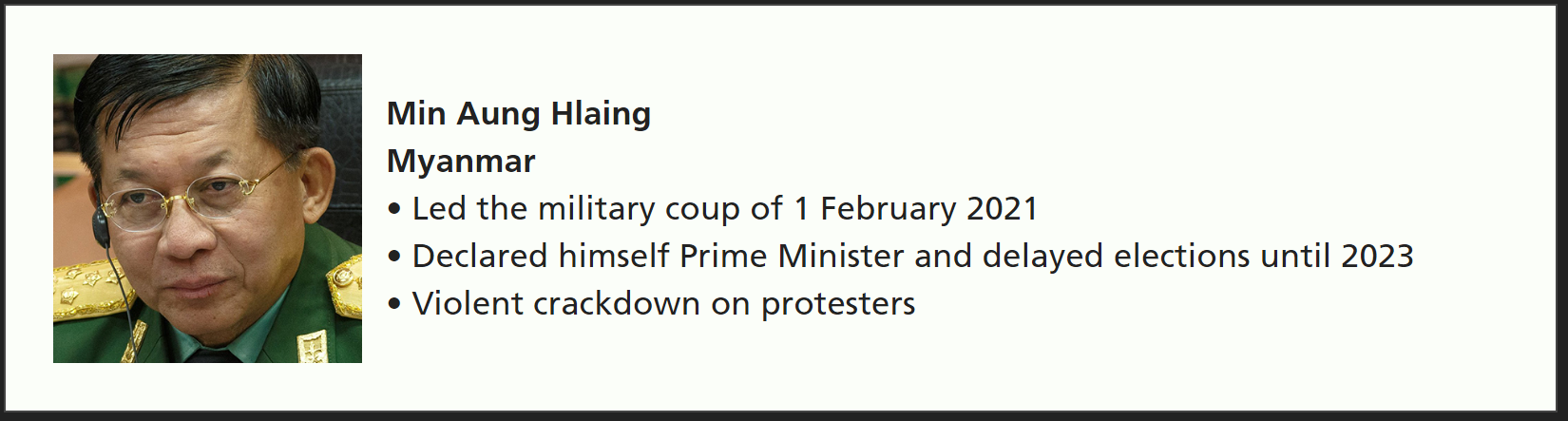
 

Мин Аунг Хлайнг

Независимостта на Мианмар от британско управление през 1948 г. изважда на показ редица проблеми в страната. Гражданската война, бедността, военното управление и установяването на диктатура, са основни проблеми пред, които е изправен Мианмар. Въоръжените сили на Мианмар, известни като „Татмаду“, превърнаха мюсюлманското общество „Рохингя“ в мишена.

През 2020 г. Аун Сан Су Чжи и нейната политическа партия „Национална лига за демокрация“ спечелиха изборите за втори път. Военните лидери обвиниха изборите, че са фалшифицирани, а висшият генерал на Мианмар Мин Аунг Хлайнг организира преврат през 2021 г. завземайки властта в страната, задържайки Су Чжи и други опозиционни лидери.

Когато в страната избухват мирни протести след преврата, много цивилни губят живота си, тъй като военният режим на Аунг Хлайнг убива, измъчва и изнасилва протестиращите, докато сълзотворен газ и други оръжия са използвани за разпръскването на демонстрантите.

Като се има предвид настоящата политическа нестабилност в старната, много ученици са спрели образованието си поради опасения, че училищните програми са продиктувани от военна политика прославяща лидерството на Аунг Хлайнг.


Ким Чен Ун

Северна Корея е една от най-изолираните държави. Управната система е комбинация между комунизъм, конфуцианство и монархическа диктатура. Северна Корея е известна със своя авторитарен режим, тъй като владетелят Ким Чен Ун и неговата партия „Работническа партия на Корея“ използват заплахи, за да могат да подчинят хората. Ким ограничава връзката с външния свят, като така гарантира, че хората остават в държавата. Концепцията за свобода или опозиция не се толерира от Чен Ун и всъщност не съществува в севрнокорейското общество. Това обяснява защо независими медии и опозиционни партии не съществуват в Северна Корея, тъй като Чен Ун и предците му са изолирали напълно държавата, превръщайки себе си в Бог, и  техния народ „Божи роби“.

Нивата на бедност в Северна Корея постоянно нарастват и до 2018 г. нивата на бедност бяха определени на 80%. Както във Венецуела, ученици напускат училище, за да работят и да изкарват прехрана за себе си и семейството си. По време на ваканции, учениците са принудени да работят в провинциалните райони, а учителите за правителството. Учителите са заети с изграждане на железопътни линии, земеделие и други незаконни работи, за да оцелеят.

Образователната система на Корея се състои от насилствена пропаганда за Ким Чен Ун. Студентите трябва да изнасят безкрайни речи, възхвалявайки наследството на Ким. Управлението се поддържа от системно индоктриниране на населението, като по този начин се запазва подчинението към лидера. Понятия като свобода или човешки права не съществуват, а международните въпроси се представят невярно.


Пол Кагаме

Въпреки напредъка на Руанда в области като здравеоопазването и образованието, за които президентът Кагме твърди, че има заслуга, в правителството има сериозни недостатъци. Кагаме става президент на Руанда през 2000г. и както всеки друг диктатор, използва властта си, за да закрие опозиционните партии и журналисти, които разкриват за нарушените човешки права по време на неговото управление. Той неколкократно е вкарвал в затвора кандидати за президент, като ги обвинява в укриване на данъци и твърди, че представляват заплаха за националната сигурност. Тези обвинения, разбира се, са фалшиви и единствената им цел е да успее да запази властта си.

Въпреки, че Кагаме си приписва заслуги за развитие в образователната сфера, записи на УНИЦЕФ сочат точно обратното. Много деца с увреждания не са записани в начални училища, тъй като няма никакви условия за тях. Много от съораженията не са проектирани да отговарят на техните нужди.

Образователната сфера се нуждае от много внимание. Само 18% от децата посещават детска градина, а момичетата са по-склонни да напуснат училище.
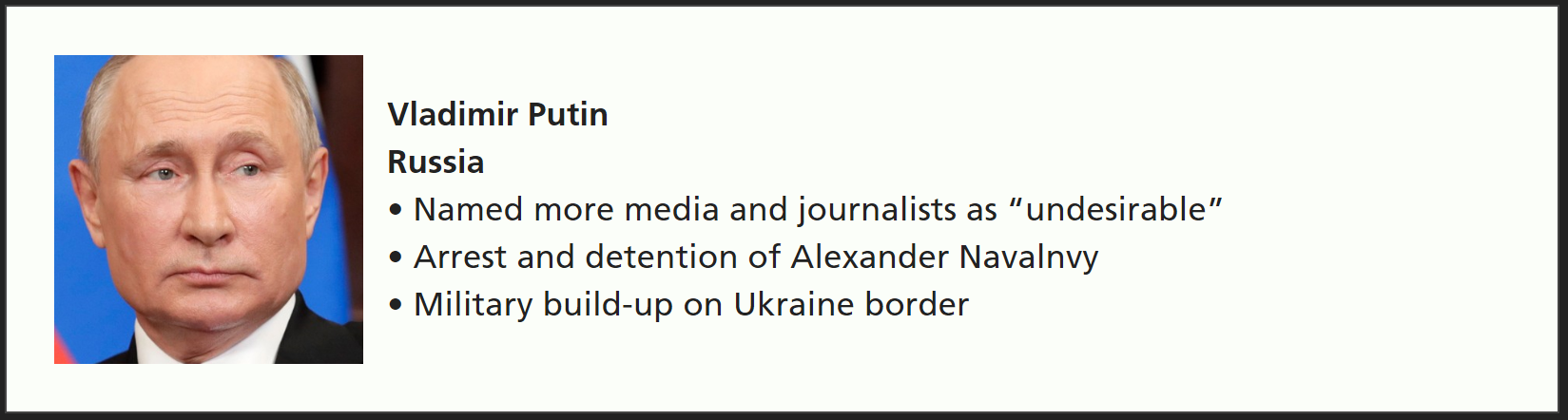
 

Владимир Путин

Според „Freedomhouse.org” Русия има едва 20 от 100 възможни точки по отношение на политически права и свобода на словото. Президентът на страната Владимир Путин упражнява авторитарен режим с позиция на нулева толерантност към опозицията и критика към режима. Той обвинява опозиционните партии и протестиращите като „терористи“ и „шпиони“, които заплашват безопасността на страната. Алексей Навални, известен критик на ръководството на Путин и активист за борба с корупцията, беше отровен през 2020 г. ,твърдейки се, че е по заповед на Путин. През 2021 г. Навални бе пратен в затвора, действие, което накара много от организациите за правата на човека да осъдят режима на Путин и да поискат от хората да се надигнат срещу него. Включително незаконното анексиране на Крим и участие в политиката на постсъветските държави, са част от нарушенията на човешки права от Владимир Путин.

Путин наложи идеологиите си и върху образователната система, като одобри нов закон, който забранява образователни промени без съгласието на властите, като по този начин създава сериозно ограничение на свободата на училищата и университетите.

С цел да разкраси историята, Министерството на образованието в Русия одобри учебниците в училищата да представят анексирането на Крим като мирно събитие. Това е само пример как Путин ръководи авторитарен режим, което води до създаването на поколение, което да се гордее със Съветския съюз.


Теодоро Обианг

Известен като втория национален лидер, който не е крал, Обианг ръководи Екваториална Гвинея от 1979 г., чрез авторитарен режим. Правата на човека се нарушават редовно, тъй като злоупотребата с човешки права, корупцията и насилствената власт, са основните проблеми пред, които страната е изправена през последните 43 години. Населението живее в постоянен страх, а защитниците на човешките права и политическите опоненти са изправени пред системен тормоз от страна на Обианг.

Въпреки множеството природни ресурси, от които страната печели, сферата на образованието е тотално занемарена. Най-често учителите им се плаща под минималната заплата като има и недостиг  на училищни пособия. Училищата са проектирани по начин, който не отговаря на нуждите на учениците. Корупцията играе огромна роля в образователната система, тъй като учителите, които имат политически връзки, получават длъжност в училища или университети без да имат нужните опит и квалификации.


Шейх Хасина

Управлението на шейх Хасина е известно с множество нарушения на човешките права. Журналисти за арестувани незаконно, а активисти за човешките права изчезват. Режимът измъчва протестиращите срещу ръководството на Хасина.

Бангладеш е сред държавите с най-много нарушения на женските права. Домашното насилие, киселинните атаки, изнасилванията и детските бракове са непропорционално високи в цялата страна. С грешното ползване на законите, които защитават жените и децата, случаите нарастват ежедневно.

Образованието в Бангладеш продължава да страда, тъй като процентът на бедност се увеличава всяка година, принуждавайки учениците да напуснат училище, за да помагат на семействата си. Момичетата са по-склонни да напуснат училище и много от тях дори не посещават начално училище, тъй като то е предразположено към сексизъм. От тази гледна точка родителите не намират образованието за момичетата като нужно.


Гурбангули Бердимухамедов

Гурбангули Бердимухамедов е най-лошият диктатор в света според списание „Обозревател“. Съобщава се, че той е извършил едни от най-сериозните нарушения на човешките права в Туркменистан, държава, която е една от най-изолираните в света.

Свободата под всякаква форма не съществува в Туркменистан. Бердимухамедов налага властта си във всяко кътче на страната. Няма свобода на словото, нито на религията, камо ли на медиите и информацията като насилието и отвличането е нормализирано при неговия режим.

Пропагандата на Бердимухамедов оказва влияние и на образователната система. В училищата се преподава по учебници, съдържащи възхвалителни речи за управлението на Бердимухамедов и неговия режим. Тези учебници промиват мозъците на младото поколение.

Училищата и университетите се контролират от правителството, тъй като те решават каква да бъде информацията, която учениците и студентите да получават, за да гарантират сигурността на настоящия политически режим.

Туркменистан има недостиг на квалифицирани учители в резултат на лошите условия в образователния сектор, като липса на образователни ресурси в училищата и университетите. Двойните смени и съботните часове оказват сериозно напрежение върху ученици и учители. Жените страдат и от допълнителните очаквания, че трябва да се оженят на 20, 21 годишна възраст. Следователно много от тях се чувстват обезкуражени да завършат висшето си образование, тъй като вече са създали собствени семейства, което възпрепятства образование и респективно кариера.


Кой е Тиранин на годината за 2021 г.? ПОБЕДИТЕЛЪТ ОБЯВЕН


Original text: Zinat Asadova

Translated by: Ivan Evstatiev  [Who is 2021’s Tyrant of the Year?]


Sources:
1. https://www.indexoncensorship.org/2021/12/who-is-2021s-tyrant-of-the-year/
2. https://www.washingtonpost.com/world/2021/05/24/faq-lukashenko-belarus/
3. https://belsat.eu/en/news/lukashenka-wants-opposition-minded-students-out-of-universities/
4. https://www.voiceofbelarus.com/lukashenko-fires-teachers/
5. https://www.france24.com/en/live-news/20211116-bolsonaro-govt-accused-of-censoring-brazil-school-exam
6. https://theconversation.com/bolsonaro-faces-crimes-against-humanity-charge-over-covid-19-mishandling-5-essential-reads-170332
7. https://theconversation.com/brazilian-universities-fear-bolsonaro-plan-to-eliminate-humanities-and-slash-public-education-budgets-117530
8. https://www.wilsoncenter.org/xis-statements-education
9. https://www.jpolrisk.com/what-the-chinese-education-minister-is-really-trying-to-say/
10. https://cmsny.org/trumps-executive-orders-immigration-refugees/
11. https://apnews.com/article/politics-lifestyle-us-news-education-donald-trump-07c8e7c5a69942699f7640890677c2d2
12. https://www.educationnext.org/harmful-policies-values-rhetoric-trump-and-nations-schools-forum-jeffries/
13. https://www.hrw.org/news/2021/03/24/turkey-erdogans-onslaught-rights-and-democracy
14. https://www.nytimes.com/2017/03/10/world/europe/un-turkey-kurds-human-rights-abuses.html
16. https://www.hrw.org/news/2021/02/18/turkey-student-protesters-risk-prosecution
17. https://www.ibtimes.co.uk/erdogans-war-education-exodus-turkeys-teachers-1656930
18. https://en.wikipedia.org/wiki/Hasan_Akhund
19. https://www.hrw.org/news/2021/09/29/list-taliban-policies-violating-womens-rights-afghanistan
20. https://www.insider.com/women-can-attend-university-mixed-classes-banned-taliban-education-minister-2021-8
21. https://theworld.org/stories/2014-09-24/8-reminders-how-horrible-syrian-president-bashar-al-assad-has-been-his-people
22. https://theworld.org/stories/2014-09-24/8-reminders-how-horrible-syrian-president-bashar-al-assad-has-been-his-people
23. https://www.hrw.org/report/2013/06/05/safe-no-more/students-and-schools-under-attack-syria
24. https://www.hrw.org/report/2013/06/05/safe-no-more/students-and-schools-under-attack-syria
25. https://justice4iran.org/12022/
26. https://tolonews.com/world/iran-bans-english-primary-schools-over-%E2%80%98cultural-invasion%E2%80%99
27. https://www.statista.com/statistics/370935/unemployment-rate-in-venezuela/
28. https://www.statista.com/statistics/1235189/household-poverty-rate-venezuela/
29. https://www.vox.com/world/2017/9/19/16189742/venezuela-maduro-dictator-chavez-collapse
30. https://www.globalcitizen.org/en/content/venezuela-crisis-childrens-education/
31. https://www.timeshighereducation.com/news/venezuelan-universities-approaching-point-no-return
32. https://www.refworld.org/docid/5be942fca.html
33. https://www.cfr.org/backgrounder/myanmar-history-coup-military-rule-ethnic-conflict-rohingya
34. https://www.hrw.org/news/2021/09/27/what-impunity-looks
35. https://www.frontiermyanmar.net/en/parents-teachers-and-students-boycott-slave-education-system/
36. https://www.hrw.org/world-report/2020/country-chapters/north-korea#
37. https://s-space.snu.ac.kr/bitstream/10371/110061/1/02.pdf
38. https://www.researchgate.net/figure/North-Korea-estimated-poverty-rates-by-region-2012-and-2018-Figures-obtained-using_fig5_339990994
39. https://s-space.snu.ac.kr/bitstream/10371/110061/1/02.pdf
40. https://s-space.snu.ac.kr/bitstream/10371/110061/1/02.pdf
41. https://www.cfr.org/blog/alongside-real-progress-kagames-human-rights-abuses-persist
42. https://www.unicef.org/rwanda/education
43. https://www.unicef.org/rwanda/education
44. https://freedomhouse.org/country/russia/freedom-world/2021
45. https://thebell.io/en/russia-tightens-state-control-over-education/
46. https://khpg.org/en/1608809430
47. https://en.wikipedia.org/wiki/Teodoro_Obiang_Nguema_Mbasogo
48. https://www.amnesty.org/en/latest/news/2019/08/equatorial-guinea-years-of-repression-and-rule-of-fear/
49. https://www.borgenmagazine.com/education-equatorial-guinea-budget-crisis/
50. https://www.justiceinitiative.org/voices/amidst-unesco-scandal-president-obiang-gives-schools-notebooks-his-image
51. https://www.amnestyusa.org/countries/bangladesh/
52. https://www.amnestyusa.org/countries/bangladesh/
53. https://borgenproject.org/girls-education-in-bangladesh/
54. https://en.wikipedia.org/wiki/Gurbanguly_Berdimuhamedow
55. https://www.hrw.org/world-report/2020/country-chapters/turkmenistan
56. https://borgenproject.org/8-facts-about-education-in-turkmenistan/#:~:text=Turkmenistan%20has%20an%20impressively%20high,through%2010th%20grade%20in%20Turkmenistan.
57. https://borgenproject.org/8-facts-about-education-in-turkmenistan/#:~:text=Turkmenistan%20has%20an%20impressively%20high,through%2010th%20grade%20in%20Turkmenistan.

pictures are taken from : https://www.indexoncensorship.org/2021/12/who-is-2021s-tyrant-of-the-year/

Nuriye Gülmen : Une lutte de six ans contre les abus systématiques du gouvernement turc

Nuriye Gulmen

Il y a près de six ans, la Turquie a été secouée par la prétendue tentative de coup d’État du 15 juillet 2016. Un jour après la tentative, le gouvernement turc a rapidement établi l’état d’urgence et adopté les décrets exécutifs d’urgence nos 667-676 qui a censuré les médias et les journalistes, [i] mais a ensuite étendu sa portée à des milliers de fonctionnaires, de policiers, de membres des forces armées, de professeurs d’université et de personnel nommément dans les annexes du décret 679 du 6 janvier 2017. [ii]  Cela a abouti à un total de plus de 150 000 de personnes perdant leur emploi, l’accès aux services sociaux, leur liberté de mouvement est devenue restreinte, leur vie ternie par l’accusation du gouvernement selon laquelle elles étaient liées au coup d’État prétendument provoqué par Fetullah Gulen, un érudit turc qui vit en exil aux États-Unis depuis 1999 et qui a constamment nié l’accusation venant d’Ankara.[iii]

L’une de ces personnes touchées à la suite de ces événements est Nuriye Gülmen, une ancienne professeure turcque de littérature comparée à l’Université de Selçuk en 2012 et qui, avant la tentative de coup d’État, a été nommée assistante de recherche à l’Université Eskişehir Osmangazi en 2015. [iv] Gülmen est non seulement universitaire, mais a également une histoire d’activisme et de batailles juridiques contre l’abus des institutions en Turquie en raison d’un procès politique après sa nomination et l’a vue détenue pendant 109 jours, retardant ses études et sa réintégration à Eskişehir. [v]

Le jour où elle a été nommée à son poste de rechercheuse était le jour de la tentative de coup d’État, qui a conduit à sa suspension d’Eskişehir le lendemain. Cela était dû aux nouveaux décrets qui l’ont accusée, comme des milliers avec elle, d’être membre de FETO, la soi-disante organisation de partisans des exilés Gulen qu’Erdogan et le gouvernement l’accusait d’être une organisation terroriste. Cela a déclenché la phase suivante de son histoire de militante et depuis le 9 novembre 2016, où elle avait protesté contre sa suspension, son licenciement éventuel et réclamé avec insistance son travail à Eskişehir tous les jours auprès du monument des droits de l’homme situé dans la rue Yüksel, Ankara, où siège le Conseil de l’enseignement supérieur et qui doit répondre à ses exigences. [vi] Gülmen explique qu’il s’agit d’une “tradition révolutionnaire” déterminée à attirer l’attention et à obtenir ce que vous voulez, exigeant dans ce cas la fin de l’état d’urgence, permettant aux travailleurs publics démocratiques révolutionnaires qui ont été licenciés de reprendre leur travail, et demande de sécurité d’emploi pour tous les travailleurs de l’éducation et des sciences.[vii] Gülmen a commencé sa manifestation en grande partie par elle-même, étant arrêtée 26 fois au total, ce qui peut être attribué à l’attention croissante des spectateurs étrangers et nationaux observant ses actions, lisant son expérience sur son blog WordPress en ligne, et finalement nommée par CNN comme l’une des huit femmes exceptionnelles de 2016 par son 50e jour de protestation. [viii]

Cette situation s’est considérablement détériorée après le décret du 6 janvier 2017, lorsque Gülmen a été renvoyée d’Eskişehir, ce qui l’a amenée à passer à la vitesse supérieure en engageant une grève de la faim le 9 mars 2017. Gülmen, alors qu’elle était en garde à vue aux côtés de l’institutrice principale Semih Özakça, ont été victimes de tortures. [ix] La justification de la grève était que les protestations verbales ont tendance à être la norme dans la boîte à outils des militants, qui le plus souvent n’attirent pas suffisamment l’attention des autorités, mais une grève de la faim est une action forte qui positionne les acteurs qui s’y engagent.[x] En réaction à la grève de la faim, un acte d’accusation a été déposé le 2 mai 2017 auprès de la 19e Cour pénale d’Ankara accusant à la fois Gülmen et Özakça d’être membres et impliqués dans les activités illicites du Parti révolutionnaire de libération du peuple-Front. (DHKP-C), conduisant à leur tour à leur détention à la prison de Sincan à Ankara le 23 mai 2017. [xi]  Le tribunal a déclaré les deux femmes coupable parce que “s’ils n’étaient pas placés en détention provisoire, ils nuiraient au cours de la justice”, une ligne qui semble contradictoires compte tenu du manque de preuves dans les accusations portées et alors que les deux enseignantes restent vigilantes en niant toute implication avec DHKP-C au point que leur avocat a même rendu public leur casier judiciaire comme preuve qu’une telle implication n’existe pas et a contré les efforts du ministre de la Intérieur Suleyman Soylu et le centre de recherche et d’études de son ministère pour tenter de solidifier les accusations. [xii]

On craignait que les deux enseignantes soient confrontés à de nouvelles violations des droits humains, puisque les gardiens de prison et les médecins sont légalement autorisés à intervenir et à mettre fin à une grève de la faim sans le consentement des enseignants. Ils peuvent également intervenir lorsqu’ils sont inconscients, comme le stipule l’article 82 de la loi sur l’exécution de l’arrêt n° 5275, ce qui violerait la liberté d’expression et est susceptible d’entraîner à des peines ou traitements cruels, inhumains ou dégradants.[xiii] Lors d’une visite du président de l’association du barreau d’Ankara, Hakan Canduran, et de certains de ses collègues, Gülmen a exprimé la situation désastreuse dans laquelle elle et Özakça se sont retrouvées. À son tour, nous avons vu Canduran appeler le gouvernement à mettre fin à la grève de la faim par la réconciliation sociale et à négocier avec ceux qui sont injustement touchés par les décrets d’urgence. [xiv]  Tout au long de la mi-2017, les deux enseignantes ont déposé une demande auprès de la Cour constitutionnelle et de la Cour européenne des droits de l’homme pour mettre fin à leur détention au motif que leur grève de la faim avait alors posé des risques évidents pour leur santé, mais les deux tribunaux ont rejeté leur demande parce que ces risques ne mettaient pas leur vie en danger et les mesures médicales appropriées étaient en place pour les aider si cela devenait le cas. [xv]

L’état de santé de Gülmen est finalement devenu grave et, le 26 septembre 2017, avait justifié son transfert dans une cellule de l’hôpital de Numune. Elle a ensuite été libérée de sa détention le 1er décembre, date à laquelle le tribunal l’a condamnée à 6 ans et 3 mois de prison, autorisant toutefois sa libération sous contrôle judiciaire.[xvi] Malgré leur libération, Gülmen et Özakça ont poursuivi leur manifestation devant le Monument des droits de l’homme, mais ont finalement dû mettre fin à leur grève de la faim le 26 janvier 2018, suite au rejet d’une commission gouvernementale chargée d’examiner leurs cas, et à la place ont cherché à concentrer leurs efforts au sein du système judiciaire national pour aller de l’avant, soulignant que leur résistance n’avait pas pris fin et qu’elles poursuivraient leur effort. [xvii]  Après 324 jours de grève de la faim, Gülmen avait perdu une quantité importante de son poids initial, passant de 59 kilogrammes à 33,8 kilogrammes, ce qui montre à quel point ses efforts étaient sérieux pour conserver son emploi et le respect de ses droits.[xviii]

La prochaine fois que Gülmen a été sous les feux de la rampe, c’est lorsqu’elle a de nouveau été arrêtée le 11 août 2020, lors d’une patrouille de police au centre culturel Idil d’Istanbul, un centre dirigé par le groupe folk de gauche Grup Yurum, dont les raisons restent inexpliquées. [xix]  Plus tard cette année-là, Gülmen et d’autres collègues ont été expulsés du Syndicat des travailleurs de l’éducation et des sciences (Eğitim-Sen) en raison de leur image de «résistants Yüksel» ou de combattants de la résistance aux yeux du gouvernement. [xx]  Le dernier développement était le 4 novembre 2021, lorsque le couple avait déposé une plainte auprès de la Cour constitutionnelle qui a ensuite rejeté leurs allégations selon lesquelles l’acte d’accusation du 2 mai 2017 utilisait les mêmes preuves qu’une enquête antérieure du 14 mars 2017, qui a conduit à leur arrestation mais ont ensuite été démis de leurs fonctions et libérés sous contrôle judiciaire, indiquant que l’acte d’accusation du 2 mai et la détention du 23 mai 2017 ont violé leurs droits à la liberté et à la sécurité, précisant en outre que les autorités judiciaires statuant sur l’affaire n’étaient ni impartiales ni indépendantes . [xxi]  La Cour a rejeté leur affaire parce que les demandes de Gülmen et Özakça manquaient de preuves concrètes, que leurs droits violés étaient inacceptables à faire valoir et qu’ils n’avaient pas épuisé tous les moyens internes avant de déposer leurs demandes.[xxii]

Ce qui ressort cruellement de l’activisme audacieux de Nuriye Gülmen, c’est que depuis 2016, le gouvernement turc a injustement ciblé des centaines de milliers d’individus sur la base d’arguments qui ne tiennent pas la route, et ceux qui ont été les plus touchés et décident de s’opposer à l’action du gouvernement. Et ces actions font systématiquement l’objet d’une répression importante par la détention et l’intimidation légale. Broken Chalk appelle le gouvernement turc et les autorités compétentes à reconsidérer sérieusement ses actions qui ont laissé des milliers de personnes sans sécurité d’emploi ou la possibilité de quitter le pays et de trouver un emploi à l’étranger. Broken Chalk demande en particulier la réintégration de Nuriye Gülmen et Semih Özakça, parmi tant d’autres, à leurs postes respectifs dans le domaine de l’éducation, dont leur retrait a certainement réduit l’accès et la qualité de l’éducation en Turquie.


Par Karl Baldacchino  Translated from Englsih Version : https://brokenchalk.org/nuriye-gulmen-a-six-year-struggle-against-systematic-abuses/

Edited by Erika Grimes


Sources:

[i] Grabenwarter, C. et al. (2017) ‘Draft Opinion on the Measures Provided in the Recent Emergency Decree Laws with Respect to Freedom of the Media’. European Commission for Democracy Through Law (Venice Commission). Available online from: https://www.venice.coe.int/webforms/documents/default.aspx?pdffile=CDL(2017)006-e [Accessed on 08/03/2022], pp. 3-4.

[ii] Decree-Law No. 679 (6th January 2017) ‘Measures Regarding Public Personnel’. Available online from: https://insanhaklarimerkezi.bilgi.edu.tr/media/uploads/2017/02/09/KHK_679_ENG.pdf [Accessed 08/03/2022], p. 1.

[iii] Jones, T. (2018) ‘Two Turkish Teachers End Almost 11-Month Hunger Strike’.  DW. Available online from: https://www.dw.com/en/two-turkish-teachers-end-almost-11-month-hunger-strike/a-42318478 [Accessed 08/03/2022]; Işık, A. (2017) ‘In Turkey, Hope for ‘Justice is Fading Away Just like my Muscles’’. DW. Available online from: https://www.dw.com/en/in-turkey-hope-for-justice-is-fading-away-just-like-my-muscles/a-39482207 [Accessed 08/03/2022].

[iv] Halavut, H. (2017) ‘Interview with Nuriye Gülmen: ‘I Have More Hope Today Than I Did on the First Day’’.  5 Harliler. Available online from: https://www.5harfliler.com/interview-with-nuriye-gulmen/ [Accessed on 08/03/2022].

[v] Ibid.

[vi] Ibid.

[vii] Ibid.; see also Gülmen, N. (2016) ‘DİRENİŞİN TALEPLERi’. Available online from: https://nuriyegulmendireniyor.wordpress.com/2016/11/08/basin-aciklamasina-cagri/ [Accessed on 08/03/2022]; see also Wikipedia (2022) ‘Nuriye Gülmen’. Available online from: https://en.wikipedia.org/wiki/Nuriye_G%C3%BClmen#cite_note-18 [Accessed 08/03/2022].

[viii] Ibid.

[ix] Ibid.; see also Amnesty International (2017) ‘Urgent Action: Fear for Hunger Strikers’ Wellbeing’. Available online from: https://www.amnesty.org/en/wp-content/uploads/2021/05/EUR4463402017ENGLISH.pdf [Accessed on 08/03/2022].

[x] Ibid.

[xi] ‘Urgent Action: Fear for Strikers’ Wellbeing’.

[xii] Cumhuriyet (2017) ‘Criminal Record of Gülmen and Özakça, Declared ‘Terrorists’ by Minister Soylu’. Available online from: https://www.cumhuriyet.com.tr/haber/bakan-soylunun-terorist-ilan-ettigi-gulmen-ve-ozakcanin-adli-sicil-kaydi-748105 [Accessed on 08/03/2022]; see also NTV (2017) ‘Statements by Minister Soylu about Semih Özakça and Nuriye Gülmen’. Available online from: https://www.ntv.com.tr/turkiye/bakan-soyludan-aclik-grevi-yapan-nuriye-gulmenle-ilgili-aciklamalar,Jg2i0I634EyPWqK_cXdIbg [Accessed on 08/03/2022]; see also Milliyet (2017) ‘The Unending Scenario of a Terrorist Organisation: “The Truth of Nuriye Gülmen and Semih Özakça”’. Available online from: https://web.archive.org/web/20170813220846/http://www.milliyet.com.tr/bir-teror-orgutunun-bitmeyen-senaryosu-ankara-yerelhaber-2179760/ [Accessed on 08/03/2022].

[xiii] ‘Urgent Action: Fear for Strikers’ Wellbeing’; see also ‘In Turkey, Hope for ‘Justice is Fading Away Just like My Muscles’.

[xiv] ‘In Turkey, Hope for ‘Justice is Fading Away Just like My Muscles’.

[xv] Armutcu, O. (2017) ‘The Constitutional Court Rejected the Appeal Against the Detention of Nuriye Gülmen and Semih Özakça’ Hurriyet. Available online from: https://www.hurriyet.com.tr/gundem/anayasa-mahkemesi-nuriye-gulmen-ve-semih-ozakcanin-tutukluluguna-yapilan-itirazi-reddetti-40503721 [Accessed on 08/03/2022]; see also Cakir, A. (2017) ‘ECHR Rejects Semih Özakça and Nuriye Gülmen’s Application’. Voice of America. Available online from: https://www.amerikaninsesi.com/a/aihm-semih-ozakca-ve-nuriye-gulmen-in-basvurusunu-reddetti/3969669.html [Accessed on 08/03/2022].

[xvi] Bianet (2017) ‘Nuriye Gülmen Released’. Available online from: https://bianet.org/english/human-rights/192100-nuriye-gulmen-released [Accessed on 08/03/2022].

[xvii] ‘Two Turkish Teachers End Almost 11-Month Hunger Strike’.

[xviii] Ibid.

[xix] Duvar English (2020) ‘Dismissed Turkish Academic, Known for Hunger Strike, Arrested Again’. Available online from: https://www.duvarenglish.com/human-rights/2020/08/11/dismissed-turkish-academic-known-for-hunger-strike-arrested-again [Accessed on 08/03/2022].

[xx] Yeni Bir Mecra (2020) ‘Critical Decisions in Eğitim-Sen: Nuriye Gülmen was Expelled’. Available online from: https://yeni1mecra.com/egitim-sende-kritik-kararlar-nuriye-gulmen-ihrac-edildi/ [Accessed on 08/03/2022].

[xxi] Duvar English (2021) ‘Turkey’s Top Court Rules Dismissed Educators’ Rights Not Violated’. Available online from: https://www.duvarenglish.com/turkeys-top-court-rules-rights-of-dismissed-educators-nuriye-gulmen-and-semih-ozakca-not-violated-news-59436 [Accessed on 08/03/2022].

[xxii] Ibid.

Нурие Гюлмен: 6 годишна борба срещу злоупотребите на системата

Nuriye Gulmen

Преди 6 години, Турция бе разтърсена от предполагаемия опит за държавен преврат на 15 Юли 2016. Ден след опита, турското правителство моментално въведе извънредно положение и прие извънредни изпълнителни укази, които основно цензорираха медии и журналисти. След това обхвата се разшири до хиляди държавни служители, полицаи, служители на въоражените сили, университетски преподаватели и служители поименно в приложенията към Указ 679 от 6 Януари 2017 г. Тези действия оставиха повече от 150,000 без работа, без социални услуги и без достъп на свобода на движение. Животът им беше опетнен от обвиненията на правителството за участие в преврата, за който се твърди, че е организиран от Фетуллах Гюлен. Гюлен е турски учен и духовник, който живее в изгнание в САЩ от 1999г и отрича всякаква връзка с опита за преврат. 

Едно от лицата засегнати от тези събития е Нурие Гюлмен, бивш турски професор по сравнителна литература в университета в Селчук през 2012 г. През 2015 я назначават за научен сътрудник  в университета Ескишехир Османгази. Гюлмен е не само академик, но също така е водила и правни битки срещу злоупотребата с институциите в Турция. Поради политически съдебен процес, след назначаването и тя е задържана за 109 дни, което забавя постъпването и в Ескишехир. Денят, в който е назначена отново съвпада с деня на преврата, което води до отстраняването на Гюлмен още на следващия ден. Това се дължи на новите укази според, които тя и още хиляди са били част от ФЕТО, така определената от Ердоган терористична организация на изгнаника Фетхула Гюлен. Това предизвиква следващата част от нейната активистка история и от 9 Ноември 2016 г. всеки ден тя протестира с искането да получи работата си обратно. Гюлмен протестира пред паметника на човешките права, намиращ се в Анкара, където се намира и съветът за висше образование, който трябва да отговори на нейните искания. Гюлмен обяснява, че това е „революционна традиция“, с която трябва да привлечеш внимание и да получиш каквото искаш. В този случай, прекратяване на извънредното положение и разрешение на всички уволнение работници да се върнат на работа, както и сигурност на местата на всички работници в сферата на образованието и науката. Гюлмен започва протестите си общо взето сама, като е арестувана общо 26 пъти, което вероятно се дължи и на нарастващото внимание от страна на местни и чуждестранни зрители, които следят действията и блоговете й. В крайна сметка тя е оценена от CNN, които я обявяват за една от осемте най-смели жени на 2016 г. 


CNN, които я обявяват за една от осемте най-смели жени на 2016 г. 

На 9 Март 2017 г. Гюлмен прави действията си още по-сериозни, като обявява гладна стачка. Заедно с началната учителка Семих Йозакча, двете изпитаха несгодите от нововъведените кризисни укази. Разбирането зад гладната стачка е, че стачка само с думи не привлича достатъчно внимание от старна на властите, но гладната стачка е следващото ниво. Както Гюлмен сама казва „Необходимо е съпротивата да бъде на следващото стъпало и наистина да ги притиснем, за да предприемат някакви действия“. В отговор на гладната стачка е внесен обвинителен акт в 19-ти наказателен съд, обвинявайки Гюлмен и Йозакча, че са членове и участват в незаконната Революционно-народоосвободителна партия. Това довежда до задържането им в затвора Синджан в Анкара до 23 Май 2017 г. Съдът намира и двете за виновни, защото „ ако не са задържани под надзор, те биха навредили на хода на правосъдието“. Цитат, който си противоречи, предвид липсата на каквито и да е доказателства по обвиненията. Дори адвокатът на обвиняемите публикува криминалните им досиета като доказателство, че не участват в никаква партия, противопоставяйки се на Министъра на вътрешните работи Сюлейман Сойлу, който се опитва да докаже правотата на повдигнатите обвинения. 

Има опасения, че още човешки права ще бъдат нарушени, тъй като надзирателите в затвора и докторите имат право да се намесят и да прекратят гладна стачка без съгласието на учителите. По време на посещение от Хакан Кандуран, който е президент на адвокатската колегия в Анкара, той заявява следното: „ справедливостта изчезва точно като нея (Гюлмен). Тя не може да държи главата си изправена без помощ, да вдига ръцете си, нито да държи химикал“. На свой ред видяхме как Кандуран призовава правителството да прекрати гладната стачка чрез обществено примирие и да преговаря с онези, които са засегнати от извънредните укази. В средата на 2017, Гюлмен и Йозакча подават иск в Касационния, както и в Европейския съд по правата на човека за прекратяване на задържането им с мотива, че гладната им стачка е представлява очевидна заплаха за здравето им. И двете институции отхвърлят исковете, тъй като заплахата не е била животозастрашаваща и са били взети необходимите медицинскки мерки, ако състоянието им се влоши. 

В крайна сметка здравето на Гюлмен се влошава и на 26 Септември 2017 г. се налага преместването й в затворничереска килия в Нумуне. До 1-ви Декември тя е свободна, докато 19-ти районен съд не я осъжда на 6 години и 3 месеца затвор, под условие, че освобождаването й е под съдебен контрол.  Въпреки освобождаването им, Гюлмен и Йозакча продължават протестите си пред паметника на човешките права. В крайна сметка на 26 Януари, 2018 г. те приключват гладната си стачка, поради отказа на съдебната система да разгледат случая. Това не сломява двете бунтовнички и те продължават със стачата си. 324 дни по-късно, Гюлмен е загубила повече от 20 килограма, показвайки колко усилия влага в това да запази работата и да извоюва правата си.  

Следващият път, в който Гюлмен бе под светлината на прожекторите беше през 2020 година, когато отново бе арестувана по време на полицейска акция в Истанбулския културен център Идил на 5-ти Август. Центърът е управляван от лявата фолк група „Юрум“, а причините за нападението все още са неизяснени. По-късно същата година, Гюлмен и други нейни колеги са изключени от синдиката на работниците в образованието и науката, тъй като чрез имиджа си на „ бойци на съпротивата“ оронват престижа на синдиката. Последното развитие по-случая е неотдавна, на 4 Ноември 2021 г. двойката подава молба до конституционния съд. Гюлмен и Йозакча твърдят, че обвинителен акт от 2 Май, 2017 г. съдържа същите обвинения срещу тях като тези в обвинителен акт от Март същата година. Обвиненията водят до техния арест, но в последствие са освободени под съдебен контрол, което доказва, че те са задържани неправомерно. Това също доказва, че съдебните органи, които се занимават със случая не са нито безпристрастни, нито независими.  Съдът отхвърля исканията им, като причини за това посочва, че липсват конкретни доказателстваи не са използвали всички местни институции преди това. 

Това, което явно се забелязва от смелият активизъм на Гюлмен е, че от 2016 г. насам, правителството несправедливо е сложило мишени на гърбовете на стотици хиляди хора, въз основа на фалшиви аргументи. Тези, които се противопоставят на правителството ще бъдат подложени на репресия чрез арести и законово сплашване. „Броукън Чолк“ призовава турското правителство и съответните власти сериозно да преразгледат, своите действия, които оставиха стотици хиляди без работа или възможност да напуснат страната, за да потърсят ново начало. „Броукън Чолк“ призовава връщането на Нурие Гюлмен и Семих Йозакча, и много други потърпевши, на съответните им работни позиции в образователната система. Отстраняването на тези хора със сигурност е намалило качеството на образованието в Турция.


Original text: Karl Baldacchino

Translated by: Ivan Evstatiev  from [Nuriye Gülmen: A Six-Year Struggle Against Systematic Abuses]


Sources:

[i] Grabenwarter, C. et al. (2017) ‘Draft Opinion on the Measures Provided in the Recent Emergency Decree Laws with Respect to Freedom of the Media’. European Commission for Democracy Through Law (Venice Commission). Available online from: https://www.venice.coe.int/webforms/documents/default.aspx?pdffile=CDL(2017)006-e [Accessed on 08/03/2022], pp. 3-4.

[ii] Decree-Law No. 679 (6th January 2017) ‘Measures Regarding Public Personnel’. Available online from: https://insanhaklarimerkezi.bilgi.edu.tr/media/uploads/2017/02/09/KHK_679_ENG.pdf [Accessed 08/03/2022], p. 1.

[iii] Jones, T. (2018) ‘Two Turkish Teachers End Almost 11-Month Hunger Strike’.  DW. Available online from: https://www.dw.com/en/two-turkish-teachers-end-almost-11-month-hunger-strike/a-42318478 [Accessed 08/03/2022]; Işık, A. (2017) ‘In Turkey, Hope for ‘Justice is Fading Away Just like my Muscles’’. DW. Available online from: https://www.dw.com/en/in-turkey-hope-for-justice-is-fading-away-just-like-my-muscles/a-39482207 [Accessed 08/03/2022].

[iv] Halavut, H. (2017) ‘Interview with Nuriye Gülmen: ‘I Have More Hope Today Than I Did on the First Day’’.  5 Harliler. Available online from: https://www.5harfliler.com/interview-with-nuriye-gulmen/ [Accessed on 08/03/2022].

[v] Ibid.

[vi] Ibid.

[vii] Ibid.; see also Gülmen, N. (2016) ‘DİRENİŞİN TALEPLERi’. Available online from: https://nuriyegulmendireniyor.wordpress.com/2016/11/08/basin-aciklamasina-cagri/ [Accessed on 08/03/2022]; see also Wikipedia (2022) ‘Nuriye Gülmen’. Available online from: https://en.wikipedia.org/wiki/Nuriye_G%C3%BClmen#cite_note-18 [Accessed 08/03/2022].

[viii] Ibid.

[ix] Ibid.; see also Amnesty International (2017) ‘Urgent Action: Fear for Hunger Strikers’ Wellbeing’. Available online from: https://www.amnesty.org/en/wp-content/uploads/2021/05/EUR4463402017ENGLISH.pdf [Accessed on 08/03/2022].

[x] Ibid.

[xi] ‘Urgent Action: Fear for Strikers’ Wellbeing’.

[xii] Cumhuriyet (2017) ‘Criminal Record of Gülmen and Özakça, Declared ‘Terrorists’ by Minister Soylu’. Available online from: https://www.cumhuriyet.com.tr/haber/bakan-soylunun-terorist-ilan-ettigi-gulmen-ve-ozakcanin-adli-sicil-kaydi-748105 [Accessed on 08/03/2022]; see also NTV (2017) ‘Statements by Minister Soylu about Semih Özakça and Nuriye Gülmen’. Available online from: https://www.ntv.com.tr/turkiye/bakan-soyludan-aclik-grevi-yapan-nuriye-gulmenle-ilgili-aciklamalar,Jg2i0I634EyPWqK_cXdIbg [Accessed on 08/03/2022]; see also Milliyet (2017) ‘The Unending Scenario of a Terrorist Organisation: “The Truth of Nuriye Gülmen and Semih Özakça”’. Available online from: https://web.archive.org/web/20170813220846/http://www.milliyet.com.tr/bir-teror-orgutunun-bitmeyen-senaryosu-ankara-yerelhaber-2179760/ [Accessed on 08/03/2022].

[xiii] ‘Urgent Action: Fear for Strikers’ Wellbeing’; see also ‘In Turkey, Hope for ‘Justice is Fading Away Just like My Muscles’.

[xiv] ‘In Turkey, Hope for ‘Justice is Fading Away Just like My Muscles’.

[xv] Armutcu, O. (2017) ‘The Constitutional Court Rejected the Appeal Against the Detention of Nuriye Gülmen and Semih Özakça’ Hurriyet. Available online from: https://www.hurriyet.com.tr/gundem/anayasa-mahkemesi-nuriye-gulmen-ve-semih-ozakcanin-tutukluluguna-yapilan-itirazi-reddetti-40503721 [Accessed on 08/03/2022]; see also Cakir, A. (2017) ‘ECHR Rejects Semih Özakça and Nuriye Gülmen’s Application’. Voice of America. Available online from: https://www.amerikaninsesi.com/a/aihm-semih-ozakca-ve-nuriye-gulmen-in-basvurusunu-reddetti/3969669.html [Accessed on 08/03/2022].

[xvi] Bianet (2017) ‘Nuriye Gülmen Released’. Available online from: https://bianet.org/english/human-rights/192100-nuriye-gulmen-released [Accessed on 08/03/2022].

[xvii] ‘Two Turkish Teachers End Almost 11-Month Hunger Strike’.

[xviii] Ibid.

[xix] Duvar English (2020) ‘Dismissed Turkish Academic, Known for Hunger Strike, Arrested Again’. Available online from: https://www.duvarenglish.com/human-rights/2020/08/11/dismissed-turkish-academic-known-for-hunger-strike-arrested-again [Accessed on 08/03/2022].

[xx] Yeni Bir Mecra (2020) ‘Critical Decisions in Eğitim-Sen: Nuriye Gülmen was Expelled’. Available online from: https://yeni1mecra.com/egitim-sende-kritik-kararlar-nuriye-gulmen-ihrac-edildi/ [Accessed on 08/03/2022].

[xi] Duvar English (2021) ‘Turkey’s Top Court Rules Dismissed Educators’ Rights Not Violated’. Available online from: https://www.duvarenglish.com/turkeys-top-court-rules-rights-of-dismissed-educators-nuriye-gulmen-and-semih-ozakca-not-violated-news-59436 [Accessed on 08/03/2022].

[xii] Ibid.

Qui est le tyran de l’année 2021?

Imaginez vivre au 21ème siècle: la technologie, la science, la santé, les médias, l’art et l’éducation sont en essor; mais vous êtes emprisonné pour avoir exprimé votre opinion ou avoir défendu vos droits. Malheureusement, cette imagination est une réalité dans de nombreux pays autour du globe.

Même si de nombreux dirigeants travaillent pour le développement et l’implémentation de la démocratie, ainsi que l’accès aux droits de l’homme, d’autres, au contraire, emprisonnent les citoyens qui revendiquent l’accès à ces droits fondamentaux.

L’année précédente, nombreux journalistes et activistes furent emprisonnés pour avoir défendu les droits de l’homme tel que l’accès égal à l’éducation et les droits des femmes.  Ces journalistes ont vu leurs droits retirés par leurs dirigeants; qui eux ont utilisé de fausses justifications telles que la pandémie du Covid-19, la religion et les idéologies extrémistes.


“Index on Censorship” a formulé une liste de potentiels tyrans de l’année (1), choisis pour leurs violations des droits de l’homme.

Votez pour votre Tyran de l’Année 2021

Aleksandr Lukashenka

‘Le dernier dictateur Européen’, tel qu’il aime tant se qualifier, Lukashenka, ainsi que son règne en Biélorussie, est réputé comme étant un des pires que le pays ait connu .En effet, il a emprisonné des manifestants, tel que des journalistes de l’opposition et des défenseurs des droits de l’homme. De plus, il a adopté une loi autorisant les policiers à tirer sur les manifestants; et cela sans répercussion. Evidemment, cette réforme laisse place à la brutalité policière (2).

Puisque le média est contrôlé par le gouvernement, la transparence d’information n’existe plus et critiquer Lukashenka est formellement interdit par le gouvernement.

Alors même que l’éducation se doit d’être accessible à tous, le régime actuel Biélorusse empêche les étudiants opposants au régime d’acquérir une éducation universitaire. Pareillement, les enseignants ne respectant pas l’idéologie de l’État sont empêchés de pratiquer. (3) (4)


Jair Bolsonaro

Depuis l’arrivée au pouvoir de Bolsonaro en 2019, le Brésil fait face à de nombreuses difficultés. Les médias critiquant Bolsonaro et son régime sont censurés et les journalistes blâmant son idéologie d’extrême droite sont attaqués et emprisonnés.

Son mandat vient bénéficier de nombreux partisans d’extrême droite et participe à la hausse d’attaques homophobes et misogynes. En effet, Bolsonaro est connu pour ses déclarations misogynes et homophobes et pour l’intolérance aux critiques vis-à-vis de ce comportement. (5)

De plus, sa mauvaise gestion de la crise sanitaire participe à une propagation de masse du Covid-19 et fait connaître au Brésil une de ses pires périodes depuis le début de la crise sanitaire. (6)

Bolsonaro est accusé de contrôle sur l’éducation ainsi que d’attaquer certains sujets scolaires tel que le racisme, les droits des femmes et l’histoire LGBTQ+. La majorité des universités brésiliennes dépendent de fonds gouvernementaux; mais le Ministère de l’éducation à proposé la réduction des fonds de 30% ainsi que de supprimer les départements de philosophie et sociologie. Le régime actuel bresilien encourage aussi la dénonciation et la résiliation des enseignants de gauche ainsi que les élèves opposés au régime de Bolsonaro. (7)


Xi Jinping

Xi Jinping est un des dirigeants les plus dangereux de Chine, connu pour ses convictions d’extrême droite et révisionniste, ainsi que responsable pour le genocide actuel des Uighur, minorité ethnique de Xinjiang. Xi Jinping appartient au Parti Communiste Chinois, contrôlant presque l’entièreté du pays, et cela des citoyens jusqu’au média en passant par l’éducation.

Comme chaque autre dirigeant dans le monde, se divertissant avec l’emprisonnement de journalistes et des défenseurs des droits de l’homme, il n’est pas surprenant que Xi Jinping s’adonne aux mêmes activités. En effet, il est responsable pour l’arrestation de nombreux journalistes et activistes des droits de l’homme qui ont mis la lumière sur la corruption de son parti et lui-même.

Jinping et son parti politique contrôlent le système éducatif chinois, menaçant chaque individu qui saurait le critiquer; lui ou le PCC. L’ancien ministre de l’éducation Yuan Guiren a déclaré publiquement que les manuels occidentaux se doivent d’être banni du système éducatif, particulièrement ceux critiquant le PCC et ses dirigeants. (8) L’intention est telle que ces textes critiques n’atteignent aucun étudiant afin de minimiser les reproches des étudiants vis-à-vis du PCC.

Le peuple chinois est attendu de suivre la direction du PCC tel que ceux osant critiquer Jinping et le PCC seront accusés de trahison, d’espionnage étranger et de violation de la loi. Les étudiants et enseignants critiquant de telles actions font face à des accusations et poursuites pour ne pas avoir respecté la loi.


Donald Trump

La présidence de Donald Trump représente une période terrible dans l’histoire des Etats-Unis. Trump est réputé pour ses propos d’extrême droite tels que la suprématie blanche, des remarques anti-réfugiés, racistes, islamophobes et pour avoir promu des théories du complot.

Les lois anti-réfugiés mises en place sont telles que la construction du mur le long de la frontière Etats-Unis-Mexique, afin de réduire le flux d’entrées d’immigrants depuis le Mexique; mais aussi un ordre exécutif nommé ’Protéger la Nation d’attaques Terroristes de nationaux Etranger’ banni l’entrée des citoyens de septs pays majoritairement musulmans sur le territoire américain. Cet ordre est ciblé aux immigrants musulmans, particulièrement ceux originaires de pays à faible revenu et suggère que les citoyens de ces pays sont des ‘terroristes qui constitue une menace à la sécurité des Etats-Unis’.(10)

Les déclarations d’extrême droite émises par Trump ont encouragé les suprémacistes blancs à attaquer les personnes de couleurs, les migrants et les membres de minorités religieuses. Les élèves d’école et universitaires d’origine minoritaire étaient les cibles principales de ces attaques racistes puisque en 2018, l’administration de Trump vient supprimer une réforme datant de la présidence d’Obama, destinée à réduire la discrimnation raciale au sein des écoles. Betsy DeVos, Secrétaire de l’éducation a exprimé que les enseignants et responsables locaux nécessitent de l’autonomie vis-à-vis de la discipline. (11) Le département de l’Education a également révoqué d’autre réformes du temps d’Obama telles que: des procédures plus strictes vis-à-vis des agressions sexuelles sur campus; la protection supplémentaire contre ces agressions et la protection des élèves transgenre contre toute forme d’attaques (12).


Recep Tayyip Erdogan

Erdogan est le dirigeant controversé de la Turquie, connu pour ses idéologies fortement religieuses, conservatives et d’extrême droite ainsi que son opposition publique à la communauté LGBTQ+; mais également pour ses propos misogynes et populistes telle que la création d’un khalifat musulman et la restoration de l’Empire Ottoman.

La Turquie s’est retirée de la Convention d’Istanbul, une convention élaborée afin de protéger les droits des femmes et de la communauté LGBTQ+. (13) Cet acte a amené de la controverse importante vis-à-vis du régime d’Erdogan; particulièrement considérant le taux augmenté de féminicide et d’attaques homophobes, et cela sans aucune protection des victimes.

Le sectarisme et l’intolérance religieuse ont augmenté massivement en Turquie depuis l’arrivée d’Erdogan au pouvoir. Les réfugiés et minorités ethniques, particulièrement les Kurdes, sont les principales victimes de ce régime. Les Nations Unies ont communiqué en 2016 que l’armée et la police Turque ont tué un milliers d’individus durant une opération contre les rebelles Kurdes dans le Sud-Est de la Turquie. Dans le rapport, meutre, torture, viol ainsi que destructions de biens sont listés; parmi un ensemble de violations des droits de l’homme.(14)

Des manifestations pacifiques se sont formées à l’Université Boğaziçi après que Erdogan nomme l’académique Melih Bulu comme recteur de l’Université. Bulu est réputé pour ses liens étroits avec le Parti d’Erdogan: le parti de la Justice et du Développement (AKP). Les étudiants ayant protesté la nomination se sont fait arrêtés, inculpés, menacés et maltraités; et tout cela pendant que Erdogan les qualifiait de ‘paresseux et fermé d’esprit’. Il les as accusé d’être liés au terrorisme; une accusation communement utilisé par les officiers Turques pour faire réference aux parties opposés et à chaque individu critiquant le regime d’Erdogan, notamment les enseignants, les activistes des droits de l’homme et les journalistes (16).

Plus de 100,000 enseignants, officiers du gouvernement et journalistes ont été emprisonnés par le régime d’Erdogan depuis le coup d’État échoué en 2016. Un grand nombre de ces détenus sont des membres du mouvement Hizmet; créé par Fetullah Gülen, que Erdogan a accusé d’avoir conduit ce cout d’État raté. Gülen et Hizmet ont nié ces accusations tout en affirmant que Erdogan aurait monté le coup afin de sécuriser sa position. Cette répression a conduit à la fermeture des écoles de Gülen, a l’extraction des postes milliers d’adeptes de Gülen, ainsi qu’à l’arrestation de plus de 150,000 civils Turcs, soupçonnés d’entretenir des liens avec Gülen. (17)


Mohammad Hasan Akhund

L’Afghanistan est au centre de l’attention depuis que le Taliban a repris contrôle du pays après plus d’une décennie. Depuis, le pays est tombé dans une récession économique, éducationnelle et humanitaire; affectant particulièrement les droits des femmes.

Mulla Hasan Akhund, une des membres fondateurs des Talibans et érudit religieux ultra-conservateur (18) a été nommé Premier ministre Afghan depuis le retour des Talibans, inquiétant la population afghane sur la possible augmentation des violations des droits de l’homme.

Depuis la nomination de Mulla Hasan Akhund, les femmes, journalistes et défenseurs des droits de l’homme sont les principales victimes du régime Taliban. Les filles ne sont pas autorisées à aller à l’école et à l’université sans porter la tenue religieuse et sans l’accompagnement d’un homme. Le régime a mis en place des lois promouvant la discrimnation genrée, constituant une attaque ouverte sur les droits des femmes. Par exemple, nombreuses sont celles ayant perdu leurs professions. (19)

Le retour au pouvoir des Talibans a profondément influencé l’éducation. Ayant pourtant promis aux femmes l’autorisation d’aller à l’école et à l’université, le ministre de l’éducation supérieure Abdul Baqi Haqqani a émis la condition que cela sera le cas seulement pour les femmes accompagnées d’un homme et étudiant selon l’interprétation Talibane de la loi musulmane. Haqqani a aussi déclaré l’interdiction des classes mixtes et l’implémentation de la loi de Sharia dans les écoles et universités. (20)


Bashar al-Assad

Bashar Al Assad personnifie la dictature. Assad, dictateur de la Syrie, est responsable pour le massacre de millers de citoyens s’opposants à son régime à l’aide d’armes chimiques, torture and d’executions. Il continue d’arrêter et de tuer des journalistes ayant exposé ses crimes de guerre ainsi que de bombarder les populations civiles en masse (21). Ceci provoque un exode de masse de réfugiés vers les États voisins, dans lesquels 9 million de personnes ont dû s’échapper, demander l’asile dans des camps de réfugiés et vivre dans des conditions médiocres. Le Programme Mondial Alimentaire de l’ONU a indiqué que presque 6 millions de Syriens sont maintenant dépendants de leurs programmes d’aide alimentaire afin de survivre. (22)

La situation actuelle syrienne est telle que de nombreux élèves d’école et universitaires ont peur pour leur vie et que nombreux parents refusent d’envoyer leurs enfants à l’école depuis que les écoles se sont transformées en service de renseignement militaire. Si il est découvert que ces familles font partie de manifestations anti-gouvernementales ou bien s’opposent au régime d’Assad, elles seront torturées et menacées ou seront, comme la plupart du temps, tuées par les forces armées syriennes puis enregistrées comme “disparues”. (23)

Les écoles et universités syriennes suivent le programme scolaire interprété par le régime d’Assad qui endoctrine les élèves conformément à l’idéologie du gouvernement et résulte en de nouvelles générations dictées par la rhétorique nationale soutenant le régime d’Assad. (24)


Ali Khameini

L’Iran est connu pour son histoire culturelle riche ainsi que sa contribution dans le monde scientifique, philosophique et de la santé. Malgré sa riche histoire, l’Iran souffre actuellement de violations sévères des droits de l’homme, à la main de son dirigeant suprême.

Ali Khameini est une figure très controversée en Iran, connu pour ses idéologies religieuses extrêmes ainsi que ses convictions d’extrême droite.  Le régime de Khameini est réputé pour sa brutalité et son oppression religieuse sur sa population, tout en ignorant les autres religions et communautés coexistant en Iran. Quiconque critique le gouvernement est assujetti aux menaces et charges criminelles, puisque la loi de Sharia, interprétée par le régime de Khamenei, est implémentée dans chaque institutions gouvernementales.

Khameini est responsable de la fermeture de nombreuses universités au sein desquelles les élèves se sont opposés au gouvernement et aux violations des droits de l’homme. Il a opprimé violemment ces élèves et universités. (25)

L’Iran a banni l’apprentissage de l’Anglais en école primaire, justifiant par le fait que cela participerait à la propagation des idéologies occidentales, qualifié d ‘ “invasion culturelle occidentale”. Cette action vise à minimiser les critiques du gouvernement au sein des élèves ainsi qu’à les rendre inconscients des violations des droits de l’homme commises dans l’ensemble du pays. (26)


Nicolas Maduro

Depuis quelques années, le Venezuela souffre d’une crise économique colossale et  d’une augmentation du taux de chômage (27) et de pauvreté (28), croissant chaque année. Les chiffres ont considérablement explosé lors de la prise de pouvoir de Nicolas Maduro en 2013, créant une forte opposition à sa mauvaise gestion de la crise.

Les manifestations contre Maduro et son régime, l’accuse de corruption et totalitarisme, ainsi que d’avoir échoué à protéger la démocratie d’Hugo Chavez. En réponse, son régime a emprisonné, torturé et assassiné les participants, notamment les journalistes et défenseurs des droits de l’homme qui critiquent sa manière de diriger. Nombreux ont été déclarés disparus. (29)

Cette crise connaît un effet massif sur l’éducation des enfants puisque les parents ne peuvent pas payer les affaires scolaires et les repas. Nombreux élèves ont dû abandonner l’école afin de travailler et aider leur famille à subvenir à ses besoins; puisque cette pression prend le dessus sur l’éducation. (30)

La situation universitaire est tout autant mauvaise. En effet, les enseignants et académiques sont sous-payés et dans certains cas, pas payés du tout. Certaines universités ont été déclaré comme souffrant d’un manque d’eau, exemplification du manque d’attention au secteur éducatif au Venezuela.(31) Le régime de Maduro a arrêté nombreux élèves protestant la situation actuelle de l’éducation, parfois même avec l’aide des balles des armées gouvernementales. (32)


Min Aung Hlaing

En 1984, Myanmar prend son indépendance du gouvernement britannique. Cet événement provoque nombreux problèmes tels que: guerres civiles, pauvreté, un régime militaire ainsi que l’établissement d’une dictature. Les forces armées de Myanmar, connu comme le ‘Tatmadaw’ ont fait de la minorité musulmane des Rohingya une cible de génocide.

En 2020, Aung San Suu Kyi et son parti politique ‘La Ligue Nationale pour la Démocratie’ gagnent les élections pour la seconde fois et les dirigeants militaires accusent le trucage de l’élection. Le général en chef du Myanmar, Min Aung Hlaing, planifie un coup d’État en 2021, accède au pouvoir et détient Suu Kyi ainsi que les autres membres de l’opposition (33).

Lorsque les manifestations pacifiques sont apparues après le coup, de nombreux civils ont perdu leur vie. Le régime militaire d’Aung Hlaing a assassiné, torturé et violé les manifestants pendant que du gaz lacrymogène et d’autres armes ont été utilisés pour les disperser. (34)

Considérant l’instabilité politique du pays, de nombreux étudiants ont interrompu leurs éducations, de peur que les programmes scolaires soient dictés par les politiques militaires et autoritaires glorifiant la direction d’Aung Hlaing. (35)


Kim Jong Un

La Corée du Nord constitue un des pays les plus isolés du monde. Son système de direction est un mixte entre le communisme, le confucianisme et la monarchie dictatoriale. La Corée du Nord est réputée pour son régime autoritaire, puisque son dirigeant, Kim Jong Un et son parti ‘Le parti des travailleurs de Corée’ utilisent force et intimidation afin de forcer l’obéissance par la peur. Kim restreint la communication avec le monde extérieur en s’assurant que la civilisation demeure dans les frontières nord-coréenne.(36)

Le concept de liberté ou d’opposition n’est pas toléré par Jong Un et n’existe en fait pas au sein de la société coréenne.(37) Ceci explique pourquoi les médias indépendants et les parties d’oppositions n’existent pas en Corée du Nord, puisque Kim et ses ancêtres ont complètement isolés le pays, s’affirmant eux mêmes comme les ‘Esclaves de Dieu’.

Le taux de pauvreté élevé en Corée du Nord augmente constamment. D’ici 2018, les taux de pauvreté avaient atteint 80% (38). Comme mentionné précédemment au Venezuela, de nombreux élèves quittent l’école afin de subvenir aux besoins de leurs familles. Pendant les vacances, les élèves sont forcés de travailler dans les espaces ruraux et les enseignants forcés de travailler pour le  gouvernement en prenant des postes tels que la construction de route, l’agriculture ainsi que des travaux illégaux afin de survivre. (39)

Le système éducatif de la Corée du Nord est une propagande renforcée de Kim. Les élèves doivent endurer de long discours sur l’héroïsme de Kim. Le système demeure de par l’indoctrination de la population du pays, et protège ainsi l’obéissance vis-à-vis de son dirigeant. Les notions telles que la liberté et les droits de l’homme sont ignorées par les écoles et universités et les problèmes internationaux ne sont pas enseignés correctement aux élèves.(40)


Paul Kagame

Malgré les progrès récents du Rwanda dans les départements de la santé et de l’éducation, dont le président Paul Kagame revendique le mérite, le gouvernement est profondément déficient.  Kagame devient le président du Rwanda en 2000; et comme chaque autre dictateur, utilise son pouvoir comme moyen d’éteindre les partis de l’opposition et les journalistes qui portent attention sur ses violations des droits de l’homme.

Il a constamment emprisonné des candidats à la présidentielle en les accusant d’évasion de taxes et de menace à la sécurité nationale. Ces accusations sont seulement utilisées pour subvenir à des fins politiques afin de sécuriser sa position en tant que dirigeant du Rwanda. (41)

Bien qu’il s’attribue les mérites des progrès en éducation, des rapports de l’UNICEF présentent des résultats différents. Nombreux enfants avec handicap ne sont pas inscrits dans une école primaire puisqu’ils font faces au rejet des écoles; et cela sans représailles. La plupart des écoles ne sont pas conçues pour être accessibles aux enfants handicapés.(42)

Le système éducatif requiert beaucoup d’attention car 18% des enfants seulement sont inscrits à l’enseignement préscolaire et les filles sont plus susceptibles d’abandonner l’école. (43)


Vladimir Putin

D’après ‘Freedomhouse.org’, la Russie exhibe un score de 20 sur 100 en droits politiques et liberté d’expression. (44) Le président, Vladimir Putin, exerce un régime autoritaire et un tolérance zéro sur l’opposition et les critiques de son régime. Il accuse les parties de l’opposition et les manifestants de ‘terroristes’ et d’espions qui menacent la sécurité du pays’. Alexei Navalny, un critique de la direction de Putin et activiste anti-corruption, fut empoisonné en 2020, soi-disant sous les ordres de Putin. En 2021, il est emprisonné par le régime de Putin, soulevant l’attention d’organisations des droits de l’homme. Celles-ci vont ensuite condamner son régime et exiger que le monde agisse contre les violations des droits de l’homme commises par Putin, telles que l’annexion illégale de Crimea et l’entrave aux politiques domestiques des États post-soviétiques.

Putin a forcé son autorité et idéologies sur le système éducatif en approuvant une nouvelle loi qui interdit les activités éducatives sans l’approbation des autorités, posant par conséquent une restriction majeure sur la liberté d’action des écoles et universités. (45)

Comme tentative de ‘whitewash’ (rendre blanc) l’histoire, le Ministre de l’education aprouve des manuels scolaires representant l’annexe de Crimea comme pacifique. Ces exemples mettent en lumière l’autoritarisme du régime Russe de Putin ainsi que la création d’une génération glorifiant l’Union soviétique et ses idéologies.


Teodoro Obiang

Connu comme le deuxième dirigeant national non-royal du monde, Obiang dirige la Guinée Équatoriale depuis 1979 (soit depuis 43 ans) à l’aide d’un régime autoritaire. (47) Les droits de l’homme sont constamment transgressés puisque la corruption et l’abus de pouvoir marque le pays depuis ces 43 dernières années. La population guinéenne vit continuellement dans la peur et les defendants des droits de l’homme, activités et opposés politique font l’objet d’un abus systémique sous le régime d’Obiang. (48)

Malgré la grande variété de ressources naturelles, la richesse dont la Guinée Equatoriale jouit ne profite pas au secteur éducationnel. Les enseignants sont sous-payés, le matériel scolaire est en pénurie et les écoles sont conçues sans correspondre aux besoins des élèves. [1] La corruption joue un rôle important dans le système éducatif puisque les enseignants ayant des connections politiques et aucune expérience ou qualifications sont recrutés par les écoles et universités. (50)

[1] Source: https://www.borgenmagazine.com/education-equatorial-guinea-budget-crisis/


Sheikh Hasina

Le règne de Sheikh Hasina sur le Bangladesh abuse notoirement des droits humains. Les journalistes sont arrêtés illégalement pour avoir critiqué le régime d’Hasina et les défenseurs des droits de l’homme disparaissent. Le régime torture les protestans qui participent aux demonstrations contre la direction d’Hasina. (51)

Le Bangladesh exhibe un des taux les plus élevés d’atteinte aux droits des femmes. La violence domestique, les attaques à l’acide, les viols et les mariages d’enfants sont anormalement élevés, et les lois protégeant les femmes et les enfants sont guère appliquées, participant à l’augmentation de ces abus. (52)

L’éducation au Bangladesh continue de souffrir, puisque la pauvreté augmente chaque année, obligeant les étudiants d’abandonner l’école pour aider leurs familles. Les filles sont plus susceptibles d’abandonner l’école et nombreuses sont celles qui ne vont même pas à l’école primaire, puisque ces écoles sont propices à la discrimination genrée. Compte tenu de ce fait, les parents ne considèrent pas l’éducation comme importante pour les femmes et les filles. (53)


Gurbanguly Berdimuhamedow

Gubanguly Berdimuhamedow a été nommé comme pire dictateur du monde par le magazine Obozrevatel. (54) Il a apparemment commis les pires abus des droits de l’homme au Turkménistan, un des pays les plus isolés au monde.

La liberté comme droit humain n’existe pas au Turkménistan. Berdimuhamedow impose son pouvoir dans chaque coins du pays tel qu’il n’y existe aucune liberté d’expression, de religion et de média et d’information. De plus, la torture pénitentiaire ainsi que les disparitions forcées sont la norme au sein du régime de Berdimuhamedow. (55)

La propagande influence le système éducatif dans la mesure ou les écoles enseignent à l’aide de manuels scolaires contenant des discours de glorification du régime de Berdimuhamedow afin d’endoctriner les enfants dès leur plus jeune âge. Les écoles et universités du Turkménistan sont contrôlées et surveillées strictement par le gouvernement. Le gouvernement contrôle l’information acquise par les élèves et enseignants afin d’assurer la sécurité et la stabilité du régime politique actuel. (56)

Le Turkménistan fait face à une pénurie d’enseignants qualifiés, résultat des conditions déplorables du système éducatif tel que le manque de ressources dans lés écoles et universités. Les heures supplémentaires et classes du samedi mettent beaucoup de pression sur les élèves. Les femmes souffrent de pression additionnelle en termes de standards sociaux leurs imposant le mariage à leur 20ème ou 21ème anniversaire. Par extension, nombreuses se découragent de compléter leur éducation supérieure, puisqu’elles forment leur famille à leurs vingtaines; au détriment de la construction d’une carrière. (57)


By Zinat Asadova

Translated by Maya Shaw from [Who is 2021’s Tyrant of the Year?]

Sources:
1. https://www.indexoncensorship.org/2021/12/who-is-2021s-tyrant-of-the-year/
2. https://www.washingtonpost.com/world/2021/05/24/faq-lukashenko-belarus/
3. https://belsat.eu/en/news/lukashenka-wants-opposition-minded-students-out-of-universities/
4. https://www.voiceofbelarus.com/lukashenko-fires-teachers/
5. https://www.france24.com/en/live-news/20211116-bolsonaro-govt-accused-of-censoring-brazil-school-exam
6. https://theconversation.com/bolsonaro-faces-crimes-against-humanity-charge-over-covid-19-mishandling-5-essential-reads-170332
7. https://theconversation.com/brazilian-universities-fear-bolsonaro-plan-to-eliminate-humanities-and-slash-public-education-budgets-117530
8. https://www.wilsoncenter.org/xis-statements-education
9. https://www.jpolrisk.com/what-the-chinese-education-minister-is-really-trying-to-say/
10. https://cmsny.org/trumps-executive-orders-immigration-refugees/
11. https://apnews.com/article/politics-lifestyle-us-news-education-donald-trump-07c8e7c5a69942699f7640890677c2d2
12. https://www.educationnext.org/harmful-policies-values-rhetoric-trump-and-nations-schools-forum-jeffries/
13. https://www.hrw.org/news/2021/03/24/turkey-erdogans-onslaught-rights-and-democracy
14. https://www.nytimes.com/2017/03/10/world/europe/un-turkey-kurds-human-rights-abuses.html
16. https://www.hrw.org/news/2021/02/18/turkey-student-protesters-risk-prosecution
17. https://www.ibtimes.co.uk/erdogans-war-education-exodus-turkeys-teachers-1656930
18. https://en.wikipedia.org/wiki/Hasan_Akhund
19. https://www.hrw.org/news/2021/09/29/list-taliban-policies-violating-womens-rights-afghanistan
20. https://www.insider.com/women-can-attend-university-mixed-classes-banned-taliban-education-minister-2021-8
21. https://theworld.org/stories/2014-09-24/8-reminders-how-horrible-syrian-president-bashar-al-assad-has-been-his-people
22. https://theworld.org/stories/2014-09-24/8-reminders-how-horrible-syrian-president-bashar-al-assad-has-been-his-people
23. https://www.hrw.org/report/2013/06/05/safe-no-more/students-and-schools-under-attack-syria
24. https://www.hrw.org/report/2013/06/05/safe-no-more/students-and-schools-under-attack-syria
25. https://justice4iran.org/12022/
26. https://tolonews.com/world/iran-bans-english-primary-schools-over-%E2%80%98cultural-invasion%E2%80%99
27. https://www.statista.com/statistics/370935/unemployment-rate-in-venezuela/
28. https://www.statista.com/statistics/1235189/household-poverty-rate-venezuela/
29. https://www.vox.com/world/2017/9/19/16189742/venezuela-maduro-dictator-chavez-collapse
30. https://www.globalcitizen.org/en/content/venezuela-crisis-childrens-education/
31. https://www.timeshighereducation.com/news/venezuelan-universities-approaching-point-no-return
32. https://www.refworld.org/docid/5be942fca.html
33. https://www.cfr.org/backgrounder/myanmar-history-coup-military-rule-ethnic-conflict-rohingya
34. https://www.hrw.org/news/2021/09/27/what-impunity-looks
35. https://www.frontiermyanmar.net/en/parents-teachers-and-students-boycott-slave-education-system/
36. https://www.hrw.org/world-report/2020/country-chapters/north-korea#
37. https://s-space.snu.ac.kr/bitstream/10371/110061/1/02.pdf
38. https://www.researchgate.net/figure/North-Korea-estimated-poverty-rates-by-region-2012-and-2018-Figures-obtained-using_fig5_339990994
39. https://s-space.snu.ac.kr/bitstream/10371/110061/1/02.pdf
40. https://s-space.snu.ac.kr/bitstream/10371/110061/1/02.pdf
41. https://www.cfr.org/blog/alongside-real-progress-kagames-human-rights-abuses-persist
42. https://www.unicef.org/rwanda/education
43. https://www.unicef.org/rwanda/education
44. https://freedomhouse.org/country/russia/freedom-world/2021
45. https://thebell.io/en/russia-tightens-state-control-over-education/
46. https://khpg.org/en/1608809430
47. https://en.wikipedia.org/wiki/Teodoro_Obiang_Nguema_Mbasogo
48. https://www.amnesty.org/en/latest/news/2019/08/equatorial-guinea-years-of-repression-and-rule-of-fear/
49. https://www.borgenmagazine.com/education-equatorial-guinea-budget-crisis/
50. https://www.justiceinitiative.org/voices/amidst-unesco-scandal-president-obiang-gives-schools-notebooks-his-image
51. https://www.amnestyusa.org/countries/bangladesh/
52. https://www.amnestyusa.org/countries/bangladesh/
53. https://borgenproject.org/girls-education-in-bangladesh/
54. https://en.wikipedia.org/wiki/Gurbanguly_Berdimuhamedow
55. https://www.hrw.org/world-report/2020/country-chapters/turkmenistan
56. https://borgenproject.org/8-facts-about-education-in-turkmenistan/#:~:text=Turkmenistan%20has%20an%20impressively%20high,through%2010th%20grade%20in%20Turkmenistan.
57. https://borgenproject.org/8-facts-about-education-in-turkmenistan/#:~:text=Turkmenistan%20has%20an%20impressively%20high,through%2010th%20grade%20in%20Turkmenistan.

pictures are taken from : https://www.indexoncensorship.org/2021/12/who-is-2021s-tyrant-of-the-year/

2021 का वर्ष का तानाशाह कौन है? विजेता की घोषणा

इंडेक्स रीडर्स द्वारा 2021 में जिस व्यक्ति को सबसे अधिक दमनकारी वोट दिया गया है, उसका नाम है


हर साल के अंत में, सेंसरशिप पर सूचकांक मानवाधिकार रक्षकों, कलाकारों और पत्रकारों पर ध्यान केंद्रित करने के लिए एक अभियान शुरू करता है जो पिछले बारह महीनों के दौरान समाचारों की सुर्खियों में रहे हैं और उनके उत्पीड़क हैं।

इस साल, हमने वर्ष के तानाशाह की पहचान करने में आपकी मदद मांगी। भयंकर प्रतिस्पर्धा थी, कई शासकों ने अपने विरोधियों पर नकेल कसने के लिए कोविड लॉकडाउन के कवर का उपयोग करने का विकल्प चुना।

हृदयविदारक रूप से भयंकर प्रतिस्पर्धा थी – बहुत अधिक दमनकारी शासन चल रहे थे। हालाँकि, आपके विचार स्पष्ट थे।

2021 के सबसे दमनकारी तानाशाह का ताज तुर्की के राष्ट्रपति एर्दोआन को जाता है।

हम कुछ कारणों के बारे में सोच सकते हैं कि एर्दोआन ने शीर्ष स्थान का दावा क्यों किया। उन्होंने नागरिक समाज के नेता उस्मान कवाला को रिहा करने से इनकार कर दिया, जो 2017 से दो बार बरी होने के बावजूद जेल में बंद थे। अंतर्राष्ट्रीय महिला दिवस पर छात्र LGBTQ+ कलाकृति और प्रचार के कारण भी देश में गिरफ्तारी हुई है।

विडंबना यह है कि वह महिलाओं के खिलाफ हिंसा पर इस्तांबुल कन्वेंशन से हटने वाले पहले यूरोपीय नेता भी बन गए हैं। कुर्दों ने भी अभिव्यक्ति की स्वतंत्रता के अपने अधिकारों को लगातार कम होते देखा है, जबकि विपक्षी राजनेताओं जैसे कि डेमोक्रेसी और प्रोग्रेस पार्टी के मेटिन गुरकन को भी राष्ट्रपति की आलोचना करने के लिए जेल में डाला गया है।

जबकि एर्दोआन ने इस साल के मतदान में शीर्ष स्थान हासिल किया, दो अन्य नामों को बहुत अधिक वोट मिले: चीन के शी जिनपिंग दूसरे स्थान पर रहे और सीरिया के बशर अल-असद तीसरे स्थान पर रहे।

दिसंबर के मतदान में हजारों मतों के साथ हमारी वेबसाइट पर भारी मात्रा में यातायात देखा गया। हमने इस अवधि के दौरान अपनी साइट पर साइबर हमलों की संख्या दोगुनी देखी, यह सुझाव देते हुए कि इसने सर्वेक्षण में शामिल लोगों या उनके समर्थकों में से कुछ को नाराज़ कर दिया था।

हम उन सभी को धन्यवाद देते हैं जिन्होंने वोट दिया, जो लगातार वैश्विक स्तर पर अत्याचारियों की जोरदार आलोचना कर रहे हैं, और उन सभी को सतर्क रहने की याद दिलाते हैं जो उन्हें और हम सभी को चुप कराने की कोशिश कर रहे हैं।


By Aniruddh Rajendran

Who is 2021’s Tyrant of the Year?

2021 का वर्ष का तानाशाह कौन है? विजेता की घोषणा


Nuriye Gülmen: een zesjarige strijd tegen systematisch misbruik

Nuriye Gulmen

Bijna zes jaar geleden werd Turkije opgeschrikt door de vermeende poging tot staatsgreep op 15 juli 2016. Een dag na de poging stelde de Turkse regering snel de noodtoestand in en nam ze nooduitvoeringsdecreten nrs. 667-676 aan die voornamelijk gecensureerde media en journalisten, ,[i] maar breidde het bereik vervolgens uit tot duizenden ambtenaren, politieagenten, strijdkrachten, universiteitsprofessoren en personeel met naam in de bijlagen van decreet 679 op 6 januari 2017. [ii] Dit resulteerde in een totaal van meer dan 150.000 mensen die hun baan verliezen, toegang tot sociale diensten, hun bewegingsvrijheid wordt beperkt, hun leven bezoedeld door de beschuldiging van de regering dat ze betrokken waren bij de staatsgreep die zou zijn veroorzaakt door Fetullah Gülen, een Turkse geleerde-geestelijke die in zelfballingschap heeft geleefd in de VS sinds 1999 en die de aanklacht uit Ankara hardnekkig heeft ontkend.[iii]

Een van die personen die getroffen is in de nasleep van deze gebeurtenissen is Nuriye Gülmen, een voormalige Turkse professor in vergelijkende literatuurwetenschap aan de Selçuk Universiteit in 2012 en die, voorafgaand aan de poging tot staatsgreep, werd aangesteld als onderzoeksassistent aan de Eskişehir Osmangazi Universiteit in 2015.[iv] Gülmen is niet alleen een academicus, maar heeft ook een geschiedenis van activisme en juridische strijd tegen het misbruik van instellingen in Turkije als gevolg van een politieke rechtszaak na haar benoeming en zag haar 109 dagen vastzitten, waardoor haar studies vertraging opliepen en ze opnieuw werd opgenomen in Eskişehir.[v] De dag dat ze weer in haar onderzoekspositie werd benoemd, was de dag van de poging tot staatsgreep, wat leidde tot haar schorsing uit Eskişehir de volgende dag. Dit was te wijten aan de nieuwe decreten waarin haar werd beschuldigd, zoals duizenden met haar, van lidmaatschap van FETO, de zogenaamde organisatie van aanhangers van de verbannen Gülen die Erdogan en zijn regering ervan beschuldigden een terroristische organisatie te zijn. Dit leidde tot de volgende fase van haar activistische geschiedenis en sinds 9 november 2016, waarin ze had geprotesteerd tegen haar schorsing, eventueel ontslag, en hardnekkig elke dag vroeg om haar baan bij Eskişehir voor het Mensenrechtenmonument in Yüksel Street, Ankara, waar de Raad voor Hoger Onderwijs is gevestigd en die aan haar eisen moet voldoen. [vi] Gülmen legt uit dat dit een ‘revolutionaire traditie’ is die vastbesloten is aandacht te trekken en te krijgen wat je wilt, waarbij in dit geval wordt geëist een einde te maken aan de noodtoestand, zodat de revolutionaire democratische ambtenaren die werden ontslagen en ontslagen weer aan het werk konden gaan. zekerheid voor de 13.000 OYP-onderzoeksassistenten en het vragen van werkzekerheid voor alle onderwijs- en wetenschapswerkers. [vi] Gülmen begon haar protest grotendeels alleen, ze werd in totaal 26 keer gearresteerd, wat kan worden toegeschreven aan de toenemende aandacht van buitenlandse en binnenlandse toeschouwers die haar acties observeren, haar ervaring lezen op haar online WordPress-blog en uiteindelijk door CNN worden genoemd als een van de acht uitmuntende vrouwen van 2016 op haar 50e dag van protest. [viii]

Deze aandacht werd aanzienlijk vergroot na het decreet van 6 januari 2017 toen Gülmen werd ontslagen uit Eskişehir, wat ertoe leidde dat ze haar strategie naar een volgende versnelling verlegde door op 9 maart 2017 in hongerstaking te gaan. onderwijzer Semih Özakça, de vrouwen hebben de weerslag van de nooddecreten meegemaakt. [ix]  De grondgedachte achter de staking was dat verbale protesten de norm zijn in de activistische toolkit, die vaker wel dan niet genoeg aandacht van de autoriteiten krijgt, maar een hongerstaking is een krachtige actie die actoren die zich ermee bezighouden, plaatst met de ernstige gezondheidsproblemen. risico’s die op het spel staan, vergelijkbaar met wat Gülmen uitlegt als ‘noodzakelijk om het verzet naar een hoger niveau te tillen’ en ‘ze echt onder druk te zetten om actie te ondernemen’.[x]  Als reactie op de hongerstaking werd op 2 mei 2017 een aanklacht ingediend bij het 19e zware strafhof in Ankara, waarbij zowel Gülmen als Özakça werden beschuldigd van lidmaatschap van en betrokkenheid bij de illegale activiteiten van het Revolutionaire Volksbevrijdingspartijfront (DHKP-C), wat op zijn beurt leidde tot hun detentie op 23 mei 2017 in de Sincan-gevangenis in Ankara. [xi] De rechtbank vond het paar schuldig omdat ‘als ze niet werden teruggezonden, ze de rechtsgang zouden schaden’, een regel die lijkt tegenstrijdig gezien het gebrek aan bewijs in de ingediende aanklachten en wanneer beide docenten waakzaam blijven in het ontkennen van enige betrokkenheid bij DHKP-C tot het punt dat hun advocaat zelfs hun strafblad openbaar maakte als bewijs dat een dergelijke betrokkenheid niet bestaat en de inspanningen van de minister van Justitie tegengingen Binnenlandse Zaken Suleyman Soylu en het onderzoeks- en studiecentrum van zijn ministerie om te proberen de beschuldigingen te staven. [xii]


Er werd gevreesd dat beide leraren zouden worden geconfronteerd met verdere mensenrechtenschendingen, aangezien gevangenisbewakers en artsen wettelijk mogen ingrijpen en een hongerstaking beëindigen zonder de toestemming van de leraren. Ze kunnen ook ingrijpen wanneer ze bewusteloos zijn, zoals vermeld in artikel 82 van de wet op de tenuitvoerlegging van vonnis nr. 5275, wat als gevolg daarvan de vrijheid van meningsuiting zou schenden en waarschijnlijk zal leiden tot bij wrede, onmenselijke of onterende behandeling of bestraffing.[xiii] Tijdens een bezoek van de voorzitter van de Orde van Advocaten van Ankara, Hakan Canduran, en enkele van zijn collega’s, uitte Gülmen de benarde situatie waarin zij en Özakça zich bevinden, en vertelde Canduran dat ze ziet ‘het recht vervaagt net als [haar] spieren’ terwijl ze niet in staat is haar nek zonder hulp omhoog te houden, haar armen te bewegen of een pen vast te houden. Op zijn beurt zagen we Canduran de regering oproepen om een ​​einde te maken aan de hongerstaking door middel van maatschappelijke verzoening en te onderhandelen met degenen die onterecht zijn getroffen door de nooddecreten.[xiv] Medio 2017 diende het duo bij het Grondwettelijk Hof en ook bij het Europees Hof voor de Rechten van de Mens een verzoek in om een ​​einde te maken aan hun detentie omdat hun hongerstaking tegen die tijd duidelijke gezondheidsrisico’s met zich meebracht, maar beide rechtbanken wezen hun verzoek af omdat deze risico’s niet levensbedreigend waren en de juiste medische maatregelen waren getroffen om hen bij te staan ​​als dat het geval zou zijn. [xv]

De gezondheid van Gülmen werd uiteindelijk ernstig en tegen 26 september 2017 had ze haar overplaatsing naar een gevangenencel in het Numune-ziekenhuis gerechtvaardigd. Ze werd vervolgens op 1 december uit haar detentie vrijgelaten, toen het 19e zware strafhof haar veroordeelde tot 6 jaar en 3 maanden gevangenisstraf, maar haar vrijlating onder gerechtelijk toezicht mogelijk maakte. [xvi] Ondanks hun vrijlating bleven Gülmen en Özakça protesteren voor het Mensenrechtenmonument, maar moesten uiteindelijk hun hongerstaking beëindigen op 26 januari 2018, na de afwijzing van een regeringscommissie die was aangetikt om hun zaken te beoordelen, en in plaats daarvan probeerden hun inspanningen in de toekomst te concentreren op het binnenlandse rechtssysteem, waarbij ze benadrukten dat hun verzet niet was geëindigd en zou voortduren.[xvii]  Na 324 dagen in hongerstaking te zijn gegaan, had Gülmen een aanzienlijk deel van haar oorspronkelijke gewicht verloren, van 59 kilogram naar 33,8 kilogram, wat aantoont hoe serieus haar inspanningen waren om haar baan te behouden en haar rechten te respecteren.[xviii]

De volgende keer dat Gülmen in de schijnwerpers stond, was toen ze op 11 augustus 2020 opnieuw werd gearresteerd tijdens een politie-inval in het Idil Culture Centre in Istanbul op 5 augustus, een centrum dat wordt gerund door de linkse folkband Grup Yurum, waarvan de redenen onverklaard blijven.[xix] Later dat jaar werden Gülmen en andere collega’s van haar uit de Education and Science Workers’ Union (Eğitim-Sen) gezet vanwege hun imago als ‘Yüksel Resistanceists’ of verzetsstrijders in de publieke belangstelling. [xx] De laatste ontwikkeling was zo recent als 4 november 2021, toen het paar een klacht indiende bij het Grondwettelijk Hof, dat later hun beweringen verwierp dat de aanklacht van 2 mei 2017 hetzelfde bewijs gebruikte als een eerder onderzoek op 14 maart 2017, wat leidde tot tot hun arrestatie, maar werd vervolgens ontslagen en werden vrijgelaten onder gerechtelijk toezicht, wat aangeeft dat de aanklacht en detentie op 2 mei 2017 hun recht op vrijheid en veiligheid schonden, verder stellend dat de gerechtelijke autoriteiten die over de zaak beslisten, onpartijdig of onafhankelijk waren .[xxi] Het Hof verwierp hun zaak omdat de beweringen van Gülmen en Özakça geen concreet bewijs bevatten, dat hun geschonden rechten onaanvaardbaar waren om naar voren te brengen en dat ze niet alle binnenlandse middelen hadden uitgeput voordat ze hun vorderingen indienden.[xxii]

Wat duidelijk blijkt uit het gedurfde activisme van Nuriye Gülmen, is dat de regering van Turkije sinds 2016 honderdduizenden individuen onterecht heeft aangevallen op basis van argumenten die geen steek houden, en degenen die het meest getroffen zijn en besluiten zich te verzetten tegen de regeringsbesluiten. acties zullen te maken krijgen met aanzienlijke repressie door middel van detentie en juridische intimidatie. Broken Chalk roept de Turkse regering en de juiste autoriteiten op om haar acties ernstig te heroverwegen, waardoor duizenden mensen geen werkzekerheid meer hebben of de mogelijkheid hebben om het land te verlaten en werk te zoeken in het buitenland. Broken Chalk roept in het bijzonder op tot het herstel van onder meer Nuriye Gülmen en Semih Özakça, in hun respectievelijke banen op het gebied van onderwijs, en hun verwijdering heeft de toegang en kwaliteit van het onderwijs in Turkije zeker verminderd.


Door Karl Baldacchino

Edited by Erika Grimes

Vertaald door Karl Baldacchino uit  Nuriye Gülmen: A Six-Year Struggle Against Systematic Abuses

Sources:

[i] Grabenwarter, C. et al. (2017) ‘Draft Opinion on the Measures Provided in the Recent Emergency Decree Laws with Respect to Freedom of the Media’. European Commission for Democracy Through Law (Venice Commission). Available online from: https://www.venice.coe.int/webforms/documents/default.aspx?pdffile=CDL(2017)006-e [Accessed on 08/03/2022], pp. 3-4.

[ii] Decree-Law No. 679 (6th January 2017) ‘Measures Regarding Public Personnel’. Available online from: https://insanhaklarimerkezi.bilgi.edu.tr/media/uploads/2017/02/09/KHK_679_ENG.pdf [Accessed 08/03/2022], p. 1.

[iii] Jones, T. (2018) ‘Two Turkish Teachers End Almost 11-Month Hunger Strike’.  DW. Available online from: https://www.dw.com/en/two-turkish-teachers-end-almost-11-month-hunger-strike/a-42318478 [Accessed 08/03/2022]; Işık, A. (2017) ‘In Turkey, Hope for ‘Justice is Fading Away Just like my Muscles’’. DW. Available online from: https://www.dw.com/en/in-turkey-hope-for-justice-is-fading-away-just-like-my-muscles/a-39482207 [Accessed 08/03/2022].

[iv] Halavut, H. (2017) ‘Interview with Nuriye Gülmen: ‘I Have More Hope Today Than I Did on the First Day’’.  5 Harliler. Available online from: https://www.5harfliler.com/interview-with-nuriye-gulmen/ [Accessed on 08/03/2022].

[v] Ibid.

[vi] Ibid.

[vii] Ibid.; see also Gülmen, N. (2016) ‘DİRENİŞİN TALEPLERi’. Available online from: https://nuriyegulmendireniyor.wordpress.com/2016/11/08/basin-aciklamasina-cagri/ [Accessed on 08/03/2022]; see also Wikipedia (2022) ‘Nuriye Gülmen’. Available online from: https://en.wikipedia.org/wiki/Nuriye_G%C3%BClmen#cite_note-18 [Accessed 08/03/2022].

[viii] Ibid.

[ix] Ibid.; see also Amnesty International (2017) ‘Urgent Action: Fear for Hunger Strikers’ Wellbeing’. Available online from: https://www.amnesty.org/en/wp-content/uploads/2021/05/EUR4463402017ENGLISH.pdf [Accessed on 08/03/2022].

[x] Ibid.

[xi] ‘Urgent Action: Fear for Strikers’ Wellbeing’.

[xii] Cumhuriyet (2017) ‘Criminal Record of Gülmen and Özakça, Declared ‘Terrorists’ by Minister Soylu’. Available online from: https://www.cumhuriyet.com.tr/haber/bakan-soylunun-terorist-ilan-ettigi-gulmen-ve-ozakcanin-adli-sicil-kaydi-748105 [Accessed on 08/03/2022]; see also NTV (2017) ‘Statements by Minister Soylu about Semih Özakça and Nuriye Gülmen’. Available online from: https://www.ntv.com.tr/turkiye/bakan-soyludan-aclik-grevi-yapan-nuriye-gulmenle-ilgili-aciklamalar,Jg2i0I634EyPWqK_cXdIbg [Accessed on 08/03/2022]; see also Milliyet (2017) ‘The Unending Scenario of a Terrorist Organisation: “The Truth of Nuriye Gülmen and Semih Özakça”’. Available online from: https://web.archive.org/web/20170813220846/http://www.milliyet.com.tr/bir-teror-orgutunun-bitmeyen-senaryosu-ankara-yerelhaber-2179760/ [Accessed on 08/03/2022].

[xiii] ‘Urgent Action: Fear for Strikers’ Wellbeing’; see also ‘In Turkey, Hope for ‘Justice is Fading Away Just like My Muscles’.

[xiv] ‘In Turkey, Hope for ‘Justice is Fading Away Just like My Muscles’.

[xv] Armutcu, O. (2017) ‘The Constitutional Court Rejected the Appeal Against the Detention of Nuriye Gülmen and Semih Özakça’ Hurriyet. Available online from: https://www.hurriyet.com.tr/gundem/anayasa-mahkemesi-nuriye-gulmen-ve-semih-ozakcanin-tutukluluguna-yapilan-itirazi-reddetti-40503721 [Accessed on 08/03/2022]; see also Cakir, A. (2017) ‘ECHR Rejects Semih Özakça and Nuriye Gülmen’s Application’. Voice of America. Available online from: https://www.amerikaninsesi.com/a/aihm-semih-ozakca-ve-nuriye-gulmen-in-basvurusunu-reddetti/3969669.html [Accessed on 08/03/2022].

[xvi] Bianet (2017) ‘Nuriye Gülmen Released’. Available online from: https://bianet.org/english/human-rights/192100-nuriye-gulmen-released [Accessed on 08/03/2022].

[xvii] ‘Two Turkish Teachers End Almost 11-Month Hunger Strike’.

[xviii] Ibid.

[xix] Duvar English (2020) ‘Dismissed Turkish Academic, Known for Hunger Strike, Arrested Again’. Available online from: https://www.duvarenglish.com/human-rights/2020/08/11/dismissed-turkish-academic-known-for-hunger-strike-arrested-again [Accessed on 08/03/2022].

[xx] Yeni Bir Mecra (2020) ‘Critical Decisions in Eğitim-Sen: Nuriye Gülmen was Expelled’. Available online from: https://yeni1mecra.com/egitim-sende-kritik-kararlar-nuriye-gulmen-ihrac-edildi/ [Accessed on 08/03/2022].

[xxi] Duvar English (2021) ‘Turkey’s Top Court Rules Dismissed Educators’ Rights Not Violated’. Available online from: https://www.duvarenglish.com/turkeys-top-court-rules-rights-of-dismissed-educators-nuriye-gulmen-and-semih-ozakca-not-violated-news-59436 [Accessed on 08/03/2022].

[xxii] Ibid.

Nuriye Gülmen: A Six-Year Struggle Against Systematic Abuses

Nuriye Gulmen

Nearly six years ago, Turkey was rocked by the alleged coup d’état attempt on the 15th of July 2016. A day after the attempt, the Turkish government swiftly established a state of emergency and passed emergency executive decrees Nos. 667-676 that mainly censored media outlets and journalists,[i] but then extended its reach to thousands of civil servants, police officers, armed forces personnel, University professors and staff by name in the annexes of Decree 679 on 6th January 2017.[ii] This resulted in a total of more than 150,000 people losing their jobs, access to social services, their freedom of movement being restricted, their lives tarnished by the government’s accusation that they were tied to the coup allegedly caused by Fetullah Gulen, a Turkish scholar-cleric who has been living in self-exile in the U.S. since 1999 and who has persistently denied the charge coming from Ankara.[iii]

One such person affected in the aftermath of these events is Nuriye Gülmen, a former Turkish professor of comparative literature at Selçuk University in 2012 and who, prior to the coup attempt, was appointed as a research assistant to Eskişehir Osmangazi University in 2015.[iv] Gülmen is not only an academic but also has a history of activism and legal battles against the abuse of institutions in Turkey due to a political lawsuit after her appointment and saw her detained for 109 days, delaying her studies and reinstatement at Eskişehir.[v] The day she was appointed back into her research position was the day of the coup attempt, which led to her suspension from Eskişehir the following day. This was due to the new decrees which found her accused, like thousands with her, of being a member of FETO, the so-called organization of supporters of the exiled Gulen that Erdogan and his government accused of being a terrorist organization. This triggered the next phase of her activist history and since the 9th of November 2016, wherein she had protested against her suspension, eventual dismissal, and persistently requested her job at Eskişehir back every day in front of the Human Rights Monument located in Yüksel Street, Ankara, where the Council of Higher Education is based and who must answer to her demands.[vi] Gülmen explains that this is a ‘revolutionary tradition’ determined in garnering attention and getting what you want, demanding in this case an end to the state of emergency, allowing the revolutionary democratic public labourers that were dismissed and fired to return to their jobs, start assurance for the 13,000 OYP research assistants, and requesting job security for all education and science workers.[vii] Gülmen started her protest largely on her own, being arrested for a total of 26 times which can be attributed to the increasing attention by foreign and domestic spectators observing her actions, reading her experience on her online WordPress blog, and ultimately being named by CNN as one of the eight outstanding women of 2016 by her 50th day of protest.[viii]

This attention was majorly increased after the 6th January Decree of 2017 when Gülmen was dismissed from Eskişehir, resulting in her shifting her strategy to the next gear by engaging in a hunger strike on the 9th of March, 2017. Gülmen, whilst in police custody alongside primary teacher Semih Özakça, he women texperienced the backlash of the Emergency Decrees.[ix] The rationale behind the strike was that verbal protests tend to be the norm in the activist toolkit, which more often than not don’t garner enough attention from authorities, but a hunger strike is a strong action that positions actors engaging in it with the serious health risks at stake, similarly to what Gülmen explains as ‘necessary to take the resistance to the next level’ and to ‘really pressure them to take action’.[x] In reaction to the hunger strike, an indictment was filed on the 2nd of May, 2017, to the 19th Heavy Penal Court in Ankara accusing both Gülmen and Özakça of being members of and involved in the illicit activities of the Revolutionary People’s Liberation Party-Front (DHKP-C), in turn leading to their detention at Sincan Prison in Ankara by 23rd May, 2017.[xi] The court found the pair guilty because ‘if they were not remanded, they would damage the course of justice’, a line that seems contradictory given the lack of evidence in the charges filed and when both teachers remain vigilant in denying any involvement with DHKP-C to the point that their lawyer even publicised their criminal records as proof that no such involvement exists and countered the efforts by Minister for the Interior Suleyman Soylu and his ministry’s research and studies centre to try and solidify the charges.[xii]

It was feared that both teachers would face further human rights violations, since prison guards and doctors are legally allowed to intervene and end a hunger strike without the consent of the teachers. They can also intervene when they are unconscious, as stated under Article 82 of the Law on the Execution of Judgement No. 5275, which as a result would violate freedom of expression and is likely to result in cruel, inhumane or degrading treatment or punishment.[xiii] During a visit by the President of the Ankara Bar Association, Hakan Canduran, and some of his colleagues, Gülmen expressed the dire situation in which she and Özakça have found themselves in, telling Canduran that she sees ‘justice is fading just like [her] muscles’ while being unable to hold her neck up without assistance, move her arms or hold a pen. In turn, we saw Canduran call upon the government to end to the hunger strike through societal reconciliation and negotiate with those unjustly impacted by the emergency decrees.[xiv] Throughout mid-2017, the duo filed in the Constitutional Court and also to the European Court of Human Rights to end their detention on the grounds that their hunger strike had by then posed evident health risks, yet both Courts rejected their application because these risks were not life threatening and the proper medical measures were in place to assist them if that became the case.[xv]

Gülmen’s health eventually did become serious and by 26th September, 2017, had warranted her transfer to an inmate cell in Numune Hospital. She was then released from her detention by 1st December, when the 19th Heavy Penal Court sentenced her to 6 years and 3 months in prison, however allowing for her release under judicial control.[xvi] Despite their release, Gülmen and Özakça kept up their protest in front of the Human Rights Monument, but eventually had to end their hunger strike on the 26th of January, 2018, following the rejection of a government commission tapped to review their cases, and instead sought to focus their efforts within the domestic judicial system going forwards, emphasising that their resistance had not ended and would continue.[xvii] After 324 days of engaging in their hunger strike, Gülmen had lost a significant amount of her original weight, dropping from 59 kilograms to 33.8 kilograms, this showing the extent of how serious her efforts were in retaining her job and respect for her rights.[xviii]

The next time Gülmen was in the limelight was when she was once again arrested on 11th August, 2020, during a police raid on the Istanbul’s Idil Culture Centre on the 5th of August, a centre that is run by the leftist folk band Grup Yurum, the reasons for which remain unexplained.[xix] Later that year, Gülmen and other colleagues of hers were expelled from the Education and Science Workers’ Union (Eğitim-Sen) due their image as ‘Yüksel Resistanceists’ or resistance fighters in the public eye.[xx] The last development was as recent as 4th November, 2021, when the pair had filed to the Constitutional Court which later rejected their claims that the 2nd May, 2017, indictment used the same evidence as an earlier investigation on 14th March, 2017, which led to their arrest but was subsequently dismissed and were released under judicial control, indicating that the 2nd May indictment and detention on 23rd May, 2017, violated their rights to liberty and security, further stating that the judicial authorities deciding the case were neither impartial nor independent.[xxi] The Court dismissed their case because Gülmen and Özakça’s claims lacked concrete evidence, that their violated rights was unacceptable to put forward, and that they had not exhausted all domestic means before filing their claims.[xxii]

What is sorely evident from the bold activism of Nuriye Gülmen is that since 2016, the government of Turkey has unjustly targeted hundreds of thousands of individuals based on arguments that do not hold water, and those who have been most affected and decide to oppose the government’s actions will face significant repression through detention and legal intimidation. Broken Chalk calls upon the Turkish Government and proper authorities to seriously reconsider its actions which have left thousands without job security or the option to leave the country and find employment abroad. Broken Chalk especially calls for the reinstatement of Nuriye Gülmen and Semih Özakça, amongst many others, to their respective job positions in the sphere of education, their removal from which has surely reduced the access and quality of education in Turkey.


Written by Karl Baldacchino

Edited by Erika Grimes


Sources:

[i] Grabenwarter, C. et al. (2017) ‘Draft Opinion on the Measures Provided in the Recent Emergency Decree Laws with Respect to Freedom of the Media’. European Commission for Democracy Through Law (Venice Commission). Available online from: https://www.venice.coe.int/webforms/documents/default.aspx?pdffile=CDL(2017)006-e [Accessed on 08/03/2022], pp. 3-4.

[ii] Decree-Law No. 679 (6th January 2017) ‘Measures Regarding Public Personnel’. Available online from: https://insanhaklarimerkezi.bilgi.edu.tr/media/uploads/2017/02/09/KHK_679_ENG.pdf [Accessed 08/03/2022], p. 1.

[iii] Jones, T. (2018) ‘Two Turkish Teachers End Almost 11-Month Hunger Strike’.  DW. Available online from: https://www.dw.com/en/two-turkish-teachers-end-almost-11-month-hunger-strike/a-42318478 [Accessed 08/03/2022]; Işık, A. (2017) ‘In Turkey, Hope for ‘Justice is Fading Away Just like my Muscles’’. DW. Available online from: https://www.dw.com/en/in-turkey-hope-for-justice-is-fading-away-just-like-my-muscles/a-39482207 [Accessed 08/03/2022].

[iv] Halavut, H. (2017) ‘Interview with Nuriye Gülmen: ‘I Have More Hope Today Than I Did on the First Day’’.  5 Harliler. Available online from: https://www.5harfliler.com/interview-with-nuriye-gulmen/ [Accessed on 08/03/2022].

[v] Ibid.

[vi] Ibid.

[vii] Ibid.; see also Gülmen, N. (2016) ‘DİRENİŞİN TALEPLERi’. Available online from: https://nuriyegulmendireniyor.wordpress.com/2016/11/08/basin-aciklamasina-cagri/ [Accessed on 08/03/2022]; see also Wikipedia (2022) ‘Nuriye Gülmen’. Available online from: https://en.wikipedia.org/wiki/Nuriye_G%C3%BClmen#cite_note-18 [Accessed 08/03/2022].

[viii] Ibid.

[ix] Ibid.; see also Amnesty International (2017) ‘Urgent Action: Fear for Hunger Strikers’ Wellbeing’. Available online from: https://www.amnesty.org/en/wp-content/uploads/2021/05/EUR4463402017ENGLISH.pdf [Accessed on 08/03/2022].

[x] Ibid.

[xi] ‘Urgent Action: Fear for Strikers’ Wellbeing’.

[xii] Cumhuriyet (2017) ‘Criminal Record of Gülmen and Özakça, Declared ‘Terrorists’ by Minister Soylu’. Available online from: https://www.cumhuriyet.com.tr/haber/bakan-soylunun-terorist-ilan-ettigi-gulmen-ve-ozakcanin-adli-sicil-kaydi-748105 [Accessed on 08/03/2022]; see also NTV (2017) ‘Statements by Minister Soylu about Semih Özakça and Nuriye Gülmen’. Available online from: https://www.ntv.com.tr/turkiye/bakan-soyludan-aclik-grevi-yapan-nuriye-gulmenle-ilgili-aciklamalar,Jg2i0I634EyPWqK_cXdIbg [Accessed on 08/03/2022]; see also Milliyet (2017) ‘The Unending Scenario of a Terrorist Organisation: “The Truth of Nuriye Gülmen and Semih Özakça”’. Available online from: https://web.archive.org/web/20170813220846/http://www.milliyet.com.tr/bir-teror-orgutunun-bitmeyen-senaryosu-ankara-yerelhaber-2179760/ [Accessed on 08/03/2022].

[xiii] ‘Urgent Action: Fear for Strikers’ Wellbeing’; see also ‘In Turkey, Hope for ‘Justice is Fading Away Just like My Muscles’.

[xiv] ‘In Turkey, Hope for ‘Justice is Fading Away Just like My Muscles’.

[xv] Armutcu, O. (2017) ‘The Constitutional Court Rejected the Appeal Against the Detention of Nuriye Gülmen and Semih Özakça’ Hurriyet. Available online from: https://www.hurriyet.com.tr/gundem/anayasa-mahkemesi-nuriye-gulmen-ve-semih-ozakcanin-tutukluluguna-yapilan-itirazi-reddetti-40503721 [Accessed on 08/03/2022]; see also Cakir, A. (2017) ‘ECHR Rejects Semih Özakça and Nuriye Gülmen’s Application’. Voice of America. Available online from: https://www.amerikaninsesi.com/a/aihm-semih-ozakca-ve-nuriye-gulmen-in-basvurusunu-reddetti/3969669.html [Accessed on 08/03/2022].

[xvi] Bianet (2017) ‘Nuriye Gülmen Released’. Available online from: https://bianet.org/english/human-rights/192100-nuriye-gulmen-released [Accessed on 08/03/2022].

[xvii] ‘Two Turkish Teachers End Almost 11-Month Hunger Strike’.

[xviii] Ibid.

[xix] Duvar English (2020) ‘Dismissed Turkish Academic, Known for Hunger Strike, Arrested Again’. Available online from: https://www.duvarenglish.com/human-rights/2020/08/11/dismissed-turkish-academic-known-for-hunger-strike-arrested-again [Accessed on 08/03/2022].

[xx] Yeni Bir Mecra (2020) ‘Critical Decisions in Eğitim-Sen: Nuriye Gülmen was Expelled’. Available online from: https://yeni1mecra.com/egitim-sende-kritik-kararlar-nuriye-gulmen-ihrac-edildi/ [Accessed on 08/03/2022].

[xi] Duvar English (2021) ‘Turkey’s Top Court Rules Dismissed Educators’ Rights Not Violated’. Available online from: https://www.duvarenglish.com/turkeys-top-court-rules-rights-of-dismissed-educators-nuriye-gulmen-and-semih-ozakca-not-violated-news-59436 [Accessed on 08/03/2022].

[xii] Ibid.

Who is 2021’s Tyrant of the Year?

Imagine living in the 21st century, where technology, science, health, media, art, and education are developing, and being imprisoned for expressing your opinion, or defending your rights. Sadly, this is currently happening in many countries around the world.
Although leaders of different countries are trying to develop and implement democracy together with human rights, there are others which, in contrary, imprison the citizens that demand basic human rights.
Last year, many journalists and human rights activists were jailed for expressing their opinion and defending human rights such as equality in education and women’s rights. These journalists’ rights have been taken away from them by the rulers of the countries they belong to, as these rulers have used fake excuses to justify their imprisonment, such as the Covid-19 pandemic, religion and beliefs, extremist ideologies, among others.
Index censorship(1) has prepared a list of tyrant leaders who are notable for their human rights violations:

Vote for your Tyrant of the Year 2021

Aleksandr Lukashenka
Known as “Europe’s last dictator” as he proudly refers to himself, Lukashenka’s ruling period in Belarus is known as one of the worst ruling periods in the country. He has jailed protestors, including the opposition journalists and human rights activists. In addition to this, he has signed a law allowing police officers to shoot protestors without being held accountable for shooting, providing the police with a huge power to commit “police brutality” to the protestors.(2)
Since the media outlets are government controlled, there is zero transparency in news reporting, and the media outlets who talk unfavorable about the president are subjected to threats by the government.
Education should be provided for everyone equally, but the current regime in Belarus renders this impossible, as Lukashenka’s latest human rights violation in the educational field includes the failure to allow students who oppose his regime to attend universities, as well as to fire teachers who do not follow the state’s ideology.(3)(4)


Jair Bolsonaro
Since Bolsonaro came to power in 2019, Brazil has faced serious problems in many fields. Media censorship has been implemented to those who criticize Bolsonaro and his regime, and journalists have been attacked and jailed for criticizing his far-right ideologies.
Bolsonaro’s appointment as the president of Brazil has benefited people with far-right ideologies, resulting in an increase in homophobic and misogynist attacks on the LGBTQ+ community. Bolsonaro is known for his homophobic and misogynist statements and for not allowing criticisms of homophobia and misogyny.(5)
Brazil has been going through one of its worst periods since covid-19 did hit the country, as Bolsonaro’s mishandling of the covid-19 situation has caused the enormous spread of the pandemic across the country.(6)
Bolsonaro is accused of controlling the education in the country, and has attacked subjects dealing with racism, women, and LGBTQ+ history, and gender equality. Most of the federal public universities in Brazil depend on government funding, but there has been a proposal from the Ministry of Education to reduce funding for Brazilian public universities by 30% and to cut funding entirely to the philosophy and sociology departments of public universities. The current regime in Brazil also encourages to expose and fire teachers with leftist ideologies, and to expel students who criticize Bolsonrano’s regime.(7)


Xi Jinping
One of the most dangerous rulers of China, known for his brutal far right and revisionist ideologies, and responsible for the genocide that is currently cleansing the Uighur minority in Xinjiang. The political party that Xi Jinping belongs to, the Chinese Communist Party, controls almost everything in the country: from citizens to media outlets, and, above all, education.
As any other far right rulers of the world entertaining themselves with imprisoning journalists and human rights activists, it is not a surprise that Xi Jinping is one of these rulers. He was responsible for the arrest of many journalists and human rights activists that exposed him and his political party.
Jinping and his political party have been controlling the education in China and abroad, threatening anyone who talks unfavorably about the CCP and himself. Former Minister of Education Yuan Guiren has publicly stated that western textbooks should be banned from entering educational field, especially those criticizing the CCP and its leader(8). The intention behind this statement is not to allow any criticism to reach to the students, with the aim of reducing attacks on the CCP by students.
People in China are expected to follow the leadership of the Chinese Communist Party, and anyone daring to criticize Jinping and the CCP will be accused of treason and foreign espionage and will face law-breaching accusations. This means that any teacher or student who dares to openly criticize Chinese Communist Party or any of its members will be accused and charged for breaking the law.(9)


Donald Trump
Donald Trump’s presidency was a terrible period in America’s history. Trump is known for his far-right ideals including white supremacy, anti-refugee remarks, racism, Islamophobic statements, and promoting conspiracy theories.
His anti-refugee laws include construction of a wall along the US – Mexico border, reducing the entrance of immigrants from Mexico to USA. An executive order called “Protecting the Nation from Terrorist Attacks by Foreign Nationals” includes banning citizens of 7 Muslim majority countries to enter USA, which targeted Muslim immigrants, especially those from low-income backgrounds, and suggests that citizens of these countries are “terrorists that pose as threats to the safety of USA”.(10)
Trump’s far right statements have encouraged white supremacists to attack people of color, migrants, and people from religious minorities. School and university students with minority backgrounds were the target of racist attacks, as Trump’s administration in 2018 revoked an Obama-era policy aimed at ending racial discrimination in schools. Education Secretary Betsy DeVos stated that “discipline is a matter on which classroom teachers and local school leaders deserve and need autonomy”.(11) The Department of Education additionally revoked other Obama-era policies that proposed stricter procedures to address campus-based sexual assaults, and protection against sexual abuse on college campuses, as well as protecting transgender students from all forms of attacks.(12)


Recep Tayyip Erdogan
Erdogan is the controversial ruler of Turkey, known for his strong religious conservative ideologies and extreme far right views, such as his opposition to the LGBTQ+ community and misogynist statements, with public speeches containing populist rhetoric propaganda such as creating an Islamic khalifate and restoring the Ottoman Empire.
Turkey has withdrawn from the Istanbul Convention, a convention aimed to protect women and the LGBTQ+ community from violence and abuse and secure their rights.(13) This has sparked major controversy on how Erdogan and his regime are ruling the country amidst the increasing rates of femicide and homophobic attacks, without providing security to the victims of these attacks.
Sectarianism and religious intolerance have increased massively in Turkey since Erdogan came to power. Refugees and ethnic minorities, especially Kurdish people, have been suffering the most from his regime. The United Nations reported in 2016 that Turkey’s military and police forces have killed thousands of people during an operation against Kurdish rebels in southeast Turkey, as the report listed summary of killings, torture, rape, and property destruction among a group of human rights violations.(14)
Peaceful protests erupted at the Boğaziçi University after Erdogan’s appointment of academic Melih Bulu as the University’s rector. Bulu is known for his close ties with Erdogan’s Justice and Development Party (AKP). The students who protested for Bulu’s appointment were arrested and criminally charged, threatened, and abused, while Erdogan referred to them as “lazy and narrow-minded”. He accused them of having links with terrorism, which is an accusation widely used by Turkish officials for opposition parties and anyone who criticized Erdogan’s regime, including teachers, human rights activists, and journalists.(16)

Over 100,000 professors, government officials, and journalists have been jailed by the Erdogan regime since the failed coup attack in 2016, as many of those detained are member of the Hizmet movement that was created by Turkish preacher Fetullah Gülen, which Erdogan has accused Gülen and the member of Hizmet movement of the attempting the failed coup attack. Gülen and Hizmet movement members have denied these allegations, claiming that Erdogan staged the coup to secure his position and power, which this crackdown has led to the closure of Gülen schools, removal of thousands of Gülen followers from their state jobs, and the arrest of more than 150,000 educated Turkish civilians suspected of having links to Gülen.(17)


Mohammad Hasan Akhund
Afghanistan has been the at center of attention since the Taliban regained the control of the country after over a decade. Since then, the country has fallen into an economic, educational, and humanitarian recession, particularly affecting women’s rights.
Mulla Hasan Akhund, one of the founding members of the Taliban and an Ultra-Conservative religious scholar(18), has been appointed as the Prime Minister of Afghanistan since the return of Taliban, raising alarms on increased human-rights violations by the Afghan population.
Since Mulla Hasan Akhund was appointed as Prime Minister, women, journalists, and human-rights activists have been suffering the most from the Taliban regime. Girls are not allowed to attend schools and universities without religious attire, and women forbidden to leave their houses without a male companion. The Taliban has enforced laws that promote gender discrimination, consequently leading to women losing their jobs and constituting an open attack on women’s’ rights.(19)
The Taliban’s return to power has had a profound influence on education. Albeit having promised to allow women to attend schools and universities, Higher Education Minister Abdul Baqi Haqqani has stated that women will be allowed to get education with the condition that they are accompanied with a male companion, and that their studies are in line with the Taliban’s interpretation of Islamic law. Haqqani also stated that gender-mixed classes will be banned and Sharia law will be implemented in schools and universities.(20)


Bashar al-Assad
Bashar Al Assad is the personified definition of dictatorship. Assad, Syria’s dictator, is responsible for the massacre of millions of civilians opposing his regime, and has used chemical weapons, torture, and execution as means of attack. He has been arresting and killing journalists that exposed his war crimes, as well as bombing densely populated civilian areas.(21) This has resulted in a refugee crisis, whereby 9 million people have had to flee to neighboring states, seeking asylum in refugee camps and living under harsh conditions. The UN World Food Program reported that nearly 6 million Syrians now rely on its food assistance programs to survive.(22)
With the current situation in Syria, many school and university students are afraid for their lives, and even many parents refuse to send their kids to schools, as schools have turned into a military intelligence service. If these families have been discovered to be part of anti-government protests, or opposing the Assad regime, they will be tortured and threated, and most of the time they are being killed by the Syrian Armed Forces and reported as “missing”.(23)
Schools and Universities in Syria are following the curriculum that has been interpreted by the Assad regime, which indoctrinates students in line with government’s ideologies, resulting in new generations dictated by nationalist rhetoric in support of Assad’s regime.(24)


Ali Khameini
Iran is known for its rich culture and a history that has had major contributions in the scientific, health, and philosophic realm. Despite its rich history, Iran is currently suffering from severe human-rights violations by the country’s Supreme Leader.
Ali Khameini is a very controversial figure in Iran, known for his extreme religious beliefs and views, with a conservative far-right mindset. The Khameini regime is known for its brutality and the enforcement of religious beliefs upon people, whilst disrespecting other religious of ethnic minorities co-existing in Iran. Anyone who critisises the government is subjected to threats and criminal charges, as the Sharia laws interpreted by the Khameini regime are implemented in all governmental institutions.
Khameini has been responsible for the closure of many universities where students opposed his government condemned human rights violations. He has violently suppressed these students and threatened universities that disagree and oppose his regime.(25)
Iran has banned teaching English language in primary schools, citing that it opens the gate to the spread of Western ideologies, something that he has termed “western cultural invasion”. This action seeks to minimize government criticism among students and render them oblivious to the human rights violations being committed throughout the country.(26)


Nicolas Maduro
Venezuela has been suffering from a huge economic crisis in the past years, with unemployment(27) and poverty(28) rates increasing every year. The numbers have significantly surged after Nicolas Maduro took power in 2013, and has created strong opposition for Maduro’s handling of the crisis.
Protests against Maduro and his regime, accusing him of corruption and totalitarianism, as well as failing to protect late Hugo Chávez’s democracy. In response to the protests, Maduro’s regime has jailed, tortured, and killed civilians participating in the protests, including journalists and human rights activists criticizing his leadership style. Many of them have been reported missing.(29)
The crisis has deeply affected children’s education, as parents cannot afford their school supplies and meals. Many students have dropped out of school to work and help their families earn a living, as providing money for food is more pressing than attending school.(30)
The situation in universities is equally as bad. Professors and academics are underpaid and, in some cases, not paid at all. Some universities have been reported to be suffering from water shortage, which shows that there has been little to no attention to the educational factor in Venezuela.(31) Maduro’s regime arrested students protesting against the current conditions in the educational sphere, sometimes through the use of government armed forces’ bullets.(32)


Min Aung Hlaing
Myanmar’s independence from British rule in 1948 surfaced an array of problems in the country. Civil war, poverty, military rule, and the establishment of a dictatorship are only some of the issues Myanmar faces. The Myanmar armed forces, known as the ‘Tatmadaw’ have made the Rohingya Muslim minority a target of genocide.
In 2020, Aung San Suu Kyi and her political party ‘National League for Democracy’ won the elections for the second time. Military leaders accused the elections of being rigged, and Myanmar’s top general Min Aung Hlaing staged a coup in 202, seizing power of the country and detaining Suu Kyi and other opposition party leaders.(33)
When peaceful protests erupted in the country after the coup, many civilians have lost their lives, as Aung Hlaing military regime have killed, tortured, and raped the protestors, while tear gas and other weapons have been used to disperse demonstrators.(34)
Considering the country’s current political instability, many students have halted education amidst fears that school curriculums are dictated by military policies and an authoritarian rhetoric glorifying Aung Hlaing’s leadership.(35)


Kim Jong Un
North Korea is one of the world’s most isolated countries. Its ruling system is a mixture between communism, Confucianism, and monarchic dictatorship. North Korea is known for its authoritarian regime, as the country’s ruler Kim Jong Un and his political party ‘Workers’ Party of Korea’ use threat and intimidation to force fearful obedience on people. Kim restricts communication with the outside world by ensuring people to remain within the country’s borders.(36)
The concept of freedom or opposition is not tolerated by Jong Un, and, in fact, does not exist in North Korean society.(37) This explains why independent media and opposition parties do not exist in North Korea, as Kim and his ancestors have completely isolated the country, rendering themselves as God equivalents and its people ‘God’s slaves’.
The steep poverty rates in North Korea consistently increase, and, by 2018, poverty rates were set at 80%.(38) As previously seen in other Venezuela, students drop out of school in order to provide food and maintenance to their families. During holidays and vacations, students are forced to work in rural areas, and teachers forced to work for the government, undertaking jobs such as building railroads, farming, and other illegal jobs to survive.(39)
North Korea’s education system consists of Kim’s enforced propaganda. Students must endure endless speeches depicting the Kim’s legacy as heroic. The system is upheld by the systemic indoctrination of the country’s population, thereby sustaining obedience to its leader. Concepts such as freedom or human rights blindsided schools and universities, and international issues are not properly taught to students.(40)


Paul Kagame
Despite Rwanda’s recent progress in areas like health and education president Paul Kagame claims credit for, the government is deeply flawed. Kagame became the president of Rwanda in 2000, and, just as every other dictator, has utilized his power as a way to shut down opposition parties and journalists drawing attention to human rights violations under his rule. He has consistently imprisoned human presidency candidates by accusing them of tax evasion and threat to national security, but these accusations are merely used for political purposes as a way of securing his position as Rwanda’s leader.(41)
Albeit accrediting himself for the huge progress and development in the educational field, records from UNICEF have opposing results. Many children with disabilities are not enrolled in primary schools as they face rejection by the schools without accountability. Most of schools are not designed to be accessible for disabled children, as materials and facilities are not designed to meet their needs.(42)
The educational field requires a lot of attention; only 18% of children enroll to pre-primary education, and girls are more likely to drop out of schools.(43)


Vladimir Putin
According to ‘Freedomhouse.org’, Russia has scored 20 out of 100 in political rights and freedom of speech.(44) The country’s president, Vladimir Putin, is exercising an authoritarian regime with a zero-tolerance stance on opposition and criticism to its regime. He accuses the opposition parties and protestors as “terrorists” and “spies that threat the safety of the country”. Alexei Navalny, a prominent critic of Putin’s leadership and anti-corruption activist, was poisoned in 2020, allegedly under Putin’s orders. In 2021 he was jailed by Putin’s regime, an act which drew the attention of human rights organizations which in turn condemned his regime and demanded the world to act against the human rights violations being committed by Putin, including the unlawful annexation of Crimea and the hampering of domestic policies of post-Soviet states.
Putin has forced his authority and ideologies upon the educational filed by approving a new law that prohibits educational activities without approval from authorities, thus posing a major restriction upon schools and universities’ freedom.(45)
As an effort to whitewash history, Russia’s Ministry of Education has approved school history textbooks depicting Russia’s annexation of Crimea as peaceful. These are mere examples shedding light on how Putin is leading an authoritarian regime in Russia and leading to the creation of generation that will glorify the Soviet Union and its ideologies.(46)


Teodoro Obiang
Known as the 2nd non-royal national leader in the world, Obiang has been leading Equatorial Guinea for 43 years since 1979 by means of an authoritarian regime.(47) Human rights are being consistently violated in Equatorial Guinea, as human rights abuse, corruption, and power abuse are the major issues affecting the country for the past 43 years. Its population live in constant fear, and human rights defenders, activists, and political opponents face systemic abuse under Obiang’s regime.(48)
Despite Equatorial Guinea’s array of natural resources, the wealth it profits from completely ignores the educational sector. Teachers tend to be underpaid, and there is shortage in school supplies, with school being designed in a way that fails to account for students’ needs. Corruption plays a huge role in the education system, as teachers that have political connections with no experience or accreditation in the field get hired in schools and universities.(50)


Sheikh Hasina
Sheikh Hasina’s rule of Bangladesh is notoriously violating human rights. Journalists are arrested unlawfully for criticizing Hasina’s regime, and human rights activists are disappearing. The regime tortures protestors participating in demonstrations against Hasina’s leadership.(51)
Bangladesh has one of the highest rates of women’s rights violations. Domestic violence, acid attacks, rape, and child marriage have are disproportionately high in the country, with a poor implementation of laws protecting women and children, consequentially increasing such abuses.(52)
Education in Bangladesh continues to suffer, as poverty rates increase every year, forcing students to drop out of school to assist their families. Girls are more likely to drop out of school, and many of them are not even attending elementary school, as it is prone to inequality and gender bias. In light of this, parents do not consider education as important for women.(53)


Gurbanguly Berdimuhamedow
Gurbanguly Berdimuhamedow is named as world’s worst dictator by the Obozrevatel Magazine.(54) He reportedly committed the worst human rights violations in Turkmenistan, one of the world’s most isolated countries.
Freedom as a human right does not exist in Turkmenistan. Berdimuhamedow forces his power upon every corner of the country; there is no freedom of expression and religion or freedom of media and information, and prison-torture as well as enforced disappearance are standard within Berdimuhamedow’s regime.(55)
Berdimuhamedow’s propaganda influences the educational sector, insofar as schools teach using textbooks containing speeches of glorification to Berdimuhamedow’s regime, in an effort to indoctrinate children from an early age. Schools and universities in Turkmenistan are controlled and strictly monitored by the government, as they control the information that is being acquired by the students and teacher to ensure the security and the protection of the current political regime.(56)
Turkmenistan is faced with a shortage of qualified teachers as a result of the poor conditions in the educational sector, such as the lack of educational resources in schools and universities. Double shifts and Saturday classes put a great amount of pressure on students. Women suffer from this added pressure in terms of societal standards which expect them to marry by their 20th or 21st birthday. Many of them consequently feel discouraged to complete their higher education, as they form their own families in their early 20’s rather than pursue a career.(57)

By Zinat Asadova

Sources:
1. https://www.indexoncensorship.org/2021/12/who-is-2021s-tyrant-of-the-year/
2. https://www.washingtonpost.com/world/2021/05/24/faq-lukashenko-belarus/
3. https://belsat.eu/en/news/lukashenka-wants-opposition-minded-students-out-of-universities/
4. https://www.voiceofbelarus.com/lukashenko-fires-teachers/
5. https://www.france24.com/en/live-news/20211116-bolsonaro-govt-accused-of-censoring-brazil-school-exam
6. https://theconversation.com/bolsonaro-faces-crimes-against-humanity-charge-over-covid-19-mishandling-5-essential-reads-170332
7. https://theconversation.com/brazilian-universities-fear-bolsonaro-plan-to-eliminate-humanities-and-slash-public-education-budgets-117530
8. https://www.wilsoncenter.org/xis-statements-education
9. https://www.jpolrisk.com/what-the-chinese-education-minister-is-really-trying-to-say/
10. https://cmsny.org/trumps-executive-orders-immigration-refugees/
11. https://apnews.com/article/politics-lifestyle-us-news-education-donald-trump-07c8e7c5a69942699f7640890677c2d2
12. https://www.educationnext.org/harmful-policies-values-rhetoric-trump-and-nations-schools-forum-jeffries/
13. https://www.hrw.org/news/2021/03/24/turkey-erdogans-onslaught-rights-and-democracy
14. https://www.nytimes.com/2017/03/10/world/europe/un-turkey-kurds-human-rights-abuses.html
16. https://www.hrw.org/news/2021/02/18/turkey-student-protesters-risk-prosecution
17. https://www.ibtimes.co.uk/erdogans-war-education-exodus-turkeys-teachers-1656930
18. https://en.wikipedia.org/wiki/Hasan_Akhund
19. https://www.hrw.org/news/2021/09/29/list-taliban-policies-violating-womens-rights-afghanistan
20. https://www.insider.com/women-can-attend-university-mixed-classes-banned-taliban-education-minister-2021-8
21. https://theworld.org/stories/2014-09-24/8-reminders-how-horrible-syrian-president-bashar-al-assad-has-been-his-people
22. https://theworld.org/stories/2014-09-24/8-reminders-how-horrible-syrian-president-bashar-al-assad-has-been-his-people
23. https://www.hrw.org/report/2013/06/05/safe-no-more/students-and-schools-under-attack-syria
24. https://www.hrw.org/report/2013/06/05/safe-no-more/students-and-schools-under-attack-syria
25. https://justice4iran.org/12022/
26. https://tolonews.com/world/iran-bans-english-primary-schools-over-%E2%80%98cultural-invasion%E2%80%99
27. https://www.statista.com/statistics/370935/unemployment-rate-in-venezuela/
28. https://www.statista.com/statistics/1235189/household-poverty-rate-venezuela/
29. https://www.vox.com/world/2017/9/19/16189742/venezuela-maduro-dictator-chavez-collapse
30. https://www.globalcitizen.org/en/content/venezuela-crisis-childrens-education/
31. https://www.timeshighereducation.com/news/venezuelan-universities-approaching-point-no-return
32. https://www.refworld.org/docid/5be942fca.html
33. https://www.cfr.org/backgrounder/myanmar-history-coup-military-rule-ethnic-conflict-rohingya
34. https://www.hrw.org/news/2021/09/27/what-impunity-looks
35. https://www.frontiermyanmar.net/en/parents-teachers-and-students-boycott-slave-education-system/
36. https://www.hrw.org/world-report/2020/country-chapters/north-korea#
37. https://s-space.snu.ac.kr/bitstream/10371/110061/1/02.pdf
38. https://www.researchgate.net/figure/North-Korea-estimated-poverty-rates-by-region-2012-and-2018-Figures-obtained-using_fig5_339990994
39. https://s-space.snu.ac.kr/bitstream/10371/110061/1/02.pdf
40. https://s-space.snu.ac.kr/bitstream/10371/110061/1/02.pdf
41. https://www.cfr.org/blog/alongside-real-progress-kagames-human-rights-abuses-persist
42. https://www.unicef.org/rwanda/education
43. https://www.unicef.org/rwanda/education
44. https://freedomhouse.org/country/russia/freedom-world/2021
45. https://thebell.io/en/russia-tightens-state-control-over-education/
46. https://khpg.org/en/1608809430
47. https://en.wikipedia.org/wiki/Teodoro_Obiang_Nguema_Mbasogo
48. https://www.amnesty.org/en/latest/news/2019/08/equatorial-guinea-years-of-repression-and-rule-of-fear/
49. https://www.borgenmagazine.com/education-equatorial-guinea-budget-crisis/
50. https://www.justiceinitiative.org/voices/amidst-unesco-scandal-president-obiang-gives-schools-notebooks-his-image
51. https://www.amnestyusa.org/countries/bangladesh/
52. https://www.amnestyusa.org/countries/bangladesh/
53. https://borgenproject.org/girls-education-in-bangladesh/
54. https://en.wikipedia.org/wiki/Gurbanguly_Berdimuhamedow
55. https://www.hrw.org/world-report/2020/country-chapters/turkmenistan
56. https://borgenproject.org/8-facts-about-education-in-turkmenistan/#:~:text=Turkmenistan%20has%20an%20impressively%20high,through%2010th%20grade%20in%20Turkmenistan.
57. https://borgenproject.org/8-facts-about-education-in-turkmenistan/#:~:text=Turkmenistan%20has%20an%20impressively%20high,through%2010th%20grade%20in%20Turkmenistan.

pictures are taken from : https://www.indexoncensorship.org/2021/12/who-is-2021s-tyrant-of-the-year/