Imagine living in the 21st century, where technology, science, health, media, art, and education are developing, and being imprisoned for expressing your opinion, or defending your rights. Sadly, this is currently happening in many countries around the world.
Although leaders of different countries are trying to develop and implement democracy together with human rights, there are others which, in contrary, imprison the citizens that demand basic human rights.
Last year, many journalists and human rights activists were jailed for expressing their opinion and defending human rights such as equality in education and women’s rights. These journalists’ rights have been taken away from them by the rulers of the countries they belong to, as these rulers have used fake excuses to justify their imprisonment, such as the Covid-19 pandemic, religion and beliefs, extremist ideologies, among others.
Index censorship(1) has prepared a list of tyrant leaders who are notable for their human rights violations:
Vote for your Tyrant of the Year 2021

Aleksandr Lukashenka
Known as “Europe’s last dictator” as he proudly refers to himself, Lukashenka’s ruling period in Belarus is known as one of the worst ruling periods in the country. He has jailed protestors, including the opposition journalists and human rights activists. In addition to this, he has signed a law allowing police officers to shoot protestors without being held accountable for shooting, providing the police with a huge power to commit “police brutality” to the protestors.(2)
Since the media outlets are government controlled, there is zero transparency in news reporting, and the media outlets who talk unfavorable about the president are subjected to threats by the government.
Education should be provided for everyone equally, but the current regime in Belarus renders this impossible, as Lukashenka’s latest human rights violation in the educational field includes the failure to allow students who oppose his regime to attend universities, as well as to fire teachers who do not follow the state’s ideology.(3)(4)

Jair Bolsonaro
Since Bolsonaro came to power in 2019, Brazil has faced serious problems in many fields. Media censorship has been implemented to those who criticize Bolsonaro and his regime, and journalists have been attacked and jailed for criticizing his far-right ideologies.
Bolsonaro’s appointment as the president of Brazil has benefited people with far-right ideologies, resulting in an increase in homophobic and misogynist attacks on the LGBTQ+ community. Bolsonaro is known for his homophobic and misogynist statements and for not allowing criticisms of homophobia and misogyny.(5)
Brazil has been going through one of its worst periods since covid-19 did hit the country, as Bolsonaro’s mishandling of the covid-19 situation has caused the enormous spread of the pandemic across the country.(6)
Bolsonaro is accused of controlling the education in the country, and has attacked subjects dealing with racism, women, and LGBTQ+ history, and gender equality. Most of the federal public universities in Brazil depend on government funding, but there has been a proposal from the Ministry of Education to reduce funding for Brazilian public universities by 30% and to cut funding entirely to the philosophy and sociology departments of public universities. The current regime in Brazil also encourages to expose and fire teachers with leftist ideologies, and to expel students who criticize Bolsonrano’s regime.(7)

Xi Jinping
One of the most dangerous rulers of China, known for his brutal far right and revisionist ideologies, and responsible for the genocide that is currently cleansing the Uighur minority in Xinjiang. The political party that Xi Jinping belongs to, the Chinese Communist Party, controls almost everything in the country: from citizens to media outlets, and, above all, education.
As any other far right rulers of the world entertaining themselves with imprisoning journalists and human rights activists, it is not a surprise that Xi Jinping is one of these rulers. He was responsible for the arrest of many journalists and human rights activists that exposed him and his political party.
Jinping and his political party have been controlling the education in China and abroad, threatening anyone who talks unfavorably about the CCP and himself. Former Minister of Education Yuan Guiren has publicly stated that western textbooks should be banned from entering educational field, especially those criticizing the CCP and its leader(8). The intention behind this statement is not to allow any criticism to reach to the students, with the aim of reducing attacks on the CCP by students.
People in China are expected to follow the leadership of the Chinese Communist Party, and anyone daring to criticize Jinping and the CCP will be accused of treason and foreign espionage and will face law-breaching accusations. This means that any teacher or student who dares to openly criticize Chinese Communist Party or any of its members will be accused and charged for breaking the law.(9)
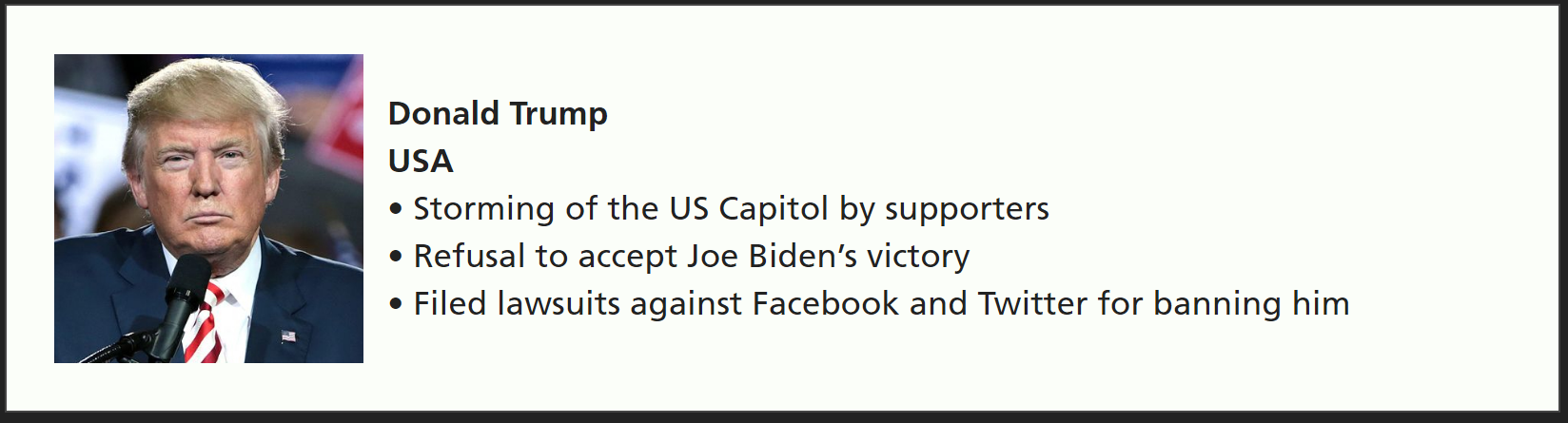
Donald Trump
Donald Trump’s presidency was a terrible period in America’s history. Trump is known for his far-right ideals including white supremacy, anti-refugee remarks, racism, Islamophobic statements, and promoting conspiracy theories.
His anti-refugee laws include construction of a wall along the US – Mexico border, reducing the entrance of immigrants from Mexico to USA. An executive order called “Protecting the Nation from Terrorist Attacks by Foreign Nationals” includes banning citizens of 7 Muslim majority countries to enter USA, which targeted Muslim immigrants, especially those from low-income backgrounds, and suggests that citizens of these countries are “terrorists that pose as threats to the safety of USA”.(10)
Trump’s far right statements have encouraged white supremacists to attack people of color, migrants, and people from religious minorities. School and university students with minority backgrounds were the target of racist attacks, as Trump’s administration in 2018 revoked an Obama-era policy aimed at ending racial discrimination in schools. Education Secretary Betsy DeVos stated that “discipline is a matter on which classroom teachers and local school leaders deserve and need autonomy”.(11) The Department of Education additionally revoked other Obama-era policies that proposed stricter procedures to address campus-based sexual assaults, and protection against sexual abuse on college campuses, as well as protecting transgender students from all forms of attacks.(12)

Recep Tayyip Erdogan
Erdogan is the controversial ruler of Turkey, known for his strong religious conservative ideologies and extreme far right views, such as his opposition to the LGBTQ+ community and misogynist statements, with public speeches containing populist rhetoric propaganda such as creating an Islamic khalifate and restoring the Ottoman Empire.
Turkey has withdrawn from the Istanbul Convention, a convention aimed to protect women and the LGBTQ+ community from violence and abuse and secure their rights.(13) This has sparked major controversy on how Erdogan and his regime are ruling the country amidst the increasing rates of femicide and homophobic attacks, without providing security to the victims of these attacks.
Sectarianism and religious intolerance have increased massively in Turkey since Erdogan came to power. Refugees and ethnic minorities, especially Kurdish people, have been suffering the most from his regime. The United Nations reported in 2016 that Turkey’s military and police forces have killed thousands of people during an operation against Kurdish rebels in southeast Turkey, as the report listed summary of killings, torture, rape, and property destruction among a group of human rights violations.(14)
Peaceful protests erupted at the Boğaziçi University after Erdogan’s appointment of academic Melih Bulu as the University’s rector. Bulu is known for his close ties with Erdogan’s Justice and Development Party (AKP). The students who protested for Bulu’s appointment were arrested and criminally charged, threatened, and abused, while Erdogan referred to them as “lazy and narrow-minded”. He accused them of having links with terrorism, which is an accusation widely used by Turkish officials for opposition parties and anyone who criticized Erdogan’s regime, including teachers, human rights activists, and journalists.(16)
Over 100,000 professors, government officials, and journalists have been jailed by the Erdogan regime since the failed coup attack in 2016, as many of those detained are member of the Hizmet movement that was created by Turkish preacher Fetullah Gülen, which Erdogan has accused Gülen and the member of Hizmet movement of the attempting the failed coup attack. Gülen and Hizmet movement members have denied these allegations, claiming that Erdogan staged the coup to secure his position and power, which this crackdown has led to the closure of Gülen schools, removal of thousands of Gülen followers from their state jobs, and the arrest of more than 150,000 educated Turkish civilians suspected of having links to Gülen.(17)

Mohammad Hasan Akhund
Afghanistan has been the at center of attention since the Taliban regained the control of the country after over a decade. Since then, the country has fallen into an economic, educational, and humanitarian recession, particularly affecting women’s rights.
Mulla Hasan Akhund, one of the founding members of the Taliban and an Ultra-Conservative religious scholar(18), has been appointed as the Prime Minister of Afghanistan since the return of Taliban, raising alarms on increased human-rights violations by the Afghan population.
Since Mulla Hasan Akhund was appointed as Prime Minister, women, journalists, and human-rights activists have been suffering the most from the Taliban regime. Girls are not allowed to attend schools and universities without religious attire, and women forbidden to leave their houses without a male companion. The Taliban has enforced laws that promote gender discrimination, consequently leading to women losing their jobs and constituting an open attack on women’s’ rights.(19)
The Taliban’s return to power has had a profound influence on education. Albeit having promised to allow women to attend schools and universities, Higher Education Minister Abdul Baqi Haqqani has stated that women will be allowed to get education with the condition that they are accompanied with a male companion, and that their studies are in line with the Taliban’s interpretation of Islamic law. Haqqani also stated that gender-mixed classes will be banned and Sharia law will be implemented in schools and universities.(20)

Bashar al-Assad
Bashar Al Assad is the personified definition of dictatorship. Assad, Syria’s dictator, is responsible for the massacre of millions of civilians opposing his regime, and has used chemical weapons, torture, and execution as means of attack. He has been arresting and killing journalists that exposed his war crimes, as well as bombing densely populated civilian areas.(21) This has resulted in a refugee crisis, whereby 9 million people have had to flee to neighboring states, seeking asylum in refugee camps and living under harsh conditions. The UN World Food Program reported that nearly 6 million Syrians now rely on its food assistance programs to survive.(22)
With the current situation in Syria, many school and university students are afraid for their lives, and even many parents refuse to send their kids to schools, as schools have turned into a military intelligence service. If these families have been discovered to be part of anti-government protests, or opposing the Assad regime, they will be tortured and threated, and most of the time they are being killed by the Syrian Armed Forces and reported as “missing”.(23)
Schools and Universities in Syria are following the curriculum that has been interpreted by the Assad regime, which indoctrinates students in line with government’s ideologies, resulting in new generations dictated by nationalist rhetoric in support of Assad’s regime.(24)

Ali Khameini
Iran is known for its rich culture and a history that has had major contributions in the scientific, health, and philosophic realm. Despite its rich history, Iran is currently suffering from severe human-rights violations by the country’s Supreme Leader.
Ali Khameini is a very controversial figure in Iran, known for his extreme religious beliefs and views, with a conservative far-right mindset. The Khameini regime is known for its brutality and the enforcement of religious beliefs upon people, whilst disrespecting other religious of ethnic minorities co-existing in Iran. Anyone who critisises the government is subjected to threats and criminal charges, as the Sharia laws interpreted by the Khameini regime are implemented in all governmental institutions.
Khameini has been responsible for the closure of many universities where students opposed his government condemned human rights violations. He has violently suppressed these students and threatened universities that disagree and oppose his regime.(25)
Iran has banned teaching English language in primary schools, citing that it opens the gate to the spread of Western ideologies, something that he has termed “western cultural invasion”. This action seeks to minimize government criticism among students and render them oblivious to the human rights violations being committed throughout the country.(26)

Nicolas Maduro
Venezuela has been suffering from a huge economic crisis in the past years, with unemployment(27) and poverty(28) rates increasing every year. The numbers have significantly surged after Nicolas Maduro took power in 2013, and has created strong opposition for Maduro’s handling of the crisis.
Protests against Maduro and his regime, accusing him of corruption and totalitarianism, as well as failing to protect late Hugo Chávez’s democracy. In response to the protests, Maduro’s regime has jailed, tortured, and killed civilians participating in the protests, including journalists and human rights activists criticizing his leadership style. Many of them have been reported missing.(29)
The crisis has deeply affected children’s education, as parents cannot afford their school supplies and meals. Many students have dropped out of school to work and help their families earn a living, as providing money for food is more pressing than attending school.(30)
The situation in universities is equally as bad. Professors and academics are underpaid and, in some cases, not paid at all. Some universities have been reported to be suffering from water shortage, which shows that there has been little to no attention to the educational factor in Venezuela.(31) Maduro’s regime arrested students protesting against the current conditions in the educational sphere, sometimes through the use of government armed forces’ bullets.(32)
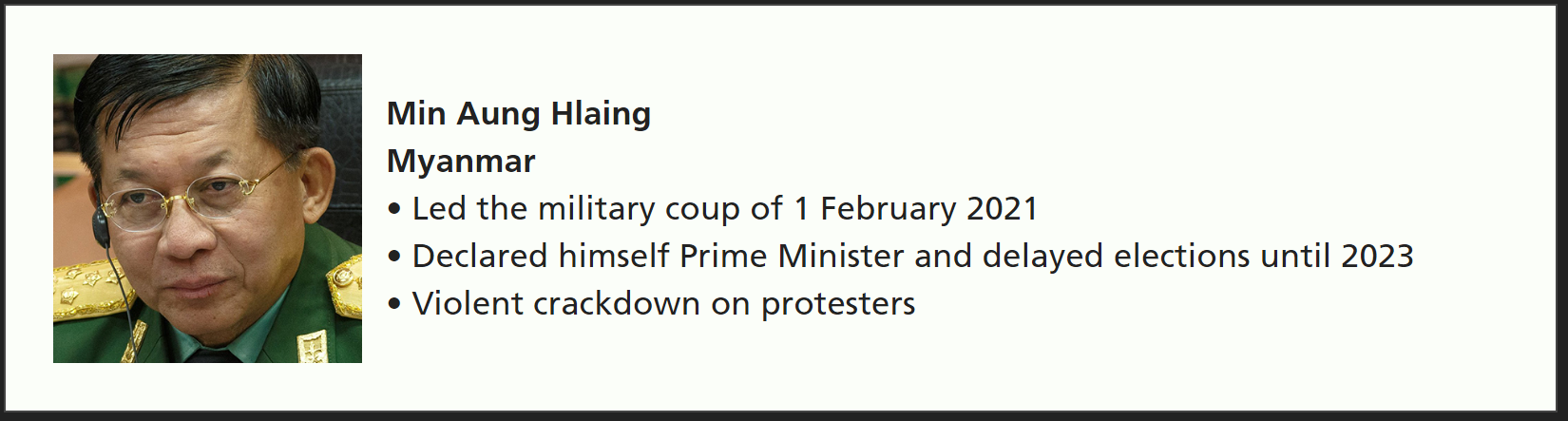
Min Aung Hlaing
Myanmar’s independence from British rule in 1948 surfaced an array of problems in the country. Civil war, poverty, military rule, and the establishment of a dictatorship are only some of the issues Myanmar faces. The Myanmar armed forces, known as the ‘Tatmadaw’ have made the Rohingya Muslim minority a target of genocide.
In 2020, Aung San Suu Kyi and her political party ‘National League for Democracy’ won the elections for the second time. Military leaders accused the elections of being rigged, and Myanmar’s top general Min Aung Hlaing staged a coup in 202, seizing power of the country and detaining Suu Kyi and other opposition party leaders.(33)
When peaceful protests erupted in the country after the coup, many civilians have lost their lives, as Aung Hlaing military regime have killed, tortured, and raped the protestors, while tear gas and other weapons have been used to disperse demonstrators.(34)
Considering the country’s current political instability, many students have halted education amidst fears that school curriculums are dictated by military policies and an authoritarian rhetoric glorifying Aung Hlaing’s leadership.(35)

Kim Jong Un
North Korea is one of the world’s most isolated countries. Its ruling system is a mixture between communism, Confucianism, and monarchic dictatorship. North Korea is known for its authoritarian regime, as the country’s ruler Kim Jong Un and his political party ‘Workers’ Party of Korea’ use threat and intimidation to force fearful obedience on people. Kim restricts communication with the outside world by ensuring people to remain within the country’s borders.(36)
The concept of freedom or opposition is not tolerated by Jong Un, and, in fact, does not exist in North Korean society.(37) This explains why independent media and opposition parties do not exist in North Korea, as Kim and his ancestors have completely isolated the country, rendering themselves as God equivalents and its people ‘God’s slaves’.
The steep poverty rates in North Korea consistently increase, and, by 2018, poverty rates were set at 80%.(38) As previously seen in other Venezuela, students drop out of school in order to provide food and maintenance to their families. During holidays and vacations, students are forced to work in rural areas, and teachers forced to work for the government, undertaking jobs such as building railroads, farming, and other illegal jobs to survive.(39)
North Korea’s education system consists of Kim’s enforced propaganda. Students must endure endless speeches depicting the Kim’s legacy as heroic. The system is upheld by the systemic indoctrination of the country’s population, thereby sustaining obedience to its leader. Concepts such as freedom or human rights blindsided schools and universities, and international issues are not properly taught to students.(40)

Paul Kagame
Despite Rwanda’s recent progress in areas like health and education president Paul Kagame claims credit for, the government is deeply flawed. Kagame became the president of Rwanda in 2000, and, just as every other dictator, has utilized his power as a way to shut down opposition parties and journalists drawing attention to human rights violations under his rule. He has consistently imprisoned human presidency candidates by accusing them of tax evasion and threat to national security, but these accusations are merely used for political purposes as a way of securing his position as Rwanda’s leader.(41)
Albeit accrediting himself for the huge progress and development in the educational field, records from UNICEF have opposing results. Many children with disabilities are not enrolled in primary schools as they face rejection by the schools without accountability. Most of schools are not designed to be accessible for disabled children, as materials and facilities are not designed to meet their needs.(42)
The educational field requires a lot of attention; only 18% of children enroll to pre-primary education, and girls are more likely to drop out of schools.(43)
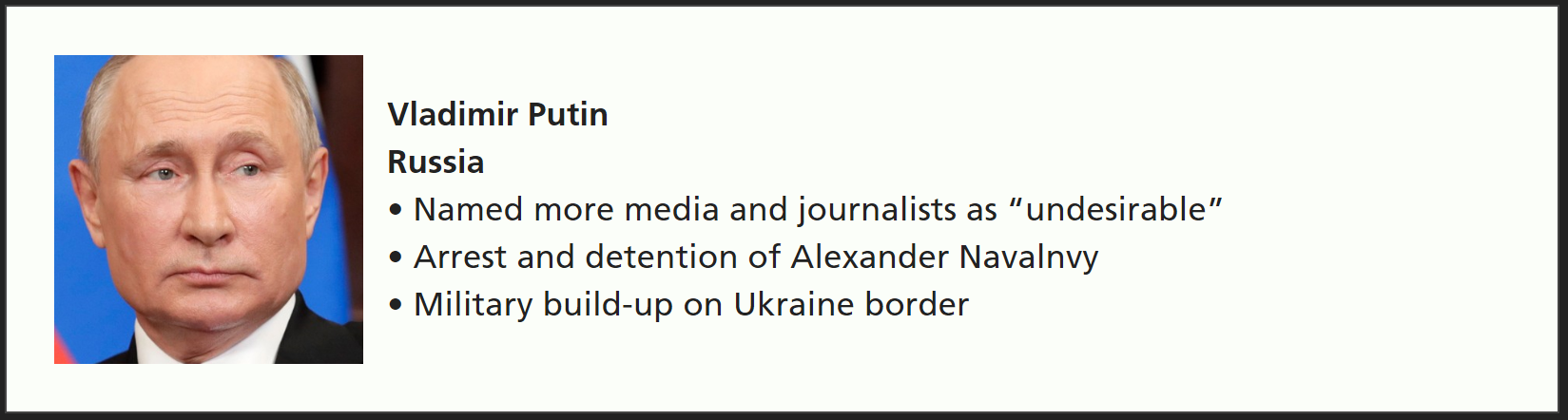
Vladimir Putin
According to ‘Freedomhouse.org’, Russia has scored 20 out of 100 in political rights and freedom of speech.(44) The country’s president, Vladimir Putin, is exercising an authoritarian regime with a zero-tolerance stance on opposition and criticism to its regime. He accuses the opposition parties and protestors as “terrorists” and “spies that threat the safety of the country”. Alexei Navalny, a prominent critic of Putin’s leadership and anti-corruption activist, was poisoned in 2020, allegedly under Putin’s orders. In 2021 he was jailed by Putin’s regime, an act which drew the attention of human rights organizations which in turn condemned his regime and demanded the world to act against the human rights violations being committed by Putin, including the unlawful annexation of Crimea and the hampering of domestic policies of post-Soviet states.
Putin has forced his authority and ideologies upon the educational filed by approving a new law that prohibits educational activities without approval from authorities, thus posing a major restriction upon schools and universities’ freedom.(45)
As an effort to whitewash history, Russia’s Ministry of Education has approved school history textbooks depicting Russia’s annexation of Crimea as peaceful. These are mere examples shedding light on how Putin is leading an authoritarian regime in Russia and leading to the creation of generation that will glorify the Soviet Union and its ideologies.(46)

Teodoro Obiang
Known as the 2nd non-royal national leader in the world, Obiang has been leading Equatorial Guinea for 43 years since 1979 by means of an authoritarian regime.(47) Human rights are being consistently violated in Equatorial Guinea, as human rights abuse, corruption, and power abuse are the major issues affecting the country for the past 43 years. Its population live in constant fear, and human rights defenders, activists, and political opponents face systemic abuse under Obiang’s regime.(48)
Despite Equatorial Guinea’s array of natural resources, the wealth it profits from completely ignores the educational sector. Teachers tend to be underpaid, and there is shortage in school supplies, with school being designed in a way that fails to account for students’ needs. Corruption plays a huge role in the education system, as teachers that have political connections with no experience or accreditation in the field get hired in schools and universities.(50)

Sheikh Hasina
Sheikh Hasina’s rule of Bangladesh is notoriously violating human rights. Journalists are arrested unlawfully for criticizing Hasina’s regime, and human rights activists are disappearing. The regime tortures protestors participating in demonstrations against Hasina’s leadership.(51)
Bangladesh has one of the highest rates of women’s rights violations. Domestic violence, acid attacks, rape, and child marriage have are disproportionately high in the country, with a poor implementation of laws protecting women and children, consequentially increasing such abuses.(52)
Education in Bangladesh continues to suffer, as poverty rates increase every year, forcing students to drop out of school to assist their families. Girls are more likely to drop out of school, and many of them are not even attending elementary school, as it is prone to inequality and gender bias. In light of this, parents do not consider education as important for women.(53)

Gurbanguly Berdimuhamedow
Gurbanguly Berdimuhamedow is named as world’s worst dictator by the Obozrevatel Magazine.(54) He reportedly committed the worst human rights violations in Turkmenistan, one of the world’s most isolated countries.
Freedom as a human right does not exist in Turkmenistan. Berdimuhamedow forces his power upon every corner of the country; there is no freedom of expression and religion or freedom of media and information, and prison-torture as well as enforced disappearance are standard within Berdimuhamedow’s regime.(55)
Berdimuhamedow’s propaganda influences the educational sector, insofar as schools teach using textbooks containing speeches of glorification to Berdimuhamedow’s regime, in an effort to indoctrinate children from an early age. Schools and universities in Turkmenistan are controlled and strictly monitored by the government, as they control the information that is being acquired by the students and teacher to ensure the security and the protection of the current political regime.(56)
Turkmenistan is faced with a shortage of qualified teachers as a result of the poor conditions in the educational sector, such as the lack of educational resources in schools and universities. Double shifts and Saturday classes put a great amount of pressure on students. Women suffer from this added pressure in terms of societal standards which expect them to marry by their 20th or 21st birthday. Many of them consequently feel discouraged to complete their higher education, as they form their own families in their early 20’s rather than pursue a career.(57)
By Zinat Asadova
Sources:
1. https://www.indexoncensorship.org/2021/12/who-is-2021s-tyrant-of-the-year/
2. https://www.washingtonpost.com/world/2021/05/24/faq-lukashenko-belarus/
3. https://belsat.eu/en/news/lukashenka-wants-opposition-minded-students-out-of-universities/
4. https://www.voiceofbelarus.com/lukashenko-fires-teachers/
5. https://www.france24.com/en/live-news/20211116-bolsonaro-govt-accused-of-censoring-brazil-school-exam
6. https://theconversation.com/bolsonaro-faces-crimes-against-humanity-charge-over-covid-19-mishandling-5-essential-reads-170332
7. https://theconversation.com/brazilian-universities-fear-bolsonaro-plan-to-eliminate-humanities-and-slash-public-education-budgets-117530
8. https://www.wilsoncenter.org/xis-statements-education
9. https://www.jpolrisk.com/what-the-chinese-education-minister-is-really-trying-to-say/
10. https://cmsny.org/trumps-executive-orders-immigration-refugees/
11. https://apnews.com/article/politics-lifestyle-us-news-education-donald-trump-07c8e7c5a69942699f7640890677c2d2
12. https://www.educationnext.org/harmful-policies-values-rhetoric-trump-and-nations-schools-forum-jeffries/
13. https://www.hrw.org/news/2021/03/24/turkey-erdogans-onslaught-rights-and-democracy
14. https://www.nytimes.com/2017/03/10/world/europe/un-turkey-kurds-human-rights-abuses.html
16. https://www.hrw.org/news/2021/02/18/turkey-student-protesters-risk-prosecution
17. https://www.ibtimes.co.uk/erdogans-war-education-exodus-turkeys-teachers-1656930
18. https://en.wikipedia.org/wiki/Hasan_Akhund
19. https://www.hrw.org/news/2021/09/29/list-taliban-policies-violating-womens-rights-afghanistan
20. https://www.insider.com/women-can-attend-university-mixed-classes-banned-taliban-education-minister-2021-8
21. https://theworld.org/stories/2014-09-24/8-reminders-how-horrible-syrian-president-bashar-al-assad-has-been-his-people
22. https://theworld.org/stories/2014-09-24/8-reminders-how-horrible-syrian-president-bashar-al-assad-has-been-his-people
23. https://www.hrw.org/report/2013/06/05/safe-no-more/students-and-schools-under-attack-syria
24. https://www.hrw.org/report/2013/06/05/safe-no-more/students-and-schools-under-attack-syria
25. https://justice4iran.org/12022/
26. https://tolonews.com/world/iran-bans-english-primary-schools-over-%E2%80%98cultural-invasion%E2%80%99
27. https://www.statista.com/statistics/370935/unemployment-rate-in-venezuela/
28. https://www.statista.com/statistics/1235189/household-poverty-rate-venezuela/
29. https://www.vox.com/world/2017/9/19/16189742/venezuela-maduro-dictator-chavez-collapse
30. https://www.globalcitizen.org/en/content/venezuela-crisis-childrens-education/
31. https://www.timeshighereducation.com/news/venezuelan-universities-approaching-point-no-return
32. https://www.refworld.org/docid/5be942fca.html
33. https://www.cfr.org/backgrounder/myanmar-history-coup-military-rule-ethnic-conflict-rohingya
34. https://www.hrw.org/news/2021/09/27/what-impunity-looks
35. https://www.frontiermyanmar.net/en/parents-teachers-and-students-boycott-slave-education-system/
36. https://www.hrw.org/world-report/2020/country-chapters/north-korea#
37. https://s-space.snu.ac.kr/bitstream/10371/110061/1/02.pdf
38. https://www.researchgate.net/figure/North-Korea-estimated-poverty-rates-by-region-2012-and-2018-Figures-obtained-using_fig5_339990994
39. https://s-space.snu.ac.kr/bitstream/10371/110061/1/02.pdf
40. https://s-space.snu.ac.kr/bitstream/10371/110061/1/02.pdf
41. https://www.cfr.org/blog/alongside-real-progress-kagames-human-rights-abuses-persist
42. https://www.unicef.org/rwanda/education
43. https://www.unicef.org/rwanda/education
44. https://freedomhouse.org/country/russia/freedom-world/2021
45. https://thebell.io/en/russia-tightens-state-control-over-education/
46. https://khpg.org/en/1608809430
47. https://en.wikipedia.org/wiki/Teodoro_Obiang_Nguema_Mbasogo
48. https://www.amnesty.org/en/latest/news/2019/08/equatorial-guinea-years-of-repression-and-rule-of-fear/
49. https://www.borgenmagazine.com/education-equatorial-guinea-budget-crisis/
50. https://www.justiceinitiative.org/voices/amidst-unesco-scandal-president-obiang-gives-schools-notebooks-his-image
51. https://www.amnestyusa.org/countries/bangladesh/
52. https://www.amnestyusa.org/countries/bangladesh/
53. https://borgenproject.org/girls-education-in-bangladesh/
54. https://en.wikipedia.org/wiki/Gurbanguly_Berdimuhamedow
55. https://www.hrw.org/world-report/2020/country-chapters/turkmenistan
56. https://borgenproject.org/8-facts-about-education-in-turkmenistan/#:~:text=Turkmenistan%20has%20an%20impressively%20high,through%2010th%20grade%20in%20Turkmenistan.
57. https://borgenproject.org/8-facts-about-education-in-turkmenistan/#:~:text=Turkmenistan%20has%20an%20impressively%20high,through%2010th%20grade%20in%20Turkmenistan.
pictures are taken from : https://www.indexoncensorship.org/2021/12/who-is-2021s-tyrant-of-the-year/


