फ्रांस में शिक्षा चुनौतियां

जबकि फ्रांसीसी शिक्षा प्रथम दृष्टया सभी के लिए सुलभ है, क्योंकि यह उच्च शिक्षा तक स्टार्ट अप से मुक्त है, फ्रांसीसी लोग दावा करते हैं कि फ्रांसीसी शिक्षा प्रणाली कई बाधाओं को जानती है। मैंने उन फ्रांसीसी लोगों का साक्षात्कार लिया है जो अभी भी निजी और सार्वजनिक दोनों तरह की फ्रांसीसी शिक्षा प्रणाली में हैं, और कुछ ऐसे भी हैं जो दावों की प्रासंगिकता का परीक्षण करने की उम्मीद में बहुत पहले समाप्त हो गए थे।

सबसे अधिक बार-बार आने वाली बाधा शिक्षकों की स्थिति का उल्लेख किया गया था। शिक्षकों को कम वेतन दिया जाता है और उनका मूल्यांकन नहीं किया जाता है। बदले में, उनके शिक्षण की गुणवत्ता की आलोचना अल्पकालिक और एकतरफा होने के लिए की जाती है। फ्रांसीसी शिक्षा प्राप्त कई व्यक्तियों ने महसूस किया कि उन्हें शिक्षकों की अपेक्षाओं का पूरी तरह से पालन करना था और उनके पास व्यक्तित्व या मौलिकता के लिए कोई स्थान नहीं था। विशेष रूप से, मानसिक स्वास्थ्य की अनदेखी की जाती है क्योंकि छात्रों को लंबे समय तक काम करना चाहिए। उसी तरह, कोई मनोवैज्ञानिक समर्थन या सामान्य प्रोत्साहन नहीं है क्योंकि फ्रांसीसी प्रणाली प्रतिस्पर्धा पर आधारित है, और सफलता पूरी तरह से छात्र की जिम्मेदारी है। एक बार उत्तीर्ण स्तर पर पहुंचने के बाद प्रोत्साहित होने के बजाय, छात्रों की बेहतर नहीं होने के लिए आलोचना की जाती है। समवर्ती रूप से, थकान, खराब मानसिक स्वास्थ्य या मानसिक विकारों की कोई समझ नहीं होती है, क्योंकि छात्रों से मदद मांगने की अपेक्षा नहीं की जाती है और ऐसा करने पर उन्हें ठुकरा दिया जाता है।

एक साक्षात्कारकर्ता ने समझाया:

“जब मैं लंबे घंटों के कारण उदास और थक जाता था, तो शिक्षक जब उनकी कक्षा में सो जाते थे, तो वे क्रोधित हो जाते थे। मुझे सात घंटे की हिरासत में दिया गया क्योंकि शिक्षक ने अपमानित महसूस किया। जब मैंने कहा कि मुझे रिवीजन करने और सोने के लिए उन घंटों की जरूरत है तो किसी ने नहीं सुनी।”

वास्तव में, शिक्षण विद्यार्थियों के इर्द-गिर्द केंद्रित नहीं है। इसके बजाय, यह एक पदानुक्रमित प्रणाली पर बनाया गया है।

सार्वजनिक शिक्षा में एक छात्र ने यह भी समझाया कि उन्हें भविष्य के विकल्पों के बारे में कभी भी सलाह नहीं दी गई, यानी किस नौकरी या विदेश में अवसरों को प्राप्त करने के लिए कौन सा कार्यक्रम चुनना है। उनका प्रत्येक निर्णय पूरी तरह से उनके अपने शोध पर निर्भर था।

विशेष रूप से, सार्वजनिक और निजी शिक्षा के छात्रों के उत्तरों में स्पष्ट अंतर था, क्योंकि निजी तौर पर शिक्षित बच्चों ने समग्र रूप से उच्च संतुष्टि व्यक्त की। यह विभाजन बच्चों को उनकी सामाजिक-आर्थिक पृष्ठभूमि के आधार पर अलग-अलग मौके देने के लिए जाना जाता है। तदनुसार, पब्लिक स्कूल के शिक्षकों को सफलतापूर्वक अपना काम करने के बेहतर अवसर देने के लिए एक व्यवस्थित सुधार की आवश्यकता है। सरकार की ओर से पेशे के प्रति सम्मान का यह उदाहरण बच्चों के व्यवहार में भी दिखने की संभावना है।man and woman sitting on chairsPhoto by Kenny Eliason on Unsplash

यह एकतरफा प्रारूप फ्रेंच स्कूल के कार्यक्रमों में परिलक्षित होता है, जिससे 2021 तक केवल तीन मुख्य मार्ग पेश किए गए: साहित्य, अर्थशास्त्र या गणित और विज्ञान। केवल उन्हीं तीन थ्योरी आधारित योग्यताओं को ही योग्य माना गया है। जो लोग इस प्रोग्रामेटिक संरचना में फिट नहीं होते हैं, उनके लिए अधिक व्यावहारिक-आधारित, काम के करीब डिप्लोमा की ओर रुख करना नकारात्मक और उप-मानक के रूप में आंका जाएगा। वास्तव में, अन्य देशों की तुलना में यूरोपीय और विश्व मूल्यांकन में फ्रांसीसी स्कूल कम हैं जो बच्चों को अधिक व्यावसायिक कक्षाएं देते हैं। सबसे विशेष रूप से, इस प्रोग्रामेटिक संरचना को न्यूरोडिवर्जेंट व्यक्तियों के लिए विशेष रूप से चुनौतीपूर्ण होने की भविष्यवाणी की जा सकती है। हालाँकि, ‘बैकालॉरिएट’ में हालिया बदलाव है

एक ‘ए ला कार्टे’ चयन के करीब और पाठ्यक्रमों के निर्माण में अधिक स्वतंत्रता की अनुमति देता है; उम्मीद है कि इन आलोचकों को कम से कम।

विशेष रूप से, विश्व रिपोर्ट ने 2022 में शिक्षा में विकलांगता अधिकारों को मुख्य मुद्दे के रूप में पहचाना। वास्तव में, शिक्षा में विकलांग बच्चों के लिए फ्रेंच एकीकरण नियम बड़े पैमाने पर भ्रमित और निराशाजनक होने के लिए जाने जाते हैं, जिससे माता-पिता असमर्थित हो जाते हैं। अभी भी प्रगति की जानी है क्योंकि अपने आप में एकीकरण पर्याप्त नहीं है। उदाहरण के लिए, एक साक्षात्कारकर्ता ने याद किया कि कुछ दोस्तों, विकलांग बच्चों के माता-पिता, अपने बच्चों को बदमाशी से बचाने और उनकी सहायता करने के लिए स्कूल में कर्मियों की कमी पर खेद व्यक्त करते हैं।

इसके अतिरिक्त, हम हाल ही में (2021) स्कूलों में नाबालिगों के साथ-साथ माता-पिता के लिए मुस्लिम घूंघट पर प्रतिबंध को नोट कर सकते हैं। यह अद्यतन प्रतिबंध पुराने प्रतिबंधों का पालन करता है जिनकी पूरी तरह से इस्लामोफोबिक के रूप में आलोचना की गई है। वास्तव में, यह प्रतिबंध अन्य बच्चों की तुलना में स्कूल जाने वाली मुस्लिम लड़कियों पर अधिक भार डालता है।

boy in gray sweater beside boy in gray and white plaid dress shirtPhoto by Adam Winger on Unsplash

हाल ही में, शैक्षिक क्षेत्र में सरकार द्वारा कोविड-19 उपायों से निपटने के विरोध में फ्रांसीसी शिक्षकों ने सबसे बड़ी शिक्षा हड़तालों में से एक का आयोजन किया है। पर विचार करते हुए शिक्षकों के गलत व्यवहार पर उपरोक्त बिंदु; वे शिकायत करते हैं कि सरकारी फैसलों में उनसे सलाह नहीं ली जाती है; अंतिम समय में अपने पाठ्यक्रम बदलने के लिए कहा जा रहा है; बिना समर्थन के हाइब्रिड पाठ्यक्रम संचालित करने की अपेक्षा की जा रही है और बीमार पड़ने की स्थिति में प्रतिस्थापित नहीं किया जा रहा है। अंततः, यह अस्थिरता बड़े पैमाने पर बच्चों की शिक्षा को बाधित कर रही है

माया शॉ   [Educational Challenges in France]

संदर्भ

  1. https://www.mma.fr/zeroblabla/nouveau-bac-2021-reforme-changements.html
  2. https://www.weforum.org/agenda/2017/09/these-are-the-ten-best-countries-for-skill-and-education/
  3. https://www.hrw.org/world-report/2022
  4. www.theiwi.org/gpr-reports/the-french-hijab-ban-and-the-freedom-of-choice
  5. https://www.theguardian.com/world/2022/jan/13/half-of-french-primary-schools-expected-to-close-teachers-strike-protest-covid-education
  6. Cover image source – https://commons.wikimedia.org/wiki/User:GilPe

Educational Challenges in the Republic of Colombia: Great Access, Little Quality

A ‘Silent Revolution’ in Education

When one thinks about Colombia today, what may first come to mind is the infamous drug lord Pablo Escobar due to the hit Netflix series Narcos or the decades-long civil conflict waged between the Colombian Government and left-wing guerrilla groups, namely the National Liberation Army (ELN) or the Revolutionary Armed Forces of Colombia (FARC), the latter of whom recently signed a peace agreement with the Government in mid-2016. Despite this, Colombia is home to the second-largest amount of people in Latin America and has experienced a period of major economic growth that decreased the rate of poverty. Hailed as the ‘Colombian Miracle’, and more so a ‘silent revolution’ in education, Colombia has achieved this by expanding the learning outcomes of students, raising the bar in equal and equitable opportunities in schools, utilising the collection and analysis of data to make informed decisions and create policies, and focusing an increased amount of funding on seeing education reforms bear fruit.[i]

(Source: Education in Colombia: Highlights, OECD, 2016)

These educational achievements are primarily due to a firmer control over the consequences of Colombia’s troubled history of violent socio-political unrest since 1948 after the political assassination of Jorge Eliecer, resulting in the internal displacement of millions.[ii] Such control allowed the Colombian government to introduce reformed policies like ‘From Zero to Forever’ in 2010, which is now the common structure of handling the development and well-being of children through holistic measures; its 2014 ‘New School’ model to expand education to rural and poorer regions of Colombia by making it affordable and focusing on training teachers to create an environment that encourages a stimulating yet tailored education; and the ‘40 by 40 Program’ implemented by the former Education Secretary of Bogotá, Óscar Sánchez, that increased the number of hours in school to 40 hours per week for 40 weeks per year so that children can participate in extra-curricular activities like sports and art.[iii] These policies indeed raised the level and quality of education that each student received, as noted by the OECD, with participation in early childhood education and care (ECEC) and tertiary education increasing to 40% and 50% respectively, the rate of enrolment for 0-to-5 year olds went from 16% to 41% between 2007-2013, and increasing the gross enrolment from 57% to 76% between 2002-2012.[iv] This has been the case especially for girls, who between 1900 and 2000 saw their average years of completed education grow by 23% from 3 to 3.7 years, their completion of lower-secondary education increase from 37% in 1989 to 94% by 2011, and their representation in the labour market rise from 30% to 43% between 1990 and 2012.[v]

An Unequal Education System

Despite these positive actions, it is also true that there is still a long way to go for Colombia to establish an education system that is genuinely equal between private and public schools in urban and rural regions, which provide the same quality education, and both increase the net enrolment into education and retain attendance throughout the lifecycle of children’s education. In 2017, Children Beyond Our Borders, an organization working towards equal empowerment in education, reported that 37.2% of Colombian students did not continue their education past upper-secondary education. This has resulted in a significant gap for those who have attained a PhD degree, standing at a ratio of 7 per one million Colombians; 45.4% of students had dropped out of university since 2010 in contrast to the approximately 75% of students who dropped out of education by age 17; an estimated 37% of students started their education at a later period; and 41% repeated at least one grade by the age of 15.[vi] With regards to universities, this high dropout rate is mainly due to the overall system being overloaded and fragmented by lacking a standard curriculum for schools and the insufficient salaries paid to teachers that have led to a high rate of absenteeism. Still, because of the total 4.6% of GDP invested into education, only 0.5% went to rural areas, which might explain why two out of ten students from rural areas still cannot afford to access education, reproducing a vicious cycle of poverty, unemployment, and violence.[vii]

The 2018 Programme for International Student Assessment (PISA) noted that over 70% of upper-secondary students lacked basic literacy and numeracy skills, creating a major barrier to enter public universities that require passing the standardized entrance exam called the SABER 11 (ICFES) that measures the level of performance in English, mathematics, natural sciences, social science, and civics across grades 3, 5, 9, and 11, and policy-makers have so far failed to respond to the higher rate of failure in public schools in comparison to private schools when taking the exam(s).[viii] In connection to this, there was significant tension since the early 2010s due to the Ser Pilo Paga initiative intentionally diverting funds to private institutions and subsidized approximately 32% of top-performing students to enter accredited, private universities through grants and financial loans, and was only suspended in 2018 when large numbers of students protested against this unjust inequality and demanded that President Ivan Duque Marquez increase expenditure for public universities whose tuition fees remained a barrier for many.[ix]

There remains an apparent mismatch of supply, in the sense that more Colombian students aspire to attain higher education (reportedly growing from 3,600 in 2001 to 6,276 by 2011), in parallel to a stagnant level of quality sometimes referred to as ‘garage universities’ running alongside the top-tier institutions ranking relatively high in regional and global rankings.[x] This is further illustrated in the sphere of inbound and outbound education opportunities, whereby although Colombians are the 7th largest population deciding to study English or enter vocational training abroad, the country remains an undesirable destination for foreign students, except for Venezuelans who face significant barriers.[xi]

Barriers to Venezuelan Refugees

The cross-sectional crisis in Venezuela since 2015 has caused millions of people to flee from societal collapse. By November 2020, 1.7 million Venezuelans were living in Colombia, out of which approximately 460,000 were school-aged children.[xii] Colombia’s government and civil society once again outshined most in granting Venezuelans access to healthcare and placed nearly 200,000 school-aged Venezuelans in education, primarily due to the cultural and linguistic similarities between the two populations.[xiii] However, barriers are still evident in cities like Cucuta, which have struggled with a high rate of out of school (OOS) children and unemployment. It was estimated that there would be 22,350 Venezuelan OOS from the 93,000 Venezuelans living in Cucuta by early 2020, compared to the 361,433 OOS Colombians nationwide.[xiv] Venezuelans and Colombians in schools are struggling to attain basic literacy and numeracy skills, with 69% and 65%, 61% and 64%, 70% and 68%, and 93% and 94% respectively falling below the benchmarks for oral reading fluency, reading comprehension capability, simple addition, and subtraction problems.[xv]

Another worrying issue is the fact that Venezuelan OOS children show higher signs of social and emotional learning (SEL) than their in-school peers, with 66% of Venezuelan and 63% of Colombian children respectively showing empathy in imagined negative scenarios in comparison to 76% of Venezuelan OOS, and young or disabled students become victims of bullying.[xvi] UNESCO acknowledged that other barriers are the indirect costs of transportation, uniforms, food, and school materials, as well as the fact that Venezuelan teachers have struggled to have their credentials recognized by Colombia, which could potentially reduce the lack of human resources and overcrowding in schools.[xvii] According to the International Rescue Committee, these barriers are a result of the overburdened educational system in Colombia, applauding access as the first step but calling for more focus on absorbing OOS children, combining academic and SEL tools, increasing teacher training, and adhering to the 2013 ‘Ley de Convivencia’, a provision that seeks to implement co-existence committees for all stakeholders of education.[xviii]

The COVID-19 Pandemic

The COVID-19 outbreak amplified the socio-economic and educational challenges across the board in Colombia, leaving many at risk of dropping out of education to enter the labour market.[xix] In a New York Times article, Gloria Vasquez explains how graduating in Colombia is a major achievement since, in the past, Colombians did not have the same opportunities for education, aptly explaining that ‘violence and crime are as common here as the ice cream cart that circles the block each afternoon’, and many parents in the past worked as ‘recyclers’ who roamed the streets to collect anything of value in order to attempt selling it.[xx] The COVID-19 pandemic has exacerbated the pre-existing fear that many children will drop out of education, especially since 50% of households cannot afford an internet connection and children did not have the digital means to follow their classes or complete their assignments, nor remain in contact with their teachers when schools closed, often burdening uneducated parents in ensuring the education of their offspring.[xxi]

Due to the financial fallout of the pandemic, an estimated 100,000 children dropped out of school in 2020.[xxii] In his interview with Peoples Dispatch, Harold Garcia, a Colombian popular educator and a secondary-school teacher, explained that cities and private schools were better equipped to handle the outbreak and doubled the work of teachers who raced to complete the curriculum whilst learning how to use and incorporate digital methods of teaching.[xxiii] Garcia further expressed the dissatisfaction with the administration of President Marquez during the outbreak, who diverted public spending critically needed by education towards national security measures and assisting banks.[xxiv] The 1.5 million indigenous peoples living in Colombia, on the other hand, gained attention during this time. The largest indigenous group, the Wayuu people, who predominantly inhabit the La Guajira region, were severely impacted by the closure of the tourism sector since 90% of them worked informally in it, and only 10% had sufficient internet access to work or learn remotely.[xxv] Initiatives by Fundación El Origen increased indigenous children’s access to virtual education in terms of language, through the use of applications, and through proving 260 Wayuu children with tablets, which both support the steps to expand the language of instruction to the 64 languages that are spoken outside of the official Spanish and aid indigenous peoples break the cycle of poverty.[xxvi]

Lastly, COVID-19 put children at significant risk of being recruited by the remaining guerrilla groups as child soldiers, rolling back the efforts achieved through the 2019 national plan and Case No. 7 of the Special Jurisdiction for Peace that aims to prevent the recruitment of and sexual violence against children, as well as the positive work being done by civil society organizations like the Misiones Salesians and Missioni Don Bosco Onlus to ensure access to education.[xxvii] It is a known strategy for these groups to target children who live in rural regions and come from a poor socio-economic background and are thus easier to coerce due to their lack of access to education and vocational training, but often become human shields, porters, spies, child brides, sex slaves, or used for labour activities in the ongoing civil conflict with the Colombian government.[xxviii] To address this persistent issue, the Borgen Project has recently called on both the Colombian government to implement stricter policies and measures that discourage recruitment, and demand that the international community adopts more substantial foreign aid plans that aims more towards holistic, collective progress.[xxix]

***

Colombia’s educational system has taken positive steps that have borne great results in access to education. Still, it underscores the quality that is both affordable and valuable in the outcomes that education ought to prepare students to attain higher levels of education or enter the labour market. Globally, education is an important asset which shows that the benefits outweigh the costs of injecting time and funding to boost the access, quality, outcomes, and value that each child receives through their education, serving as crucial defining moments in their future and of their countries. In this way, Colombia would not only address the other half of Goal 4 of the Sustainable Development Goals concerning quality but also bolster its progress to reduce poverty, establish lasting mechanisms of peaceful and just resolution, streamline economic growth, achieve more robust levels of health and wellbeing, and closing the remaining inequality gaps.

Written by Karl Baldacchino

Edited by Olga Ruiz Pilato

Sources;

[i] Organization for Economic Cooperation and Development (2016) ‘Education in Colombia: Highlights’, pp. 2-3; see also Trines, S. (2020) ‘Education in Colombia’. World Education News + Reviews. Available online from: https://wenr.wes.org/2020/06/education-in-colombia-2/ [Accessed on 27/03/2022[.

[ii] Ventura, R. C. (2018) ‘Girls’ Education in Colombia Continues to on the Path of Progress’. The Borgen Project. Available online from: https://borgenproject.org/girls-education-in-colombia/ [Accessed 27/03/2022]; see also Gozzo, F. (2022) ‘The Struggle of Child Soldiers in Colombia’. The Borgen Project. Available online from: https://borgenproject.org/child-soldiers-in-colombia/ [Accessed on 27/03/2022].

[iii] Ibid.; see also ‘Education in Colombia’; see also Solivan, M. (2014) ‘A City’s Push for Access and Quality Education for All: Report on a Recent Visit to Bogota’. Brookings. Available online from: A City’s Push for Access and Quality Education for All: Report on a Recent Visit to Bogotá (brookings.edu) [Accessed on 27/03/2022]; see also ‘Education in Colombia: Highlights’, pp. 6 & 8.

[iv] ‘Education in Colombia: Highlights’, pp. 4, 6 & 10.

[v]  ‘Girls’ Education in Colombia Continues to on the Path of Progress’.

[vi] Moutter, C. (2017) ‘Colombia’s Education System’. Children Beyond Our Borders. Available online from: http://www.chbob.org/blog/colombias-education-system [Accessed on 27/03/2022]; see also ‘Education in Colombia’; see also Education in Colombia: Highlights’, pp. 6-7, 8 & 10.

[vii] Ibid.; see also ‘Education in Colombia’.

[viii] ‘Education in Colombia’; ‘Education in Colombia: Highlights’, p. 10

[ix] Ibid.; see also Alexandra, Z. (2020) ‘In Colombia, the Pandemic is Widening Inequality in Access to Education’. Peoples Dispatch. Available online from: https://peoplesdispatch.org/2020/05/29/in-colombia-the-pandemic-is-widening-inequality-in-access-to-education/ [Accessed 27/03/2022].

[x] Ibid.

[xi] Ibid.

[xii] International Rescue Committee (2020) ‘Colombia’s Education Crisis: Results from a Learning Assessment of Colombian and Venezuelan Children’, p. 2.

[xiii] Ibid.; see also ‘Education in Colombia’; see also United Nations Educational, Scientific, and Cultural Organization (2020) ‘Significant Efforts by Colombia Ensure that Nearly 200,000 Children and Youth Have access to the Education System’. Available online from: https://en.unesco.org/news/significant-efforts-colombia-ensure-nearly-200000-venezuelan-children-and-youth-have-access [Accessed on 28/03/2022].

[xiv] Ibid.

[xv] Ibid., pp. 3 & 4; see also ‘Significant Efforts by Colombia Ensure that Nearly 200,000 Children and Youth Have access to the Education System’.

[xvi] Ibid., p.5.

[xvii] ‘Significant Efforts by Colombia Ensure that Nearly 200,000 Children and Youth Have access to the Education System’.

[xviii] Ibid., pp. 5 & 6.

[xix] ‘Education in Colombia’; see also Turkewitz, J. (2021) ‘1+1 = 4? Latin American Confronts a Pandemic Education Crisis’. The New York Times. Available online from: https://www.nytimes.com/2021/06/26/world/americas/latin-america-pandemic-education.html [Accessed 28/03/2022]; see also ‘In Colombia, the Pandemic is Widening Inequality in Access to Education’.

[xx] 1+1 = 4? Latin American Confronts a Pandemic Education Crisis’.

[xxi] Ibid.; see also ‘In Colombia, the Pandemic is Widening Inequality in Access to Education’.

[xxii] Pope, L. (2021) ‘Virtual Learning for Colombia’s Indigenous People’. The Borgen Project. Available online from: https://borgenproject.org/colombias-indigenous-people/ [Accessed on 28/03/2022].

[xxiii] ‘In Colombia, the Pandemic is Widening Inequality in Access to Education’.

[xxiv] Ibid.

[xxv] ‘Virtual Learning for Colombia’s Indigenous People’.

[xxvi] Ibid.; see also ‘Education in Colombia’.

[xxvii] ‘The Struggle of Child Soldiers in Colombia’.

[xxviii] Ibid.

[xxix] Ibid.

Cover Image by Rafael Socarras from Pixabay

تعليم الوضع في فرنسا

في حين أن التعليم الفرنسي يبدو متاحًا للوهلة الأولى للجميع حيث أنه مجاني لجميع المراحل الابتدائية وحتى التعليم العالي، يزعم الفرنسيين أن النظام التعليمي الفرنسي يواجه العديد من العقبات. ولقد أجريت عدد من المقابلات مع أشخاص فرنسيين لا يزالون داخل النظام التعليمي الفرنسي الخاص والعام  وبعضهم انتهى منذ فترة طويلة على أمل معرفة مدى ملاءمة الادعاءات.

يتضح أنه أكثر العوائق تكرارا التي تم ذكرها كانت حالة المعلمين. حيث يتقاضون رواتب متدنية ولا يعطى لهم الاعتبار الواجب. في المقابل، يتم انتقاد جودة تعليمهم لكونها انفعالية وأحادية التلقي. مما أدى إلى شعور العديد من الأفراد الحاصلين على تعليم فرنسي أنه يتعين عليهم اتباع توقعات المعلمين تمامًا وليس لديهم مساحة للتفرد أو الأصالة. على وجه التحديد، يتم تجاهل الأمور المتعلقة بالصحة العقلية حيث يجب على الطلاب العمل لساعات طويلة. وعلى نفس المنوال، لا يوجد دعم نفسي أو تشجيع عام لأن النظام الفرنسي قائم على المنافسة، والنجاح هو مسؤولية الطالب. فعوضًا عن تشجيع الطلاب بمجرد وصولهم إلى مستوى النجاح، يتم انتقاد الطلاب لعدم كونهم أفضل. في الوقت نفسه، لا يوجد استيعاب للتعب أو سوء الصحة العقلية أو الاضطرابات العقلية، حيث لا يُتوقع من الطلاب طلب المساعدة ويتم رفضهم عند قيامهم بذلك. أوضح أحد الذين تمت مقابلتهم:

“عندما كنت أشعر بالاكتئاب والإرهاق بسبب ساعات العمل الطويلة، يغضب المعلمين عندما أنام خلال الدرس. حيث أنه تم توقيفي سبع ساعات لأن المدرس شعر بالإهانة. ولم يستمع إلي أحد عندما قلت إنني بحاجة إلى تلك الساعات للمراجعة والنوم “.

في الواقع، لا يتمحور التدريس حول التلاميذ. بدلاً من ذلك، فهو مبني على نظام هرمي.

كما أوضح أحد الطلاب أنه في التعليم العام لا يتم تقديم أي توجيه أو نصح بشأن الخيارات المستقبلية، فيما يتعلق بالبرامج الملائمة للحصول على أي وظيفة أو فرص بالخارج. بل على العكس، فإن الأمر يعتمد كليًا على البحث الخاص.

والجدير بالذكر أنه كان هناك اختلاف واضح في الإجابات مع الطلاب من التعليم العام والخاص، حيث أعرب الأطفال المتعلمين في المدارس الخاصة عن رضاهم بشكل عام. ومن المعروف جيدًا أن هذا الانقسام يعطي فرصًا مختلفة للأطفال اعتمادًا على خلفياتهم الاجتماعية والاقتصادية. وبناءً عليه، هناك حاجة إلى إصلاح منهجي لمنح معلمي المدارس العامة فرصًا أفضل لأداء وظائفهم بنجاح.

ومن المرجح أن ينعكس هذا المثال على احترام الحكومة للمهنة على سلوك الأطفال أيضًا.

man and woman sitting on chairsPhoto by Kenny Eliason on Unsplash

ينعكس هذا الشكل أحادي التلقي في برامج المدارس الفرنسية، حيث قدمت حتى عام 2021 ثلاث مسارات رئيسية فقط: الأدب أو الاقتصاد أو الرياضيات والعلوم. فقط هذه المسارات المبنية على النظريات تم أخذها في الاعتبار. وبالنسبة للأشخاص الذين لا يتناسبون مع هذه المسارات، فإن التوجه نحو الدبلوما يعد أكثر عملية وأقرب إلى العمل. و سيتم الحكم عليها سلبًا وعلى أنها دون المستوى. في الواقع، المدارس الفرنسية منخفضة في التقييم الأوروبي والعالمي مقارنة بالدول الأخرى التي تمنح الأطفال المزيد من الفصول المهنية. وعلى وجه الخصوص، يمكن توقع أن تكون هذه الهيكلة للمسارات تحديًا بشكل خاص للأفراد ذوي التنوع العصبي. ومع ذلك، فإن التغيير الأخير في البكالوريا هو أقرب إلى اختيار “حسب الطلب” ويسمح بمزيد من الحرية في بناء المواد؛ على أمل التقليل من النقد.

والجدير بالذكر أن التقرير العالمي حدد حقوق ذوي الاحتياجات الخاصة في التعليم كقضية رئيسية في عام 2022. وبالفعل، عُرفت قواعد الاندماج الفرنسية للأطفال ذوي الاحتياجات الخاصة في التعليم بأنها مربكة ومخيبة للآمال إلى حد كبير، مما يترك الآباء بلا أي دعم. ولا يزال هناك تقدم يتعين إحرازه لأن التكامل في حد ذاته لا يكفي. على سبيل المثال، ذكر أحد الأشخاص الذين تمت مقابلتهم أن بعض الأصدقاء وأولياء أمور الأطفال ذوي الاحتياجات الخاصة أعربوا عن أسفهم لعدم وجود موظفين في المدرسة لمساعدة أطفالهم وحمايتهم من التنمر.

بالإضافة إلى ذلك، يمكننا أن نلاحظ الحظر الأخير (2021) على الحجاب للقصر في المدارس وكذلك الآباء المرافقين. يتبع هذا الحظر المحدث قيودًا قديمة تم انتقادها بالكامل باعتبارها معادية للإسلام. وبالفعل، فإن هذا الحظر يضع وزنًا غير متناسب على الفتيات المسلمات اللائي يذهبن إلى المدرسة مقارنة بالأطفال الآخرين.

boy in gray sweater beside boy in gray and white plaid dress shirtPhoto by Adam Winger on Unsplash

أخيرًا، في الآونة الأخيرة نظم المعلمين الفرنسيين أحد أكبر الإضرابات التعليمية احتجاجًا على تعامل الحكومة مع إجراءات جائحة كورونا في القطاع التعليمي. وبالعودة إلى النقطة المذكورة أعلاه بشأن المعاملة الغير دقيقة للمعلمين؛ فقد تقدم المعلمين بشكوى  تتعلق بعدم استشارتهم في صنع قرارات الحكومة حيث أنه يُطلب منهم تغيير المواد وطريقة التدريس في اللحظة الأخيرة بشكل متوقع دون تقديم أي دعم أو وجود معلمين احتياطيين في حالات المرض. في نهاية المطاف، يجدر التأكيد أن عدم الاستقرار يؤدي بشكل كبير إلى تعطيل تعليم الأطفال.

Maya Shaw

Translated by Mahnoor Tariq from [Educational Challenges in France]

المراجع:

  1. https://www.mma.fr/zeroblabla/nouveau-bac-2021-reforme-changements.html
  2. https://www.weforum.org/agenda/2017/09/these-are-the-ten-best-countries-for-skill-and-education/
  3. https://www.hrw.org/world-report/2022
  4. www.theiwi.org/gpr-reports/the-french-hijab-ban-and-the-freedom-of-choice
  5. https://www.theguardian.com/world/2022/jan/13/half-of-french-primary-schools-expected-to-close-teachers-strike-protest-covid-education
  6. Cover image source – https://commons.wikimedia.org/wiki/User:GilPe

التحديات الرئيسية للتعليم الابتدائي والثانوي في دول غرب البلقان

التحديات الرئيسية للتعليم الابتدائي والثانوي في دول غرب البلقان (WB6) 


تمر دول غرب البلقان (التي حددها الاتحاد الأوروبي وتشمل ألبانيا، والبوسنة والهرسك، وكوسوفو، والجبل الأسود، وجمهورية مقدونيا الشمالية، وصربيا) بمرحلة انتقالية ، تنطوي على صراعات وتقدم.

تشترك هذه البلدان في الأحداث التاريخية الفريدة التي تؤثر على النظام السياسي والاقتصادي والتعليمي اليوم وذلك على سبيل المثال لا الحصر. ومع ذلك، يطمح كل من هذه البلدان إلى بناء مجتمعات ديناميكية وتحسين القدرة التنافسية الاقتصادية، مما يجعل الإصلاح التعليمي ركيزة أساسية لجهود التنمية الإقليمية. حيث يعد بناء أنظمة تعليمية نوعية وعادلة والحفاظ عليها أمرًا حيويًا لاستراتيجيات الاندماج في كل بلد في أوروبا.


ألبانيا

نظام التعليم الألباني معقد ويتأثر حتما بالتطور التاريخي السياسي والاجتماعي والاقتصادي الألباني. يعد التعليم بحد ذاته حافزًا لتحسين هذه الركائز، مما يثير مخاوف في ألبانيا بشأن عدم مساهمة نظامها التعليمي في التنمية الاجتماعية والاقتصادية للبلد.

الأطفال في العمل

التعليم في ألبانيا إلزامي للأطفال الذين تتراوح أعمارهم بين ستة وستة عشر عامًا. ومع ذلك، يشارك العديد من الأطفال في ألبانيا في أسوأ مجالات عمل الأطفال بما في ذلك التعدين والتسول القسري. ذكرت دراسة أجراها المعهد الألباني للإحصاء ومنظمة العمل الدولية (ILO) أن 7.7٪ من الأطفال الألبان الذين تتراوح أعمارهم بين 5 و 17 سنة يعملون غالبًا بشكل يتجاوز قدراتهم. وتشير التقديرات إلى أن حوالي 54000 طفل يعملون في ألبانيا.Photo by note thanun on Unsplash


نصف المدارس تفتقر إلى المرافق الأساسية

تواجه المدارس في ألبانيا صعوبات من حيث الشروط والتسهيلات. في المناطق النائية من البلاد ، تفتقر المدارس إلى وسائل التدفئة بالإضافة إلى البنية التحتية الضرورية والأساسية الأخرى. وفقًا لتقرير اليونيسف ومنظمة الصحة العالمية ، فإن 29٪ من المدارس في ألبانيا لا تستوفي الحد الأدنى من شروط النظافة. كما ركز التقرير على الاحتياجات العامة في المدارس وأظهر أن النظافة ليست المشكلة الوحيدة. ووفقًا للبيانات المنشورة  فإن 53٪ من المدارس لا تستطيع الوصول إلى الإنترنت وبالتالي فهي تحتل مرتبة أقل من المتوسط ​​الأوروبي.

التعليم الشامل

يبلغ معدل الالتحاق بالتعليم الابتدائي في ألبانيا 96٪. ومع ذلك فإن القضايا في قطاع التعليم تؤثر بشدة على الفئات الأكثر تهميشًا من الأطفال. حيث لا يتمتع أطفال أقلية الروما أو ذوي الاحتياجات الخاصة بالحق في التعليم. وفقًا لوزارة التعليم والرياضة في ألبانيا، يبلغ معدل الغياب الرسمي لأطفال الروما حوالي 4 ٪. ولا يزال حوالي 34.4٪ من أطفال الروما الذين تتراوح أعمارهم بين 7 و 18 عامًا أميين لأنهم لم يلتحقوا بالمدرسة مطلقًا.


جودة المعلمين

تعمل ألبانيا على تحسين جودة التدريس من خلال امتحانات القبول القياسية الحكومية. في الوقت الحالي، هناك فجوة كبيرة بين المناطق الحضرية والمناطق الريفية المحرومة من التعليم. بالإضافة إلى ذلك، فإن النسبة المئوية للمعلمين الحاصلين على مستوى معين من التعليم العالي أقل من المتوسط ​​عبر البلدان والاقتصادات المشاركة في منظمة التعاون الاقتصادي والتنمية (98٪) والاتحاد الأوروبي (98٪) (منظمة التعاون الاقتصادي والتنمية، 2019 [44]). وتواجه المناطق المحرومة تحديات إضافية يرجع ذلك جزئيًا إلى ارتفاع مستويات الهجرة.

ميزانية منخفضة في التخلص

في حين أن البلدان في جميع أنحاء منظمة التعاون الاقتصادي والتنمية أنفقت حوالي 5٪ من ناتجها المحلي الإجمالي على التعليم في السنوات الماضية لا تزال ميزانية ألبانيا عند 3٪.

مونتينيغرو

الجبل الأسود جمهورية صغيرة يبلغ عدد سكانها حوالي 650.000 نسمة وأقل من 300 مدرسة وجامعة واحدة. عانى النظام التعليمي عشر سنوات من العزلة بسبب نقص الاستثمار وتدهور عام في البنية التحتية والجودة. تشمل التحديات الأكاديمية على سبيل المثال لا الحصر:

Photo by Conner Baker on Unsplash

مرافق المدرسة

تختلف أوضاع المدارس باختلاف المنطقة، لكن العديد منها تعاني من ضعف المرافق. في المناطق الريفية، لا سيما في الأقليات الألبانية تفتقر المدارس إلى مراحيض داخلية أو مياه جارية أو تركيبات كهربائية آمنة. ويعد الأثاث في معظم المدارس في حالة سيئة ولا توجد إمدادات كافية. بالإضافة إلى ذلك، هناك مشكلة تدفئة كبيرة في المدارس وخاصة في المناطق الجبلية. تعالج المدارس حاليًا المشكلة من خلال وضع طبقات باستخدام أقل قدر ممكن من الوقود لتدفئة المدارس بشكل دوري.

اكتظاظ المدارس

مدارس الجبل الأسود شديدة الازدحام. تستوعب الفصول ما بين 35 و 40 طالبًا  مما يخلق مشكلة تتعلق بالمساحة  وهي مشكلة بارزة بشكل خاص في المدارس الثانوية. حيث أن هنالك حاجة إلى مرافق جديدة بسبب الزيادة السكانية في المناطق الحضرية حيث تعمل المدارس على فترتين أو ثلاث فترات. وبالتالي يؤثر هذا الأمر على الصيانة  لذلك يجب على الجبل الأسود زيادة الاستثمار في هذا الصدد.

طرق التدريس

لا تمارس طرق التدريس الإيجابية بشكل منصف في الجبل الأسود. بل يتم استخدام الممارسات التقليدية مثل الإرشادات الموجهة من المعلم بشكل متكرر في المدارس التي بها طلاب ومبرمجين مهنيين أكثر حرمانًا. طريقة التوجيه والتلقي غالبًا ما ترتبط بنتائج أعلى في المدارس التي يوجد بها طلاب أكثر حظًا ومبرمجو التعليم عام. على الرغم من هذه التحديات، يُلحظ عمومًا حضورًا في المدارس الثانوية. ويتم تدريس اللغات المستخدمة رسميًا (الصربية، والبوسنية، والألبانية، والكرواتية) بشكل كافٍ. ووفقًا لدراسة 2012 التي أجراها مكتب الإحصاء في الجبل الأسود فإن حساب الأشخاص الذين تتراوح أعمارهم بين 25 و 29 عامًا يمثلون أعلى مستوى تعليمي بنسبة 28٪. تلقى تعليمه في الكليات.

صربيا

التركيبة التعليمية للسكان غير مواتية

كشفت بيانات التعداد السكاني لعام 2011 أن الهيكل التعليمي للسكان غير موات. وأظهرت كذلك أن حوالي 34٪ من السكان الذين تبلغ أعمارهم 15 عامًا فما فوق بالكاد حصلوا على التعليم الابتدائي. بالإضافة إلى ذلك، فإن معظم السكان (49٪) حاصلون على تعليم ثانوي و 16٪ فقط حاصل على تعليم عالي (المكتب الإحصائي لجمهورية صربيا [SORS] ، 2013).

Photo by Good Free Photos on Unsplash

التعليم الشامل

انطلاقًا من تعريف التعليم الشامل ، “يتعلم الطلاب المختلفين والمتنوعين جنبًا إلى جنب في نفس الفصل الدراسي”، ويمكن استنتاج أن مؤشرات التحصيل التعليمي في صربيا هي الأقل تفضيلًا لسكان الروما؛ ومعظم الأعضاء حاصلين على مستوى تعليمي ابتدائي فقط أو أقل (87٪)، وأقل منهم حصلوا على تعليم ثانوي (11.5٪)، والأقل حصلوا على تعليم عالٍ (أقل من 1٪) (Radovanović & Knežević 2014). وفقًا لتقريرهيومن رايتس ووتش لعام 2016، يواجه مئات الأطفال الصربيين ذوي الاحتياجات الخاصة الإهمال والعزلة في المؤسسات، مما يؤدي إلى توقف النمو الفكري والعاطفي والجسدي. يوثق التقرير المؤلف من 88 صفحة  “أحلم أن أترك هذا المكان”: الأطفال ذوي الاحتياجات الخاصة في المؤسسات الصربية ” الضغط الذي تواجهه الأسر لإرسال الأطفال ذوي الاحتياجات الخاصة إلى مؤسسات سكنية كبيرة، غالبًا بعيدة عن منازلهم  وفصلهم عن عائلاتهم. في هذه المؤسسات، قد يعاني الأطفال من الإهمال، والأدوية غير المناسبة، وانعدام الخصوصية، ومحدودية الوصول إلى التعليم أو انعدامه.

 تحدي التمويل

استنادًا إلى البيانات التي نشرها معهد اليونسكو للإحصاء في سبتمبر 2021، كان إنفاق الحكومة الصربية على التعليم والتدريب 3.5٪ من الناتج المحلي الإجمالي للبلاد في عام 2018. هذه البيانات مقلقة مقارنة بمتوسط ​​دول الاتحاد الأوروبي البالغ 4.7٪ لـ 2017.

شمال مقدونيا

انخفاض تحصيل الطلاب

النتائج التي اوضحتها أحد الاختبارات الدولية في مقدونيا الشمالية تسلط الضوء على أن أحد التحديات في مستوى التعليم الابتدائي في مقدونيا الشمالية هو أن الإنجازات التعليمية للتلاميذ منخفضة للغاية. فيما يتعلق بذلك، لا تحدد الدورات التعليمية أهدافًا واضحة لنتائج التعلم بعد كل مرحلة من مراحل التعليم الابتدائي. حيث أن المنهج مثقل بالأعباء ولا علاقة له بالبيئة المحلية.

بين عامي 2013 و 2017 ، استخدمت مقدونيا نظام اختبار خارجي لكنها فشلت في تحقيق أفضل منه. لقد حولت التركيز من التدريس القائم على الأستاذ إلى حفظ المعلومات بدلاً من الفهم الأساسي والمنطق الواسع. هذه مشكلة متكررة في جميع أنحاء دول غرب البلقان.

Photo by Aaron Burden on Unsplash

التعليم الشامل

في مقدونيا ، كما هو الحال في بلدان غرب البلقان الأخرى، لا يتم تضمين العديد من أطفال الروما في نظام التعليم. ترتبط حالات الحضور والغياب بالخلفيات الاجتماعية والاقتصادية للطالب، مثل انخفاض مستويات تعليم الوالدين، والزواج المبكر، وقلة المعرفة باللغة المقدونية. وبشكل شامل يعد معدل الغياب مرتفع جدًا.

الأطفال ذوو الاحتياجات التعليمية الخاصة غير مدرجين بشكل كافٍ في نظام التعليم الابتدائي. لم يتم تنظيم إدراجهم في المدارس العادية بشكل كافٍ ولم يتم إدخال الآليات المناسبة. ترتبط هذه القضية أيضًا بالعوامل الثقافية مثل التحيزات بين أولياء الأمور والمعلمين والطلاب في هذه المجموعات. المعلمين غير مؤهلين للعمل مع فئات معينة من المتعلمين. بالإضافة إلى ذلك، يعاني الأحداث من المؤسسات الإصلاحية والمشردون من مشاكل القدرة على الاندماج.

مناهج

يعد تحسين الكتب المدرسية عملية طويلة، لكنها تفتقر إلى العديد من الجوانب حتى الآن. تفتقر الكتب إلى عناصر التعددية الثقافية والتكامل والاحترام. وتؤثر القوالب النمطية والتحيز والوصمة على المناهج الدراسية.

البوسنة وهرسيغوفينا

التعليم المنقسم عرقيا في البوسنة

بعد انهيار يوغوسلافيا السابقة في التسعينيات، تم تقسيم البوسنة والهرسك إلى كيانين منفصلين وهما الاتحاد البوسني الكرواتي وجمهورية صربسكا التي يهيمن عليها الصرب. كمجموعة سكانية مختلطة بدون أغلبية هناك العديد من المشكلات المتعلقة بالأطفال: وفقًا للتشريعات على مستوى الدولة، يحق للطلاب التعلم بلغتهم. ويجب على كل مجموعة عرقية أن تلتحق بمدارس تكون نموذجية “مدرستين تحت سقف واحد”. بمعنى آخر، يحضر الطلاب البوسنيون والكرواتيون نفس المدارس ولكن يتم فصلهم عن بعضهم البعض حيث يتعلمون برامج وكتب مدرسية مختلفة. في هذا البلد تطلب المنظمات غير الحكومية مثل Humanity in Action و YIHR منهجًا مشتركًا للتعامل مع حقيقة أن الشباب ينشأون على أن الانقسام هو المعيار.

Photo by Aaron Burden on Unsplash

التمويل التربوي

في البوسنة والهرسك  لا يوجد نظام متوازن للأجور للمعلمين. على سبيل المثال  في المدارس في كانتون الهرسك-نيريتفا  يتم إجراء الفصل وفقًا للمنهج الدراسي الإطاري لاتحاد البوسنة والهرسك، ويتم دفع وظيفة التوظيف بغض النظر عن مؤهلات الموظف. بهذا المعنى يحصل الشخص الحاصل على شهادة جامعية لمدة عامين أو على نفس الأجر. هذا ليس هو الحال في كانتون سراييفو، حيث يتم تعويض المستويات التعليمية بشكل مختلف.

تقييم المعرفة

فيما يتعلق بتقييم الطلاب، فإن الطلاب في البوسنة والهرسك لديهم معدلات تحصيل أقل من تلك الموجودة في البلدان الأخرى. يتم اختبار الطلاب من خلال قدرتهم على الحفظ ولكنهم يفتقرون إلى المهارات التقييمية أو التحليلية أو الإبداعية أثناء الدراسة. و يستمر هذا في الدورة الثانية من الدراسات، حيث تظل النتائج غير كافية على الرغم من إصلاحات التدريس. من ناحية أخرى، هناك مدارس ذات أنظمة وبرامج دولية لكنها تتطلب رسومًا كبيرة.


كوسوفو

شهد النظام التعليمي في كوسوفو حدثين فريدين. أولاً، فصل المتحدثين الألبان في عام 1989 من المدارس و الوكالات في جميع أنحاء كوسوفو واستبدالهم بالمسؤولين الصرب (شاهاني، 2016). ثانيًا، كرد مباشر على عمليات الفصل استمر تطوير نظام تعليمي مواز في التعليم الألباني في عام 1992. تركت هذه الأحداث بصمات تاريخية على تطوير النظام التعليمي. استنادًا إلى بيانات اليونيسف تشمل التحديات الرئيسية للتعليم التي تواجه كوسوفو كما يلي:

Photo by Tim Mossholder on Unsplash

البنية التحتية للمدرسة

الحديث عن وضع كوسوفو يعني الحديث عن الواقع بعد 20 سنة فقط من الحرب. كان تأثير الحرب على نظام التعليم في كوسوفو مدمرًا. 50٪ من المدارس تعرضت لأضرار أو دمرت وتعرضت الكتب المدرسية والمعدات والمرافق للتخريب.

حضور منخفض

لا يتمتع جميع الأطفال بحقهم في التعليم في كوسوفو. يلتحق العديد من الطلاب في وقت متأخر ويتغيب آخرين، تاركين السنوات التسع للتعليم الإلزامي غير مكتملة. 84٪ من الأطفال في سن الخامسة يلتحقون بمرحلة ما قبل الابتدائي  لكن 15٪ فقط من الأطفال يلتحقون ببرنامج التعليم المبكر. 87٪ من أطفال كوسوفو و 24٪ فقط من أطفال الروما والأشكالي والمصريين يكملون تعليمهم الثانوي.

التعليم الشامل

بناءً على العام الدراسي 2011/2012، تم تسجيل 33٪ فقط من الأطفال ذوي الاحتياجات الخاصة في التعليم. ويرجع ذلك جزئياً إلى عدم وجود إجراءات متماسكة ومنسقة بين السلطات المركزية والمحلية. في كوسوفو، يُستبعد أطفال الأقليات من الروما والأشكالي والمصريين من نظام التعليم. وينطبق هذا أيضًا على الأطفال ذوي الاحتياجات الخاصة، والأطفال في سن ما قبل المدرسة، والعائدين، والأطفال فوق السن. تقل احتمالية حصول الأطفال في المناطق الريفية على تعليم جيد يمكن الوصول إليه. لديهم القليل من الرعاية الصحية أو لا يحصلون عليها، ويرجع ذلك جزئيًا إلى عدم وجود إجراءات متماسكة ومنسقة بين السلطات والمؤسسات المركزية والمحلية.

كوسوفو – برنامج تعليم الأقليات الصربية

إن مشاركة الجالية الصربية أمر بالغ الأهمية. بعد الحرب، رفض صرب كوسوفو المشاركة في نظام التعليم المعاد تأسيسه. يعمل صرب كوسوفو مع الكتب المدرسية الصربية ، مما يجعل النموذج التعليمي نموذجًا موازياً تدير بموجبه الحكومة الوطنية جزءًا منه. في المقابل ، تدار المجتمعات الصربية الأخرى وتدعمها صربيا. النظام الحالي يخلق التوتر في بعض الأحيان. توجد حاليًا مدارس متعددة اللغات (الصربية والألبانية والإنجليزية) ، والتي يمكن أن تكون نموذجًا مستقبليًا.

تشمل التحديات المشتركة بين الدول الست

1.جائحة كورونا أكدت على عدم جاهزية المدارس.


لا تزال المشاركة المنخفضة في التعليم في مرحلة الطفولة المبكرة، وانخفاض جاذبية مهنة التدريس، وعدم كفاية المواد التعليمية أو البنية التحتية المادية  من التحديات الهيكلية الرئيسية للتعليم في المنطقة (منظمة التعاون الاقتصادي والتنمية ، 2018 [14]).

أثناء إغلاق المدارس خلال جائحة كورونا، كان التحدي الرئيسي الذي واجهته دول غرب البلقان هو عدم كفاءة المدارس ونقص المعدات المناسبة للتعلم الرقمي المقترن بالمهارات الرقمية للمعلمين استنادًا إلى بيانات PISA 2018 حول إمكانية التعلم المدرسي في المنزل في دول غرب البلقان (منظمة التعاون الاقتصادي والتنمية ، 2019 [15]):

  • يتم تعليم حوالي ثلثي الطلاب البالغين من العمر 15 عامًا في مؤسسات لا تتوفر فيها منصات فعالة لدعم التعلم عبر الإنترنت.
  • يتم تعليم حوالي ثلثي الطلاب البالغين من العمر 15 عامًا في أماكن عمل بها أجهزة رقمية غير كافية للتعليم.
  • يقوم المدرسين بتدريس حوالي ربع الطلاب البالغين من العمر 15 عامًا دون المهارات التقنية والتربوية اللازمة لدمج الأجهزة الرقمية في التدريس.

2.نقص الخدمات المهنية

في السنوات الأخيرة، أدرجت مدارس مختلفة في دول غرب البلقان خدمات مهنية في مجالات علم الاجتماع وعلم النفس. وعلى الرغم من ذلك، لا يزال النظام غير فعال بسبب عدم كفاية عدد مقدمي الخدمة ونهجهم تجاه التلاميذ حيث يقومون بمهام إدارية مختلفة.

دول المجموعة السادسة: النتائج المستخلصة من برنامج التقييم الدولي للطلاب (PISA)

يستعرض هذا القسم نتائج برنامج التقييم الدولي للطلاب (PISA) التابع لمنظمة التعاون الاقتصادي والتنمية (PISA) 2018 ، حيث شاركت دول البلقان.

  1.  تكشف النتائج أن النتائج الإجمالية للمنطقة آخذة في التحسن.
  2. الأداء في دول غرب البلقان (متوسط ​​الدرجات في القراءة، 402) أقل عمومًا من أداء البلدان عبر بلدان وسط وشرق أوروبا (CEEC) (476) 1 ، والاتحاد الأوروبي (الاتحاد الأوروبي) (481)، ومنظمة التعاون والتنمية في الميدان الاقتصادي ( 487).
  3. نتائج التعلم في المنطقة غير منصفة إلى حد كبير. أداء الأولاد أسوأ من أداء البنات بمعدلات تفوق المعدلات العالمية.
  4. الإنفاق على التعليم منخفض في المنطقة، لا سيما عند النظر إلى الاستثمارات الكبيرة في البنية التحتية التي تحتاجها العديد من المدارس. تميل المدارس ذات الطلاب المتميزين اجتماعيًا واقتصاديًا إلى التمتع بقدر أكبر من الموارد.
  5. اكتظاظ المدارس في المناطق الحضرية وانكماش المدارس في المناطق الريفية من القضايا الأخرى الناتجة عن التحضر.
  6. في دول غرب البلقان، تعتبر ممارسات المعلم تقليدية بشكل أساسي وتتمحور حول المعلم (على سبيل المثال، إلقاء محاضرة على الفصل بأكمله) مع تركيز أقل على التعليم الفردي والتكيف. تم إعداد هذه المقالة باستخدام أساليب الدراسة النوعية، مع التركيز على المصادر الثانوية مثل تقارير وكالات الدولة في دول غرب البلقان والمنظمات الدولية وغيرها من الهياكل.

By Xhina Cekani

Translated by Mahnoor Tariq from [Main Challenges of Primary and Secondary Education in The Western Balkan countries]

المراجع:

Government expenditure on education, total (% of GDP) – Serbia | Data (worldbank.org)

8 Facts About Education in Serbia – The Borgen Project

Strategija-za-obrazovanie-ENG-WEB-1.pdf (mrk.mk)

Executive summary | Education in the Western Balkans : Findings from PISA | OECD iLibrary (oecd-ilibrary.org)

https://www.oecd-ilibrary.org/sites/7f73878ben/index.html?itemId=/content/component/7f73878b-en

http://www.herdata.org/public/education-needs_assessment-yug-mon-enl-t05.pdf

https://pisabyregion.oecd.org/montenegro/#section-02

https://www.unicef.org/montenegro/media/2976/file/MNE-media-MNEpublication44.pdf

Pupils Challenge Ethnically-Divided Education in Bosnia | Balkan Insight

Primary-and-secondary-education-in-Bosnia-and-Herzegovina.pdf (eu-monitoring.ba)

Children in Kosovo | UNICEF Kosovo Programme

Inclusive education | UNICEF Kosovo Programme

core-curriculum-for-pre-primary-grade-and-primary-education-in-kosovo.pdf (rks-gov.net) Kosovo’s ghost schools – Kosovo 2.0 (kosovotwopointzero.com)

Cover Photo source:United States. Central Intelligence Agency. Library of Congress http://www.loc.gov/ 

Educational Challenges in Vietnam

PHYSICAL AND SEXUAL ABUSE IN VIETNAMESE SCHOOLS


Physical and sexual abuse is one of the most common issues in the Vietnamese educational sector. All types of child maltreatment are highly prevalent, ranging from physical and sexual to emotional abuse. According to the Human Rights Watch 2021 Report, violence against children, including sexual abuse, is pervasive in Vietnam, including at home and in schools. Numerous media reports have described cases of guardians, teachers, or government caregivers engaging in sexual abuse, beating children, or hitting them with sticks. During the first six months of 2021, amid the pandemic lockdown, there were reports of increasing physical and sexual abuses of children in Vietnam.[1]

This article aims to explore some of the educational challenges in Vietnam, mainly focusing on the abuse suffered by students and the challenges faced by the LGBTQ+ community in the educational sector.

In 2019, UNICEF published a report on the child abuse epidemic in Vietnam. It shared the story of Thao, a Vietnamese 13-year-old girl who her math teacher abused for two years. The abuser was never named or taken to court due to the stigma and damaging culture of secrecy. Thao shared that her math teacher used to beat her up, “I was so scared but I didn’t dare to tell my parents because he threatened me that he would kill me”. Upon turning 14, the abuse turned sexual. Even after telling her mother, they chose to leave the matter unreported, due to the lack of action by police and authorities and the fear of judgement and rumours at school. UNICEF’s report states that most of the profile child abuse cases in Vietnam in 2019 involved teachers, with severe cases such as the arrest of a teacher for impregnating a student.[2]

According to the statistics provided by Tran, a PhD candidate, 31.8% of 1900 Vietnamese school children surveyed suffered emotional abuse, and 19% suffered physical abuse.[3]

Photo by Tra Nguyen on Unsplash

A news article published in 2017 by Vietnam Insider condemns lack of supervision, increased stress at work, and low salaries as probable factors for the increasing child abuse in Vietnam’s kindergartens. The previous month, a Youth newspaper published a video showing shocking footage of infants being beaten in a private daycare center. Common classroom items such as slippers, combs, brooms, spoons, and even knives are examples of props teachers use to instill fear among their students. Nguyen Thanh Loan, a teacher at a public kindergarten in Hanoi’s Hai Ba Trung District, said every kindergarten class of 50 children has 2-3 teachers who must do everything from feeding children and coaxing them to sleep, to teaching them and cleaning the classrooms.[4] Low incomes paired with insufficient government supervision of private kindergartens are factors amounting to the aggressive behaviour carried out by educational staff. According to government data, more than 2,000 children in Vietnam suffer severe abuse that requires special help and intervention every year.[5] Despite the government’s supposed efforts on tackling the issue, Vietnam Insider published another news article in 2019 on children mistreatment by teachers in private kindergartens in Hanoi. Maple Bear Westlake, a high-end Canadian Kindergarten, was the spotlight of attention after a parent asked the school to let her watch the security camera footage. The footage showed the teacher locking a child in a cupboard.[6]

In April 2016, a teacher at an elementary school in Sa Pa, northern Vietnam, was taken into police custody for allegedly conducting lewd acts with a fifth-grader at his school. Moreover, in December 2017, police in the southern province of An Giang launched legal proceedings against a P.E. teacher, who was denounced by parents as having sexually abused at least ten fourth and fifth graders at his school. In the same year, Lang Thanh Duan, a school guard in the Central Highlands province of Dak Lak was prosecuted for raping five 11-year-old schoolgirls and one nine-year-old student between 2015 and 2017.[7] Although the Ho Chi Minh City education department has advised the municipal administration to encourage local kindergartens to install CCTV cameras to give better oversight of their children, the dilemma is still prevalent and extremely worrying.

The matter is not merely of concern amongst kindergartens. Vnexpress, a local Vietnamese newspaper, revealed that in December 2018, the principal of a high school in the northern province of Phu Tho was found to have forced numerous male students to “perform sexual services” to him for years.[8]

LGBTQ+

Vietnamese LGBT youth face widespread discrimination and violence at home and school. Pervasive myths about sexual orientation and gender identity, including the false belief that same-sex attraction is a diagnosable and curable mental health condition, are common among Vietnamese school officials and the population at large. This section will analyse the Human Rights Watch 2020 report on abuses faced by the queer community in Vietnam.

“‘My Teacher Said I Had a Disease’: Barriers to the Right to Education for LBGT Youth in Vietnam”, a 65-page report released by Human Rights Watch in 2020, documented how LGBT youth in Vietnam face stigma and discrimination at schools over myths such as the false belief that same-sex attraction is a diagnosable, treatable, and curable mental health condition. Many experience verbal harassment and bullying, which in some cases leads to physical violence. Teachers are often ill-equipped to handle instances of anti-LGBT discrimination, and their lessons frequently uphold the widespread myth in Vietnam that same-sex attraction is a disease, Human Rights Watch found. The report is based on in-depth interviews with 52 LGBT youth as well as teachers and other school staff in Vietnam. While some teachers and schools take it upon themselves to include lessons on sexual orientation and gender identity, the lack of national-level inclusion leaves most students in Vietnam without basic knowledge on sexual orientation and gender identity.[9]

Photo by Aaron Burden on Unsplash

In a promising step in 2019, the education ministry, with the assistance of United Nations agencies, produced guidelines for an LGBT-inclusive comprehensive sexuality education curriculum, but such a curriculum has not yet been created.[10]

Human Rights Watch found that verbal harassment of LGBT students is common in Vietnamese schools. Students in various types of schools – rural and urban, public, and private – said that students and teachers commonly use derogatory words to refer to LGBT people, sometimes targeted directly at them and coupled with threats of violence.

Other studies, including research by UN agencies and Vietnamese groups, have included similar evidence. In a 2014 report, the UN Development Programme (UNDP) noted that “education institutions are not safe for LGBT students due to the lack of anti-bullying and

non-discrimination policies. Furthermore, sex and sexual orientation and gender identity education is still limited in Vietnam and are considered sensitive topics that teachers usually avoid”.

While it appears to be less common, some LGBT youth report physical violence as well. “The bullying was mostly verbal but there was one time when I was beat up by five or six guys in eighth grade just because they didn’t like how I looked”, an interviewee stated.

In cases of both verbal and physical abuse, school staff responds inconsistently. Most of the LGBT youth interviewed who had experienced bullying at school said they did not feel comfortable reporting the incidents. This was sometimes because of overt, discriminatory behaviour by the staff. In other cases, students assumed it was unsafe to turn to the adults around them for help.

Even in cases where students did not face verbal or physical abuse, many reported that their teachers implicitly and explicitly alienate and exclude them. This occurs in classrooms, where teachers refer to anything other than procreative heterosexual relationships as “unnatural”.[11]

By Olga Ruiz Pilato

Sources;

[1] https://www.hrw.org/world-report/2022/country-chapters/vietnam

[2] https://www.unicef.org/vietnam/stories/shame-and-pain-vietnam-starts-grapple-child-abuse-epidemic

[3] https://www.universiteitleiden.nl/en/news/2017/12/promotie-child-abuse-in-vietnam

[4] https://vietnaminsider.vn/child-abuse-vietnams-kindergartens-continues-keep-parents-awake-night/

[5] Ibid

[6] https://vietnaminsider.vn/teacher-fired-for-child-abuse/

[7] https://vietnaminsider.vn/child-abuse-remains-unsolved-problem-vietnam/

[8] https://e.vnexpress.net/news/life/trend/vietnam-shocked-by-extent-of-sexual-abuse-children-face-3905361.html

[9] https://www.hrw.org/news/2020/02/12/vietnam-lgbt-youth-unprotected

[10] Ibid

[11] Ibid

Cover photo source – Image by David Peterson from Pixabay

Educational Challenges in Azerbaijan

Educational Challenges in Azerbaijan

Corruption in Azerbaijan: A Guide into Educational Challenges

Azerbaijan is a country located in the Caucasus region, and, up until its independence in 1991, it was ruled by the Soviet Union. Despite the vastness of Azerbaijan’s natural resources, it suffers from inadequate infrastructure impacting numerous sectors, particularly the educational one.

Although education is free in public schools, more advanced instruction is determined by the financial situation of the household.[1] The yearly income of an average Azerbaijani family is 4250 manat (2500$), consequently affecting the educational budget or regular families. Hiring private tutors and paying for school materials require a larger budget than families currently afford. The higher education systems tend to opt for admitting students from wealthy backgrounds and dismiss students from rural and lower-income families.[2]

When it comes to the quality of the educational system, the fact that secondary schools fail to adequately prepare students for university admissions leads to many students failing the university entrance exams due to low performance.[3] Considering the flawed education system, parents from wealthier backgrounds hire private tutors in order to ensure quality education. Those who benefit from the situation are government elites, as their options for providing better education to their offspring are much higher. These children are sometimes then sent abroad to countries such as the USA, Canada, and Western European countries, to continue pursuing a good quality education. Those who cannot afford this are left behind with insufficient education levels.

Access to educational materials such as books, articles, journals, etc., is minimal, especially those in the Azerbaijani language.  University libraries lack the necessary resources for educational purposes, and students complain about the content of such materials being outdated and irrelevant to today.

One of the main reasons for the shortage of educational materials and resources is the government’s lack of support for academic research and translation. The budget proposals for

developing the educational sector and the restricted financial aid and support for academic research leave the country in an intellectual shortage. This is paired with the fact that most often than not, academics migrate to more developed countries that provide them with better incentives for research.

Postgraduate education in Azerbaijan requires significant changes in its system. It needs a lot of attention and development insofar as postgraduate programs do not provide students with the professionalism they need in order to become more specialized in their field. Richard D. Kortum, a Professor Emeritus at East Tennessee State University, describes the poor education in Azerbaijan’s master’s degree education “Master’s students in Azerbaijan commonly have to go through the same course, same instructor, same book, same lecture material, same tests as they did as undergraduates”.[4]

Another major problem existing in Azerbaijan at the moment is bribery. Albeit illegal in the Constitution, it has become a normalized way of survival within the population. The population has no choice but to pay bribes to access all sectors, including education, healthcare, government services, employment, among others. The heads of these institutions benefit from these bribes by putting people in a situation whereby they must pay to have any problem solved.

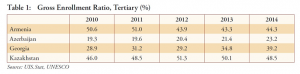
According to the UNESCO Institute for Statistics, Azerbaijan has scored the lowest post-secondary (tertiary) education enrollment rate compared to other countries in the Caucasus region and Central Asia, as 77% of Azerbaijanis who graduate from school do not enroll in universities. This is likely due to “the poorly conceived and highly centralized state quota allocation system”.[5] Table 1 below shows the percentage of students that applied to universities from 2010 to 2014 in Azerbaijan, Armenia, Georgia, and Kazakhstan.[6]

Educational Challenges in Azerbaijan

By Zinat Asadova

Sources;

[1] Souce: Mammadova, S., Guliyev, F., Wallwork, L. and Azimli, N., 2016. Human Capital Development in Azerbaijan. Caucasus Analytical Digest, (90), pp. 8,. Available at: <https://www.academia.edu/30431942/The_Quality_of_Education_in_Azerbaijan_Problems_and_Prospects>

[2] Mammadova, S., Guliyev, F., Wallwork, L. and Azimli, N., 2016. Human Capital Development in Azerbaijan. Caucasus Analytical Digest, (90), pp.8,. Available at: <https://www.academia.edu/30431942/The_Quality_of_Education_in_Azerbaijan_Problems_and_Prospects>

[3] Mammadova, S., Guliyev, F., Wallwork, L. and Azimli, N., 2016. Human Capital Development in Azerbaijan. Caucasus Analytical Digest, (90), pp. 7,. Available at: <https://www.academia.edu/30431942/The_Quality_of_Education_in_Azerbaijan_Problems_and_Prospects>

[4] Richard D. Kortum, “Emerging Higher Education in Azerbaijan”, Journal of Azerbaijani Studies, 12, 2009.

[5] Mammadova, S., Guliyev, F., Wallwork, L. and Azimli, N., 2016. Human Capital Development in Azerbaijan. Caucasus Analytical Digest, (90), pp. 7,. Available at: <https://www.academia.edu/30431942/The_Quality_of_Education_in_Azerbaijan_Problems_and_Prospects>

[6] Souce: Mammadova, S., Guliyev, F., Wallwork, L. and Azimli, N., 2016. Human Capital Development in Azerbaijan. Caucasus Analytical Digest, (90), pp. 8,. Available at: <https://www.academia.edu/30431942/The_Quality_of_Education_in_Azerbaijan_Problems_and_Prospects>

Cover Image by OpenClipart-Vectors from Pixabay

MAIN CHALLENGES OF PRIMARY AND SECONDARY EDUCATION IN RUSSIA

The Russian Federation itself is a relatively new state. It was shaped 30 years ago after the Soviet Union’s dissolution. Russia has a unique historical, social, and cultural background, with a mix between imperialism, soviet influence, and 30 years of modern history. All these different periods have had an impact on the educational system. There were numerous attempts to reform the education system after the dissolution of the Soviet Union. Some of the most significant ones were the 1992 federal law “On Education” innovations, including the possibility of private schools, new textbooks, and school financial autonomy (Dashchinskaya, 1997); the 2003 signing of the Bologna Declaration marking the beginning of a unified European educational space in some Russian institutions; and the introduction of national standardized testing, which has been mandatory since 2009 (Tsyrlina-Spady, 2016).

According to an education expert, fundamental changes have come up with the 2009-2010 reforms and the issue of a new law directive (On Education in the Russian Federation, 2012). Crucial reforms included funding schools per student, new standardized tests for school graduates and college freshmen, prioritization of school proximity in the admission process, creation and sustainability of safe school environments, promotion of inclusive education, and gradual termination of specialized educational institutions.

Photo by Oleksandr P: https://www.pexels.com/photo/boy-looking-on-a-tidied-desk-2781814/ 

Such successful changes as a consistent investment in education, creation of a national assessment system and the inclusion of obtained scores as main indicators for university admission (providing equal access to universities for all adolescents, including lower-income families and people from distant regions), almost universal coverage of pre-school education, and per capita funding. These changes have allowed Russian students to exceed in results of Trends in International Mathematics and Science Study (TIMSS) for 2019, which, upon publishing, showed Russia leading the rankings after the East Asian economies (Shmis, 2021). Nevertheless, the purpose of this article is to shed light on some of the most pressing issues within the Russian educational sector.

Inclusive education challenges

There are several types of challenges impeding the fulfillment of inclusive education. Firstly, there are insufficient specialists who possess the necessary skills and expertise to work with children with special needs. A study conducted in the Ural Federal region highlighted that around 60% of respondents noted the absence of highly specialized staff (psychologists, social pedagogues, tutors, etc.), especially in schools in small towns and rural areas (Grunt, 2019). Secondly, there is not enough material. Although most inclusive schools nowadays have elevators, ramps, widened doorways, Braille signs, and sound accompaniment, there is a lack of educational and methodological materials for teaching children with special needs (Mironova, Smolina, Novgorodtseva 2019). Thirdly, the bureaucracy around education is particularly burdensome regarding inclusive education. The distribution of power and responsibilities between teachers, tutors, psychologists, or social workers can pose barriers to reaching agreements. Finally, there is a huge gap in communication, collaboration, and proper interaction between teachers and parents, between children with and without special health needs. Value conflicts become apparent when the classes are mixed with disabled children and. Unfortunately, the actors involved in educational activities are not always willing to comprehend the changes that have occurred in the past few years.

A decline in the prestige of vocational and technical colleges

The widespread trend of obtaining a higher education diploma is undoubtedly beneficial for society; however, every coin has two sides. In the case of the Russian Federation, this trend has brought about the oversaturation of the labor market with specialists with higher education. This has, in turn, decreased the prestige of vocational and technical colleges and has resulted in the lack of technical specialists or workers with secondary vocational training (Ivanova, 2016). Russia has one of the highest tertiary attainment rates among the OECD members, as illustrated in Graph 1 below (OECD, 2019). Despite the declining levels of the prestige of vocational studies, vocational programs are still relatively more widespread than in other OECD countries.

Resource: OECD. (2019). Education at a Glance 2019: Country note. OECD.

Increase in investment resulting from the new challenges in the educational system

To increase the quality of Russian education, new investment is necessary. Russia offers great digital infrastructure, so the digitalization and creation of tailored educational platforms is just a matter of extra investment and collaborative efforts. It is crucial to adapt to changing teaching modalities such as hybrid and online regimes during the COVID-19 pandemic. Introducing unique teaching and learning methods will increase students’ motivation and engagement in the process.

Teaching real-life skills development

After the participation by Russian students in the PISA assessment of collaborative problem-solving skills (2015), the most significant negative gap was noted between results in mathematics, science, and reading (core PISA tests) and the students’ ability to solve problems collaboratively (Shmis, 2021). As it is one of the vital modern skills, new reforms should be adapted to introduce new aspects of collaborative work in schools and make them a center of obtaining new knowledge and mastering skills necessary for the modern world.

By Elizaveta Rusakova

Resources:

Educational Challenges in France

Whereas French education is prima facie accessible to everyone, as it is free from the start up until higher education, French people claim the French educational system knows many obstacles. I have interviewed French people who are still in the French educational system, both private and public, and some who ended a long time ago, hoping to test the relevance of the claims.

The most recurring obstacle that was mentioned was the teachers’ status. Teachers are underpaid and undervalued. In turn, their quality of teaching is criticised for being short-fused and unilateral. Many individuals with a French education felt they had to follow teachers’ expectations perfectly and had no space for individuality or originality. Specifically, mental health is overlooked as students must work for long hours. In the same vein, there is no psychological support or general encouragement as the French system is competition-based, and success is wholly put out to be the student’s responsibility. Rather than being encouraged once having reached a passing level, students are criticised for not being better.

Concurrently, there is no understanding of tiredness, poor mental health, or mental disorders, as students are not expected to ask for help and are turned down when they do. One interviewee explained:

two young girls sitting at a table with markers and crayons

Photo by Alan Rodriguez on Unsplash

When I was depressed and exhausted because of the long hours, teachers would get angry when I fell asleep in their class. I was given seven hours of detention because the teacher felt insulted. Nobody listened when I said I needed those hours to revise and sleep.”

Indeed, teaching is not centred around pupils. Instead, it is built on a hierarchical system.

One student in public education also explained they were never mentored or told about future options i.e., what programme to choose to get into which job or abroad opportunities. Each of his decisions was dependent entirely on his own research.

Notably, there was a clear difference in answers with students from public and private education, as privately educated children expressed overall higher satisfaction. This divide is well known to give different chances to children, depending on their socio-economic backgrounds. Accordingly, a systemic reform is needed in order to give public school teachers better chances of successfully conducting their job. This example of respect for the profession from the government is likely to be reflected in children’s behaviour as well.man and woman sitting on chairs

Photo by Kenny Eliason on Unsplash

This unilateral format is reflected in French school programs, whereby up until 2021[1] merely offered three main paths: Literature, Economics or Maths and Science. Only those three theory-based qualifications have been considered worthy. For people who do not fit this programmatic structure, turning towards a more practical-based, closer to work diploma will be judged negatively and as sub-standard. Indeed, French schools are low in the European and world assessment compared to other countries that give children more vocational classes.[2] Most notably, this programmatic structure can be predicted to be especially challenging for neurodivergent individuals. However, the recent change in ‘baccalauréat’ is

closer to an ‘à la carte’ selection and allows more freedom in the building of courses; hopefully minimising these critics.

Notably, the world report identified disability rights in education as the main issue in 2022.[3] Indeed, French integration rules for disabled children in education have been known for being largely confusing and disappointing, leaving parents unsupported. There is still progress to be made as integration in itself is not enough. For example, one interviewee recalled that some friends, parents of children with disabilities, regretted the lack of personnel in school to assist and protect their kids from bullying.

Additionally, we can note the recent (2021) ban on Muslim veils for minors in schools, as well as accompanying parents. This updated ban follows older restrictions that have been wholly criticised as Islamophobic.[4] Indeed, this ban puts a disproportionate weight on Muslim girls attending school, compared to other children.

boy in gray sweater beside boy in gray and white plaid dress shirtPhoto by Adam Winger on Unsplash

Most recently, French teachers have held one of the biggest education strikes in protest of the government’s handling of Covid-19 measures in the educational sector. Reflecting on the

aforementioned point on the inaccurate treatment of teachers; they complain about not being consulted in government decisions; being told to change their courses at the very last minute; being expected to conduct hybrid courses without support and not being replaced in case they fall ill. Ultimately, this instability is largely disrupting children’s education.[5]

Maya Shaw

Sources;

  1. https://www.mma.fr/zeroblabla/nouveau-bac-2021-reforme-changements.html
  2. https://www.weforum.org/agenda/2017/09/these-are-the-ten-best-countries-for-skill-and-education/
  3. https://www.hrw.org/world-report/2022
  4. www.theiwi.org/gpr-reports/the-french-hijab-ban-and-the-freedom-of-choice
  5. https://www.theguardian.com/world/2022/jan/13/half-of-french-primary-schools-expected-to-close-teachers-strike-protest-covid-education
  6. Cover image source – https://commons.wikimedia.org/wiki/User:GilPe

Main Challenges of Primary and Secondary Education in The Western Balkan countries

MAIN CHALLENGES OF PRIMARY AND SECONDARY EDUCATION IN WB6: PER COUNTRY


The Western Balkan countries (defined by the European Union as Albania, Bosnia and Herzegovina, Kosovo, Montenegro, the Republic of North Macedonia, and Serbia) are transitioning, involving both struggles and progress. 

These countries share unique historical events which impact today’s political, economic, and educational system, to name a few. However, each of these countries aspires to build dynamic societies and improve economic competitiveness, making educational reform a central pillar of regional development efforts. Building and maintaining qualitative and equitable education systems is vital for each country’s integration strategies into Europe.


ALBANIA 

The Albanian education system is complex and inevitably impacted by Albanian political, social, and economic historical development. Education itself is a catalyst for improving these pillars, which raises concerns in Albania about their educational system not contributing to the country’s socio-economic development.

Children at work

Education in Albania is mandatory for children aged six to sixteen. However, many children in Albania are involved in the worst forms of child labor, including mining and forced begging. A study by INSTAT (Albanian Institute of Statistics) and the ILO (International Labor Organization) stated that 7.7% of Albanian children between the ages of 5 and 17 work, often beyond their capabilities. It is estimated that about 54,000 children in Albania work.

Photo by note thanun on Unsplash

Half of the schools lack basic facilities

Schools in Albania face difficulties in terms of conditions and facilities. In remote areas of the country, schools lack access to heating as well as other necessary and basic infrastructure. According to the UNICEF and WHO’s report, 29% of schools in Albania do not meet the minimum hygienic conditions. The report focused on general needs in schools and showed that hygiene is not the only problem. According to data published, 53% of schools do not have access to the Internet, thus ranking below the European average.

Inclusive education

Albania has a 96% rate of primary education enrolment. However, issues in the educational sector severely affect the most vulnerable categories of children. Children of the Roma minority or with disabilities do not enjoy education. According to the Ministry of Education and Sports of Albania, the official dropout rate for Roma children is nearly 4%. About 34.4% of Roma children 7-18 years remain illiterate as they have never attended school.

Children living in rural and remote areas need to walk for hours, sometimes in harsh weather conditions, rendering inclusive education challenging.

The quality of teachers

Albania is improving the quality of teaching through standard entry state exams. At the moment, there is a significant gap between urban areas and those disadvantaged rural ones. In addition, the percentage of teachers with some level of higher education is below the average across participating countries and economies in the OECD (98%) and the EU (98%) (OECD, 2019[44]). Underprivileged areas face additional challenges in part due to the high migration levels.

Low budget in disposal

Whereas countries throughout the OECD have spent around 5% of their GDP on education in the past years, Albania’s budget has remained at 3%.

MONTENEGRO

Montenegro is a small republic with a population of around 650.000 people and less than 300 schools and one university. The educational system has suffered ten years of isolation due to both lack of investment and a general decline in infrastructure and quality. The academic challenges include, but are not limited to:

Photo by Conner Baker on Unsplash

School facilities

The schooling situations differ according to the area, but numerous schools suffer from poor amenities. In rural areas, particularly in the Albanian-minority ones, the schools lack indoor toilets, running water, or secure electrical installations. Furniture in most schools is in disrepair and inadequate supply. There is, additionally, a significant heating issue in schools, especially in mountainous regions. Schools are currently addressing the issue by layering up and using a minimal amount of fuel to heat schools periodically.

Schools are overcrowded

Montenegro’s schools are massively overcrowded. The classes accommodate between 35 and 40 students, creating a problem of space, which is especially acute in secondary schools. They need new facilities due to the population increase in urban areas, where schools operate on two or three shifts. The shift system consequently affects maintenance, so Montenegro must increase investment in this regard.

Teaching methods

Positive teaching methods are not practiced equitably in Montenegro. Traditional practices such as teacher-directed instructions are more frequently used in schools with more disadvantaged students and vocational programmers. Adaptive instructional approaches associated with higher outcomes often occur in schools with more advantaged students and general education programmers.

Despite these challenges, Montenegro generally sees high-school attendance. The languages in official use (Serbian, Bosnian, Albanian, and Croatian) are adequately taught and, according to the 2012 study by the Montenegro Statistical Office, 25 to 29 year old’s account for the highest level of education, with a percentage of 28 being educated in colleges.

SERBIA

The population’s educational structure is unfavorable

The 2011 Census data revealed that the population’s educational structure is unfavorable. It further showed that around 34% of the population aged 15 and over barely have a primary-level education. Additionally, most of the population (49%) has secondary education; and only 16% has attained higher education (Statistical Office of the Republic of Serbia [SORS], 2013).

Photo by Good Free Photos on Unsplash

Inclusive education 

Stemming from the definition of the inclusive education, “different and diverse students learning side by side in the same classroom”, it can be deduced that, in Serbia, educational attainment indicators are the least favorable for Roma population; most members have only a primary level of education or lower (87%), significantly fewer have a secondary education (11.5%), and the least have a higher education (less than 1%) (Radovanović & Knežević, 2014). According to the Human Rights Watch’s 2016 report, hundreds of Serbian children with disabilities face neglect and isolation in institutions, leading to stunted intellectual, emotional, and physical development. The 88-page report, “It is my dream to leave this place’: Children with Disabilities in Serbian Institutions,” documents the pressure families face to send children born with disabilities to large residential institutions, often far away from their homes, separating them from their families. In these institutions, children may experience neglect, inappropriate medication, lack of privacy, and limited or no education access.

The challenge of funding

Based on the data published by the UNESCO Institute for Statistics in September 2021, the Serbian government expenditure on education and training was 3.5% of the country’s GDP back in 2018. This data is concerning compared to the European Union countries’ average of 4.7% for 2017.

NORTH MACEDONIA 

Low achievement of students 

The results illustrated by the international testing events in North Macedonia highlight that one of the challenges in the primary education level in North Macedonia is that the learning accomplishments of pupils are critically low. In relation to this, education cycles do not define clear objectives of learning outcomes after each cycle of primary education. The framework curriculum is overburdened and irrelevant to the local environment.

Photo by Aaron Burden on Unsplash

Between 2013 and 2017, North Macedonia employed an external testing system but failed to achieve better. It diverted the focus from professor-based teaching and shifted it to memorizing information rather than essential understanding and broad logic. This is a recurring issue throughout the Western Balkans Countries.

Inclusive education 

In North Macedonia, as in other WB6 countries, many Roma children are not included in the education system. Attendance and dropout cases are related to the student’s socio-economic backgrounds, such as low parental levels of education, early marriage, and little knowledge of the Macedonian language. In cases of inclusiveness, the dropout rate is too high.

Children with special educational needs are not sufficiently included in the primary education system. Their inclusion in regular schools is not adequately regulated, and appropriate mechanisms have not been introduced. This issue is also related to cultural factors such as the prejudices among parents, teachers, and students on these groups. Teachers are not qualified to work with specific categories of learners. In addition, juveniles from correctional institutions as well as homeless people suffer from inclusion.

Curricula

Improving textbooks is a lengthy process, but as of now they are lacking in many respects. Books lack elements of multiculturalism, integration, and differential respect. Stereotypes, prejudice, and stigma affect the curriculums.

BOSNIA & HERCEGOVINA


Ethnically divided education in Bosnia

After the collapse of the former Yugoslavia in the 1990s, Bosnia and Herzegovina was divided into two separate entities, namely the Bosniak-Croat Federation and the Serb-dominated Republika Srpska. As a mixed population without a majority, there are several problems concerning the children: according to state-level legislation, students have the right to be educated in their language. Each ethnic group has to attend schools that are typically “two schools under one roof” model. In other words, Bosniak and Croat students attend the same schools but are kept separate. They learn different programs and textbooks.

In this country, NGOs such as Humanity in Action and YIHR are asking for a common curriculum to tackle the fact that the youth is growing up thinking divisions are standard.

Photo by Aaron Burden on Unsplash

Educational funding 

In Bosnia and Herzegovina, there is no balanced wages system for teachers. For instance, in the schools in the canton Herzegovina-Neretva, where a class is conducted in accordance with the Framework Curriculum of the Federation of Bosnia and Herzegovina, the employment position is paid regardless of the employee’s qualifications. In this sense, someone with a two-year or university degree gets the same wage. This is not the case in the Sarajevo canton, where educational levels are compensated differently.

Evaluation of knowledge

Concerning student assessment, students in Bosnia and Herzegovina have lower achievement rates than those in other countries. Students are tested for their knowledge through memorization but lack evaluative, analytical, or creative skills during schooling. This continues in the second cycle of studies, whereby despite the teaching reforms, results remain insufficient.

On the other hand, there are schools with international systems and programs, but incur large fees.

KOSOVO


Kosovo’s educational system experienced two unique events. Firstly, the dismissal of Albanian speakers in 1989 from schools and agencies throughout Kosovo and their replacement by Serbian officials (Shahani, 2016). Secondly, as a direct response to the dismissals, the development of a parallel educational system continued Albanian-based education in 1992. These events left historical footprints on the educational system development.

Based on UNICEF data, the main challenges of education that Kosovo is facing include:

Photo by Tim Mossholder on Unsplash

Low school’s infrastructure

Speaking about Kosovo’s situation means talking about reality merely 20 years after a war. The war’s impact on the education system in Kosovo was devastating. 50% of the schools were damaged or destroyed, and textbooks, equipment, and facilities were vandalized.

Low attendance

Not all children enjoy their right to education in Kosovo. Many students enroll late, and others drop out, leaving the nine years of compulsory education unfinished. 84% of five-year-old children attend pre-primary school, but only 15% of children attend an early education program. 87% of Kosovo’s children and only 24% of children from Roma, Ashkali, and Egyptian communities’ complete upper secondary education.

Inclusive education

Based on the 2011/12 academic year, only 33% of special-needs children were enrolled in education. This is partly due to the lack of coherent and coordinated actions between central and local authorities. In Kosovo, children of the Roma, Ashkali, and Egyptian minorities are being left out of the schooling system. This is also the case for children with disabilities, pre-school age children, returnees, and over-age children.

Children in rural areas are less likely to have accessible quality education. They have little to no access to health care, partly due to the lack of coherent and coordinated actions between central and local authorities and institutions.

Kosovar – Serbs Minority education program 

The engagement of the Serbian community is critical. After the war, Kosovar Serbs refused to partake in the reestablished education system. Kosovar Serbs work with Serbian textbooks, rendering the educational model a parallel one whereby the national government manages a part of it. In contrast, others are managed by Serbian communities and supported by Serbia. The current system creates tension occasionally. There are present multi-lingual schools (Serbian, Albanian, and English) models, which could be a future model.

Challenges shared amongst the six countries include 

  1. Covid – 19 Crisis found the WB6 schools un-prepared

Low participation in early childhood education, low attractiveness of the teaching profession, inadequate educational material or physical infrastructure remain key structural challenges for education in the region (OECD, 2018[14]).

During the Covid-19 lockdown, the main challenge faced by the WB6 countries was the schools’ inefficiency and the lack of adequate equipment for digital learning paired with teachers’ digital skills. Based on PISA 2018 data on the possibility of home-based school learning in the WB6 (OECD, 2019[15]):

  • About two-thirds of 15-year-old students are schooled in institutions where effective online learning support platforms were not available.
  • About two-thirds of 15-year-old students are schooled on premises with insufficient digital devices for instruction.
  • Teachers teach about one-quarter of 15-year-old students without the necessary technical and pedagogical skills to integrate digital devices in instruction.
  1. Lack of professional services 


In recent years, various schools in the WB6 countries have included professional services in the sociology and psychology fields. Despite this, the system remains inefficient due to the insufficient number of service providers and their approach towards pupils, as they engage in different administrative tasks.

WB6 COUNTRIES: FINDINGS FROM PISA

This section will present the results from OECD’s Program for International Student Assessment (PISA), PISA 2018, where the Balkan countries participated.

  1. The results reveal that overall outcomes from the region are improving. 


  1. Performance in the Western Balkans (average score in reading, 402) is generally lower than that of countries across Central and Eastern European Countries (CEEC) (476)1, the European Union (EU) (481), and the OECD (487). 


  1. Learning outcomes in the region are highly inequitable. Boys perform worse than girls at rates exceeding international averages. 


  1. Educational spending in the region is low, especially when considering the significant infrastructural investment that many schools need. Schools with socio-economically advantaged students tend to enjoy greater resourcing.


  1. Overcrowded schools in urban areas and shrinking schools in rural areas are other issues resulting from urbanization. 


  1. In the Western Balkans, teacher practices are primarily traditional and centered around the teacher (e.g., delivering a lecture to the whole class), with less emphasis on individualized, adaptive instruction.

This article has been prepared using qualitative study methods, focusing on secondary sources such as reports of the Western Balkan countries’ state agencies, international organizations, and other structures.

By Xhina Cekani

References:

Cover Photo source: United States. Central Intelligence Agency. Library of Congress – http://www.loc.gov/

Government expenditure on education, total (% of GDP) – Serbia | Data (worldbank.org)

8 Facts About Education in Serbia – The Borgen Project

Strategija-za-obrazovanie-ENG-WEB-1.pdf (mrk.mk)

Executive summary | Education in the Western Balkans : Findings from PISA | OECD iLibrary (oecd-ilibrary.org)

https://www.oecd-ilibrary.org/sites/7f73878ben/index.html?itemId=/content/component/7f73878b-en

http://www.herdata.org/public/education-needs_assessment-yug-mon-enl-t05.pdf

https://pisabyregion.oecd.org/montenegro/#section-02

https://www.unicef.org/montenegro/media/2976/file/MNE-media-MNEpublication44.pdf

Pupils Challenge Ethnically-Divided Education in Bosnia | Balkan Insight

Primary-and-secondary-education-in-Bosnia-and-Herzegovina.pdf (eu-monitoring.ba)

Children in Kosovo | UNICEF Kosovo Programme

Inclusive education | UNICEF Kosovo Programme

core-curriculum-for-pre-primary-grade-and-primary-education-in-kosovo.pdf (rks-gov.net) Kosovo’s ghost schools – Kosovo 2.0 (kosovotwopointzero.com)