Educational Challenges in France

Whereas French education is prima facie accessible to everyone, as it is free from the start up until higher education, French people claim the French educational system knows many obstacles. I have interviewed French people who are still in the French educational system, both private and public, and some who ended a long time ago, hoping to test the relevance of the claims.

The most recurring obstacle that was mentioned was the teachers’ status. Teachers are underpaid and undervalued. In turn, their quality of teaching is criticised for being short-fused and unilateral. Many individuals with a French education felt they had to follow teachers’ expectations perfectly and had no space for individuality or originality. Specifically, mental health is overlooked as students must work for long hours. In the same vein, there is no psychological support or general encouragement as the French system is competition-based, and success is wholly put out to be the student’s responsibility. Rather than being encouraged once having reached a passing level, students are criticised for not being better.

Concurrently, there is no understanding of tiredness, poor mental health, or mental disorders, as students are not expected to ask for help and are turned down when they do. One interviewee explained:

two young girls sitting at a table with markers and crayons

Photo by Alan Rodriguez on Unsplash

When I was depressed and exhausted because of the long hours, teachers would get angry when I fell asleep in their class. I was given seven hours of detention because the teacher felt insulted. Nobody listened when I said I needed those hours to revise and sleep.”

Indeed, teaching is not centred around pupils. Instead, it is built on a hierarchical system.

One student in public education also explained they were never mentored or told about future options i.e., what programme to choose to get into which job or abroad opportunities. Each of his decisions was dependent entirely on his own research.

Notably, there was a clear difference in answers with students from public and private education, as privately educated children expressed overall higher satisfaction. This divide is well known to give different chances to children, depending on their socio-economic backgrounds. Accordingly, a systemic reform is needed in order to give public school teachers better chances of successfully conducting their job. This example of respect for the profession from the government is likely to be reflected in children’s behaviour as well.man and woman sitting on chairs

Photo by Kenny Eliason on Unsplash

This unilateral format is reflected in French school programs, whereby up until 2021[1] merely offered three main paths: Literature, Economics or Maths and Science. Only those three theory-based qualifications have been considered worthy. For people who do not fit this programmatic structure, turning towards a more practical-based, closer to work diploma will be judged negatively and as sub-standard. Indeed, French schools are low in the European and world assessment compared to other countries that give children more vocational classes.[2] Most notably, this programmatic structure can be predicted to be especially challenging for neurodivergent individuals. However, the recent change in ‘baccalauréat’ is

closer to an ‘à la carte’ selection and allows more freedom in the building of courses; hopefully minimising these critics.

Notably, the world report identified disability rights in education as the main issue in 2022.[3] Indeed, French integration rules for disabled children in education have been known for being largely confusing and disappointing, leaving parents unsupported. There is still progress to be made as integration in itself is not enough. For example, one interviewee recalled that some friends, parents of children with disabilities, regretted the lack of personnel in school to assist and protect their kids from bullying.

Additionally, we can note the recent (2021) ban on Muslim veils for minors in schools, as well as accompanying parents. This updated ban follows older restrictions that have been wholly criticised as Islamophobic.[4] Indeed, this ban puts a disproportionate weight on Muslim girls attending school, compared to other children.

boy in gray sweater beside boy in gray and white plaid dress shirtPhoto by Adam Winger on Unsplash

Most recently, French teachers have held one of the biggest education strikes in protest of the government’s handling of Covid-19 measures in the educational sector. Reflecting on the

aforementioned point on the inaccurate treatment of teachers; they complain about not being consulted in government decisions; being told to change their courses at the very last minute; being expected to conduct hybrid courses without support and not being replaced in case they fall ill. Ultimately, this instability is largely disrupting children’s education.[5]

Maya Shaw

Sources;

  1. https://www.mma.fr/zeroblabla/nouveau-bac-2021-reforme-changements.html
  2. https://www.weforum.org/agenda/2017/09/these-are-the-ten-best-countries-for-skill-and-education/
  3. https://www.hrw.org/world-report/2022
  4. www.theiwi.org/gpr-reports/the-french-hijab-ban-and-the-freedom-of-choice
  5. https://www.theguardian.com/world/2022/jan/13/half-of-french-primary-schools-expected-to-close-teachers-strike-protest-covid-education
  6. Cover image source – https://commons.wikimedia.org/wiki/User:GilPe

The decision of the International Labor Organization (ILO) following the failed 2016 coup in Turkey

On 15 July 2016, a failed coup d’état took place in Turkey against President Tayyip Erdogan and state institutions. The disintegration of democratic rule, the threat to human rights, and secularism were among the reasons cited for the coup. The coup attempt was carried out by a small section of the Turkish Armed Forces, who referred to themselves as the ‘Peace at Home Council’. The Turkish government linked the coup plotters to the Gulen movement, which is deemed a terrorist organization by the Turkish government. Fethullah Gulen, a Turkish Islamic scholar, preacher, and one-time opinion leader currently residing in Pennsylvania after a self-imposed exile, led the Gulen movement. Gulen has denied any link to the coup attack. Mass arrests have occurred following the event.


A group of Government Workers known as “Yuksel Direniscileri” asking to the Turkish Government to get their work back. from: https://gercekhaberajansi.org/fotograflarla-yuksel-direnisi/

At least 20,000 Turkish citizens were detained due to alleged links with the Gulen movement. Turkish officials wanted Gulen’s repatriation; however, the Justice Department and State department found the evidence presented by their Turkish counterparts to be incoherent and non-credible. The detainees included 5,000 members of the educational sector and 21,000 teachers whose licenses were revoked, and national security numbers were added to the Turkish database to restrict future employment. However, evidence to suggest the loyalty of 20,000 citizens to Gulen was weak. Moreover, theories suggested that the coup was staged. After the coup’s first week, thousands of public servants and soldiers were purged. Nonetheless, ‘the list of alleged coup plotters was so extensive that it was impossible to put it together in the hours after the coup’.[1] Individuals who had passed away weeks and months before the coup were part of this list. Suspicion on the quality and honesty of the investigation grew. The United States, German intelligence, and the British Government have doubted the official Turkish narrative.


According to the Turkish Government, over 135,000 public servants, including around 40,000 teachers, have been dismissed or suspended since the government resorted to repression after the failed coup in July. No source of income and allegation of connection with a terrorist organization not only entails financial losses but poses threats of ostracism from the Turkish society altogether. The International Labor Organization has denounced the detaining of these individuals and has maintained that this was done without any supervision from the judicial bodies, without proper investigation, and without the ‘principle of presumption of innocence and rights’ accorded by ILO Conventions.[2]

The Turkish government states that the dissolution of the Action Workers’ Union Confederation (Aksiyon-Is), and its associated trade union was due to their connection with the so-called Fethullahist Terrorist Organization (FETÖ/PDY), which the Turkish government claims were responsible for the attempted coup. The government maintains that no application was filed to the Inquiry Commission by Aksiyon-Is and its affiliated trade unions, failing to use all available domestic channels and remedies.


However, the ILO committee’s findings note that the decision and power to declare a state of emergency for the dissolution of these unions was granted to the Council of Ministers when the decision-making power should rest with the parliament. This authorization allowed the executive body to issue Decrees with the force of law in place of the parliament’s ordinary legislative procedures. Therefore, all domestic channels for seeking legal amends have now lapsed.


The ILO stated that individuals having membership of trade unions associated with FETÖ/PDY was entirely lawful under Article 2 of Convention No. 87. They maintained that these trade unions had been constituted and operated lawfully until the state of emergency was declared. Therefore, it is unlawful to punish workers for simply having membership in a trade union without proof of involvement, a specific action, or even knowledge that they may have had possible affiliations with a terrorist organization. Aksiyon-Is maintains that all these dismissals took place before any investigations and in the absence of due process. Aksiyon-Is further argues that none of the detainees were allowed to contest the decision of their dismissal to a neutral body, which violates Article 8 of the Convention.

United Nations International Labor Organization (ILO) Executive Board dated 24 March 2021, numbered GB.341/INS/13/5/, concludes that the dismissals made with the Statutory Decrees and the closure of institutions in Turkey are contrary to the International Conventions No. 158 and No. 87 and therefore illegal.


Erdogan’s AKP Government is asked to rectify this unlawfulness. Although it has been over ten months since the decision, the AKP Government has not fulfilled its requirements, nor has it shown any interest in implementing it. The ILO must uphold its decision and put pressure on the AKP Government, considering the unlikelihood of implementing the decision by themselves if left unsupervised.


Fulfillment of the decision taken by the ILO Executive Board is obligatory both in terms of International Law and Turkish Law. The following petition provides an in-depth course of action to rectify its unfairness.

The petition asks the ILO to uphold its decision and act in favor of the implementation of the Board of Directors’ decision please take a moment to read through the cause and support. Contribute to the ILO and AKP Government officials’ action by signing.


Written by Mahnoor Tariq


References

Michael Rubin, (2017), ‘Did Erdogan stage the coup?’,  AEIdeas
David Lepeska, (2020), The ‘gift from god’ that crushed Turkish democracy, Retrieved from http://ahval.co/en-84353

Source URL: https://www.ilo.org/wcmsp5/groups/public/—ed_norm/—relconf/documents/meetingdocument/wcms_775695.pdf
Source URL: Human Rights Watch, https://www.hrw.org/news/2016/07/18/turkey-protect-rights-law-after-coup-attempt


[1] (Rubin, 2017)

[2] https://www.ilo.org/wcmsp5/groups/public/—ed_norm/—relconf/documents/meetingdocument/wcms_775695.pdf

Main Challenges of Primary and Secondary Education in The Western Balkan countries

MAIN CHALLENGES OF PRIMARY AND SECONDARY EDUCATION IN WB6: PER COUNTRY


The Western Balkan countries (defined by the European Union as Albania, Bosnia and Herzegovina, Kosovo, Montenegro, the Republic of North Macedonia, and Serbia) are transitioning, involving both struggles and progress. 

These countries share unique historical events which impact today’s political, economic, and educational system, to name a few. However, each of these countries aspires to build dynamic societies and improve economic competitiveness, making educational reform a central pillar of regional development efforts. Building and maintaining qualitative and equitable education systems is vital for each country’s integration strategies into Europe.


ALBANIA 

The Albanian education system is complex and inevitably impacted by Albanian political, social, and economic historical development. Education itself is a catalyst for improving these pillars, which raises concerns in Albania about their educational system not contributing to the country’s socio-economic development.

Children at work

Education in Albania is mandatory for children aged six to sixteen. However, many children in Albania are involved in the worst forms of child labor, including mining and forced begging. A study by INSTAT (Albanian Institute of Statistics) and the ILO (International Labor Organization) stated that 7.7% of Albanian children between the ages of 5 and 17 work, often beyond their capabilities. It is estimated that about 54,000 children in Albania work.

Photo by note thanun on Unsplash

Half of the schools lack basic facilities

Schools in Albania face difficulties in terms of conditions and facilities. In remote areas of the country, schools lack access to heating as well as other necessary and basic infrastructure. According to the UNICEF and WHO’s report, 29% of schools in Albania do not meet the minimum hygienic conditions. The report focused on general needs in schools and showed that hygiene is not the only problem. According to data published, 53% of schools do not have access to the Internet, thus ranking below the European average.

Inclusive education

Albania has a 96% rate of primary education enrolment. However, issues in the educational sector severely affect the most vulnerable categories of children. Children of the Roma minority or with disabilities do not enjoy education. According to the Ministry of Education and Sports of Albania, the official dropout rate for Roma children is nearly 4%. About 34.4% of Roma children 7-18 years remain illiterate as they have never attended school.

Children living in rural and remote areas need to walk for hours, sometimes in harsh weather conditions, rendering inclusive education challenging.

The quality of teachers

Albania is improving the quality of teaching through standard entry state exams. At the moment, there is a significant gap between urban areas and those disadvantaged rural ones. In addition, the percentage of teachers with some level of higher education is below the average across participating countries and economies in the OECD (98%) and the EU (98%) (OECD, 2019[44]). Underprivileged areas face additional challenges in part due to the high migration levels.

Low budget in disposal

Whereas countries throughout the OECD have spent around 5% of their GDP on education in the past years, Albania’s budget has remained at 3%.

MONTENEGRO

Montenegro is a small republic with a population of around 650.000 people and less than 300 schools and one university. The educational system has suffered ten years of isolation due to both lack of investment and a general decline in infrastructure and quality. The academic challenges include, but are not limited to:

Photo by Conner Baker on Unsplash

School facilities

The schooling situations differ according to the area, but numerous schools suffer from poor amenities. In rural areas, particularly in the Albanian-minority ones, the schools lack indoor toilets, running water, or secure electrical installations. Furniture in most schools is in disrepair and inadequate supply. There is, additionally, a significant heating issue in schools, especially in mountainous regions. Schools are currently addressing the issue by layering up and using a minimal amount of fuel to heat schools periodically.

Schools are overcrowded

Montenegro’s schools are massively overcrowded. The classes accommodate between 35 and 40 students, creating a problem of space, which is especially acute in secondary schools. They need new facilities due to the population increase in urban areas, where schools operate on two or three shifts. The shift system consequently affects maintenance, so Montenegro must increase investment in this regard.

Teaching methods

Positive teaching methods are not practiced equitably in Montenegro. Traditional practices such as teacher-directed instructions are more frequently used in schools with more disadvantaged students and vocational programmers. Adaptive instructional approaches associated with higher outcomes often occur in schools with more advantaged students and general education programmers.

Despite these challenges, Montenegro generally sees high-school attendance. The languages in official use (Serbian, Bosnian, Albanian, and Croatian) are adequately taught and, according to the 2012 study by the Montenegro Statistical Office, 25 to 29 year old’s account for the highest level of education, with a percentage of 28 being educated in colleges.

SERBIA

The population’s educational structure is unfavorable

The 2011 Census data revealed that the population’s educational structure is unfavorable. It further showed that around 34% of the population aged 15 and over barely have a primary-level education. Additionally, most of the population (49%) has secondary education; and only 16% has attained higher education (Statistical Office of the Republic of Serbia [SORS], 2013).

Photo by Good Free Photos on Unsplash

Inclusive education 

Stemming from the definition of the inclusive education, “different and diverse students learning side by side in the same classroom”, it can be deduced that, in Serbia, educational attainment indicators are the least favorable for Roma population; most members have only a primary level of education or lower (87%), significantly fewer have a secondary education (11.5%), and the least have a higher education (less than 1%) (Radovanović & Knežević, 2014). According to the Human Rights Watch’s 2016 report, hundreds of Serbian children with disabilities face neglect and isolation in institutions, leading to stunted intellectual, emotional, and physical development. The 88-page report, “It is my dream to leave this place’: Children with Disabilities in Serbian Institutions,” documents the pressure families face to send children born with disabilities to large residential institutions, often far away from their homes, separating them from their families. In these institutions, children may experience neglect, inappropriate medication, lack of privacy, and limited or no education access.

The challenge of funding

Based on the data published by the UNESCO Institute for Statistics in September 2021, the Serbian government expenditure on education and training was 3.5% of the country’s GDP back in 2018. This data is concerning compared to the European Union countries’ average of 4.7% for 2017.

NORTH MACEDONIA 

Low achievement of students 

The results illustrated by the international testing events in North Macedonia highlight that one of the challenges in the primary education level in North Macedonia is that the learning accomplishments of pupils are critically low. In relation to this, education cycles do not define clear objectives of learning outcomes after each cycle of primary education. The framework curriculum is overburdened and irrelevant to the local environment.

Photo by Aaron Burden on Unsplash

Between 2013 and 2017, North Macedonia employed an external testing system but failed to achieve better. It diverted the focus from professor-based teaching and shifted it to memorizing information rather than essential understanding and broad logic. This is a recurring issue throughout the Western Balkans Countries.

Inclusive education 

In North Macedonia, as in other WB6 countries, many Roma children are not included in the education system. Attendance and dropout cases are related to the student’s socio-economic backgrounds, such as low parental levels of education, early marriage, and little knowledge of the Macedonian language. In cases of inclusiveness, the dropout rate is too high.

Children with special educational needs are not sufficiently included in the primary education system. Their inclusion in regular schools is not adequately regulated, and appropriate mechanisms have not been introduced. This issue is also related to cultural factors such as the prejudices among parents, teachers, and students on these groups. Teachers are not qualified to work with specific categories of learners. In addition, juveniles from correctional institutions as well as homeless people suffer from inclusion.

Curricula

Improving textbooks is a lengthy process, but as of now they are lacking in many respects. Books lack elements of multiculturalism, integration, and differential respect. Stereotypes, prejudice, and stigma affect the curriculums.

BOSNIA & HERCEGOVINA


Ethnically divided education in Bosnia

After the collapse of the former Yugoslavia in the 1990s, Bosnia and Herzegovina was divided into two separate entities, namely the Bosniak-Croat Federation and the Serb-dominated Republika Srpska. As a mixed population without a majority, there are several problems concerning the children: according to state-level legislation, students have the right to be educated in their language. Each ethnic group has to attend schools that are typically “two schools under one roof” model. In other words, Bosniak and Croat students attend the same schools but are kept separate. They learn different programs and textbooks.

In this country, NGOs such as Humanity in Action and YIHR are asking for a common curriculum to tackle the fact that the youth is growing up thinking divisions are standard.

Photo by Aaron Burden on Unsplash

Educational funding 

In Bosnia and Herzegovina, there is no balanced wages system for teachers. For instance, in the schools in the canton Herzegovina-Neretva, where a class is conducted in accordance with the Framework Curriculum of the Federation of Bosnia and Herzegovina, the employment position is paid regardless of the employee’s qualifications. In this sense, someone with a two-year or university degree gets the same wage. This is not the case in the Sarajevo canton, where educational levels are compensated differently.

Evaluation of knowledge

Concerning student assessment, students in Bosnia and Herzegovina have lower achievement rates than those in other countries. Students are tested for their knowledge through memorization but lack evaluative, analytical, or creative skills during schooling. This continues in the second cycle of studies, whereby despite the teaching reforms, results remain insufficient.

On the other hand, there are schools with international systems and programs, but incur large fees.

KOSOVO


Kosovo’s educational system experienced two unique events. Firstly, the dismissal of Albanian speakers in 1989 from schools and agencies throughout Kosovo and their replacement by Serbian officials (Shahani, 2016). Secondly, as a direct response to the dismissals, the development of a parallel educational system continued Albanian-based education in 1992. These events left historical footprints on the educational system development.

Based on UNICEF data, the main challenges of education that Kosovo is facing include:

Photo by Tim Mossholder on Unsplash

Low school’s infrastructure

Speaking about Kosovo’s situation means talking about reality merely 20 years after a war. The war’s impact on the education system in Kosovo was devastating. 50% of the schools were damaged or destroyed, and textbooks, equipment, and facilities were vandalized.

Low attendance

Not all children enjoy their right to education in Kosovo. Many students enroll late, and others drop out, leaving the nine years of compulsory education unfinished. 84% of five-year-old children attend pre-primary school, but only 15% of children attend an early education program. 87% of Kosovo’s children and only 24% of children from Roma, Ashkali, and Egyptian communities’ complete upper secondary education.

Inclusive education

Based on the 2011/12 academic year, only 33% of special-needs children were enrolled in education. This is partly due to the lack of coherent and coordinated actions between central and local authorities. In Kosovo, children of the Roma, Ashkali, and Egyptian minorities are being left out of the schooling system. This is also the case for children with disabilities, pre-school age children, returnees, and over-age children.

Children in rural areas are less likely to have accessible quality education. They have little to no access to health care, partly due to the lack of coherent and coordinated actions between central and local authorities and institutions.

Kosovar – Serbs Minority education program 

The engagement of the Serbian community is critical. After the war, Kosovar Serbs refused to partake in the reestablished education system. Kosovar Serbs work with Serbian textbooks, rendering the educational model a parallel one whereby the national government manages a part of it. In contrast, others are managed by Serbian communities and supported by Serbia. The current system creates tension occasionally. There are present multi-lingual schools (Serbian, Albanian, and English) models, which could be a future model.

Challenges shared amongst the six countries include 

  1. Covid – 19 Crisis found the WB6 schools un-prepared

Low participation in early childhood education, low attractiveness of the teaching profession, inadequate educational material or physical infrastructure remain key structural challenges for education in the region (OECD, 2018[14]).

During the Covid-19 lockdown, the main challenge faced by the WB6 countries was the schools’ inefficiency and the lack of adequate equipment for digital learning paired with teachers’ digital skills. Based on PISA 2018 data on the possibility of home-based school learning in the WB6 (OECD, 2019[15]):

  • About two-thirds of 15-year-old students are schooled in institutions where effective online learning support platforms were not available.
  • About two-thirds of 15-year-old students are schooled on premises with insufficient digital devices for instruction.
  • Teachers teach about one-quarter of 15-year-old students without the necessary technical and pedagogical skills to integrate digital devices in instruction.
  1. Lack of professional services 


In recent years, various schools in the WB6 countries have included professional services in the sociology and psychology fields. Despite this, the system remains inefficient due to the insufficient number of service providers and their approach towards pupils, as they engage in different administrative tasks.

WB6 COUNTRIES: FINDINGS FROM PISA

This section will present the results from OECD’s Program for International Student Assessment (PISA), PISA 2018, where the Balkan countries participated.

  1. The results reveal that overall outcomes from the region are improving. 


  1. Performance in the Western Balkans (average score in reading, 402) is generally lower than that of countries across Central and Eastern European Countries (CEEC) (476)1, the European Union (EU) (481), and the OECD (487). 


  1. Learning outcomes in the region are highly inequitable. Boys perform worse than girls at rates exceeding international averages. 


  1. Educational spending in the region is low, especially when considering the significant infrastructural investment that many schools need. Schools with socio-economically advantaged students tend to enjoy greater resourcing.


  1. Overcrowded schools in urban areas and shrinking schools in rural areas are other issues resulting from urbanization. 


  1. In the Western Balkans, teacher practices are primarily traditional and centered around the teacher (e.g., delivering a lecture to the whole class), with less emphasis on individualized, adaptive instruction.

This article has been prepared using qualitative study methods, focusing on secondary sources such as reports of the Western Balkan countries’ state agencies, international organizations, and other structures.

By Xhina Cekani

References:

Cover Photo source: United States. Central Intelligence Agency. Library of Congress – http://www.loc.gov/

Government expenditure on education, total (% of GDP) – Serbia | Data (worldbank.org)

8 Facts About Education in Serbia – The Borgen Project

Strategija-za-obrazovanie-ENG-WEB-1.pdf (mrk.mk)

Executive summary | Education in the Western Balkans : Findings from PISA | OECD iLibrary (oecd-ilibrary.org)

https://www.oecd-ilibrary.org/sites/7f73878ben/index.html?itemId=/content/component/7f73878b-en

http://www.herdata.org/public/education-needs_assessment-yug-mon-enl-t05.pdf

https://pisabyregion.oecd.org/montenegro/#section-02

https://www.unicef.org/montenegro/media/2976/file/MNE-media-MNEpublication44.pdf

Pupils Challenge Ethnically-Divided Education in Bosnia | Balkan Insight

Primary-and-secondary-education-in-Bosnia-and-Herzegovina.pdf (eu-monitoring.ba)

Children in Kosovo | UNICEF Kosovo Programme

Inclusive education | UNICEF Kosovo Programme

core-curriculum-for-pre-primary-grade-and-primary-education-in-kosovo.pdf (rks-gov.net) Kosovo’s ghost schools – Kosovo 2.0 (kosovotwopointzero.com)

Children and Mental Health: The Foundation

THE FOUNDATION

Part 1

Spheres of influence

Children and young people’s mental health is one of the most critical human assets. The combination of human biology and exposure to experiences impacts and shapes the mental health of children and young people in three spheres of influence. These spheres are:

  1. The World of the Child: From birth to adolescence, immediate impacts on mental health reside in the child’s world – the world of mothers, dads, and caregivers. Appropriate nutrition, secure and safe families, skilled and active caregivers, and loving and enriching settings are all crucial factors in the child’s world.
  2. The World Around the Child: As a child’s universe expands, their circles of influence expand to encompass the world. In addition to the elements of mental health developed in the child’s world, the world around the child must be rooted in a safe and secure environment (both in-person and online), as well as in healthy relationships within their preschools, schools, and communities.
  3. The World at Large: The world at large, the third main area of influence, has a significant impact on shaping mental health. Poverty, disaster, conflict, discrimination, migration, and pandemics are examples of large-scale socioeconomic factors that impact the lives of children and young people throughout the world. The world at large affects the lives of mothers, fathers, and caregivers. As children grow into teenagers and adults, the world at large will directly affect their mental health and futures.

The major developmental stages of childhood and adolescence provide unique possibilities to improve and protect mental health.

According to UNICEF’s study in Sierra Leone, community health workers play an essential role in ensuring the emotional wellbeing of caregivers since their mental health and emotional wellbeing will contribute to their child’s wellbeing.

Part 2 

Critical moments of the child’s development

Children’s brains develop as part of a dynamic interaction between their genes, experiences, and the environment in which they live. Cultivating mental health can also be linked to critical developmental stages in children. Important moments are at the start, during the perinatal period, early childhood, childhood, and adolescence.

At the start

This contact occurs before conception and impacts genetic, biological, and developmental processes. Neurodevelopment begins in the womb, and nervous systems are developed. For example, the cells involved in the reproduction process can be transformed by an epigenetic process driven by psychological stress, toxicants, and drug exposure.

As a newborn, the brain develops at an astonishing rate, creating more than one million neural connections each second. Positive events and circumstances can foster brain growth, while negative ones might become dangerous factors.

Development and mental health are tightly tied to the environment in which a child is nurtured during prenatal and early childhood. Fathers are progressively undertaking increased caregiving responsibilities in various regions of the world. The role of parental influence in children’s and young people’s mental health is currently enduring extensive examinations.


First decade

At the initial stage of the first decade, skills that will help children understand, solve problems, interact, express themselves and perceive emotions, and create relationships are acquired in their early childhood. The children’s world expands during middle childhood, and learning environments begin to impact children’s development of transferrable skills and physical and mental health.

Second decade

Adolescence is critical for realizing human potential and ensuring long-term mental health. During adolescence, various brain parts undergo dynamic neurological changes that impact social perception and cognition. Puberty typically occurs between 8 and 12 years old for girls and 9 and 14 for boys.

Early physical maturity is linked to early sexual initiation, delinquency, and substance use in both boys and girls. Early puberty is associated with anxiety, sadness, and eating disorders for girls. The development of mental health disorders tends to occur during puberty, yet the relationship between the two remains uncertain.

Influences on mental health during adolescence are no longer concentrated on parents, caregivers, and houses. Poverty, conflict, gender norms, technology, and labor have a more substantial impact on how young people learn and work. Peer influences such as classmates, schools, and their communities play significant roles in the lives of young people.

Though socioeconomic factors of mental health have a role throughout one’s life, children might become direct dangers during adolescence, resulting in a decreased set of opportunities in the educational and employment realms.

Part 3

Connecting the critical moments

Significant developmental moments are linked by critical challenges in child development, including attachment, developmental cascades, cumulative risks, and biological embedding.


Attachment

When a child feels safe and comfortable enough to step out and experience the world, they develop attachment. Strong attachment strengthens the child’s capacity to build curiosity, emotion management, and empathy skills. Whenever attachment is positive, responsive, and sympathetic, the child learns a model to create a sense of self, identity, and a foundation for subsequent relationships.

Children conclude their attachment to a primary caregiver between 6 and 9 months. Attachment to a caregiver does not have to be instantaneous or physical in middle childhood. Secure bonds with peers are recreated during adolescence. A child’s bond to its parents is crucial, even if it then begins to seek increased independence.

Adolescent parenthood is frequently associated with risks, such as poverty and a lack of prenatal care and social support. Teenage pregnancy can negatively influence the development of the emotional and cognitive abilities needed to create a healthy connection with a newborn. Newborn’s attachment requirements might clash with an adolescent parent’s increasing demand for independence.


Developmental cascades

Positive and negative experiences and environments may drastically impact a child’s development from infancy through adolescence. Negative experiences, on the other hand (neglect, abuse, and continuous severe stress), raise exposure to additional dangers that may surface later in life. Negative experiences can have long-term effects on cognitive development, physical and mental health, as well as educational and career performance.


Cumulative risk

The higher the amount of risk factors a child is exposed to in their early childhood, the likelier mental health issues will develop at a later stage. Risk clusters are most prominent among children from low-income families, ethnic minorities, and immigrants. For instance, a child who has a toxic home environment will probably experience difficulties at school.


Biological embedding

According to research, stress and trauma can affect a child’s brain and make them more vulnerable to physical and psychological harm. Adverse events and settings that alter biology or brain development can erode resilience and increase vulnerability. These alterations can either aid or limit stability in the face of adversity.

A study has shown that children adopted from orphanages still have higher levels of cortisol (a hormone released in response to stress) than other children six years after adoption. The study was carried out on Romanian children who had lived in orphanages for over eight months in their first year of life.


Early deprivations: A life-course effect

Several studies have found a significant connection between the length of time spent in a facility and signs of mental health disorders at the age of six. Children who faced hardship were more likely to struggle in school and at work. On the other hand, those who were adopted by well-resourced and supportive families were less likely to develop mental health problems.


Part 4

Trauma and stress: How do they affect to a child’s mental health?

Stress and trauma are major factors determining children’s learning and development and young people’s mental health. When stress and trauma occur, they pose a mental health risk. However, they can trigger responses with long-term biological and cognitive health effects when they appear early in life.

Toxic stress

Stress is necessary for healthy brain growth and mental health in small doses, yet, at significant levels, it is toxic. Anxiety presents itself in varying degrees during a child’s life, from the womb to adolescence. According to the National Scientific Council on the Developing Child, there are three types of stress: positive, tolerable, and toxic.

Positive stress is moderate, short-lived, and a normal aspect of daily life. It is activated when a child obtains an immunization or encounters a new caregiver.

Tolerable stress is more severe but short-lived, giving the brain time to recover.

Toxic stress is the activation of a person’s stress management mechanisms in a powerful, frequent, or prolonged manner. Toxic stress in children arises when no caring adult is around to provide safety and comfort. According to existing research, maternal stress might impact a child’s later stress response even during the prenatal period. In contrast, damage caused by toxic stress can last a lifetime.


Adverse childhood experiences

Dangers leading to toxic stress in childhood are often categorized as adverse childhood experiences (ACEs). ACEs are defined as persistent, frequent, and intense sources of stress that children may suffer early in life. The word ACE refers to encounters that occur outside of one’s home and family boundaries.

WHO broadly defines ACEs as “multiple types of abuse; neglect; violence between parents or caregivers”. Toxic stress caused by ACEs can damage physical and mental health, social development, and educational success. ACEs are also tragically frequent, and the harm increases as they accumulate. Reports show that more than two-thirds of the population in the United States have experienced at least one ACE in the United States, and a quarter has experienced three or more.

According to research conducted in Cambodia, Malawi, and Nigeria, intimate partner violence in children can increase the risk of mental health problems.

Children and young people might be traumatized by conflict and social and political instability. As roles in families and communities shift during adolescence, new traumas might occur in young people’s lives, such as underage marriage, interpersonal violence, gender-based violence, and intimate partner violence. Some of these traumas are caused by a direct connection to war or violence, while the destruction of families and communities causes others.

A case study in Kenya showed that since the spread of the Covid-19 pandemic, children were the victim of abuses such as domestic, sexual, neglect, and physical abuse. National helplines for children, such as Childline Kenya, address mental health and violence and have played an enormous role in providing help and protection for children victimized by constant abuse, especially during the Covid-19 pandemic.


Summarized by Zinat Asadova

Revised by Olga Ruiz Pilato

Source: The State Of The Worl’s Children 2021, pages from 51 to 63

World Children: What can be done

There are three main components necessary to promote, protect and care for the mental health of children, namely:

– Commitment to strengthen leadership and scale-up investment;
– Communication to tackle stigma and engage with young people;
– Action to minimize risk factors, maximize protective factors in families and schools, strengthen the capacity of social protection and improve research in the area.

Commitment, broadly speaking, implies the need for more vital global leadership, development of financing models to bridge the investment gap, and partnerships to share knowledge and build capacity, gather data and evidence, monitor, and evaluate progress. Additionally, it entails increased funding. In many countries, mental health is underfunded, as most of the budget is invested in psychiatric services, leaving a small amount to mental health prevention and promotion. Countries have focused on setting specific budget targets for mental health issues within the healthcare realm in recent years. These are typically at least 5% in low and middle-income countries (LMICs) and at least 10% in higher-income countries.

Countries must increase funding in both education and social protection. They should set more precise targets and develop new and innovative sources of funding and financing, involving international agencies and donors, in line with human-rights approaches based on people’s needs.

Improving communication can lead to better results. It tackles misconceptions about mental health issues that fuel stigma and prevent children and adolescents from seeking support and fully participating in their communities. Governments and media must work together to end the stigma around mental health and promote the view that it is essential to talk about mental health. This would increase people’s recognition of signs of distress and inform citizens on seeking help. Communication is critical since it provides young people with the means for active and meaningful engagement, namely through investing in community youth groups or co-creating peer-to-peer initiatives and training programs. Listening to young people’s needs will improve measures aiming to help children, young people, and caregivers throughout their lives.

Action should concern four main aspects. The first aspect is to support a child’s family as their fundamental figure. Stable relations at home can help protect children against toxic stress and promote resilience and overall wellbeing. Parenting programs need to be scaled up, focusing on Social and Emotional Learning (SEL) to support families and children in developing positive attachments and create a positive home environment. Children who live under grave home conditions, including violence or severe stress, should have specific targeted support. Their respective parents ought to be provided with knowledge (such as training programs, counseling on health, nutrition, and child development) and resources such as paid parental leave, breastfeeding support, available and accessible high-quality childcare, and child benefits. This will consequently enhance the caregiver’s engagement with their children throughout their childhood and adolescence as well as foster their social, emotional, physical, and cognitive development. Caregivers need skills training to improve the developmental, behavioral, and familial outcomes for children and adolescents’ health issues.
Secondly, schools are a big part of children’s lives, and as such, should be one of the leading institutions ensuring mental health support. Violence, bullying, stress, and pressure to perform are the main underminers of mental health. In this sense, schools must implement a holistic approach to enhancing children’s development and wellbeing. They should encourage a warm, positive climate that makes children feel safe and connected and empowers them to express their opinions, support other students in expressing theirs, and seek help when needed. It should provide regular mental health and psychosocial wellbeing training for teachers and other personnel as well as for children, adolescents, and families. Schools should further strengthen teachers’ knowledge and socioemotional competencies in order to help children and adolescents learn about mental health, develop healthy habits, and recognize students who might need additional support. They should, in addition, provide school staff with training aiming at identifying suicidal students and assist them accordingly. National suicide prevention programs should restrict access to means of suicide, encourage responsible media reporting, and identify and remove harmful content on social media.

Thirdly, multiple systems and workforces should be strengthened to address mental health challenges. Mental health services should be provided across different sectors and delivery platforms, including education, social protection, and community care. Community-based interventions such as child protection and gender-based violence case-management should be endorsed particularly to identify and support at-risk children who require specialized care. Local women’s organizations should be a crucial source of psychosocial support for women and girls, especially survivors of gender-based violence. MHPSS interventions should be upgraded so they provide children with the necessary means and resources to cope with anxiety and severe forms of distress. Child rights must be respected in the design and provision of mental health services, with service users treated not as patients but as individuals with rights. Care should be person-centered and recovery-oriented.

The fourth key factor for action is to improve data, research, and evidence. The lack of data on the mental health of children, adolescents, and caregivers, especially in the LMICs with most of the world’s adolescents, poses a challenge to policy development and planning. Countries must thus increase research budgets to apply to all ages and ethnicities, adapt to local realities, and capture diverse experiences. Qualitative research can help reduce gaps in evidence generation and provide a solid account of children’s and adolescents’ wellbeing.
It is crucial to monitor and assess mental health through a consensus-based set of core indicators around the child, adolescent, and caregiver’s mental health, covering the prevalence of mental health conditions, the provision of mental healthcare, and the extent of efforts to address issues protect at-risk children and adolescents. Research should aim to understand various needs and investigate the factors that halt or accelerate policy implementation and intervention. Increased research would provide governments with insight into the issue of mental health, turning ideas into action.


Summarize by Elizaveta Rusakova from A FRAMEWORK FOR ACTION of The State of the World’s Children 2021


German court finds a former Syrian army colonel guilty of war crimes and crimes against humanity.

A court in Germany convicted a former army colonel of war crimes and a crime against humanity.

Anwar Raslan was found guilty of 27 murder, rape, and sexual assault counts at the Al-Khatib detention center near Damascus.

This conviction was a first to connect someone directly associated with the Syrian state with war crimes.

The principle of universal jurisdiction allows courts in Germany to try those accused of war crimes in other countries.


Yasmen Almashan, a Syrian campaigner for the Caesar Families Association, waits outside the courthouse in Koblenz, western Germany on Thursday.

Charges on the perpetrator:

The perpetrator allegedly worked as the lead interrogator for the Syrian secret service at the Al-Khatib detention center in Damascus and was allegedly responsible for torturing at least 4,000 people.

He is also charged with the murder of 58 detainees. The prosecution called for a life sentence.

The former colonel rejects the accusations. He has claimed to secretly have supported the opposition, even taking part in the 2014 Geneva peace conference.

The prosecution contested this narrative with the help of witness accounts who described a man who continuously employed his power to carry out orders given by the regime.

His co-defendant Eyad. A, was accused of bringing 30 anti-government demonstrators to the Al-Khatib torture prison. An appeal from the co-defendant is pending in the courts.

By Aniruddh Rajendran

What is mental health, and why should we refine our understanding of the issue?*

A pressing issue

According to UNICEF’s report on today’s children, good mental health amounts to a positive state of wellbeing. Indeed, an individual’s mental state provides the lens through which an individual experiences the world and profoundly impacts lived experiences.(1)
In this sense, mental  health underlies activities such as thinking, feeling, learning, working, and connecting with fellow individuals. In the same vein, an individual with precaurious mental health and suffering from a mental illness may not experience life healthily and positively. Accordingly, mental health is a right that must be preserved.
This text points to the worrying amount of children and adolescents living with mental health conditions, such as depression, anxiety, and conduct and attention disorders in today’s world. These disorders will significantly hinder their life experience. Appropriate care and the right to a healthy life are fundamental rights.
However, the notion of mental health and the need for its protection is often ignored by policymakers as it is still stigma-ridden, and their nature is not properly understood by all members of society. By extension, policymakers tend to opt for silence rather than a comprehensive policy-drafting addressing mental illnesses.
Most notably, the life of those who suffer from mental illnesses can be counted in days, months, or years of missed opportunities and lost lives. This loss could be calculated in human capital, as these individuals would participate in their communities more fruitfully if they were cared for appropriately. Societies need to recognise their direct interests accordingly and improve access to mental health care.

What is mental health?

This section of the report aims to define and explain the concept of mental health. Interestingly, the notion of health has historically encapsulated physical understandings and still triggers images of physical capabilities such as exercise. The term ‘mental health’, on the other hand, often generates gross misconceptions akin to ‘crazy’ and ‘unstable’, reinforcing a binary notion of mental health. Thus, a person is viewed as either stable or ‘crazy’. In other cases, mental health care is often relegated as a luxury rather than a right. Indeed, as opposed to physical health that has become very salient with technology development, poor mental health is rarely assessed as such. Instead, diagnostics such as ‘thinking too much’ and ‘it is all in your head’ find their way into common generalisations. Despite this, ‘mental health’ refers to the actual state of health rather than the lack of disorder. The positive understanding of mental health has been defined as “a dynamic state of internal equilibrium” which involves the ability to use social, emotional, and cognitive skills to navigate efficiently through life, as well as the capacity to “enjoy life and deal with the challenges we face”.(2)
Mental disorder is defined as comprising a range of conditions with different symptoms.(3) The World Health Organisation has defined mental illness to include “anxiety, depression, schizophrenia, and alcohol and drug dependency”.(4)

In the case of children and adolescents, mental health and wellbeing stem directly from their caregivers’ intimate involvement in their life.

The spectrum of mental health
The State of the World’s Children 2021 Part II

The following section emphasizes the different shades and levels of mental health and mental illness. Indeed, a mental disorder and mental wellbeing can co-exist. On the other hand, an individual exhibiting no diagnosed disorder can have feeble mental health. For this reason, seeing mental health as a binary with mental disorders on one side and mental stability on the other is an inaccurate depiction of the continuum of human experience with mental health.

Firstly, the report looks at the myriad of possibilities in the absence of mental disorders. Scales have been invented in order to measure the level of positive or negative mental health. Some indicators are self-acceptance, optimism, resilience, positive relations with family and peers, a sense of purpose in life, and feelings of growth or achievement.(5) Other frameworks focus on how people see themselves in their public life, including their sense of social acceptance and integration into a community. Interestingly, mental health is not linear, such that a child will know different levels of mental health in their life.

Secondly, the article sheds light on the variety of mental health conditions. Disorders exist on a continuum, and, indeed, conditions may be manageable, progressive, or severe such that a child could exhibit any one of those. The most common disorders on this spectrum are anxiety, depression, psychosis, and alcohol and drug dependency disorders. We can also find bipolar, food, autism spectrum, conduct, substance abuse, idiopathic intellectual disability, attention-deficit/hyperactivity disorder (ADHD), and groups of personality disorders.(6) Terms such as ‘anxiety’ and ‘depression’ have found their way into everyday language in a way that does not always refer to the diagnosable and life-interfering disorders.


Lastly, this work emphasizes the importance of context in understanding the mental health continuum. Indeed, understanding a child’s mental state means understanding their particular cultural context. Societal and family values, age, and class shape expectations and influence both the individual’s mental health state as well as the broad understanding of the notion of it. Expectations regarding personal growth and fulfilment evolve throughout a child’s life and depend on the child’s environment, community, and peers. Accordingly, to appropriately assess mental health, the cultural, social, and political contexts need to be considered.

Concerning numbers on mental health and mental disorders in children
The State of the World’s Children 2021 Part III

This section uses numbers to illustrate the human cost of poor mental health and disabilities. Mental health conditions and its lack of appropriate care are the leading cause of death, disease, and disability in most countries, regardless of their development. This is especially the case for older adolescents.

Main takeaways:
– An estimated 86 million adolescents 15-19 years old and 80 million 10-14 years old (or 13% of adolescents in total) lived with a mental disorder as of 2019.
– Adolescent boys are more likely to experience disorders, regardless of the age group. However, girls were more likely to experience psychological distress, a lack of life satisfaction, or a sense of flourishing and happiness (40) in 2021.
– North America, the Middle East, and North Africa, followed by Western Europe, exhibit the highest percentages of mental disorders (18.6% for boys and 16.3% for girls; 17.3% for boys and 16.8% for girls; 17% for boys, and 16.1% for girls, respectively). The pattern is the same within the two adolescent age groups.
– Globally, anxiety and depression disorders are the most common disorders for adolescents aged 10-19 (56.3% for girls and 31.4% for boys). [Figure 1.3, p. 37]
– Around 45,800 adolescents a year take their own life. This equates to one every eleven minutes, and the risk increases with age.
– Suicide is the fifth most prevalent cause for adolescents aged 10-19 and the fourth for the ages 15-19. [Figure 1.4, p. 38]
– Suicide is responsible for the death of 5 out of 100,000 girls per year, and 6 in the case of boys. [Figure 1.4]
– In Eastern Europe and Central Asia, suicide is the number one cause of death for adolescents aged 15-19. It is the second most prevalent cause in North America, Western Europe, and South Asia.

Data-reading precautions

In this section, the report stresses the risks of interpreting data as the ultimate truth. Indeed, suicide has historically been underreported to the point that statistics are considered to be of poor quality. Additionally, the stigma around suicide, paired with its criminalisation in certain countries, majorly affects data availability. Often, the cause of death is registered as an ‘unknown cause’. This is particularly the case with child suicides, as families fail to report the death as a suicide to minimise social stigma.
Underreporting is, in addition, found in mental health issues as, in most places, data is not collected nor used to develop the appropriate policies. Moreover, in countries where information is collected, an array of methods is used, rendering comparison challenging.

Data accuracy is the first step in grasping the gravity of the problem and drafting the necessary response to it. In order to generate this data, the investment must increase. Nonetheless, investment in research remains stuck at around 3.7 billion USD per year, which equates to $0.50 (USD) per person per year. Only 33% of the budget is spent on research on mental health and young people. Notably, only 2.4% of this research funding is spent in low and medium-income countries, in which 84% of the world population lives. However, the cost of addressing mental health was predicted to reach $6 trillion by 2020, consequently maintaining the gap between what is needed and what is done.

Stigma as the main obstacle to mental health research and policies and the overwhelming costs it ensures
The State of the World’s Children 2021 Part IV

Whereas recent years have been marked with growing awareness of mental health and mental illness, the stigma surrounding it is still prevalent. Specifically, stigma prevents the implementation of better support systems for young people. In fact, young people have claimed that speaking out about mental conditions is often more disabling than the condition itself. Often, they do not seek help out of fear. This stigma is deeply embedded in the culture as, from the age of six, children already associate mental conditions with words such as ‘crazy’ and ‘mad’.(7) This phenomenon is emphasized for boys as societal masculine gender norms deem vulnerability as ‘unmanly’. Boys are in this respect more susceptible to stigmatization and to stigmatise in return.

The individual and structural risks of stigma

Stigma can have an influence both an individual and a collective level. On the individual scale, a child might internalise feelings of guilt, shame, or lower self-esteem. Stigma influences children’s actions, emotions, and coping strategies as well as the sense of identity. Mainly, the stigma will obstruct the individual from getting help and disclosing their conditions to relatives and friends. Stigma influences mental health at both ends; it can trigger a mental disorder and exacerbate an existing one. It is structural in nature, embedded in legislation through a lack of research, budget amounts, and medical coverage for treatments. An example of this can be seen in France, where psychologists do not receive reimbursements from Social Security. Furthermore, stigma may lead to a lack of institutional response to mental health issues.


The costs of inaction

The institutional ignorance of mental health issues has a human and financial cost, which has been calculated by estimating the value children and adolescents aged 0-19 would contribute to their economies if they did not suffer from mental health conditions. These calculations are based on years of life lost to disability and death. McDaid and Evans-Lacko calculated that the annual loss in human capital due to mental health conditions amounts to 340.2 billion USD. This number considers the financial burden these conditions bear on health education and criminal justice systems, meaning it is merely a small representation of the actual cost.(8)

Return on investment

Investing on mental health results in positive returns. For instance, companies that invest in their employees’ wellbeing will receive a $5 return for every $1 invested. This return does account for the financial improvement, but there is additionally a return in happiness and productivity. Similarly, school programs on mental wellbeing for children and adolescents provide a return of $21.5 for every $1 invested over a period of 80 years.(9) The most significant return on investment was in lower-middle-income countries, with an $88.7 return on every dollar invested. Lower-income countries exhibit a larger share of the population of children and adolescents.(10) This result provides further rationale for the investment in mental health in their case.

* Summarized by Maya Shaw from Mental Health section of  The State of the World’s Children 2021

1. ‘The State of the World’s Children 2021’ https://www.unicef.org/reports/state-worlds-children-2021
2. United Nations Children’s Fund Regional Office for Europe and Central Asia, All Children Returning to School and Learning: Considerations for monitoring access and learning participation during and beyond the COVID-19 pandemic, UNICEF Europe and Central Asia, Geneva, 2020; United Nations Children’s Fund Brazil, Cenário da exclusão escolar no Brasil: Um alerta sobre os impactos da pandemia da COVID-19 na Educação, UNICEF Brazil, Brasília, April 2021; United Nations Children’s Fund, COVID-19: A threat to progress against child marriage, UNICEF, New York, 2021; International Labour Organization and United Nations Children’s Fund, COVID-19 and Child Labour: A time of crisis, a time to act, ILO and UNICEF, New York, 2020; Azevedo, Joao Pedro, et al., ‘Learning Losses due to COVID19 Could Add Up to $10 Trillion’, World Bank Blogs, 10 September 2020, https://blogs.worldbank.org/education/learning- losses-due-covid19-could-add-10-trillion .
World Health Organization, updates for the 2020 World Mental Health Atlas, forthcoming.
3. World Health Organization, Mental Health Action Plan 2013–2020, WHO, Geneva, 2013, p. 38.
4. WHO, Social Determinants of Mental Health, p. 13.
5. Barry, ‘Addressing the Determinants of Positive Mental Health’.
6. World Health Organization, WHO Methods and Data Sources for Global Burden of Disease Estimates 2000–2019, WHO, Geneva, December 2020, p. 25.
7. Kaushik, Anya, et al., ‘The Stigma of Mental Illness in Children and Adolescents: A systematic review’, Psychiatry Research, vol. 243, 2016, pp. 469–294.
8. Ibid, 8.
9. RTI International, ‘The Return on Investment for School- Based Prevention of Mental Health Disorders’, background paper for The State of the World’s Children 2021, United Nations Children’s Fund, May 2021.
10. United Nations Department of Economic and Social Affairs Population Dynamics, ‘World Population Prospects 2019: Data query’, https://population.un.org/wpp/DataQuery/.


Children and Mental Health

Part I*
Chapter 3 – Factors that help and harm

Researchers have identified various risk factors known as ‘risk markers’, namely their causes and potential effects on children’s mental health. The results of these risk factors vary significantly from child to child since their experiences, and social, economic, and environmental conditions differ. There is a proportional relationship between the risk factors and their causes. As the duration and intensity of these causes increase, so do the risk factors.
Since understandings of mental health vary culturally, researchers, despite gathering large amounts of data, are still limited in identifying common risks to mental health.

Environments can act as both a risk factor and a protective factor for a child, making it hard to generalize understandings of mental health. For example, a school can prove to be an empowering surrounding for a child where he is motivated by his teachers and teaches courses that broaden his personal and academic horizons. However, in the same settings, a child can experience severe bullying, criticism, and trauma, harming their mental health.

However, despite these complexities, this chapter of the ‘The State of the World’s Children 2021’ identifies three critical factors relevant to understanding children’s mental health. These factors are not biological and can easily be changed. Therefore, they must be understood prudently. These include:
• Nurturing care from parents/ caregivers
• External environment
• Relationships with peers (as they grow older)
This chapter navigates through thoughts presented by adolescents in mental health discussion groups directed by the John Hopkins University.

A life-course approach to prevalent mental health risks

Despite the difficulty in obtaining standardized information regarding mental health factors across regions, a team of experts from Universidade Federal do Rio Grande do Sul in Brazil examined standardized data from the Demographic and Health Surveys (DHS), Multiple Indicator Cluster Surveys (MICS), and the Global School-based Student Health Survey (GSHS), in order to find commonalities in the distribution of risk factors across regions. They did so with the aim to develop and implement better interventions and methods to address mental health risks in children. The experts found 23 factors in the perinatal, early childhood, childhood, and adolescent periods of a person’s first two decades. Some of the factors include bullying, child labor, subject to violence, and lack of proper nutrition.

Risk and protective factors: Parenting (the world of the child)

The role of parents is identified as the most critical and primary role in a child’s mental health development. This is the first point of contact of the child. Particularly with regard to how they go on to view themselves and the world around them. Parents can create a safe, protected, and stable environment for a child as well as provide them with opportunities and platforms to grow in the world. However, the limited world of a child expands greatly during adolescence where other external risks enter.

The world around the child

Some of these risks exist in the world, majorly stemming from poverty and conflicts. Most of the time, parents struggle to help adolescents navigate these external risks, making it difficult for children to cope with the world around them.

Part II – Big changes start small

Not spending on mental health costs England alone £16.13 billion a year. There is a lack of priority and initiative at the early stages of a child where violent behavior that later causes widespread damage and aggression can be curtailed at a significantly lower cost if addressed and prioritized from the beginning. The Royal Foundation gives six recommendations to curtail these £16.13 billion losses per year. These include:

1. Raising awareness on the impact of a child’s early years;
2. Building a more nurturing society;
3. Creating communities of support;
4. Creating a workforce that uplifts families of the affected;
5. Gathering and interpreting more data to improve care for children and their caregivers;
6. Promoting long-term changes that provide stable yearly childhood support.

At the start

Low birth weight and malnutrition can adversely affect a child’s mental health as they grow older. High levels of depression, anxiety, shyness, and low cognitive development often result from a mother’s use of drugs and alcohol or early child marriages. Paternal depression during the early years of a child’s development is an additional cause of emotional distress in a child.

Nutrition, physical activity, and body weight

Nutrition is the basic building block of lifelong mental health stability. Lack of proper nutrition acts as a risk factor to the cognitive development of a child, while adequate nutrition serves as a protective factor. To counter the risk factor of inadequate nutrition, nutrition interventions for mothers during their pregnancy such as Calcium, Vitamin A, and Zinc are provided to reduce the risk of low birth weight and malnutrition.

Lack of physical activity and increased screen time in adolescents is a global cause of impeded brain development. One study of adolescents in the United States of teenagers aged 14–18 showed that, for each hour of sleep lost, the changes of feeling sad and hopeless rose by 38 % to 42 %. Warmth, love and affection, adolescent development, respectful communication, positive discipline, safe environments, provision of basic needs, and caregivers’ and parents’ mental health are a few of the factors identified by UNICEF to bolster children’s cognitive abilities development.

Medication and children

Between 2005 and 2012, prescription rates for antidepressants for children younger than 19 are estimated to have increased as follows:

In Denmark: 60.5%
In Germany: 49.2%
In the Netherlands: 17.6%
In the United Kingdom: 54.4%
In the United States: 26.1%

These results indicate that mental health facilities are readily becoming available in many countries and that the youth are increasingly making use of them. However, the high prices of these drugs entail that many children do not often have access to them. Moreover, these drugs merely aid in countering mental health effects but do not address the root cause of the problems, so issues such as violence, poverty, and inequality that threaten children’s mental health ought to be addressed.

Case study: Ireland
MindOut: Social and emotional learning for adolescent well-being

When Ireland developed its National Youth Strategy in 2015, many young people identified mental health as one of the top three issues. MindOut is an evidence-based universal social and emotional learning (SEL) Programme and part of Ireland’s Health Service Executive. It offers an opportunity to target mental health and general well-being issues important to young people in Ireland. MindOut is provided to 15 to 18-year-olds in schools. It is included in the Social, Personal, and Health Education (SPHE) curriculum, a compulsory part of the school curriculum.
MindOut has helped children develop social and emotional skills, including self-awareness, self-management, social awareness, relationship management, and responsible decision-making.

Violence and mental health

Violence has been identified as one of the major causes of mental distress in children. Often, one or more forms of violence can co-exist in the same family, jeopardizing the child’s mental health. Over a billion children between the ages of 12 and 17 are estimated to be exposed to interpersonal violence with consequences including depression, anxiety, suicide, and behavioral and social problems. Preventing exposure to violence in childhood is crucial to promoting mental health. The World Health Organization (WHO) strongly suggests that healthcare providers must consider exposure to violence while examining children’s health, particularly when facing conditions that may be complicated by maltreatment.

* Summarized by Mahnoor Traiq from Risk and Protection section of  The State of the World’s Children 2021

Who is 2021’s Tyrant of the Year?

Imagine living in the 21st century, where technology, science, health, media, art, and education are developing, and being imprisoned for expressing your opinion, or defending your rights. Sadly, this is currently happening in many countries around the world.
Although leaders of different countries are trying to develop and implement democracy together with human rights, there are others which, in contrary, imprison the citizens that demand basic human rights.
Last year, many journalists and human rights activists were jailed for expressing their opinion and defending human rights such as equality in education and women’s rights. These journalists’ rights have been taken away from them by the rulers of the countries they belong to, as these rulers have used fake excuses to justify their imprisonment, such as the Covid-19 pandemic, religion and beliefs, extremist ideologies, among others.
Index censorship(1) has prepared a list of tyrant leaders who are notable for their human rights violations:

Vote for your Tyrant of the Year 2021

Aleksandr Lukashenka
Known as “Europe’s last dictator” as he proudly refers to himself, Lukashenka’s ruling period in Belarus is known as one of the worst ruling periods in the country. He has jailed protestors, including the opposition journalists and human rights activists. In addition to this, he has signed a law allowing police officers to shoot protestors without being held accountable for shooting, providing the police with a huge power to commit “police brutality” to the protestors.(2)
Since the media outlets are government controlled, there is zero transparency in news reporting, and the media outlets who talk unfavorable about the president are subjected to threats by the government.
Education should be provided for everyone equally, but the current regime in Belarus renders this impossible, as Lukashenka’s latest human rights violation in the educational field includes the failure to allow students who oppose his regime to attend universities, as well as to fire teachers who do not follow the state’s ideology.(3)(4)


Jair Bolsonaro
Since Bolsonaro came to power in 2019, Brazil has faced serious problems in many fields. Media censorship has been implemented to those who criticize Bolsonaro and his regime, and journalists have been attacked and jailed for criticizing his far-right ideologies.
Bolsonaro’s appointment as the president of Brazil has benefited people with far-right ideologies, resulting in an increase in homophobic and misogynist attacks on the LGBTQ+ community. Bolsonaro is known for his homophobic and misogynist statements and for not allowing criticisms of homophobia and misogyny.(5)
Brazil has been going through one of its worst periods since covid-19 did hit the country, as Bolsonaro’s mishandling of the covid-19 situation has caused the enormous spread of the pandemic across the country.(6)
Bolsonaro is accused of controlling the education in the country, and has attacked subjects dealing with racism, women, and LGBTQ+ history, and gender equality. Most of the federal public universities in Brazil depend on government funding, but there has been a proposal from the Ministry of Education to reduce funding for Brazilian public universities by 30% and to cut funding entirely to the philosophy and sociology departments of public universities. The current regime in Brazil also encourages to expose and fire teachers with leftist ideologies, and to expel students who criticize Bolsonrano’s regime.(7)


Xi Jinping
One of the most dangerous rulers of China, known for his brutal far right and revisionist ideologies, and responsible for the genocide that is currently cleansing the Uighur minority in Xinjiang. The political party that Xi Jinping belongs to, the Chinese Communist Party, controls almost everything in the country: from citizens to media outlets, and, above all, education.
As any other far right rulers of the world entertaining themselves with imprisoning journalists and human rights activists, it is not a surprise that Xi Jinping is one of these rulers. He was responsible for the arrest of many journalists and human rights activists that exposed him and his political party.
Jinping and his political party have been controlling the education in China and abroad, threatening anyone who talks unfavorably about the CCP and himself. Former Minister of Education Yuan Guiren has publicly stated that western textbooks should be banned from entering educational field, especially those criticizing the CCP and its leader(8). The intention behind this statement is not to allow any criticism to reach to the students, with the aim of reducing attacks on the CCP by students.
People in China are expected to follow the leadership of the Chinese Communist Party, and anyone daring to criticize Jinping and the CCP will be accused of treason and foreign espionage and will face law-breaching accusations. This means that any teacher or student who dares to openly criticize Chinese Communist Party or any of its members will be accused and charged for breaking the law.(9)


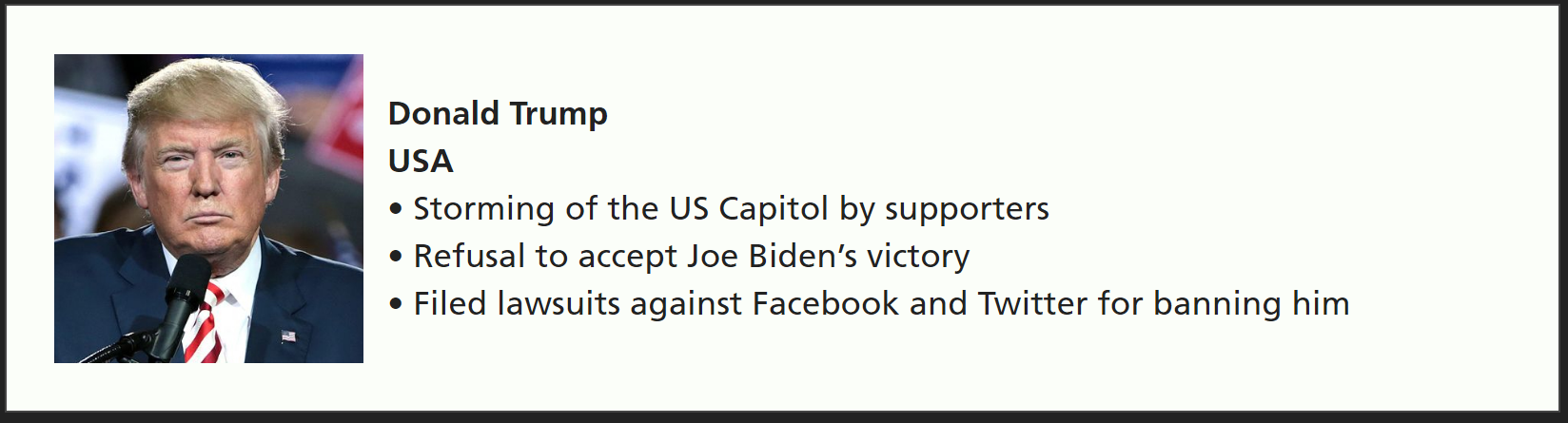
Donald Trump
Donald Trump’s presidency was a terrible period in America’s history. Trump is known for his far-right ideals including white supremacy, anti-refugee remarks, racism, Islamophobic statements, and promoting conspiracy theories.
His anti-refugee laws include construction of a wall along the US – Mexico border, reducing the entrance of immigrants from Mexico to USA. An executive order called “Protecting the Nation from Terrorist Attacks by Foreign Nationals” includes banning citizens of 7 Muslim majority countries to enter USA, which targeted Muslim immigrants, especially those from low-income backgrounds, and suggests that citizens of these countries are “terrorists that pose as threats to the safety of USA”.(10)
Trump’s far right statements have encouraged white supremacists to attack people of color, migrants, and people from religious minorities. School and university students with minority backgrounds were the target of racist attacks, as Trump’s administration in 2018 revoked an Obama-era policy aimed at ending racial discrimination in schools. Education Secretary Betsy DeVos stated that “discipline is a matter on which classroom teachers and local school leaders deserve and need autonomy”.(11) The Department of Education additionally revoked other Obama-era policies that proposed stricter procedures to address campus-based sexual assaults, and protection against sexual abuse on college campuses, as well as protecting transgender students from all forms of attacks.(12)


Recep Tayyip Erdogan
Erdogan is the controversial ruler of Turkey, known for his strong religious conservative ideologies and extreme far right views, such as his opposition to the LGBTQ+ community and misogynist statements, with public speeches containing populist rhetoric propaganda such as creating an Islamic khalifate and restoring the Ottoman Empire.
Turkey has withdrawn from the Istanbul Convention, a convention aimed to protect women and the LGBTQ+ community from violence and abuse and secure their rights.(13) This has sparked major controversy on how Erdogan and his regime are ruling the country amidst the increasing rates of femicide and homophobic attacks, without providing security to the victims of these attacks.
Sectarianism and religious intolerance have increased massively in Turkey since Erdogan came to power. Refugees and ethnic minorities, especially Kurdish people, have been suffering the most from his regime. The United Nations reported in 2016 that Turkey’s military and police forces have killed thousands of people during an operation against Kurdish rebels in southeast Turkey, as the report listed summary of killings, torture, rape, and property destruction among a group of human rights violations.(14)
Peaceful protests erupted at the Boğaziçi University after Erdogan’s appointment of academic Melih Bulu as the University’s rector. Bulu is known for his close ties with Erdogan’s Justice and Development Party (AKP). The students who protested for Bulu’s appointment were arrested and criminally charged, threatened, and abused, while Erdogan referred to them as “lazy and narrow-minded”. He accused them of having links with terrorism, which is an accusation widely used by Turkish officials for opposition parties and anyone who criticized Erdogan’s regime, including teachers, human rights activists, and journalists.(16)

Over 100,000 professors, government officials, and journalists have been jailed by the Erdogan regime since the failed coup attack in 2016, as many of those detained are member of the Hizmet movement that was created by Turkish preacher Fetullah Gülen, which Erdogan has accused Gülen and the member of Hizmet movement of the attempting the failed coup attack. Gülen and Hizmet movement members have denied these allegations, claiming that Erdogan staged the coup to secure his position and power, which this crackdown has led to the closure of Gülen schools, removal of thousands of Gülen followers from their state jobs, and the arrest of more than 150,000 educated Turkish civilians suspected of having links to Gülen.(17)


Mohammad Hasan Akhund
Afghanistan has been the at center of attention since the Taliban regained the control of the country after over a decade. Since then, the country has fallen into an economic, educational, and humanitarian recession, particularly affecting women’s rights.
Mulla Hasan Akhund, one of the founding members of the Taliban and an Ultra-Conservative religious scholar(18), has been appointed as the Prime Minister of Afghanistan since the return of Taliban, raising alarms on increased human-rights violations by the Afghan population.
Since Mulla Hasan Akhund was appointed as Prime Minister, women, journalists, and human-rights activists have been suffering the most from the Taliban regime. Girls are not allowed to attend schools and universities without religious attire, and women forbidden to leave their houses without a male companion. The Taliban has enforced laws that promote gender discrimination, consequently leading to women losing their jobs and constituting an open attack on women’s’ rights.(19)
The Taliban’s return to power has had a profound influence on education. Albeit having promised to allow women to attend schools and universities, Higher Education Minister Abdul Baqi Haqqani has stated that women will be allowed to get education with the condition that they are accompanied with a male companion, and that their studies are in line with the Taliban’s interpretation of Islamic law. Haqqani also stated that gender-mixed classes will be banned and Sharia law will be implemented in schools and universities.(20)


Bashar al-Assad
Bashar Al Assad is the personified definition of dictatorship. Assad, Syria’s dictator, is responsible for the massacre of millions of civilians opposing his regime, and has used chemical weapons, torture, and execution as means of attack. He has been arresting and killing journalists that exposed his war crimes, as well as bombing densely populated civilian areas.(21) This has resulted in a refugee crisis, whereby 9 million people have had to flee to neighboring states, seeking asylum in refugee camps and living under harsh conditions. The UN World Food Program reported that nearly 6 million Syrians now rely on its food assistance programs to survive.(22)
With the current situation in Syria, many school and university students are afraid for their lives, and even many parents refuse to send their kids to schools, as schools have turned into a military intelligence service. If these families have been discovered to be part of anti-government protests, or opposing the Assad regime, they will be tortured and threated, and most of the time they are being killed by the Syrian Armed Forces and reported as “missing”.(23)
Schools and Universities in Syria are following the curriculum that has been interpreted by the Assad regime, which indoctrinates students in line with government’s ideologies, resulting in new generations dictated by nationalist rhetoric in support of Assad’s regime.(24)


Ali Khameini
Iran is known for its rich culture and a history that has had major contributions in the scientific, health, and philosophic realm. Despite its rich history, Iran is currently suffering from severe human-rights violations by the country’s Supreme Leader.
Ali Khameini is a very controversial figure in Iran, known for his extreme religious beliefs and views, with a conservative far-right mindset. The Khameini regime is known for its brutality and the enforcement of religious beliefs upon people, whilst disrespecting other religious of ethnic minorities co-existing in Iran. Anyone who critisises the government is subjected to threats and criminal charges, as the Sharia laws interpreted by the Khameini regime are implemented in all governmental institutions.
Khameini has been responsible for the closure of many universities where students opposed his government condemned human rights violations. He has violently suppressed these students and threatened universities that disagree and oppose his regime.(25)
Iran has banned teaching English language in primary schools, citing that it opens the gate to the spread of Western ideologies, something that he has termed “western cultural invasion”. This action seeks to minimize government criticism among students and render them oblivious to the human rights violations being committed throughout the country.(26)


Nicolas Maduro
Venezuela has been suffering from a huge economic crisis in the past years, with unemployment(27) and poverty(28) rates increasing every year. The numbers have significantly surged after Nicolas Maduro took power in 2013, and has created strong opposition for Maduro’s handling of the crisis.
Protests against Maduro and his regime, accusing him of corruption and totalitarianism, as well as failing to protect late Hugo Chávez’s democracy. In response to the protests, Maduro’s regime has jailed, tortured, and killed civilians participating in the protests, including journalists and human rights activists criticizing his leadership style. Many of them have been reported missing.(29)
The crisis has deeply affected children’s education, as parents cannot afford their school supplies and meals. Many students have dropped out of school to work and help their families earn a living, as providing money for food is more pressing than attending school.(30)
The situation in universities is equally as bad. Professors and academics are underpaid and, in some cases, not paid at all. Some universities have been reported to be suffering from water shortage, which shows that there has been little to no attention to the educational factor in Venezuela.(31) Maduro’s regime arrested students protesting against the current conditions in the educational sphere, sometimes through the use of government armed forces’ bullets.(32)


Min Aung Hlaing
Myanmar’s independence from British rule in 1948 surfaced an array of problems in the country. Civil war, poverty, military rule, and the establishment of a dictatorship are only some of the issues Myanmar faces. The Myanmar armed forces, known as the ‘Tatmadaw’ have made the Rohingya Muslim minority a target of genocide.
In 2020, Aung San Suu Kyi and her political party ‘National League for Democracy’ won the elections for the second time. Military leaders accused the elections of being rigged, and Myanmar’s top general Min Aung Hlaing staged a coup in 202, seizing power of the country and detaining Suu Kyi and other opposition party leaders.(33)
When peaceful protests erupted in the country after the coup, many civilians have lost their lives, as Aung Hlaing military regime have killed, tortured, and raped the protestors, while tear gas and other weapons have been used to disperse demonstrators.(34)
Considering the country’s current political instability, many students have halted education amidst fears that school curriculums are dictated by military policies and an authoritarian rhetoric glorifying Aung Hlaing’s leadership.(35)


Kim Jong Un
North Korea is one of the world’s most isolated countries. Its ruling system is a mixture between communism, Confucianism, and monarchic dictatorship. North Korea is known for its authoritarian regime, as the country’s ruler Kim Jong Un and his political party ‘Workers’ Party of Korea’ use threat and intimidation to force fearful obedience on people. Kim restricts communication with the outside world by ensuring people to remain within the country’s borders.(36)
The concept of freedom or opposition is not tolerated by Jong Un, and, in fact, does not exist in North Korean society.(37) This explains why independent media and opposition parties do not exist in North Korea, as Kim and his ancestors have completely isolated the country, rendering themselves as God equivalents and its people ‘God’s slaves’.
The steep poverty rates in North Korea consistently increase, and, by 2018, poverty rates were set at 80%.(38) As previously seen in other Venezuela, students drop out of school in order to provide food and maintenance to their families. During holidays and vacations, students are forced to work in rural areas, and teachers forced to work for the government, undertaking jobs such as building railroads, farming, and other illegal jobs to survive.(39)
North Korea’s education system consists of Kim’s enforced propaganda. Students must endure endless speeches depicting the Kim’s legacy as heroic. The system is upheld by the systemic indoctrination of the country’s population, thereby sustaining obedience to its leader. Concepts such as freedom or human rights blindsided schools and universities, and international issues are not properly taught to students.(40)


Paul Kagame
Despite Rwanda’s recent progress in areas like health and education president Paul Kagame claims credit for, the government is deeply flawed. Kagame became the president of Rwanda in 2000, and, just as every other dictator, has utilized his power as a way to shut down opposition parties and journalists drawing attention to human rights violations under his rule. He has consistently imprisoned human presidency candidates by accusing them of tax evasion and threat to national security, but these accusations are merely used for political purposes as a way of securing his position as Rwanda’s leader.(41)
Albeit accrediting himself for the huge progress and development in the educational field, records from UNICEF have opposing results. Many children with disabilities are not enrolled in primary schools as they face rejection by the schools without accountability. Most of schools are not designed to be accessible for disabled children, as materials and facilities are not designed to meet their needs.(42)
The educational field requires a lot of attention; only 18% of children enroll to pre-primary education, and girls are more likely to drop out of schools.(43)


Vladimir Putin
According to ‘Freedomhouse.org’, Russia has scored 20 out of 100 in political rights and freedom of speech.(44) The country’s president, Vladimir Putin, is exercising an authoritarian regime with a zero-tolerance stance on opposition and criticism to its regime. He accuses the opposition parties and protestors as “terrorists” and “spies that threat the safety of the country”. Alexei Navalny, a prominent critic of Putin’s leadership and anti-corruption activist, was poisoned in 2020, allegedly under Putin’s orders. In 2021 he was jailed by Putin’s regime, an act which drew the attention of human rights organizations which in turn condemned his regime and demanded the world to act against the human rights violations being committed by Putin, including the unlawful annexation of Crimea and the hampering of domestic policies of post-Soviet states.
Putin has forced his authority and ideologies upon the educational filed by approving a new law that prohibits educational activities without approval from authorities, thus posing a major restriction upon schools and universities’ freedom.(45)
As an effort to whitewash history, Russia’s Ministry of Education has approved school history textbooks depicting Russia’s annexation of Crimea as peaceful. These are mere examples shedding light on how Putin is leading an authoritarian regime in Russia and leading to the creation of generation that will glorify the Soviet Union and its ideologies.(46)


Teodoro Obiang
Known as the 2nd non-royal national leader in the world, Obiang has been leading Equatorial Guinea for 43 years since 1979 by means of an authoritarian regime.(47) Human rights are being consistently violated in Equatorial Guinea, as human rights abuse, corruption, and power abuse are the major issues affecting the country for the past 43 years. Its population live in constant fear, and human rights defenders, activists, and political opponents face systemic abuse under Obiang’s regime.(48)
Despite Equatorial Guinea’s array of natural resources, the wealth it profits from completely ignores the educational sector. Teachers tend to be underpaid, and there is shortage in school supplies, with school being designed in a way that fails to account for students’ needs. Corruption plays a huge role in the education system, as teachers that have political connections with no experience or accreditation in the field get hired in schools and universities.(50)


Sheikh Hasina
Sheikh Hasina’s rule of Bangladesh is notoriously violating human rights. Journalists are arrested unlawfully for criticizing Hasina’s regime, and human rights activists are disappearing. The regime tortures protestors participating in demonstrations against Hasina’s leadership.(51)
Bangladesh has one of the highest rates of women’s rights violations. Domestic violence, acid attacks, rape, and child marriage have are disproportionately high in the country, with a poor implementation of laws protecting women and children, consequentially increasing such abuses.(52)
Education in Bangladesh continues to suffer, as poverty rates increase every year, forcing students to drop out of school to assist their families. Girls are more likely to drop out of school, and many of them are not even attending elementary school, as it is prone to inequality and gender bias. In light of this, parents do not consider education as important for women.(53)


Gurbanguly Berdimuhamedow
Gurbanguly Berdimuhamedow is named as world’s worst dictator by the Obozrevatel Magazine.(54) He reportedly committed the worst human rights violations in Turkmenistan, one of the world’s most isolated countries.
Freedom as a human right does not exist in Turkmenistan. Berdimuhamedow forces his power upon every corner of the country; there is no freedom of expression and religion or freedom of media and information, and prison-torture as well as enforced disappearance are standard within Berdimuhamedow’s regime.(55)
Berdimuhamedow’s propaganda influences the educational sector, insofar as schools teach using textbooks containing speeches of glorification to Berdimuhamedow’s regime, in an effort to indoctrinate children from an early age. Schools and universities in Turkmenistan are controlled and strictly monitored by the government, as they control the information that is being acquired by the students and teacher to ensure the security and the protection of the current political regime.(56)
Turkmenistan is faced with a shortage of qualified teachers as a result of the poor conditions in the educational sector, such as the lack of educational resources in schools and universities. Double shifts and Saturday classes put a great amount of pressure on students. Women suffer from this added pressure in terms of societal standards which expect them to marry by their 20th or 21st birthday. Many of them consequently feel discouraged to complete their higher education, as they form their own families in their early 20’s rather than pursue a career.(57)

By Zinat Asadova

Sources:
1. https://www.indexoncensorship.org/2021/12/who-is-2021s-tyrant-of-the-year/
2. https://www.washingtonpost.com/world/2021/05/24/faq-lukashenko-belarus/
3. https://belsat.eu/en/news/lukashenka-wants-opposition-minded-students-out-of-universities/
4. https://www.voiceofbelarus.com/lukashenko-fires-teachers/
5. https://www.france24.com/en/live-news/20211116-bolsonaro-govt-accused-of-censoring-brazil-school-exam
6. https://theconversation.com/bolsonaro-faces-crimes-against-humanity-charge-over-covid-19-mishandling-5-essential-reads-170332
7. https://theconversation.com/brazilian-universities-fear-bolsonaro-plan-to-eliminate-humanities-and-slash-public-education-budgets-117530
8. https://www.wilsoncenter.org/xis-statements-education
9. https://www.jpolrisk.com/what-the-chinese-education-minister-is-really-trying-to-say/
10. https://cmsny.org/trumps-executive-orders-immigration-refugees/
11. https://apnews.com/article/politics-lifestyle-us-news-education-donald-trump-07c8e7c5a69942699f7640890677c2d2
12. https://www.educationnext.org/harmful-policies-values-rhetoric-trump-and-nations-schools-forum-jeffries/
13. https://www.hrw.org/news/2021/03/24/turkey-erdogans-onslaught-rights-and-democracy
14. https://www.nytimes.com/2017/03/10/world/europe/un-turkey-kurds-human-rights-abuses.html
16. https://www.hrw.org/news/2021/02/18/turkey-student-protesters-risk-prosecution
17. https://www.ibtimes.co.uk/erdogans-war-education-exodus-turkeys-teachers-1656930
18. https://en.wikipedia.org/wiki/Hasan_Akhund
19. https://www.hrw.org/news/2021/09/29/list-taliban-policies-violating-womens-rights-afghanistan
20. https://www.insider.com/women-can-attend-university-mixed-classes-banned-taliban-education-minister-2021-8
21. https://theworld.org/stories/2014-09-24/8-reminders-how-horrible-syrian-president-bashar-al-assad-has-been-his-people
22. https://theworld.org/stories/2014-09-24/8-reminders-how-horrible-syrian-president-bashar-al-assad-has-been-his-people
23. https://www.hrw.org/report/2013/06/05/safe-no-more/students-and-schools-under-attack-syria
24. https://www.hrw.org/report/2013/06/05/safe-no-more/students-and-schools-under-attack-syria
25. https://justice4iran.org/12022/
26. https://tolonews.com/world/iran-bans-english-primary-schools-over-%E2%80%98cultural-invasion%E2%80%99
27. https://www.statista.com/statistics/370935/unemployment-rate-in-venezuela/
28. https://www.statista.com/statistics/1235189/household-poverty-rate-venezuela/
29. https://www.vox.com/world/2017/9/19/16189742/venezuela-maduro-dictator-chavez-collapse
30. https://www.globalcitizen.org/en/content/venezuela-crisis-childrens-education/
31. https://www.timeshighereducation.com/news/venezuelan-universities-approaching-point-no-return
32. https://www.refworld.org/docid/5be942fca.html
33. https://www.cfr.org/backgrounder/myanmar-history-coup-military-rule-ethnic-conflict-rohingya
34. https://www.hrw.org/news/2021/09/27/what-impunity-looks
35. https://www.frontiermyanmar.net/en/parents-teachers-and-students-boycott-slave-education-system/
36. https://www.hrw.org/world-report/2020/country-chapters/north-korea#
37. https://s-space.snu.ac.kr/bitstream/10371/110061/1/02.pdf
38. https://www.researchgate.net/figure/North-Korea-estimated-poverty-rates-by-region-2012-and-2018-Figures-obtained-using_fig5_339990994
39. https://s-space.snu.ac.kr/bitstream/10371/110061/1/02.pdf
40. https://s-space.snu.ac.kr/bitstream/10371/110061/1/02.pdf
41. https://www.cfr.org/blog/alongside-real-progress-kagames-human-rights-abuses-persist
42. https://www.unicef.org/rwanda/education
43. https://www.unicef.org/rwanda/education
44. https://freedomhouse.org/country/russia/freedom-world/2021
45. https://thebell.io/en/russia-tightens-state-control-over-education/
46. https://khpg.org/en/1608809430
47. https://en.wikipedia.org/wiki/Teodoro_Obiang_Nguema_Mbasogo
48. https://www.amnesty.org/en/latest/news/2019/08/equatorial-guinea-years-of-repression-and-rule-of-fear/
49. https://www.borgenmagazine.com/education-equatorial-guinea-budget-crisis/
50. https://www.justiceinitiative.org/voices/amidst-unesco-scandal-president-obiang-gives-schools-notebooks-his-image
51. https://www.amnestyusa.org/countries/bangladesh/
52. https://www.amnestyusa.org/countries/bangladesh/
53. https://borgenproject.org/girls-education-in-bangladesh/
54. https://en.wikipedia.org/wiki/Gurbanguly_Berdimuhamedow
55. https://www.hrw.org/world-report/2020/country-chapters/turkmenistan
56. https://borgenproject.org/8-facts-about-education-in-turkmenistan/#:~:text=Turkmenistan%20has%20an%20impressively%20high,through%2010th%20grade%20in%20Turkmenistan.
57. https://borgenproject.org/8-facts-about-education-in-turkmenistan/#:~:text=Turkmenistan%20has%20an%20impressively%20high,through%2010th%20grade%20in%20Turkmenistan.

pictures are taken from : https://www.indexoncensorship.org/2021/12/who-is-2021s-tyrant-of-the-year/

WORLD CHILDREN: WHAT IS BEING DONE

Here you will get the summary of Chapter 4, “What is being done” Section

Unicef recently published a report with the title “The State of the World’s Children 2021”

“The COVID-19 pandemic has raised concerns about the mental health of a generation of children. But the pandemic may represent the tip of a mental health iceberg we’ve long overlooked. State of the World’s Children 2021 examines child, adolescent, and caregiver mental health. It focuses on risks and protective factors at critical moments in the life course and explores the social determinants that shape mental health and well-being.

It calls for commitment, communication, and action as part of a comprehensive approach to promoting good mental health for every child, protecting vulnerable children, and caring for the children facing their greatest challenges.” 1

In the past decade, global mental health advocates have come together to promote initiatives that raise awareness and address children and young people’s mental health. The World Health Organisation (WHO) has also been involved in such efforts.

WHO has made significant contributions in the past decades through the ‘WHO Comprehensive Mental Health Action Plan’, or MHAP. Established in 2013, the MHAP features four objectives that guide countries’ ineffective leadership and governance; comprehensive and integrated services in communities, implementation strategies for promotion and prevention; and strengthened information systems, evidence, and research. In 2019, the MHAP extended to 2030 to align the timeline for the Sustainable Development Goals. In addition, WHO has also issued guidance on interventions for preventing and managing precarious mental health, neurological, and substance use disorders such as depression, suicide, and behavioral disorders.

Beyond the realm of healthcare, there have been additional efforts to tackle mental health issues. Various international organizations, including the UNICEF, WHO, and the World Bank, have developed the Nurturing Care Framework to address early developmental challenges. In addition, UNICEF has provided parenting guidance to provide support to caregivers and adolescents’ parents.


The financial aspect of mental health initiatives remains one of the world’s significant issues, particularly in developing. A reason for it is the lack of money to afford such financing. WHO indicates that, in some of the world’s poorest countries, governments spend less than US$1 per person on treating mental health issues. Per capita income refers to the average income of individuals in the country. In upper-middle-income countries, expenditure is around US$3 per person. Likewise, in low-income countries, median government spending on mental health per capita was US$0.08; in lower-middle-income countries, it was US$0.37; in upper-middle-income countries, it was US$3.29; and in high-income countries, US$52.73. The stark difference in the expenditure on mental health per person between developing and developed countries illustrates an evident lack of capital investment by developing countries on mental health issues.

Across the developing world, various governments have tackled mental health problems across multiple sections of society, including young people. An example of this is the SEHER Strengthening Evidence Base on School-Based Interventions for Promoting Adolescent Health. SEHER, the Bihar-based Indian program is a whole-school, multicomponent mental health promotion program operating and testing on a large-scale basis. It features activities for all students while offering individualized counseling for students in need. It works in conjunction with a life-skills training program integrated into classrooms. Evaluations showed that the program succeeded by creating a positive school atmosphere that featured strong, nurturing relationships between teachers and students and fostered a sense of belonging among students, resulting in lower rates of depression, bullying, and violence. In contrast, when teachers delivered the intervention, there was little effect.


Furthermore, the ‘Ujana Salama’ program in Tanzania seeks to address mental health issues through its implementation in tandem with social services, combining a cash transfer program for adolescents aged 14-19 along with in-person training, mentoring, grants, and healthcare services. An evaluation of the program indicated that the program led to a reduction in depressive symptoms. After a year, male and female adolescents exhibited improved mental health and self-esteem and demonstrated greater knowledge about sexual and reproductive health and HIV. Studies of the program also indicated decreases in sexual violence and increases in school attendance among girls. These examples suggest that efforts to improve the mental health of the world’s population are being addressed beyond the World Health Organisation.


PART 2 – Dealing with data

How WHO and other institutions have contributed to the improvements in efforts to collect mental health-related data

Part of the data and research problem is the lack of funding. In 2019, investment in mental health research amounted to about 50 cents per person per year, based on a population of 7.7 billion, and stark inequalities mean that only 2.4% of this funding was spent in low and middle-income countries. Only 33% of the total spent on mental health research involves adolescents.

Collecting data requires definitions of mental health conditions that can be applied in different settings and cultural contexts. Indeed, context can determine how mental health conditions present and how symptoms are interpreted. In addition, it is essential to capture information on experiences that do not necessarily meet the definitions of diagnosable disorders.

UNICEF, WHO, and other key partners have embarked on the ‘Measurement of Mental Health Among Adolescents at the Population Level’, or MMAP, a robust and methodological approach to collecting and managing mental health data for adolescents.

Research efforts are also underway to make critical links between mental health and social determinants that put children and young people at risk. For instance, CHANCES-6, a project of the Care Policy and Evaluation Centre at the London School of Economics, has engaged in a large-scale research program investigating the link between poverty, mental health, and life chances for young people from low-income backgrounds. The program was underway from 2018 to 2021 in Brazil, Colombia, Liberia, Malawi, Mexico, and South Africa. Their methods focused on examining the impact of cash transfer programs on mental health and the impact of mental health programs on poverty.

Summarized by Aniruddh Rajendran