Chapter B: Access to Education, Participation and Progress – Summary B1

  1. B1 Who participates in education?

Compulsory education

In most OECD countries, compulsory education starts in general with primary education; by the age of 6. However, there are some varieties among OECD and partner countries. Some countries have an educational system that requires parents to enroll their children to compulsory education at an earlier age; while in other countries such as Estonia, Finland, Indonesia, Lithuania, Russia, and South Africa the primary school only begins at the age of 7. Compulsory education usually ends with the completion or partial completion of upper secondary education at the age of 16 on average across OECD countries. Moreover, on average across OECD countries, full enrolment (the age range when at least 90% of the population is enrolled in education) lasts 14 years, starting from the age of 4 to the age of 17. The period of the latter lasts between 11 and 16 years in most countries and reaches 17 in Norway.

In sum, in all OECD countries, compulsory education comprises primary and lower secondary education. In most countries, there is almost universal coverage of basic education, since enrolment rates among 6- to 14-year-olds reached or exceeded 95% in all OECD countries.


Participation of 15-19 years-olds in education

With time, countries have improved their upper secondary programmes in terms of diversity. This phenomenon is the result of the increasing demand for upper secondary education and the aftermath of significant changes in curricula and labour-market needs. Indeed, curricula have developed, from general and vocational programmes to offering more comprehensive programmes that include both types of learning, leading to more academic and professional opportunities.

On average across OECD countries, 84% of the population is enrolled in education between the age of 15 and 19. The highest share of enrollments rate is in Belgium, Ireland, and Slovenia, with 94%. However, the enrolment rate did not improve in all OECD countries; for example, Germany, Hungary, and Iceland have witnessed a fall of more than 3 percentage points among 15- to 19-year-olds. Therefore, the share of students enrolled in each education level and at each stage shed lights the various educational systems and directions among countries. The highest rate of diversification in terms of academic and professional choices, is when students reach the age of 18 years old.

An additional important factor to analyse the data on ‘’Who Participates in Education?’’, is the education enrolment per gender. Indeed, studies show that female students outnumber male students in almost all age groups and at all education levels. The difference of enrolment rates can be explained through school drop-out and, indirectly, to lower school performance and grade repetition. On average across OECD countries, boys are more likely to repeat a grade in general programmes than girls and represent 61% of the repeaters in lower secondary education and 57% in upper secondary education. Consequently, women have higher enrolment rates and better performance, while repetition rates are higher among men. However, the share of repeaters varies by country with its respective educational system and by educational level.

Participation of 20- to 24-year-olds in education

A general indicator of the transition from secondary to tertiary education is the decrease of enrolment rates on average. The average enrolment rate of 20- to 24-year-olds age group across OECD countries is almost the half of 15- to 19-year-olds: only 41% of the population aged 20-24 is enrolled in education. On average across OECD countries, 37% of the female population in this group age and 29% of their male peers are enrolled in tertiary education. The gender gap in enrolment increases even more with this age group.


Participation of adults aged 25 and older in education

Among this age category, the enrolment in education becomes less common. Indeed, the OECD average enrolment rate in all levels of education reaches 16% among 25- to 29-year-olds. Moreover, the gender gap also decreases since enrolment rates are lower above age 24. Enrolment rates are only 1 percentage point higher for 25- to 29-year-old women on average. And finally, the OECD average enrolment rate for the population aged 40 to 64 is 2%.


Subnational variations in enrolment

Subnational variation in enrolment patterns emphasises on the equality of access to education across a country, as well as long term labour-market opportunities and the value of durable learning for levels beyond compulsory education or tertiary education. In addition, in more than half of the countries with data available, the difference of the enrolment rate between subnational regions is more significant than the difference of national rates across various OECD countries.


Sources

Summarized by Faical Al Azib from OECD, Education at a Glance 2021: OECD Indicators – Indicator B1; B2; B3. Access to Education, Participation and Progress: https://www.oecd-ilibrary.org/docserver/b35a14e5-en.pdf?expires=1645351809&id=id&accname=guest&checksum=0B361D22CD2C8DE309F5589F172BD8A2

Challenges In The Educational System of South Africa

In order to comply with both national and international human rights standards, South Africa must tackle several obstacles in their educational sphere. This article will present some of the most prevalent educational challenges in the country.


Infrastructure

One of the main problems in the educational sector today is the facilities available to students. It is of utmost importance that schools include facilities that are safe and secure for children, and the necessary equipment for students to pursue their education. According to Equal Education (EE, 2016) in 2013, the Minister of Basic Education, Angie Montshegka, accepted a law obliging schools throughout the country to have at least water, electricity, internet, safe classrooms with up to 40 students in class, security, and the necessary facilities to study and practice different sports. Although the target was set for 2016, today, many schools have problems far worse than a bad internet connection. The country is looking towards meeting the set goals, but there is still a long way to go. Numerous articles highlight reported deaths of learners due to poor facility infrastructure. Additionally, the inadequate sanitation of the schools is an issue that affects students’ health. An example of this is seen in their toilets and pit latrines, where students are at risk of health issues in light of their improper hygiene. These obstacles prevent students from focusing on their education and development.


Inequality in education

Inequality is largely visible in South African schools. According to Amnesty International, children in the top 200 schools score higher in maths than children in the other 6,600 schools. Other statistics highlight that more than 75% of nine-year-olds cannot read for meaning. In some provinces, the percentage is as high as 91%. The educational system is still healing from the Apartheid era, resulting in children being treated differently because of their background, wealth, or skin tone. The Quality of Primary Education in South Africa, a UNESCO report, states that, theoretically, all children have equal access to the three levels of education in the country. However, many institutions schooling students from low-income communities have failed to improve the quality of education they provide. The government must tackle the problem of poverty and education.

Poor education

Furthermore, the schools’ quality of education is a prevalent issue in South Africa. According to research undertaken by Gustafsson in 2021, the retirement of teachers in South Africa will reach a peak number by 2030, which will consequentially result in the need for newly trained educators and the restructuring of classrooms and institutions. Currently, half of the classes have 30 students per class, but the other 50% can exceed up to 50 children in a class. To reduce the numbers, it is estimated that around 100,000 new teachers enter the educational system, which requires largescale training and financing.

Another challenge that the educational sector in South Africa faces today is the quality of the instructors. Over 5,000 of the current teachers are underqualified for their profession. Instructors are not competitive in the job market; they have little understanding of the curricula and no pedagogic competency, leading to students graduating from school without the necessary knowledge.


Cycle of illiteracy

Finally, according to the OECD Report from 2019, South Africa has the highest share of people aged between 20 to 24 in the NEET sector (neither employment nor education). South Africa scored almost 50% on this criterion, the largest of all the countries examined by the OECD report. Professor Khuluvhe’s 2021 report discusses the seriousness of the illiteracy problem, stating that, in 2019, the rate of illiterate adults (over the age of 20) was 12,1%, or around 4,4 million. This equates to a considerable part of the population not achieving a 7th grade or higher level of education. Illiteracy poses far-reaching consequences for the population, including uneducated offspring and non-contribution to the society, thus harming the country’s economy. South Africa needs to tackle this issue and minimise the percentage of illiteracy as far as possible.


References

1. EE. (2006, July 19). School Infrastructure. Eqaleducation.Org.Za. Retrieved February 17, 2022, from https://equaleducation.org.za/campaigns/school-infrastructure/

2. Amnesty International. (2020, February 7). South Africa: Broken and unequal education perpetuating poverty and inequality. Www.Amnesty.Org. Retrieved February 17, 2022, from https://www.amnesty.org/en/latest/news/2020/02/south-africa-broken-and-unequal-education-perpetuating-poverty-and-inequality/

3. Gustafsson, M. (2021, August 26). A teacher retirement wave is about to hit South Africa: what it means for class size. The Conversation. Retrieved February 17, 2022, from https://theconversation.com/a-teacher-retirement-wave-is-about-to-hit-south-africa-what-it-means-for-class-size-164345

4. Khuluvhe, M. K. (2021, March 1). Adult illiteracy in South Africa. Www.Dhet.Gov.Za. Retrieved February 17, 2022, from https://www.dhet.gov.za/Planning%20Monitoring%20and%20Evaluation%20Coordination/Fact%20Sheet%20on%20Adult%20Illiteracy%20in%20South%20Africa%20-%20March%202021.pdf

5. Editor. (2019, December 27). Opinion: The Challenges Facing The Education System In South Africa. iAfrica. Retrieved February 17, 2022, from https://iafrica.com/opinion-the-challenges-facing-the-education-system-in-south-africa/

Summary of Indicator D4. How much time do teachers and school heads spend teaching and working?

Statutory working and teaching hours only partially determine the actual workload of teachers and school heads, nonetheless they do help understanding what is expected from teachers and school heads in different countries.

Together with salaries (see Indicator D3) and average class sizes (see Indicator D2), this indicator presents some key measures of the working lives of teachers and school heads. Furthermore, it can affect the amount of financial resources countries allocate to education (see Indicator C7).

Teaching Time of Teachers

On average, across OECD countries and economies, pre-primary teachers are required to teach 989 hours per year (for 195 days). At the pre-primary level there is the most variation in hours required (from 532 hours of teaching per year in Mexico to 1,755 in Germany). These variations result from the combination of school year length and number of teaching hours per day.

The OECD daily teaching average is of more than 4 hours per day (791 hours per year) in primary school.

Whereas lower secondary school teachers teach on average 723 hours per year. However, teaching time varies considerably depending on country (from less than 600 hours in Finland to more than 1000 hours in Costa Rica, see Figure D4.1).

In some countries, the teaching time requirements may vary during a teacher’s career. For example, new teachers may have a reduced teaching load to give them time to settle in and older teachers may have reduced teaching load to allow them to keep teaching despite their age.

Therefore, teaching time tends to decrease as the level of education increases. The exceptions are Chile and Scotland (UK), where teachers are required to teach the same number of hours at all levels of education.

The largest difference in teaching time requirements is between the pre-primary and primary levels of education. In the Czech Republic, Estonia, Germany, Hungary, Latvia and Slovenia, pre-primary school teachers are required to teach at least twice the number of hours per year as primary school teachers (see Figure D4.1)

Statutory teaching time refers to teaching time as defined by regulations. However, actual teaching time is the annual average hours spent teaching students, including overtime. Hence, the data suggests that the two parameters do not always coincide. Indeed, in Poland, lower secondary teachers teach 21% more hours than what is defined by regulations.

Teaching Time of School Heads

In almost half of the countries with available data, school heads in pre-primary institutions are also required to teach.

As for teachers, in countries where there are teaching requirements, the teaching hours required from school heads decrease as the level of education increases.

Working Time of Teachers

Countries differ in how they allocate teachers’ working time for each activity. More than half of OECD countries specify how much time teachers should be available at school, whereas other countries do not specify where teachers should fulfil their working hours.

In 17 OECD countries and economies, teachers’ statutory working time includes working time during students’ school holidays in at least one level of education. This can further the variation among countries in the annual working hours of teaching.

Teaching is the main component of teachers’ workloads, however, other activities such as assessing students, preparing lessons, correcting students’ work, in-service training and staff meetings should also be considered when analysing the demands placed on teachers.

In fact, on average, teachers spend only 44% of their working time teaching.

Teachers not only perform the non-teaching tasks that are required by regulations or school heads, they also often perform tasks voluntarily. In at least 17 countries and economies at the general lower secondary level, individual teachers decide themselves whether to engage in extracurricular activities.

Participation in professional development activities is pivotal for teachers at all levels of education, in fact it is mandatory in 23 countries.

In general, non-teaching tasks and responsibilities of teachers do not vary much across educational levels.


Figure D4.4. Task requirements of teachers, by tasks and responsibilities (2020)
Lower secondary teachers in public institutions

Figure D4.4. Task requirements of teachers, by tasks and responsibilities (2020)

Working time of school heads

As for teachers, many OECD countries define school heads’ statutory working time through regulations or contracts. Only in England (United Kingdom), the Flemish Community of Belgium, Germany and Italy are there no official documents specifying the working time for school heads.

On average, school heads work 212-215 days per year and their statutory working hours do not vary much across educational levels (average of 1,634 hours per year). Across all levels of education, school heads in Chile work the highest number of hours (1,998 hours per year), whereas those in Mexico and Ireland the least (below 1,300 hours per year).

In two/thirds of OECD countries with available data, school heads working time includes working during students’ school holidays (from 1 week in Austria and the Netherlands to 11 in Turkey).

In addition to fulfilling their managment and leadership roles, school heads can be expected to perform other tasks such as managing human/financial resources, organising professional development activities and students’ educational activities, and teaching students, as well as facilitating good relations with parents, education inspectorates and/or the government.

In most OECD countries, the tasks and responsibilities required from school heads do not vary across educational levels.


Source

Data are from the 2020 OECD-INES-NESLI Survey on Working Time of Teachers and School Heads and refer to the school year 2019/20 (statutory information) or school year 2018/19 (actual data).


Summarized by Francisca Orrego Galarce from OECD, Education at a Glance 2021: OECD Indicators – Indicator D4. How much time do teachers and school heads spend teaching and working?

Summary of UNICEF’s ‘The State of the World’s Children 2021’ Report

The Covid-19 pandemic has fueled what was an already existing issue – mental health. The problem has been ignored consistently throughout governments around the world for far too long, but it has now reached deeply concerning levels. Suicide is the fourth leading cause of death among 15- to 19-year olds. Every year, almost 46,000 children between the ages of 10 and 19 end their own lives. This is equivalent to about 1 every 11 minutes. The issue must no longer be pushed away. The State of the World’s Children Report is a UNICEF initiative calling for commitment, communication, and action as part of a comprehensive approach to promote good mental health for every child, protect vulnerable children, and care for children facing the greatest challenges. By means of examining child, adolescent, and caregivers’ mental health, it focuses on risks and protective factors at critical moments in their life course and delves into the social determinants that shape mental health and well-being. Upon its publishing in October 2021, it has been translated into a limited number of languages, namely French, Spanish, and Arabic. This poses restrictions upon readers that might not be familiar with these languages.

Broken Chalk is an Amsterdam-based NGO working towards removing the barriers to education in the world, bringing together individuals, groups, communities, and organizations working on this issue, and collaborating with educators around the world to create community-based solutions and to act as a catalyst in creating a sustainable change. Broken Chalk has summarized every chapter of UNICEF’s ‘The State of the World’s Children 2021’

*Report and is in the process of translating it into as many languages as possible for the team.
Written by Olga Ruiz Plato

Download the Summary as PDF click

Summary of The State of the World's Children 2021

*The link for the original report as pdf: https://www.unicef.org/reports/state-worlds-children-2021

Summary of Indicator A1. To what level have adults studied?

This subchapter focuses on output indicators consisting of features exhibited in educational systems, the most important being the level of education attained thus far, disaggregating the data into below/above secondary education, male/female, native/foreign-born, and regional gaps that remain to having equal access to lifelong learning opportunities in preparation for the socio-economic demands of the labour market. The data guides how today and tomorrow’s policymakers can instil positive impact by better observing the inputs of:


‘[classroom settings], pedagogical content and delivery of the curriculum… [and] analyse the organisation of schools and education systems, including governance, autonomy and specific policies to regulate the participation of students in certain programmes.


Taking a positive approach, the report notes that, across the member states of the OECD, the average share of upper- or post-secondary (non-tertiary) degrees held by 25-34-year-olds dropped from 44% in 2010 to 40% in 2020 because of the increased rate of young adults attaining tertiary education, with 39% attaining this level in comparison to the 21% of young adults who remain with below upper-secondary education. The latter level still decreased significantly across OECD states, standing once at 27% in 2010, which can be explained by the drop in women at this level from 27% in 2010 to 20% in 2020, whilst men saw a drop from 26% to 22%. This can be explained due to the 11% rise in women attaining tertiary education from 31% to 42% in the last decade, whilst men saw a 7% rise from 28% to 35%.


Despite the positive output results the above chart illustrates, the report highlights that unequal access to educational resources remains, which may impact a state’s lack of skills demanded by the labour market, being socially engaged, and retaining higher incomes, which increases the standard of living. It has become a fact that to meet the bare requirements for employment and stable social connections, an individual requires an upper-secondary level of education. 21% of adults in OECD states left school before attaining this level of education, which is further worsened by an unequal balance of men over women and varies by state. Therefore, the average OECD rate of young men and women with below-secondary stands at 16% and 13% respectively but then sees states like Spain and Iceland where the gender gap stands at a 10% difference and similar gaps in Canada, Costa, Rica, Mexico, South Africa, and other OECD and partner states.


Another issue is the reduced rate of women entering higher forms of tertiary education compared to men. 56% of women attain a bachelor’s, 54% a master’s, and 45% a doctorate. The gap becomes more visible if we narrow down to the level of subjects women graduated in, with the majority from health and welfare, but then a minority in the S.T.E.M. fields of science, technology, engineering, and mathematics.

Across OECD states, foreign-born adults, ranging from 25 to-64-years-old, make up an average of 17% of the total population who contribute to a state’s human capital and services. This can be seen with the outbreak of COVID-19, when it accounted for 24% and 16% of all medical doctors and nurses, albeit varied by group size and state. The capital, knowledge, and skillset this group brings for OECD states are invaluable; however, gaps in the sphere of education reluctantly remain. The average for below and above upper-secondary and tertiary education for native- and foreign-born adults stands at 19% and 22%, 44% and 37%, and 37% and 41%, respectively. This again varies by country, where the majority of OECD states have a large share of foreign-born adults holding below upper-secondary education but then reversed in Australia, Estonia, Hungary, Israel, Luxembourg, New Zealand, and the U.K. Whilst Canada sees 70% of foreign-born adults attaining tertiary education in comparison to 56% of natives, Italy experiences the opposite with 21% of foreign-born and 13% of natives. Regarding Italy and other states sharing similar rates, the report notes that if a state has a high rate of below upper-secondary attainment amongst natives, foreigners experience the same, which increasingly impacts their literacy and other essential skills.


The last issue focuses on the regional inequalities in educational attainment between those residing inside and outside capital cities or federal districts. In Brazil, the share of 25 to 64-year-old adults attaining below upper-secondary education is 30% in the federal district and 67% in Alagoas, with similar gaps above 30% found in Canada, Colombia, Portugal, Mexico, and Turkey. On the other hand, it was concluded that three out of four adults in Moscow attained tertiary education, and two out of three adults in both the District of Columbia and Greater London capital regions attained the same. It was thus noted that reducing the number of subregions results in a reduction of regional inequalities.


Summarized By Karl Baldacchino from [Education at a Glance 2021 Subchapter A.1]

Educational Challenges in Vietnam

PHYSICAL AND SEXUAL ABUSE IN VIETNAMESE SCHOOLS


Physical and sexual abuse is one of the most common issues in the Vietnamese educational sector. All types of child maltreatment are highly prevalent, ranging from physical and sexual to emotional abuse. According to the Human Rights Watch 2021 Report, violence against children, including sexual abuse, is pervasive in Vietnam, including at home and in schools. Numerous media reports have described cases of guardians, teachers, or government caregivers engaging in sexual abuse, beating children, or hitting them with sticks. During the first six months of 2021, amid the pandemic lockdown, there were reports of increasing physical and sexual abuses of children in Vietnam.[1]

This article aims to explore some of the educational challenges in Vietnam, mainly focusing on the abuse suffered by students and the challenges faced by the LGBTQ+ community in the educational sector.

In 2019, UNICEF published a report on the child abuse epidemic in Vietnam. It shared the story of Thao, a Vietnamese 13-year-old girl who her math teacher abused for two years. The abuser was never named or taken to court due to the stigma and damaging culture of secrecy. Thao shared that her math teacher used to beat her up, “I was so scared but I didn’t dare to tell my parents because he threatened me that he would kill me”. Upon turning 14, the abuse turned sexual. Even after telling her mother, they chose to leave the matter unreported, due to the lack of action by police and authorities and the fear of judgement and rumours at school. UNICEF’s report states that most of the profile child abuse cases in Vietnam in 2019 involved teachers, with severe cases such as the arrest of a teacher for impregnating a student.[2]

According to the statistics provided by Tran, a PhD candidate, 31.8% of 1900 Vietnamese school children surveyed suffered emotional abuse, and 19% suffered physical abuse.[3]

Photo by Tra Nguyen on Unsplash

A news article published in 2017 by Vietnam Insider condemns lack of supervision, increased stress at work, and low salaries as probable factors for the increasing child abuse in Vietnam’s kindergartens. The previous month, a Youth newspaper published a video showing shocking footage of infants being beaten in a private daycare center. Common classroom items such as slippers, combs, brooms, spoons, and even knives are examples of props teachers use to instill fear among their students. Nguyen Thanh Loan, a teacher at a public kindergarten in Hanoi’s Hai Ba Trung District, said every kindergarten class of 50 children has 2-3 teachers who must do everything from feeding children and coaxing them to sleep, to teaching them and cleaning the classrooms.[4] Low incomes paired with insufficient government supervision of private kindergartens are factors amounting to the aggressive behaviour carried out by educational staff. According to government data, more than 2,000 children in Vietnam suffer severe abuse that requires special help and intervention every year.[5] Despite the government’s supposed efforts on tackling the issue, Vietnam Insider published another news article in 2019 on children mistreatment by teachers in private kindergartens in Hanoi. Maple Bear Westlake, a high-end Canadian Kindergarten, was the spotlight of attention after a parent asked the school to let her watch the security camera footage. The footage showed the teacher locking a child in a cupboard.[6]

In April 2016, a teacher at an elementary school in Sa Pa, northern Vietnam, was taken into police custody for allegedly conducting lewd acts with a fifth-grader at his school. Moreover, in December 2017, police in the southern province of An Giang launched legal proceedings against a P.E. teacher, who was denounced by parents as having sexually abused at least ten fourth and fifth graders at his school. In the same year, Lang Thanh Duan, a school guard in the Central Highlands province of Dak Lak was prosecuted for raping five 11-year-old schoolgirls and one nine-year-old student between 2015 and 2017.[7] Although the Ho Chi Minh City education department has advised the municipal administration to encourage local kindergartens to install CCTV cameras to give better oversight of their children, the dilemma is still prevalent and extremely worrying.

The matter is not merely of concern amongst kindergartens. Vnexpress, a local Vietnamese newspaper, revealed that in December 2018, the principal of a high school in the northern province of Phu Tho was found to have forced numerous male students to “perform sexual services” to him for years.[8]

LGBTQ+

Vietnamese LGBT youth face widespread discrimination and violence at home and school. Pervasive myths about sexual orientation and gender identity, including the false belief that same-sex attraction is a diagnosable and curable mental health condition, are common among Vietnamese school officials and the population at large. This section will analyse the Human Rights Watch 2020 report on abuses faced by the queer community in Vietnam.

“‘My Teacher Said I Had a Disease’: Barriers to the Right to Education for LBGT Youth in Vietnam”, a 65-page report released by Human Rights Watch in 2020, documented how LGBT youth in Vietnam face stigma and discrimination at schools over myths such as the false belief that same-sex attraction is a diagnosable, treatable, and curable mental health condition. Many experience verbal harassment and bullying, which in some cases leads to physical violence. Teachers are often ill-equipped to handle instances of anti-LGBT discrimination, and their lessons frequently uphold the widespread myth in Vietnam that same-sex attraction is a disease, Human Rights Watch found. The report is based on in-depth interviews with 52 LGBT youth as well as teachers and other school staff in Vietnam. While some teachers and schools take it upon themselves to include lessons on sexual orientation and gender identity, the lack of national-level inclusion leaves most students in Vietnam without basic knowledge on sexual orientation and gender identity.[9]

Photo by Aaron Burden on Unsplash

In a promising step in 2019, the education ministry, with the assistance of United Nations agencies, produced guidelines for an LGBT-inclusive comprehensive sexuality education curriculum, but such a curriculum has not yet been created.[10]

Human Rights Watch found that verbal harassment of LGBT students is common in Vietnamese schools. Students in various types of schools – rural and urban, public, and private – said that students and teachers commonly use derogatory words to refer to LGBT people, sometimes targeted directly at them and coupled with threats of violence.

Other studies, including research by UN agencies and Vietnamese groups, have included similar evidence. In a 2014 report, the UN Development Programme (UNDP) noted that “education institutions are not safe for LGBT students due to the lack of anti-bullying and

non-discrimination policies. Furthermore, sex and sexual orientation and gender identity education is still limited in Vietnam and are considered sensitive topics that teachers usually avoid”.

While it appears to be less common, some LGBT youth report physical violence as well. “The bullying was mostly verbal but there was one time when I was beat up by five or six guys in eighth grade just because they didn’t like how I looked”, an interviewee stated.

In cases of both verbal and physical abuse, school staff responds inconsistently. Most of the LGBT youth interviewed who had experienced bullying at school said they did not feel comfortable reporting the incidents. This was sometimes because of overt, discriminatory behaviour by the staff. In other cases, students assumed it was unsafe to turn to the adults around them for help.

Even in cases where students did not face verbal or physical abuse, many reported that their teachers implicitly and explicitly alienate and exclude them. This occurs in classrooms, where teachers refer to anything other than procreative heterosexual relationships as “unnatural”.[11]

By Olga Ruiz Pilato

Sources;

[1] https://www.hrw.org/world-report/2022/country-chapters/vietnam

[2] https://www.unicef.org/vietnam/stories/shame-and-pain-vietnam-starts-grapple-child-abuse-epidemic

[3] https://www.universiteitleiden.nl/en/news/2017/12/promotie-child-abuse-in-vietnam

[4] https://vietnaminsider.vn/child-abuse-vietnams-kindergartens-continues-keep-parents-awake-night/

[5] Ibid

[6] https://vietnaminsider.vn/teacher-fired-for-child-abuse/

[7] https://vietnaminsider.vn/child-abuse-remains-unsolved-problem-vietnam/

[8] https://e.vnexpress.net/news/life/trend/vietnam-shocked-by-extent-of-sexual-abuse-children-face-3905361.html

[9] https://www.hrw.org/news/2020/02/12/vietnam-lgbt-youth-unprotected

[10] Ibid

[11] Ibid

Cover photo source – Image by David Peterson from Pixabay

Educational Challenges in Azerbaijan

Educational Challenges in Azerbaijan

Corruption in Azerbaijan: A Guide into Educational Challenges

Azerbaijan is a country located in the Caucasus region, and, up until its independence in 1991, it was ruled by the Soviet Union. Despite the vastness of Azerbaijan’s natural resources, it suffers from inadequate infrastructure impacting numerous sectors, particularly the educational one.

Although education is free in public schools, more advanced instruction is determined by the financial situation of the household.[1] The yearly income of an average Azerbaijani family is 4250 manat (2500$), consequently affecting the educational budget or regular families. Hiring private tutors and paying for school materials require a larger budget than families currently afford. The higher education systems tend to opt for admitting students from wealthy backgrounds and dismiss students from rural and lower-income families.[2]

When it comes to the quality of the educational system, the fact that secondary schools fail to adequately prepare students for university admissions leads to many students failing the university entrance exams due to low performance.[3] Considering the flawed education system, parents from wealthier backgrounds hire private tutors in order to ensure quality education. Those who benefit from the situation are government elites, as their options for providing better education to their offspring are much higher. These children are sometimes then sent abroad to countries such as the USA, Canada, and Western European countries, to continue pursuing a good quality education. Those who cannot afford this are left behind with insufficient education levels.

Access to educational materials such as books, articles, journals, etc., is minimal, especially those in the Azerbaijani language.  University libraries lack the necessary resources for educational purposes, and students complain about the content of such materials being outdated and irrelevant to today.

One of the main reasons for the shortage of educational materials and resources is the government’s lack of support for academic research and translation. The budget proposals for

developing the educational sector and the restricted financial aid and support for academic research leave the country in an intellectual shortage. This is paired with the fact that most often than not, academics migrate to more developed countries that provide them with better incentives for research.

Postgraduate education in Azerbaijan requires significant changes in its system. It needs a lot of attention and development insofar as postgraduate programs do not provide students with the professionalism they need in order to become more specialized in their field. Richard D. Kortum, a Professor Emeritus at East Tennessee State University, describes the poor education in Azerbaijan’s master’s degree education “Master’s students in Azerbaijan commonly have to go through the same course, same instructor, same book, same lecture material, same tests as they did as undergraduates”.[4]

Another major problem existing in Azerbaijan at the moment is bribery. Albeit illegal in the Constitution, it has become a normalized way of survival within the population. The population has no choice but to pay bribes to access all sectors, including education, healthcare, government services, employment, among others. The heads of these institutions benefit from these bribes by putting people in a situation whereby they must pay to have any problem solved.

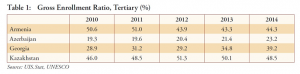
According to the UNESCO Institute for Statistics, Azerbaijan has scored the lowest post-secondary (tertiary) education enrollment rate compared to other countries in the Caucasus region and Central Asia, as 77% of Azerbaijanis who graduate from school do not enroll in universities. This is likely due to “the poorly conceived and highly centralized state quota allocation system”.[5] Table 1 below shows the percentage of students that applied to universities from 2010 to 2014 in Azerbaijan, Armenia, Georgia, and Kazakhstan.[6]

Educational Challenges in Azerbaijan

By Zinat Asadova

Sources;

[1] Souce: Mammadova, S., Guliyev, F., Wallwork, L. and Azimli, N., 2016. Human Capital Development in Azerbaijan. Caucasus Analytical Digest, (90), pp. 8,. Available at: <https://www.academia.edu/30431942/The_Quality_of_Education_in_Azerbaijan_Problems_and_Prospects>

[2] Mammadova, S., Guliyev, F., Wallwork, L. and Azimli, N., 2016. Human Capital Development in Azerbaijan. Caucasus Analytical Digest, (90), pp.8,. Available at: <https://www.academia.edu/30431942/The_Quality_of_Education_in_Azerbaijan_Problems_and_Prospects>

[3] Mammadova, S., Guliyev, F., Wallwork, L. and Azimli, N., 2016. Human Capital Development in Azerbaijan. Caucasus Analytical Digest, (90), pp. 7,. Available at: <https://www.academia.edu/30431942/The_Quality_of_Education_in_Azerbaijan_Problems_and_Prospects>

[4] Richard D. Kortum, “Emerging Higher Education in Azerbaijan”, Journal of Azerbaijani Studies, 12, 2009.

[5] Mammadova, S., Guliyev, F., Wallwork, L. and Azimli, N., 2016. Human Capital Development in Azerbaijan. Caucasus Analytical Digest, (90), pp. 7,. Available at: <https://www.academia.edu/30431942/The_Quality_of_Education_in_Azerbaijan_Problems_and_Prospects>

[6] Souce: Mammadova, S., Guliyev, F., Wallwork, L. and Azimli, N., 2016. Human Capital Development in Azerbaijan. Caucasus Analytical Digest, (90), pp. 8,. Available at: <https://www.academia.edu/30431942/The_Quality_of_Education_in_Azerbaijan_Problems_and_Prospects>

Cover Image by OpenClipart-Vectors from Pixabay

The State of the World’s Children: The Introduction

  1. A time for Action

As a result of the Covid-19 pandemic the world has witnessed a significant increase in mental health issues in children and their families. The pandemic highlighted how events throughout the world can affect the world inside our heads. However, it also offered an opportunity to build back better. According to the report, the international community has been provided with a historic chance to commit, communicate, and take action to promote, protect and care for the mental health of a generation.


  1. The Ignored Challenge

Mental health issues are still considered by many international governmental leaders as minor challenges. In light of this, governments have been systematically underfunding mental health and unwilling to invest more in the issue. Indeed, studies show that national economies benefit from positive mental health amongst their population. To pursue prosperity and equal opportunities, it is important to recognize the connection between mental and physical health and well-being, and the importance of mental health in shaping life outcomes. The latter was acknowledged in the Sustainable Development Goals (SDGs). The neglectful approach towards this matter is highly costly to the economies of the international community. Indeed, the world pays approximately US$387.2 billion a year, according to calculations for this report by David McDaid and Sara Evans-Lacko of the Department of Health Policy of the London School of Economies and Political Science. In other words, national economies lose a whopping amount of US$387.2 billion in uncontributed human potential.

  1. Interview of the Person of Concern

It is important to listen to the experiences, concerns, and ideas of children and adolescents when it comes to mental health. UNICEF teamed up with researchers from the Global Early Adolescent Study at the Johns Hopkins Bloomberg School of Public Health (JHU) to host focus group discussions on mental health and well-being. Support for the project came from the Wellcome Trust. From February to June 2021, local partners facilitated focus group discussions for adolescents aged 10 to 14 and 15 to 19 in Belgium, Chile, China, the Democratic Republic of the Congo, Egypt, Indonesia, Jamaica, Jordan, Kenya, Malawi, Sweden, Switzerland, and the United States. The discussions followed a guide developed by UNICEF, JHU, and local partners. From these discussions, qualitative data were coded using an inductive thematic analysis approach and refined throughout the data analysis process.


  1. Unheard Calls

Worldwide, surveys highlight that four out of five people worldwide believe that no one should have to deal with mental health challenges on their own. Instead, a median of 83% of young people (15- to 24-year-olds) agreed that the best solution is to share experiences and seek support. According to a survey conducted by UNICEF and Gallup in 21 countries in the first half of 2021, a median of one in five young people (19%) reported often feeling depressed or having little interest in engaging in activities.


  1. A time for Leadership

At the heart of our societies’ failure to respond to the mental health needs of children, adolescents and caregivers is an absence of leadership and commitment. We need commitment, especially financial commitment, from global and national leaders and from a broad range of stakeholders that reflects the important role of social and other determinants in helping to shape mental health outcomes.

MAIN CHALLENGES OF PRIMARY AND SECONDARY EDUCATION IN RUSSIA

The Russian Federation itself is a relatively new state. It was shaped 30 years ago after the Soviet Union’s dissolution. Russia has a unique historical, social, and cultural background, with a mix between imperialism, soviet influence, and 30 years of modern history. All these different periods have had an impact on the educational system. There were numerous attempts to reform the education system after the dissolution of the Soviet Union. Some of the most significant ones were the 1992 federal law “On Education” innovations, including the possibility of private schools, new textbooks, and school financial autonomy (Dashchinskaya, 1997); the 2003 signing of the Bologna Declaration marking the beginning of a unified European educational space in some Russian institutions; and the introduction of national standardized testing, which has been mandatory since 2009 (Tsyrlina-Spady, 2016).

According to an education expert, fundamental changes have come up with the 2009-2010 reforms and the issue of a new law directive (On Education in the Russian Federation, 2012). Crucial reforms included funding schools per student, new standardized tests for school graduates and college freshmen, prioritization of school proximity in the admission process, creation and sustainability of safe school environments, promotion of inclusive education, and gradual termination of specialized educational institutions.

Photo by Oleksandr P: https://www.pexels.com/photo/boy-looking-on-a-tidied-desk-2781814/ 

Such successful changes as a consistent investment in education, creation of a national assessment system and the inclusion of obtained scores as main indicators for university admission (providing equal access to universities for all adolescents, including lower-income families and people from distant regions), almost universal coverage of pre-school education, and per capita funding. These changes have allowed Russian students to exceed in results of Trends in International Mathematics and Science Study (TIMSS) for 2019, which, upon publishing, showed Russia leading the rankings after the East Asian economies (Shmis, 2021). Nevertheless, the purpose of this article is to shed light on some of the most pressing issues within the Russian educational sector.

Inclusive education challenges

There are several types of challenges impeding the fulfillment of inclusive education. Firstly, there are insufficient specialists who possess the necessary skills and expertise to work with children with special needs. A study conducted in the Ural Federal region highlighted that around 60% of respondents noted the absence of highly specialized staff (psychologists, social pedagogues, tutors, etc.), especially in schools in small towns and rural areas (Grunt, 2019). Secondly, there is not enough material. Although most inclusive schools nowadays have elevators, ramps, widened doorways, Braille signs, and sound accompaniment, there is a lack of educational and methodological materials for teaching children with special needs (Mironova, Smolina, Novgorodtseva 2019). Thirdly, the bureaucracy around education is particularly burdensome regarding inclusive education. The distribution of power and responsibilities between teachers, tutors, psychologists, or social workers can pose barriers to reaching agreements. Finally, there is a huge gap in communication, collaboration, and proper interaction between teachers and parents, between children with and without special health needs. Value conflicts become apparent when the classes are mixed with disabled children and. Unfortunately, the actors involved in educational activities are not always willing to comprehend the changes that have occurred in the past few years.

A decline in the prestige of vocational and technical colleges

The widespread trend of obtaining a higher education diploma is undoubtedly beneficial for society; however, every coin has two sides. In the case of the Russian Federation, this trend has brought about the oversaturation of the labor market with specialists with higher education. This has, in turn, decreased the prestige of vocational and technical colleges and has resulted in the lack of technical specialists or workers with secondary vocational training (Ivanova, 2016). Russia has one of the highest tertiary attainment rates among the OECD members, as illustrated in Graph 1 below (OECD, 2019). Despite the declining levels of the prestige of vocational studies, vocational programs are still relatively more widespread than in other OECD countries.

Resource: OECD. (2019). Education at a Glance 2019: Country note. OECD.

Increase in investment resulting from the new challenges in the educational system

To increase the quality of Russian education, new investment is necessary. Russia offers great digital infrastructure, so the digitalization and creation of tailored educational platforms is just a matter of extra investment and collaborative efforts. It is crucial to adapt to changing teaching modalities such as hybrid and online regimes during the COVID-19 pandemic. Introducing unique teaching and learning methods will increase students’ motivation and engagement in the process.

Teaching real-life skills development

After the participation by Russian students in the PISA assessment of collaborative problem-solving skills (2015), the most significant negative gap was noted between results in mathematics, science, and reading (core PISA tests) and the students’ ability to solve problems collaboratively (Shmis, 2021). As it is one of the vital modern skills, new reforms should be adapted to introduce new aspects of collaborative work in schools and make them a center of obtaining new knowledge and mastering skills necessary for the modern world.

By Elizaveta Rusakova

Resources:

President of Turkey, Recep Tayyip Erdogan, visits Albania: Brotherhood or Strategic Instrument?

On January 17, 2022, the President of Turkey, Recep Tayyip Erdogan visited Albania with an agenda that included the inauguration of infrastructural works, specifically the apartment complex built in Lac with the funds of the Turkish government, to shelter families affected by the 2019 earthquake that hit Albania, resulting in 51 people dead, over 1000 wounded and 17.000 others displaced. Turkish-funded works included the restoration of 2 schools and a square that, as a sign of gratitude, was named “Recep Tayyip Erdogan”. The “Honorary Citizen” title was awarded to the President of Turkey.


In addition, the Turkish President inaugurated the Ethem Bey Mosque in the center of Tirana, a valuable and unique monument of the Ottoman Era in Albania, restored by TIKA (Turkish Cooperation and Coordination Agency).


The plan included strengthening bilateral ties, which was finalized by signing seven cooperation agreements. During the meeting, Turkish President Erdogan and Prime Minister Edi Rama praised the close cooperation between the two countries, especially in economics, culture, law enforcement, etc. According to the latest report on Foreign Trade in Albania, Turkey ranks second after Italy in terms of the value of exchanges, thus making Turkey an important strategic partner.


It is worth noting that the meeting was discussed in terms of ‘brotherhood between the countries’. “What I want to emphasize is the principle-belief that the sign of brotherhood is not to come when called, but to come when the brother is in need. Therefore, we will continue to stand by you”, President Erdogan stated.


But does this brotherhood come unconditionally? 


If we see the continuation of the meeting and the words of the President himself: “It deeply harms our nation that FETO can still operate in … Albania. In the coming period, our sincerest expectation is that more concrete, persistent and swift steps will be taken against FETO structures in Albania,” we can say that the brotherhood comes with a request, if not with a condition.


“FETO” is the so-called organization of supporters of the exiled Turkish preacher Fethullah Gülen that Erdogan and his government accused of being a terrorist organization as well as of orchestrating the failed 2016 putsch that killed over 270 people.

“It wounds our nation that had its children martyred that FETO can still find areas of activity in friend and sibling Albania,” Erdogan said.


The beginnings of Gülen’s investments started in Albania in 1992 with the opening of the “Mehmet Akif” college for boys, and now it controls the traditional Islamic schools in Albania, known as Turkish madrasas and colleges, as well as operates in different other organizations.

taken from: https://www.facebook.com/MACGraduates

The organization has a significant impact in the Balkans. According to data published by the Turkish Anadolu News Agency, it operates in about 40 schools, including 15 schools in Bosnia and Herzegovina, 12 in Albania, 7 in Macedonia, 5 in Kosovo, and one in Serbia.


The pressure of the Turk government on the Balkan countries in this regard began in 2016. The government stopped the Turkish-owned schools from using Turkey’s flag and other symbols. Since then, Albania has officially refused to act with the Turkish authorities for the hand of most members of the Gülen movement.


Moreover, since 2016 Albania has not allowed the takeover of the Gülen-affiliated educational institutions by the Turkish-state-run Maarif Foundation, but the Albanian Government gave permission to Maarif Foundation to open their own schools.


About the condition set on January 17, the head of the Albanian government said that Albania owes nothing to Erdogan or Turkey, just as neither Turkey nor Erdogan owe Albania anything. “There are no debts between friends and brothers,” Rama said, thus responding again to Erdogan’s request against the Gülen Movement with refusal. 


This meeting was widely discussed in local and foreign media. The local press commented that the conference coincided with the 554th anniversary of the national hero, Gjergj Kastrioti (Skanderbeg), the symbol of Albanian resistance to the occupation of the Ottoman Empire in Albanian territories and beyond throughout the Balkans. Through a lengthy article posted on social networks, Prime Minister Edi Rama reacted by listing some points that, according to him, show that there is no connection between the two events.


Opinion leaders and politics analysts in Albanian saw this meeting not as a brotherhood but as a “vassal”. According to them, his expressed brotherhood makes Albania fewer Western-oriented, values ​​that Albania has embraced. This was also commented in the Greek media where earlier, the Penta Postagma had viewed the visit’s purpose to allow Erdogan to unify Greater Albania, which according to the article, he saw as a province of the Great Empire.


In conclusion, we can say that Turkey’s involvement in Albania and the Balkans, in general, is part of its larger strategy: It seeks to improve its image as an honest partner through economic and humanitarian aid in the Balkans and draw away attention from the EU. As a medium-long term objective, Turkey aims to increase its influence in Europe, strengthening its hand and presence through continuous debates with the EU.


By Xhina Cekani


Turkish leader Erdogan visits Albania to boost ties – ABC News (go.com)

Turkey’s Erdogan in Albania to boost bilateral ties | The Independent

Erdogan Opens Apartment Complex in Albania for Quake Victims | Balkan Insight

What Did Erdoğan Do In Albania? — Greek City Times

Turkish President Recep Erdogan visits Albania | Foreign Brief

Vizita e Erdogan, Nesho: Rama sillet si vasal, Shq – Syri | Lajmi i fundit

Vizita e Erdogan në Shqipëri, si u komentua në mediat greke – Opinion.al

Turkish President Recep Erdogan visits Albania | Foreign Brief

Rama i përgjigjet ultimatumit të Erdoganit për sulm ndaj Lëvizjes Gulen – Gazeta Express