Submission to the Universal Periodic Review of the United Nations Human Rights Council: Philippines

Broken Chalk is a non-profit organization that addresses the respect and enforcement of the right to education. Therefore, it is concerned on how the Philippines has expanded the access to quality education on an equal level across all levels and age groups without discrimination since the conclusion of the Universal Periodic Review’s 3rd Cycle in late 2017. Nearly 24% of the statements made by the 95 delegations during the Working Group’s Interactive Dialogue on 18th July 2017 focused on education and other issues such as the gender gap, discrimination, and human trafficking which affect the access, outputs, and outcomes of education.(1)

From 257 recommendations that these delegations put forward, the Philippines accepted all those concerning education under paragraphs 133.219 – 133.225 of the Working Group’s Report in its Addendum.(2) Thus, the Philippines accepted to prioritise public education in its budgetary expenditure; increase net enrolment for girls in pre-primary and primary education; generate legislation that increases access to quality education for vulnerable learners; and ensure education remains compulsory and free. These serve as a baseline for Broken Chalk to highlight new and persistent issues that impact the right to education within the state and conclude whether they were satisfied by the Government of the Philippines (GPH) whilst calling for actions that address the current trends and issues in a holistic manner.

By Karl Baldacchino 

Download the PDF

41st_Session_UN-UPR_Country_Review_Philippines

Cover image by Alloizajean.

Submission to the Universal Periodic Review of the United Nations Human Rights Council: Indonesia

Article 28E(1) of the 1945 Constitution of the Republic of Indonesia (“the Constitution”), ensures the right to freedom of thought, conscience, and religion: “each person is free to worship and to practice the religion of his choice, to choose education and schooling, his occupation, his nationality, his residency in the territory of the country that he shall be able to leave and to which he shall have the right to return.”(1) The Indonesian educational sector is, however, facing severe challenges, some related to human rights violations. Amongst these is the fact that many children of compulsory school age are currently out of school, particularly in Java.

By Olga Ruiz Pilato

Download the PDF

41st_Session_UN-UPR_Country_Review_Indonesia

[1] Asian Human Rights Commission, The Constitution of the Republic of Indonesia 1945 <accessed in February 2022

http://www.humanrights.asia/indonesian-constitution-1945-consolidated/>.

Cover image by Fikih Firmansyah on Pixabay.

Imprisonment of the innocent: Prof Laçiner

Who is Sedat Laçiner?

Sedat Laçiner is a Turkish professor born in Kirkale, Turkey. He is 49 years old and has been imprisoned since the summer of 2016. Professor Laçiner’s educational path began in Turkey where he graduated high school and completed hisbachelor’s degree in Ankara. He started his master’s degree in Political Science in Turkey butafter receiving a scholarship from the Ministry of National Education, he finished his degree in the United Kingdom. Upon completing his master’s degree in 2001, he obtained his Ph.D. at King’s College University of London. In 1994 Sedat Laçiner was appointed as the Prime Minister’s correspondent and has, to date, written multiple articles. He was a member of the Higher Education Council (YÖK), the National Committee of Turkish-Armenian Relations (TEİmK), and was appointed as the director of the Centre for Strategic Studies at Canakkale Onsekiz Mart University in 2003. From 2004 to 2010 he presidedthe International Institute for Strategic Studies (USAK). On March 15, 2011, Laçiner was appointed rector of Canakkale Onsekiz Mart University (ÇOMU) at the age of 38, which made him the youngest rector in Turkey. In 2006 he was awarded the prize “2006 Young Global Leader” and is still the first and only person in Turkey to be nominated for a title in the field “intellectuals”. Professor Laçiner is the author of 26 books in both Turkish and English.

Turkey’s coup attempt

The president of Turkey, Recep Erdogan, has a controversial style of leadership. It is a dubious form of democracy. Upon undertaking the presidency, Erdogan took over the media, dropped the charges of the previously convicted governmental ministers and their families, and has been involved in a huge corruption scandal. In 2014, he charged Fetullah Gulen with organizing a “parallel state structure” which was an act of competitor elimination. His actions have resulted in widespread disapproval and urge for change. In 2016, the inevitable happened – a coup d’état took place. Via a broadcaster, a faction of the army announced that “it had seized power to protect democracy from Recep Erdogan”. Despite its failure and rapid disappearance, sources suggest there were over 1,400 wounded and some dead in the process. The 7,000 people arrested included high-ranking soldiers, judges, and teachers, amongst others. According to various sources, the coup did not succeed because it did not have the needed support from civil citizens, who needed to push the “change”. When Erdogan took control over the situation, he blamed the US-based cleric Fethullah Gulen immediately. The coup is also majorly viewed as an excuse for Turkey’s current president to consolidate his power. Today over 20,000 people remain imprisoned.

Why is Sedat Laçiner in prison?

In 2018, Sedat Laçiner was sentenced to 9 years and 4 months in jail. During the process, some prosecutors wanted life imprisonment and discussions on re-establishing the death penalty arose. In one of Laçiner’s letters to his family, the former rector states: “After eight months there is still no single legal evidence for the accusation, namely attempting to remove the Erdogan government. The indictment even accepts that I have no violent or forceful action, behaviour, or activity.” He also states that he had no access to a lawyer and his file was kept away from him, which amounts to a violation of his right to a fair trial and as such, one of his fundamental human rights. The former rector was accused of being part of the “Gülen” movement and was kept in custody without sufficient evidence proving his liability.

According to Laçiner’s family, he has been charged with terrorism offenses in connection with FETÖ – the Fethullah Gülen Terrorist Organisation, which is the term the Turkish government uses to refer to the Gülen movement. FETÖcomprises of followers of the moderate Islamist preacher Fethullah Gülen and his brother, Vedat, who also an academic, but has been given no details of what they are supposed to have done to warrant being charged. Both are being held at the Çanakkale E Type Closed Prison (Malley, 2017).

The accusations include that the Gülen movement was an “armed terroristic act”, but until this day there is no evidence to back these charges. Despite Erdogan’s views, the world is taking a stance in favour of the ones suffering by his iron-fist regime. Unfortunately, there are over 200,000 innocent people arbitrarily detained – a number that illustrates how the presumption of innocence is not the Turkish government’s concern.

Original text by Ivan Evstatiev

Edited by Olga Ruiz Pilato

Sources

Malley, B. M. (2017, April 6). Is imprisoned academic a victim of a mass witchhunt? University World News. Retrieved February 22, 2022, from https://www.universityworldnews.com/post.php?story=2016111800050457

TurkeyPurge. (2017, September 25). Turkish professor Sedat Laciner, under pre-trial detention for 26 months, gets 9 years in jail | Turkey Purge. Turkeypurge.Com. Retrieved February 22, 2022, from https://turkeypurge.com/turkish-professor-sedat-laciner-under-pre-trial-detention-for-26-months-gets-9-years-in-jail

www.sabah.com.tr. (2016, July 23). Eski rektör Sedat Laçiner tutuklandı. Sabah. Retrieved February 18, 2022, from https://www.sabah.com.tr/gundem/2016/07/23/eski-rektor-sedat-laciner-tutuklandi

Educational Challenges in Vietnam

PHYSICAL AND SEXUAL ABUSE IN VIETNAMESE SCHOOLS


Physical and sexual abuse is one of the most common issues in the Vietnamese educational sector. All types of child maltreatment are highly prevalent, ranging from physical and sexual to emotional abuse. According to the Human Rights Watch 2021 Report, violence against children, including sexual abuse, is pervasive in Vietnam, including at home and in schools. Numerous media reports have described cases of guardians, teachers, or government caregivers engaging in sexual abuse, beating children, or hitting them with sticks. During the first six months of 2021, amid the pandemic lockdown, there were reports of increasing physical and sexual abuses of children in Vietnam.[1]

This article aims to explore some of the educational challenges in Vietnam, mainly focusing on the abuse suffered by students and the challenges faced by the LGBTQ+ community in the educational sector.

In 2019, UNICEF published a report on the child abuse epidemic in Vietnam. It shared the story of Thao, a Vietnamese 13-year-old girl who her math teacher abused for two years. The abuser was never named or taken to court due to the stigma and damaging culture of secrecy. Thao shared that her math teacher used to beat her up, “I was so scared but I didn’t dare to tell my parents because he threatened me that he would kill me”. Upon turning 14, the abuse turned sexual. Even after telling her mother, they chose to leave the matter unreported, due to the lack of action by police and authorities and the fear of judgement and rumours at school. UNICEF’s report states that most of the profile child abuse cases in Vietnam in 2019 involved teachers, with severe cases such as the arrest of a teacher for impregnating a student.[2]

According to the statistics provided by Tran, a PhD candidate, 31.8% of 1900 Vietnamese school children surveyed suffered emotional abuse, and 19% suffered physical abuse.[3]

Photo by Tra Nguyen on Unsplash

A news article published in 2017 by Vietnam Insider condemns lack of supervision, increased stress at work, and low salaries as probable factors for the increasing child abuse in Vietnam’s kindergartens. The previous month, a Youth newspaper published a video showing shocking footage of infants being beaten in a private daycare center. Common classroom items such as slippers, combs, brooms, spoons, and even knives are examples of props teachers use to instill fear among their students. Nguyen Thanh Loan, a teacher at a public kindergarten in Hanoi’s Hai Ba Trung District, said every kindergarten class of 50 children has 2-3 teachers who must do everything from feeding children and coaxing them to sleep, to teaching them and cleaning the classrooms.[4] Low incomes paired with insufficient government supervision of private kindergartens are factors amounting to the aggressive behaviour carried out by educational staff. According to government data, more than 2,000 children in Vietnam suffer severe abuse that requires special help and intervention every year.[5] Despite the government’s supposed efforts on tackling the issue, Vietnam Insider published another news article in 2019 on children mistreatment by teachers in private kindergartens in Hanoi. Maple Bear Westlake, a high-end Canadian Kindergarten, was the spotlight of attention after a parent asked the school to let her watch the security camera footage. The footage showed the teacher locking a child in a cupboard.[6]

In April 2016, a teacher at an elementary school in Sa Pa, northern Vietnam, was taken into police custody for allegedly conducting lewd acts with a fifth-grader at his school. Moreover, in December 2017, police in the southern province of An Giang launched legal proceedings against a P.E. teacher, who was denounced by parents as having sexually abused at least ten fourth and fifth graders at his school. In the same year, Lang Thanh Duan, a school guard in the Central Highlands province of Dak Lak was prosecuted for raping five 11-year-old schoolgirls and one nine-year-old student between 2015 and 2017.[7] Although the Ho Chi Minh City education department has advised the municipal administration to encourage local kindergartens to install CCTV cameras to give better oversight of their children, the dilemma is still prevalent and extremely worrying.

The matter is not merely of concern amongst kindergartens. Vnexpress, a local Vietnamese newspaper, revealed that in December 2018, the principal of a high school in the northern province of Phu Tho was found to have forced numerous male students to “perform sexual services” to him for years.[8]

LGBTQ+

Vietnamese LGBT youth face widespread discrimination and violence at home and school. Pervasive myths about sexual orientation and gender identity, including the false belief that same-sex attraction is a diagnosable and curable mental health condition, are common among Vietnamese school officials and the population at large. This section will analyse the Human Rights Watch 2020 report on abuses faced by the queer community in Vietnam.

“‘My Teacher Said I Had a Disease’: Barriers to the Right to Education for LBGT Youth in Vietnam”, a 65-page report released by Human Rights Watch in 2020, documented how LGBT youth in Vietnam face stigma and discrimination at schools over myths such as the false belief that same-sex attraction is a diagnosable, treatable, and curable mental health condition. Many experience verbal harassment and bullying, which in some cases leads to physical violence. Teachers are often ill-equipped to handle instances of anti-LGBT discrimination, and their lessons frequently uphold the widespread myth in Vietnam that same-sex attraction is a disease, Human Rights Watch found. The report is based on in-depth interviews with 52 LGBT youth as well as teachers and other school staff in Vietnam. While some teachers and schools take it upon themselves to include lessons on sexual orientation and gender identity, the lack of national-level inclusion leaves most students in Vietnam without basic knowledge on sexual orientation and gender identity.[9]

Photo by Aaron Burden on Unsplash

In a promising step in 2019, the education ministry, with the assistance of United Nations agencies, produced guidelines for an LGBT-inclusive comprehensive sexuality education curriculum, but such a curriculum has not yet been created.[10]

Human Rights Watch found that verbal harassment of LGBT students is common in Vietnamese schools. Students in various types of schools – rural and urban, public, and private – said that students and teachers commonly use derogatory words to refer to LGBT people, sometimes targeted directly at them and coupled with threats of violence.

Other studies, including research by UN agencies and Vietnamese groups, have included similar evidence. In a 2014 report, the UN Development Programme (UNDP) noted that “education institutions are not safe for LGBT students due to the lack of anti-bullying and

non-discrimination policies. Furthermore, sex and sexual orientation and gender identity education is still limited in Vietnam and are considered sensitive topics that teachers usually avoid”.

While it appears to be less common, some LGBT youth report physical violence as well. “The bullying was mostly verbal but there was one time when I was beat up by five or six guys in eighth grade just because they didn’t like how I looked”, an interviewee stated.

In cases of both verbal and physical abuse, school staff responds inconsistently. Most of the LGBT youth interviewed who had experienced bullying at school said they did not feel comfortable reporting the incidents. This was sometimes because of overt, discriminatory behaviour by the staff. In other cases, students assumed it was unsafe to turn to the adults around them for help.

Even in cases where students did not face verbal or physical abuse, many reported that their teachers implicitly and explicitly alienate and exclude them. This occurs in classrooms, where teachers refer to anything other than procreative heterosexual relationships as “unnatural”.[11]

By Olga Ruiz Pilato

Sources;

[1] https://www.hrw.org/world-report/2022/country-chapters/vietnam

[2] https://www.unicef.org/vietnam/stories/shame-and-pain-vietnam-starts-grapple-child-abuse-epidemic

[3] https://www.universiteitleiden.nl/en/news/2017/12/promotie-child-abuse-in-vietnam

[4] https://vietnaminsider.vn/child-abuse-vietnams-kindergartens-continues-keep-parents-awake-night/

[5] Ibid

[6] https://vietnaminsider.vn/teacher-fired-for-child-abuse/

[7] https://vietnaminsider.vn/child-abuse-remains-unsolved-problem-vietnam/

[8] https://e.vnexpress.net/news/life/trend/vietnam-shocked-by-extent-of-sexual-abuse-children-face-3905361.html

[9] https://www.hrw.org/news/2020/02/12/vietnam-lgbt-youth-unprotected

[10] Ibid

[11] Ibid

Cover photo source – Image by David Peterson from Pixabay

Educational Challenges in Azerbaijan

Educational Challenges in Azerbaijan

Corruption in Azerbaijan: A Guide into Educational Challenges

Azerbaijan is a country located in the Caucasus region, and, up until its independence in 1991, it was ruled by the Soviet Union. Despite the vastness of Azerbaijan’s natural resources, it suffers from inadequate infrastructure impacting numerous sectors, particularly the educational one.

Although education is free in public schools, more advanced instruction is determined by the financial situation of the household.[1] The yearly income of an average Azerbaijani family is 4250 manat (2500$), consequently affecting the educational budget or regular families. Hiring private tutors and paying for school materials require a larger budget than families currently afford. The higher education systems tend to opt for admitting students from wealthy backgrounds and dismiss students from rural and lower-income families.[2]

When it comes to the quality of the educational system, the fact that secondary schools fail to adequately prepare students for university admissions leads to many students failing the university entrance exams due to low performance.[3] Considering the flawed education system, parents from wealthier backgrounds hire private tutors in order to ensure quality education. Those who benefit from the situation are government elites, as their options for providing better education to their offspring are much higher. These children are sometimes then sent abroad to countries such as the USA, Canada, and Western European countries, to continue pursuing a good quality education. Those who cannot afford this are left behind with insufficient education levels.

Access to educational materials such as books, articles, journals, etc., is minimal, especially those in the Azerbaijani language.  University libraries lack the necessary resources for educational purposes, and students complain about the content of such materials being outdated and irrelevant to today.

One of the main reasons for the shortage of educational materials and resources is the government’s lack of support for academic research and translation. The budget proposals for

developing the educational sector and the restricted financial aid and support for academic research leave the country in an intellectual shortage. This is paired with the fact that most often than not, academics migrate to more developed countries that provide them with better incentives for research.

Postgraduate education in Azerbaijan requires significant changes in its system. It needs a lot of attention and development insofar as postgraduate programs do not provide students with the professionalism they need in order to become more specialized in their field. Richard D. Kortum, a Professor Emeritus at East Tennessee State University, describes the poor education in Azerbaijan’s master’s degree education “Master’s students in Azerbaijan commonly have to go through the same course, same instructor, same book, same lecture material, same tests as they did as undergraduates”.[4]

Another major problem existing in Azerbaijan at the moment is bribery. Albeit illegal in the Constitution, it has become a normalized way of survival within the population. The population has no choice but to pay bribes to access all sectors, including education, healthcare, government services, employment, among others. The heads of these institutions benefit from these bribes by putting people in a situation whereby they must pay to have any problem solved.

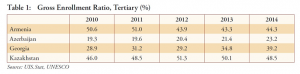
According to the UNESCO Institute for Statistics, Azerbaijan has scored the lowest post-secondary (tertiary) education enrollment rate compared to other countries in the Caucasus region and Central Asia, as 77% of Azerbaijanis who graduate from school do not enroll in universities. This is likely due to “the poorly conceived and highly centralized state quota allocation system”.[5] Table 1 below shows the percentage of students that applied to universities from 2010 to 2014 in Azerbaijan, Armenia, Georgia, and Kazakhstan.[6]

Educational Challenges in Azerbaijan

By Zinat Asadova

Sources;

[1] Souce: Mammadova, S., Guliyev, F., Wallwork, L. and Azimli, N., 2016. Human Capital Development in Azerbaijan. Caucasus Analytical Digest, (90), pp. 8,. Available at: <https://www.academia.edu/30431942/The_Quality_of_Education_in_Azerbaijan_Problems_and_Prospects>

[2] Mammadova, S., Guliyev, F., Wallwork, L. and Azimli, N., 2016. Human Capital Development in Azerbaijan. Caucasus Analytical Digest, (90), pp.8,. Available at: <https://www.academia.edu/30431942/The_Quality_of_Education_in_Azerbaijan_Problems_and_Prospects>

[3] Mammadova, S., Guliyev, F., Wallwork, L. and Azimli, N., 2016. Human Capital Development in Azerbaijan. Caucasus Analytical Digest, (90), pp. 7,. Available at: <https://www.academia.edu/30431942/The_Quality_of_Education_in_Azerbaijan_Problems_and_Prospects>

[4] Richard D. Kortum, “Emerging Higher Education in Azerbaijan”, Journal of Azerbaijani Studies, 12, 2009.

[5] Mammadova, S., Guliyev, F., Wallwork, L. and Azimli, N., 2016. Human Capital Development in Azerbaijan. Caucasus Analytical Digest, (90), pp. 7,. Available at: <https://www.academia.edu/30431942/The_Quality_of_Education_in_Azerbaijan_Problems_and_Prospects>

[6] Souce: Mammadova, S., Guliyev, F., Wallwork, L. and Azimli, N., 2016. Human Capital Development in Azerbaijan. Caucasus Analytical Digest, (90), pp. 8,. Available at: <https://www.academia.edu/30431942/The_Quality_of_Education_in_Azerbaijan_Problems_and_Prospects>

Cover Image by OpenClipart-Vectors from Pixabay

MAIN CHALLENGES OF PRIMARY AND SECONDARY EDUCATION IN RUSSIA

The Russian Federation itself is a relatively new state. It was shaped 30 years ago after the Soviet Union’s dissolution. Russia has a unique historical, social, and cultural background, with a mix between imperialism, soviet influence, and 30 years of modern history. All these different periods have had an impact on the educational system. There were numerous attempts to reform the education system after the dissolution of the Soviet Union. Some of the most significant ones were the 1992 federal law “On Education” innovations, including the possibility of private schools, new textbooks, and school financial autonomy (Dashchinskaya, 1997); the 2003 signing of the Bologna Declaration marking the beginning of a unified European educational space in some Russian institutions; and the introduction of national standardized testing, which has been mandatory since 2009 (Tsyrlina-Spady, 2016).

According to an education expert, fundamental changes have come up with the 2009-2010 reforms and the issue of a new law directive (On Education in the Russian Federation, 2012). Crucial reforms included funding schools per student, new standardized tests for school graduates and college freshmen, prioritization of school proximity in the admission process, creation and sustainability of safe school environments, promotion of inclusive education, and gradual termination of specialized educational institutions.

Photo by Oleksandr P: https://www.pexels.com/photo/boy-looking-on-a-tidied-desk-2781814/ 

Such successful changes as a consistent investment in education, creation of a national assessment system and the inclusion of obtained scores as main indicators for university admission (providing equal access to universities for all adolescents, including lower-income families and people from distant regions), almost universal coverage of pre-school education, and per capita funding. These changes have allowed Russian students to exceed in results of Trends in International Mathematics and Science Study (TIMSS) for 2019, which, upon publishing, showed Russia leading the rankings after the East Asian economies (Shmis, 2021). Nevertheless, the purpose of this article is to shed light on some of the most pressing issues within the Russian educational sector.

Inclusive education challenges

There are several types of challenges impeding the fulfillment of inclusive education. Firstly, there are insufficient specialists who possess the necessary skills and expertise to work with children with special needs. A study conducted in the Ural Federal region highlighted that around 60% of respondents noted the absence of highly specialized staff (psychologists, social pedagogues, tutors, etc.), especially in schools in small towns and rural areas (Grunt, 2019). Secondly, there is not enough material. Although most inclusive schools nowadays have elevators, ramps, widened doorways, Braille signs, and sound accompaniment, there is a lack of educational and methodological materials for teaching children with special needs (Mironova, Smolina, Novgorodtseva 2019). Thirdly, the bureaucracy around education is particularly burdensome regarding inclusive education. The distribution of power and responsibilities between teachers, tutors, psychologists, or social workers can pose barriers to reaching agreements. Finally, there is a huge gap in communication, collaboration, and proper interaction between teachers and parents, between children with and without special health needs. Value conflicts become apparent when the classes are mixed with disabled children and. Unfortunately, the actors involved in educational activities are not always willing to comprehend the changes that have occurred in the past few years.

A decline in the prestige of vocational and technical colleges

The widespread trend of obtaining a higher education diploma is undoubtedly beneficial for society; however, every coin has two sides. In the case of the Russian Federation, this trend has brought about the oversaturation of the labor market with specialists with higher education. This has, in turn, decreased the prestige of vocational and technical colleges and has resulted in the lack of technical specialists or workers with secondary vocational training (Ivanova, 2016). Russia has one of the highest tertiary attainment rates among the OECD members, as illustrated in Graph 1 below (OECD, 2019). Despite the declining levels of the prestige of vocational studies, vocational programs are still relatively more widespread than in other OECD countries.

Resource: OECD. (2019). Education at a Glance 2019: Country note. OECD.

Increase in investment resulting from the new challenges in the educational system

To increase the quality of Russian education, new investment is necessary. Russia offers great digital infrastructure, so the digitalization and creation of tailored educational platforms is just a matter of extra investment and collaborative efforts. It is crucial to adapt to changing teaching modalities such as hybrid and online regimes during the COVID-19 pandemic. Introducing unique teaching and learning methods will increase students’ motivation and engagement in the process.

Teaching real-life skills development

After the participation by Russian students in the PISA assessment of collaborative problem-solving skills (2015), the most significant negative gap was noted between results in mathematics, science, and reading (core PISA tests) and the students’ ability to solve problems collaboratively (Shmis, 2021). As it is one of the vital modern skills, new reforms should be adapted to introduce new aspects of collaborative work in schools and make them a center of obtaining new knowledge and mastering skills necessary for the modern world.

By Elizaveta Rusakova

Resources:

President of Turkey, Recep Tayyip Erdogan, visits Albania: Brotherhood or Strategic Instrument?

On January 17, 2022, the President of Turkey, Recep Tayyip Erdogan visited Albania with an agenda that included the inauguration of infrastructural works, specifically the apartment complex built in Lac with the funds of the Turkish government, to shelter families affected by the 2019 earthquake that hit Albania, resulting in 51 people dead, over 1000 wounded and 17.000 others displaced. Turkish-funded works included the restoration of 2 schools and a square that, as a sign of gratitude, was named “Recep Tayyip Erdogan”. The “Honorary Citizen” title was awarded to the President of Turkey.


In addition, the Turkish President inaugurated the Ethem Bey Mosque in the center of Tirana, a valuable and unique monument of the Ottoman Era in Albania, restored by TIKA (Turkish Cooperation and Coordination Agency).


The plan included strengthening bilateral ties, which was finalized by signing seven cooperation agreements. During the meeting, Turkish President Erdogan and Prime Minister Edi Rama praised the close cooperation between the two countries, especially in economics, culture, law enforcement, etc. According to the latest report on Foreign Trade in Albania, Turkey ranks second after Italy in terms of the value of exchanges, thus making Turkey an important strategic partner.


It is worth noting that the meeting was discussed in terms of ‘brotherhood between the countries’. “What I want to emphasize is the principle-belief that the sign of brotherhood is not to come when called, but to come when the brother is in need. Therefore, we will continue to stand by you”, President Erdogan stated.


But does this brotherhood come unconditionally? 


If we see the continuation of the meeting and the words of the President himself: “It deeply harms our nation that FETO can still operate in … Albania. In the coming period, our sincerest expectation is that more concrete, persistent and swift steps will be taken against FETO structures in Albania,” we can say that the brotherhood comes with a request, if not with a condition.


“FETO” is the so-called organization of supporters of the exiled Turkish preacher Fethullah Gülen that Erdogan and his government accused of being a terrorist organization as well as of orchestrating the failed 2016 putsch that killed over 270 people.

“It wounds our nation that had its children martyred that FETO can still find areas of activity in friend and sibling Albania,” Erdogan said.


The beginnings of Gülen’s investments started in Albania in 1992 with the opening of the “Mehmet Akif” college for boys, and now it controls the traditional Islamic schools in Albania, known as Turkish madrasas and colleges, as well as operates in different other organizations.

taken from: https://www.facebook.com/MACGraduates

The organization has a significant impact in the Balkans. According to data published by the Turkish Anadolu News Agency, it operates in about 40 schools, including 15 schools in Bosnia and Herzegovina, 12 in Albania, 7 in Macedonia, 5 in Kosovo, and one in Serbia.


The pressure of the Turk government on the Balkan countries in this regard began in 2016. The government stopped the Turkish-owned schools from using Turkey’s flag and other symbols. Since then, Albania has officially refused to act with the Turkish authorities for the hand of most members of the Gülen movement.


Moreover, since 2016 Albania has not allowed the takeover of the Gülen-affiliated educational institutions by the Turkish-state-run Maarif Foundation, but the Albanian Government gave permission to Maarif Foundation to open their own schools.


About the condition set on January 17, the head of the Albanian government said that Albania owes nothing to Erdogan or Turkey, just as neither Turkey nor Erdogan owe Albania anything. “There are no debts between friends and brothers,” Rama said, thus responding again to Erdogan’s request against the Gülen Movement with refusal. 


This meeting was widely discussed in local and foreign media. The local press commented that the conference coincided with the 554th anniversary of the national hero, Gjergj Kastrioti (Skanderbeg), the symbol of Albanian resistance to the occupation of the Ottoman Empire in Albanian territories and beyond throughout the Balkans. Through a lengthy article posted on social networks, Prime Minister Edi Rama reacted by listing some points that, according to him, show that there is no connection between the two events.


Opinion leaders and politics analysts in Albanian saw this meeting not as a brotherhood but as a “vassal”. According to them, his expressed brotherhood makes Albania fewer Western-oriented, values ​​that Albania has embraced. This was also commented in the Greek media where earlier, the Penta Postagma had viewed the visit’s purpose to allow Erdogan to unify Greater Albania, which according to the article, he saw as a province of the Great Empire.


In conclusion, we can say that Turkey’s involvement in Albania and the Balkans, in general, is part of its larger strategy: It seeks to improve its image as an honest partner through economic and humanitarian aid in the Balkans and draw away attention from the EU. As a medium-long term objective, Turkey aims to increase its influence in Europe, strengthening its hand and presence through continuous debates with the EU.


By Xhina Cekani


Turkish leader Erdogan visits Albania to boost ties – ABC News (go.com)

Turkey’s Erdogan in Albania to boost bilateral ties | The Independent

Erdogan Opens Apartment Complex in Albania for Quake Victims | Balkan Insight

What Did Erdoğan Do In Albania? — Greek City Times

Turkish President Recep Erdogan visits Albania | Foreign Brief

Vizita e Erdogan, Nesho: Rama sillet si vasal, Shq – Syri | Lajmi i fundit

Vizita e Erdogan në Shqipëri, si u komentua në mediat greke – Opinion.al

Turkish President Recep Erdogan visits Albania | Foreign Brief

Rama i përgjigjet ultimatumit të Erdoganit për sulm ndaj Lëvizjes Gulen – Gazeta Express

The decision of the International Labor Organization (ILO) following the failed 2016 coup in Turkey

On 15 July 2016, a failed coup d’état took place in Turkey against President Tayyip Erdogan and state institutions. The disintegration of democratic rule, the threat to human rights, and secularism were among the reasons cited for the coup. The coup attempt was carried out by a small section of the Turkish Armed Forces, who referred to themselves as the ‘Peace at Home Council’. The Turkish government linked the coup plotters to the Gulen movement, which is deemed a terrorist organization by the Turkish government. Fethullah Gulen, a Turkish Islamic scholar, preacher, and one-time opinion leader currently residing in Pennsylvania after a self-imposed exile, led the Gulen movement. Gulen has denied any link to the coup attack. Mass arrests have occurred following the event.


A group of Government Workers known as “Yuksel Direniscileri” asking to the Turkish Government to get their work back. from: https://gercekhaberajansi.org/fotograflarla-yuksel-direnisi/

At least 20,000 Turkish citizens were detained due to alleged links with the Gulen movement. Turkish officials wanted Gulen’s repatriation; however, the Justice Department and State department found the evidence presented by their Turkish counterparts to be incoherent and non-credible. The detainees included 5,000 members of the educational sector and 21,000 teachers whose licenses were revoked, and national security numbers were added to the Turkish database to restrict future employment. However, evidence to suggest the loyalty of 20,000 citizens to Gulen was weak. Moreover, theories suggested that the coup was staged. After the coup’s first week, thousands of public servants and soldiers were purged. Nonetheless, ‘the list of alleged coup plotters was so extensive that it was impossible to put it together in the hours after the coup’.[1] Individuals who had passed away weeks and months before the coup were part of this list. Suspicion on the quality and honesty of the investigation grew. The United States, German intelligence, and the British Government have doubted the official Turkish narrative.


According to the Turkish Government, over 135,000 public servants, including around 40,000 teachers, have been dismissed or suspended since the government resorted to repression after the failed coup in July. No source of income and allegation of connection with a terrorist organization not only entails financial losses but poses threats of ostracism from the Turkish society altogether. The International Labor Organization has denounced the detaining of these individuals and has maintained that this was done without any supervision from the judicial bodies, without proper investigation, and without the ‘principle of presumption of innocence and rights’ accorded by ILO Conventions.[2]

The Turkish government states that the dissolution of the Action Workers’ Union Confederation (Aksiyon-Is), and its associated trade union was due to their connection with the so-called Fethullahist Terrorist Organization (FETÖ/PDY), which the Turkish government claims were responsible for the attempted coup. The government maintains that no application was filed to the Inquiry Commission by Aksiyon-Is and its affiliated trade unions, failing to use all available domestic channels and remedies.


However, the ILO committee’s findings note that the decision and power to declare a state of emergency for the dissolution of these unions was granted to the Council of Ministers when the decision-making power should rest with the parliament. This authorization allowed the executive body to issue Decrees with the force of law in place of the parliament’s ordinary legislative procedures. Therefore, all domestic channels for seeking legal amends have now lapsed.


The ILO stated that individuals having membership of trade unions associated with FETÖ/PDY was entirely lawful under Article 2 of Convention No. 87. They maintained that these trade unions had been constituted and operated lawfully until the state of emergency was declared. Therefore, it is unlawful to punish workers for simply having membership in a trade union without proof of involvement, a specific action, or even knowledge that they may have had possible affiliations with a terrorist organization. Aksiyon-Is maintains that all these dismissals took place before any investigations and in the absence of due process. Aksiyon-Is further argues that none of the detainees were allowed to contest the decision of their dismissal to a neutral body, which violates Article 8 of the Convention.

United Nations International Labor Organization (ILO) Executive Board dated 24 March 2021, numbered GB.341/INS/13/5/, concludes that the dismissals made with the Statutory Decrees and the closure of institutions in Turkey are contrary to the International Conventions No. 158 and No. 87 and therefore illegal.


Erdogan’s AKP Government is asked to rectify this unlawfulness. Although it has been over ten months since the decision, the AKP Government has not fulfilled its requirements, nor has it shown any interest in implementing it. The ILO must uphold its decision and put pressure on the AKP Government, considering the unlikelihood of implementing the decision by themselves if left unsupervised.


Fulfillment of the decision taken by the ILO Executive Board is obligatory both in terms of International Law and Turkish Law. The following petition provides an in-depth course of action to rectify its unfairness.

The petition asks the ILO to uphold its decision and act in favor of the implementation of the Board of Directors’ decision please take a moment to read through the cause and support. Contribute to the ILO and AKP Government officials’ action by signing.


Written by Mahnoor Tariq


References

Michael Rubin, (2017), ‘Did Erdogan stage the coup?’,  AEIdeas
David Lepeska, (2020), The ‘gift from god’ that crushed Turkish democracy, Retrieved from http://ahval.co/en-84353

Source URL: https://www.ilo.org/wcmsp5/groups/public/—ed_norm/—relconf/documents/meetingdocument/wcms_775695.pdf
Source URL: Human Rights Watch, https://www.hrw.org/news/2016/07/18/turkey-protect-rights-law-after-coup-attempt


[1] (Rubin, 2017)

[2] https://www.ilo.org/wcmsp5/groups/public/—ed_norm/—relconf/documents/meetingdocument/wcms_775695.pdf

German court finds a former Syrian army colonel guilty of war crimes and crimes against humanity.

A court in Germany convicted a former army colonel of war crimes and a crime against humanity.

Anwar Raslan was found guilty of 27 murder, rape, and sexual assault counts at the Al-Khatib detention center near Damascus.

This conviction was a first to connect someone directly associated with the Syrian state with war crimes.

The principle of universal jurisdiction allows courts in Germany to try those accused of war crimes in other countries.


Yasmen Almashan, a Syrian campaigner for the Caesar Families Association, waits outside the courthouse in Koblenz, western Germany on Thursday.

Charges on the perpetrator:

The perpetrator allegedly worked as the lead interrogator for the Syrian secret service at the Al-Khatib detention center in Damascus and was allegedly responsible for torturing at least 4,000 people.

He is also charged with the murder of 58 detainees. The prosecution called for a life sentence.

The former colonel rejects the accusations. He has claimed to secretly have supported the opposition, even taking part in the 2014 Geneva peace conference.

The prosecution contested this narrative with the help of witness accounts who described a man who continuously employed his power to carry out orders given by the regime.

His co-defendant Eyad. A, was accused of bringing 30 anti-government demonstrators to the Al-Khatib torture prison. An appeal from the co-defendant is pending in the courts.

By Aniruddh Rajendran

CASE OF TURAN AND OTHERS v. TURKEY – a summary of the case

The case highlighted applications mainly concern the arrest and pre-trial detention of the applicants – all of whom were sitting as judges or prosecutors at different types and/or levels of court.

Background to the case were as follows:

  1. During the night of 15 to 16 July 2016 a group of members of the Turkish armed forces calling themselves the “Peace at Home Council” attempted to carry out a military coup aimed at overthrowing the democratically installed National Assembly, government and President of Turkey.
  2. The day after the attempted military coup, the national authorities blamed the attempt on the network linked to Fetullah Gülen, a Turkish citizen living in Pennsylvania (United States of America) and considered to be the leader of FETÖ/PDY.


  1. On 16 July 2016 the Bureau for Crimes against the Constitutional Order at the Ankara public prosecutor’s office initiated a criminal investigation ex proprio motu into, inter alios, the suspected members of FETÖ/PDY within the judiciary. According to the information provided by the Government, this investigation against judges and prosecutors, including members of high courts, was initiated in accordance with the provisions of the ordinary law, on the ground that there had been a case of discovery in flagrante delicto falling with the jurisdiction of the assize courts.


  1. instructions issued to the Directorate General of Security on the same day, the Ankara Chief Public Prosecutor noted that the offence of attempting to overthrow the government and the constitutional order by force was still ongoing and that there was a risk that members of the FETÖ/PDY terrorist organisation who were suspected of committing the offence in question might flee the country. He asked the Directorate General of Security to contact all the regional authorities with a view to taking into police custody all the judges and public prosecutors whose names were listed in the appendix to the instructions – including some of the applicants –, and to ensure that they were brought before a public prosecutor to be placed in pre-trial detention under Article 309 of the Criminal Code.
  2. On 20 July 2016 the Government declared a state of emergency for a period of three months as from 21 July 2016; the state of emergency was subsequently extended for further periods of three months by the Council of Ministers.


  1. During the state of emergency, the Council of Ministers passed several legislative decrees under Article 121 of the Constitution (see Baş, cited above, § 52). One of them, Legislative Decree no. 667, published in the Official Gazette on 23 July 2016, provided in its Article 3 that the High Council of Judges and Prosecutors (Hakimler ve Savcılar Yüksek Kurulu ‑“the HSYK”) was authorised to dismiss any judges or prosecutors who were considered to belong or to be affiliated or linked to terrorist organisations or organisations, structures or groups found by the National Security Council to have engaged in activities harmful to national security.


  1. On 18 July 2018 the state of emergency was lifted.


Actions against judges/prosecutors by the Turkish state:

Laws under which the Turkish state took action:

The following laws were used to take action against the prosecutors / judges by the Turkish state.

Investigation

Section 76

  1. The initial investigation in respect of offences committed by the President, the Chief Public Prosecutor, the deputy presidents, the chamber presidents and the members of the Supreme Administrative Court in connection with or in the course of their official duties shall be conducted by a committee composed of a chamber president and two members selected by the President of the Supreme Administrative Court.


The procedure for the prosecution of personal offences

Section 82

  1. The proceedings regarding the personal offences committed by the President, the Chief Public Prosecutor, the deputy presidents, the chamber presidents and the members of the Supreme Administrative Court shall be conducted in accordance with the provisions concerning the personal offences committed by the President, the Chief Public Prosecutor and the members of the Court of Cassation.


Outcome of the Judicial action by the Turkish state against prosecutors/ judges:

The Turkish state has taken judicial action against prosecutors/judges concerning the arrest and pre-trial detention of the applicants.


In the case Turan vs The State of Turkey the court noted the following:


  1. Decides, unanimously, to join the applications;
  2. Declares, unanimously, the complaint under Article 5 § 1 of the Convention concerning the lawfulness of the applicants’ initial pre-trial detention admissible;
  3. Holds, unanimously, that there has been a violation of Article 5 § 1 of the Convention on account of the unlawfulness of the initial pre-trial detention of the applicants who were ordinary judges and prosecutors at the time of their detention;
  4. Holds, unanimously, that there has been a violation of Article 5 § 1 of the Convention on account of the unlawfulness of the initial pre-trial detention of the applicants who were members of the Court of Cassation or the Supreme Administrative Court at the time of their detention;
  5. Holds, by six votes to one, that there is no need to examine the admissibility and merits of the applicants’ remaining complaints under Article 5 of the Convention;
  6. Holds, unanimously,

(a) that the respondent State is to pay each of the applicants, within three months from the date on which the judgment becomes final in accordance with Article 44 § 2 of the Convention, EUR 5,000 (five thousand euros) in respect of non-pecuniary damage and costs and TURAN AND OTHERS v. TURKEY JUDGMENT 29 expenses, plus any tax that may be chargeable on these amounts, which are to be converted into the currency of the respondent State at the rate applicable at the date of settlement;

(b) that from the expiry of the above-mentioned three months until settlement simple interest shall be payable on the above amount at a rate equal to the marginal lending rate of the European Central Bank during the default period plus three percentage points;

  1. Dismisses, unanimously, the remainder of the applicants’ claim for just satisfaction. Done in English, and notified in writing on 23 November 2021, pursuant to Rule 77 §§ 2 and 3 of the Rules of Court.


The state of judges/prosecutors in Turkey – a summary:


The actions by the Turkish state shows that its actions to initiate actions against Judges/prosecutors was arbitrary. This is why the court decided to impose fines on such actions. While, military coup is definitely hostile action against the executive, the arrest of judges and prosecutors were broad and arbitrary in its scope. Judges and Prosecutors are representatives of the critical third pillar of a country that is the Judiciary. Judiciary often acts as a check against overreach by the executive and legislature. In this way it ensures that people’s fundamental rights do not get trampled due to the actions of legislature/ executive whether knowingly/unknowingly.


The state of judges/ prosecutors in Turkey can be seen as vulnerable. The judges are vulnerable to actions by the Turkish state which believes in detention, arrest of judges without verifiable reason. This may be of significant concern because it leads to chilling stifling of judicial independence. The fundamental fact is that after the 2016 coup the arrest of prosecutors/ judges were based on suspicions of being a part of a movement that was allegedly responsible for a coup overthrowing the executive. While, overthrowing of a democratically elected government cannot be justified, the arrest of all judges who a part of a particular list shows a lack of respect for established forms. The Turkish government decided to ask the Directorate General of Security to contact all the regional authorities with a view to taking into police custody all the judges and public prosecutors whose names were listed in the appendix to the instructions – including some of the applicants –, and to ensure that they were brought before a public prosecutor to be placed in pre-trial detention under Article 309 of the Criminal Code. This is a complete violation of a proper process of prosecution in which there should have been investigation, enquiry, evidence gathering. After this there should have been arrest and then placing the evidence in court. None of this happened.


The Turkish authorities have shown complete lack of respect either for judges as individuals who have fundamental freedoms nor have they considered the impact it will have on the ability of judiciary to restrain harmful government action. In summary this is what the case and its verdict as well as Turkish govt’s actions highlight after a coup. While, coup against the state is unjustifiable detention of judges without proof of involvement in coup is also unjustifiable.


Retrieved from: