Educational Challenges in Sierra Leone

Written by Luna A. Duran van Tijn

Introduction

Over the last few decades, Sierra Leone has faced numerous setbacks. Between 1991 and 2002, Sierra Leone was witness to the devastating Sierra Leone Civil War (Ozisik 2015). 1,270 elementary schools were destroyed and 67% of all school-age students were forced out of school in 2001 as a result (ibid). A decade later, in 2012, Ebola struck Sierra Leone, leading to the closure of schools for at least nine months (Son, 2016). The nation has now stabilized and is trying to realize its potential (O’Neill 2014: 44). However, around 70% of people in Sierra Leone continue to live in poverty. This has led many children to work rather than attend school (ibid). In this context, it does not help that there are supply and space shortages, high student-to-teacher ratios and the lack of qualification and training of teachers. Additionally, an educational environment that disproportionately affects girls due to young pregnancies, child marriage, gender-based violence and cultural biases respectively. This, among other confounding factors, has laid a foundation for serious setbacks in the Sierra Leonean educational system, such as low enrollment rates, poor educational standards, and a gendered education gap. These factors are explored in this article.

School in Sierra Leone. Photo by Rokaso.

Setting the scene

The educational system in Sierra Leone has three basic levels: primary, junior secondary and senior secondary (Ozisik 2015). Primary school consists of six years, until the age of twelve, which are free for all. Between the ages of twelve and fifteen students enroll in junior secondary schools (ibid). After that, for children aged between fifteen and eighteen, students enroll in senior secondary schools (ibid). At this level, students choose whether they wish to continue their academic education by proceeding to university or focusing on vocational training instead (ibid). Regarding the first, there are two options available to students in Sierra Leone who want to pursue higher education: Njala University and the University of Sierra Leone (ibid). For vocational education programmes, agriculture is the primary subject of study, followed by skills in mechanics, carpentry, and bricklaying (ibid).

Challenges and their causes

Low attendance rates

First, only about 6% of children attended pre-primary school in 2011, meaning very few children got the foundations for learning and education (O’Neill 2014: 48-50). The primary school enrollment rate is high for males, around 100%, although much lower for females, around 70% (ibid). However, the completion rate for primary school is only about 71% for females and 76% for males (ibid). After primary school enrollment the numbers decrease drastically. Secondary school enrollment is about one-third of that of primary school enrollment (ibid). Even worse, tertiary school enrollment is just a few per cent, with the highest percentage of enrollment being 3% for men and 1% for women (ibid). This incredibly low rate of young people continuing their education demonstrates that education in Sierra Leone is neither a top priority nor an objective that most people value (ibid). This data is from 2001, following the Civil War (ibid).

In Sierra Leone, many children drop out or do not attend school for several reasons. Although many factors influence the low enrollment and high dropout rates in Sierra Leone, such as “living situations (presence of parents), location, gender, religion, cost, teen pregnancy, and early marriage” the article “The Out-of-school Children of Sierra Leone” by UNICEF (2008) argues that the main reason for children not being in school is poverty (Coinco 2008: 4). Due to the pervasive poverty, 87% of Sierra Leonean children decide to work instead of attend school, stating that they would “rather work and get paid than sit in school and be hungry” (ibid). In many cases, children are forced to work rather than attend school (O’Neill 2014: 50). For many families, children are seen as another source of income and are forced into manual labour at a young age (ibid). In line with this, many kids cannot attend school because their families simply cannot afford it (idem: 50-51). Despite the government taking steps to decrease or eliminate costs connected with attending school, many schools still require payment for services (ibid). In fact, 37% of the families who pay for their kids’ education say they struggle to do so (ibid). These two factors demonstrate that many children’s inability to attend school is mostly a result of poverty.

Low-quality education

A “Report on Basic Education in Sierra Leone”, prepared by The Campaign for Good Governance (CGG) (2006), found several factors that threaten the quality of education in Sierra Leone (O’Neill 2014: 45-46). These include supply and space shortages, high teacher-pupil ratios and the lack of qualification and training of teachers (ibid).

The past educational system in Sierra Leone was not prepared for the rapid increase in enrollment of children that would occur after the end of the Civil War (idem: 51). Although this increase was a positive development, it also resulted in supply and space shortages that made class sizes too large and simultaneously created higher pupil to teacher ratios (ibid). Due to the shortage in supplies, it is not uncommon for multiple students to share a single book for instance (Ozisik 2015). Moreover, higher student-to-teacher ratio results in less individualized learning time with the teacher (O’Neill 2014: 52). Spending time with the teacher in-person can frequently be a crucial component of understanding and learning (ibid). Without as much one-on-one time, a student can fall behind or feel lost, which would make it more difficult for them to learn fundamental skills (ibid). Additionally, larger classrooms make it more difficult for the teacher to educate, especially if the students are all at various levels of understanding (ibid).

A high student-to-teacher ratio is made even worse when taken into consideration with the reality that many teachers lack the necessary training (ibid). Since there are so few qualified teachers available, many school systems are forced to hire unqualified instructors (ibid). In fact, more than 40% of primary school teachers are untrained (Ozisik 2015). Untrained teachers might not be delivering the right lessons, they might not know how to manage huge classes of kids, and they might not know how to adapt their teaching methods to fit diverse learning types (O’Neill 2014: 52). There is also a good likelihood that Sierra Leonean native teachers did not finish primary school or go on to intermediate or university education (ibid).

It is simple to understand why Sierra Leonean children decide to take different pathways than that of education when there are so many things working against them, from a lack of resources to the large student-to-teacher ratio and their presumable inexperience (ibid). These kids and their families must put enormous work into keeping children in school for so little in return (ibid).

Children learn and play at the UNICEF-Supported Child Friendly Space at Sierra Leone’s National Stadium. Photo by UNICEF Sierra Leone.
Gendered education gap

The educational environment that disproportionately affects girls is a prevalent and particularly relevant issue that continues to affect education in Sierra Leone. Despite improvements in their access to education, a lack of class completion, high dropout rates, and continually low secondary enrollment persist for girls. The cycle of gender inequity is fueled by young pregnancies, child marriage, gender-based violence and cultural biases.

 Sierra Leone is responsible for one of the highest teen pregnancy rates in the world, a phenomenon that is largely responsible for the high incidence of female dropouts (Ozisik 2015). In fact, the country’s education ministry has decidedly prohibited pregnant girls from attending school, under claims that they would be unable to perform well in class (Son 2016). The ministry argued that exposing pregnant girls to classmates would humiliate them and encourage others to become pregnant (ibid).

In Sierra Leone, girls frequently are married as young as age 11, and more than 60% of females nationwide are married before the age of 18 (Ozisik 2015). Early marriage makes it even more difficult for these females to pursue education and independence (ibid).

Furthermore, there is a strong gender disparity brought about by a strong bias that prioritizes male education and subverses that of girls (ibid). The reality is that girls in Sierra Leone are frequently instructed to stay home and take care of household chores while their brothers go to school (ibid). The general challenges articulated so far, namely supply and space shortages, high pupil-to-teacher ratios and the lack of qualification of teachers, have already made it challenging enough for all children to enroll in school (ibid). In an environment that has a dominant preference for boys’ education, the education of girls is made virtually impossible (ibid).

Conclusion

Overall, low enrollment rates, poor educational standards and a gendered education gap remain challenges for children trying to pursue quality education in Sierra Leone. These factors are compounded by problems ranging from poverty, to supply and space shortages, high student-to-teacher ratios and the lack of qualification and training of teachers, as well as young pregnancies, child marriage, gender-based violence and cultural biases.

Reference list

Ozisik, S. (2015). “Education in Sierra Leone”, The Borgen Project, https://borgenproject.org/education-sierra-leone/. Consulted on May 24th, 2023.

Son, P. (2016). “Education in Sierra Leone: Gender Inequality After Ebola”, The Borgen Project, https://borgenproject.org/education-in-sierra-leone-2/#:~:text=According%20to%20Business%20Insider%2C%20only,in%20Sierra%20Leone%27s%20education%20system. Consulted on May 24th, 2023.

O’Neill, R. (2014). Perpetuating a Vicious Cycle: The Causes and Effects of Poorly Educated Children in Sierra Leone. Global Majority E-Journal, 5(1): 44-56.

Coinco, E., Khatete, D. and Obdura, A. (2008). “The Out-of-school Children of Sierra Leone”, UNICEF, http://www.globalpartnership.org/media/library/Final_Out_of_School_Study_Sierra_Leo ne_012009.pdf. Consulted on May 24th, 2023.

UNICEF Sierra Leone (2022). “Education”, www.unicef.org/sierraleone/education. Consulted on May 24th, 2023.

Challenges facing education system in Uganda

Writen by Ruth Lakica

Introduction

Education is a fundamental rights for all humans around the globe. Regardless of one’s economic or social status,  every human being should be entitled to Education. Despite the fact that this might seem obvious, it is not the reality for many Ugandans. Nevertheless, the government has and is still making significant efforts to cub illiteracy.  For instance, the government split the education system into pre-primary, primary, secondary and post secondary or tertiary education.

Uganda has made progress in implementing universal primary education, yet many students do not achieve minimum levels of literacy and numeracy. Low learning levels contribute to low completion rates and many students fail to transition between grades and dropout rates are high.

Alice Namweru, age 32, is a teacher trainee at Miyana Primary School & Early Childhood Development Center. Photo by: GPE/Livia Barton

Conflicts and insecurity

Nearly 40 pupils have been killed at a school in western Uganda by rebels linked to the Islamic State group (IS).

Five militants attacked the Lhubiriha secondary school in Mpondwe. Uganda’s information minister said 37 students were confirmed to have been killed, but did not give their ages. Twenty of them were attacked with machetes and 17 of them burned to death, Chris Baryomunsi told the BBC.

The Ugandan army said the rebels had also killed a school guard and three members of the local community.

Survivors said the rebels threw a bomb into the dormitory after the machete attack. It is not clear if this resulted in a fire in the building which was reported earlier.

Six students were also abducted to carry food that the rebels stole from the school’s stores, he added. The militants then returned across the border into the DR Congo.

Lack of enough teachers

The lack of teachers is yet another huge obstacle to education in the rural areas of Uganda. Actually, in rural areas, it can be extremely difficult to attract great teachers, and hiring, in general, most teachers prefers to teach in urban areas. The reason is, rural life is not suitable for everyone. Many services such as healthcare, banks and proper housing can be harder to obtain as well.

Destin at Kyanja high school Mpigi teaching climate education. Photo by: Atwijukirenaomi

Household poverty

Access to and completion of schooling is inequitable, with girls and children from the poorest families at highest risk of school dropout: According to UNICEF in 2020,the secondary level enrollment of the richest 20 per cent of the population (43.1 per cent) is five times that of the poorest 20 per cent (8.2 per cent).  In geographical terms, the highest Secondary Net Enrollment is seen in Kampala (52 per cent) and lowest in Acholi (7 per cent).  Costs associated with education account for 6 out of 10 people leaving school among the people from the poor household.

Among children that do attend school in Uganda, the absence of qualified teachers, textbooks, and low-quality school environment all adversely affect learning outcomes: most students in fifth grade in rural areas in Uganda are not able to master basic mathematics and reading skills.

Physical distance to learning centers

Physical distance is another huge problem children attaining education in mainly rural areas have go through. Schools are located kilometers away from their home stay where kids have to move for long hours to get to their school. Some fail to go to school because it’s far while others tend to drop out.

Impact of Covid-19

The school closures and the loss of household income, particularly in rural areas, restricted access to education for school-aged children. Many students abandoned school permanently due to their parent’s loss of income.  young people needed to find ways to generate an income while schools were closed. This posed different challenges depending on gender or location.

Girls did not reintegrate back into schools, and were exposed to early marriage and pregnancies. Teenage pregnancy and early marriages Ahead of the 2020 Day of the African Child, Save the Children had a discussion with selected children on how COVID-19 was affecting them. This story from Wakiso District sums it up. “A girl in primary five in a neighboring school was impregnated by a man working in a stone quarry. When schools closed, her mother sent her to sell. Many of these girls may never go back to school, because of the economic impact of COVID-19 on their families. In such instances, more girls than boys are likely to be affected as impoverished families usually prioritize educating the boys. The girls are expected to be married off.

Water, sanitation and hygiene

Water and sanitation are essential for life and health, but they are also essential for dignity, empowerment and prosperity. Water and sanitation are human rights, fundamental to every child and adult. But in Uganda, poor sanitation and hygiene, as well as unequal access to safe drinking water, make thousands of children very sick and at risk of death.

Early childhood diarrhoea is not only deadly; it also contributes to Uganda’s high levels of stunting, which in turn affects children’s cognitive development and performance at school. In school, lack of proper sanitation facilities also leads to high absenteeism and dropouts, especially for girls. According to UNICEF “Diarrhoea alone, one of three major childhood killers in Uganda, kills 33 children every day”. In most cases, children get the disease by drinking unsafe water or coming into contact with contaminated hands and most schools in Uganda especially in rural areas does not provide clean water for their students.

A primary classroom in Kampala. Uganda. Photo by: Arne Hoel / World Bank

Teenage pregnancy and child marriages

Child marriage, teenage pregnancy, abuse at schools and school fees keep many teens, especially girls, out of secondary schools.  pregnancy accounts for 8 per cent of girls who left school. Similar challenges remain in the quality of education: only about 50 per cent of the children in Primary 3 were proficient in literacy and numeracy in a 2018 survey conducted by the Government.

Conclusion

In conclusion, Uganda’s government, therefore, has a responsibility of extending better social services in rural areas such as roads, schools, hospitals to facilitate development in those areas and hence improve people’s standards of living as well as education for the poor kids.

As government seeks to alleviate the effects of lockdown brought about by the COVID-19 pandemic, emphasis should be placed on ensuring that systems that are supposed to protect girls and women from GBV are not compromised. If this is not done quickly, the country will have to deal with a number of psychosocial problems brought about by the lockdown. Clean water must be readily available for people to improve their hygiene habits, as must soap. And girls must have privacy and dignity when using sanitation facilities.

References

Patience A in Kampala & James G in London. (2023, June 17). Uganda school Attack. https://www.bbc.com/news/world-africa-65937484

UNICEF. (2020). Education. UNICEF uganda. https://www.unicef.org/uganda/what-we-do/education

Tuyambe. (2022, September 28). Education challenges faced by Uganda children in rural are as. https://www.tuyambe.org/education-challenges-faced-by-ugandan-children-in-rural-areas

The Conversation. (2022, February 15). Uganda closed schools for two years – the impact is deep and uneven. https://theconversation.com/uganda-closed-schools-for-two-years-the-impact-is-deep-and-uneven-176726

Finance.go.ug. (2020, July). COVID-19 and Girl Child Education in Uganda. What are the Emerging Issues?. https://www.finance.go.ug/sites/default/files/Publications/BMAU%20Briefing%20Paper%2013-20-COVID-19%20and%20Girl%20Child%20Education%20in%20Uganda.%20What%20are%20the%20Emerging%20Issues.pdf

UNICEF. (2022). Water, sanitation and hygiene (WASH). UNICEF. Uganda. https://www.unicef.org/uganda/what-we-do/wash

Educational Challenges in Congo

Written by Daniel Ordoñez

The education system in the Republic of Congo (Congo Brazzaville) is a kaleidoscope of realities, shortcomings and consequences of colonialism. At the same time, with an incredible potential to provide new generations with opportunities for development, sustainability and new socio-political and cultural challenges.

This article will present various aspects of the education system in the Republic of Congo, exploring its characteristics, historical contexts, current challenges,  international and internal initiatives to improve and develop education in the country. In addition, it will be imperative to analyse the academic paper presented by Dzanvoula Cheri Thibaut Gael, entitled “Promoting Teacher Retention in the Republic of the Congo: Case Study of Primary Schools” (2019).

Furthermore, it is essential to note the connection of the development of the educational system over the years with the different countries in Equatorial Africa, related by the strong influence of France on the region, also marking the national language with administrative systems linked to a colonial past, something that would damage the future of the Congo and its neighbouring countries.

This article will focus on presenting an objective and comprehensive view of the challenges and opportunities in the Congolese education system. An in-depth analysis will highlight the efforts and progress made by the country, as well as the areas where work and attention are still needed to achieve a more inclusive and effective education system.

Context of the country

The Republic of Congo presents different contexts which directly influence the development of the education system. These contexts are political, social, economic and, above all, its colonial past.

  • Historical context (with colonial past):

David E. Gardinier posits that Equatorial Africa’s French colonial rule substantially influenced Congo’s current educational structure. From the mid-19th to the 20th century, Protestant and Catholic missions were vital in initiating education along the Gabon Estuary. These centres aimed to prepare clergy, catechists, and teachers within a religious framework.

Students from Brazzaville. Photo by Fdsm.

The French colonial government promoted the French language and culture while curtailing the rise of the liberally educated intelligentsia, which could trigger anti-colonial movements. Instead, the administration prioritised grooming practically trained primary school graduates intended to serve as European auxiliaries and intermediaries.

Meanwhile, the Congo Basin experienced several exploitative policies for natural resource extraction, leading to grave environmental and societal repercussions. Following WWII decolonisation, Congo was left with a basic economy heavily reliant on farming. French remained the central language of instruction, and education was intensely focused on French culture, with further educational advancement considered unreachable.

In 1934, Congo dedicated less than 1% of its budget to education, leading to under-equipped schools. Independence was achieved by 1960, yet Congo continued to rely on France for higher education progress. Towards the 20th century latter half, Congo managed to establish a universal primary education system, but this was tightly tethered to the French system. Institutions for higher education were predominantly in France. Post-independence Congo grappled with inadequate educational infrastructure, overpopulated classrooms, and a significant attrition rate among students and teachers.

  • Sociopolitical Context:

Since 2021, Anatle Collinet has been democratically elected as the new prime minister, and his policies focus on institutional, economic, social and educational promotion and growth.  Congo has a human capital index of 0.42%. It has lagged for decades in progress in health and education, with statistics showing that only 30% of children attend primary school, and only 40% achieve high proficiency in mathematics and French. The country is also in a severe crisis regarding infant mortality, with more than 33 deaths per 1,000 births. Similarly, the infrastructure of public services, such as electricity, is only 66% in urban areas and only 15% in rural areas. On the other hand, access to clean and potable water is below 74% in urban areas and 46% in rural areas, placing it below its hydrological potential.

  • Economic context:

According to World Bank reports for the Republic of Congo, the country presents extreme poverty, with 52% of the population in 2021, with an economic contraction between 2020 and 2021. These indicators show an economic dependence on oil prices, which fell sharply during the Covid-19 pandemic. The country also has a stable inflation rate of 2% in 2021 and 3.2% in 2022. The GTP’s economic growth is estimated at 4.% in 2023 and 2024, directly linked to risks in international oil price variations. This could positively or negatively affect the development and implementation of education policies.

  • Education of the Republic of the Congo:

The education system in the country, structured after its independence as a French colony, has undergone several changes and approaches over the decades. Currently, the Republic of Congo has a free and compulsory education system for young people aged 6 to 16. It is classified into two levels: primary education starts at the age of 6 and lasts for six years. During this time, they are taught agricultural techniques, domestic science and manual skills. Then there is secondary-level education, which has two cycles, with four and three years of study; courses are offered in vocational training, academic and technical training, general education, and teacher training.

It is important to note that the country has consolidated higher education institutions over the decades. The university that stands out the most is Marien Ngouabi University, and it has also managed to structure colleges and centres for specialised and technical training.

Young students at the Mugosi Primary School, Kitschoro. Photo by M. Hofer, UNESCO.

Challenges

During the last decades of the Republic of Congo’s socio-economic, political and cultural development, the country has presented challenges in its education system, which have remained constant until today.

Within the report presented by UNICEF for 2020 to 2022, one of the most pressing issues confronting the country is the underdevelopment of pre-primary education possibilities. This issue has far-reaching repercussions for the country’s educational environment and residents’ prospects. The quality of primary education is also inadequate, resulting in only 60% of children attending secondary education, and in the case of higher education, the percentage is even higher. On the other hand, the country has a very high repetition rate per class in primary schools. In the case of vocational education, more is needed to meet the needs of the market and the country’s economy. Another critical challenge is the long list of inequalities that still exist in the country’s regions, according to geography or ethnicity.

Teachers attrition

Despite these challenges, one situation threatens the future and the capacity for development in the education system. This is the retention of teachers in primary schools, which are one of the fundamental pillars of the education system and the academic preparation of children.

According to a study presented in 2019 with the title “Promoting Teacher Retention in the Republic of the Congo: Case Study of Primary Schools” by the Zhejiang Normal University of China, most teachers in the country become teachers by accident rather than as vocation, with a very high rate of teachers resigning from their jobs in primary schools. Within the study, the teachers who took part in the surveys had all failed their entry exams as secondary school teachers, showing several factors that encouraged career change and resignations. It is estimated that the country has approximately 23,000 teachers, and to achieve adequate coverage of the education sector, 48,000 teachers would be needed, with primary education being the most affected sector. In a 2015 UNICEF report, Congo has more than 529,000 pupils compared to 15,000 teachers, which means that the workload and quality of education are very low.

The study conducted by the Zhejiang Normal University of China found that the motivating elements influence teachers to enter and remain in the primary school teaching business. Most teachers entered the field due to a lack of alternative job possibilities after graduating from university and failing the admission test for secondary teacher training institutes. Although some instructors saw teaching as a passion, most teachers noted a lack of motivating elements for staying in the primary school sector for a lengthy period.

Poor working conditions, poor compensation, and a lack of resources all led to low job satisfaction, which resulted in significant teacher turnover. According to the findings, intrinsic variables such as personal worth, respect, and reputation are more important than extrinsic criteria such as money and promotions in determining teacher turnover and attrition. Finally, intrinsic and extrinsic variables influence teacher turnover and attrition in the primary school sector.

Ambitions, expectations and plans

According to UNICEF, in its report presented for 2020-2022, the Republic of Congo seeks to use education as a lever to develop the economy’s future, diversify it and integrate it into the global economy. Its main objective is to train and educate its population to become a highly skilled and competitive workforce. The report details the strategies the country will have between 2015 and 2025, developed with the full participation of three ministries in charge of the country’s education system. It sets three essential points, focusing on the actions of the education system.

Strategies

The first point of this strategy is to provide and guarantee a 10-year education for all Congolese children. This strategy would focus on primary education, with essential competencies, and include a first level of secondary education, with all vocational and technical options. Also, as an alternative to general education, the creation of technical schools to provide more significant employment and economic opportunities for rural or underprivileged areas to attend formal education. Similarly, this strategy seeks to provide non-formal literacy programmes for children or young adults who have dropped out of school.

Science education to develop a mathematic and scientific culture. As a second strategy, it seeks to ensure a good match between education and the country’s economic needs by developing high school programmes that prepare students for more advanced academic and professional work demands. On the other hand, it aims for technical high schools to produce and generate competencies relevant to the economic needs of the Republic of Congo. Furthermore, education should have a social development focus.

As a third strategy, the Republic of Congo seeks to strengthen and enable the development of the education sector through two programmes, “Information & Steering” and “management”. These are aimed at enabling the government to have good tools to implement different strategies.

For the development and support of these strategies, the government has a budget of about US $10 million, which will also allow it to establish the main components of these strategies, which are structured in three sections.

As a first area of the programme, it seeks to increase equity in primary education through packages of activities to improve the conditions of schools in Cuvette-Ouest and Plateau. In these places, the percentage of repetition among students is high, and the attendance ratio by gender of students is lower for girls compared to other regions and departments of the country. According to the UNICEF report, the programme would support the construction of classrooms, teaching materials, drinking water and sanitation infrastructure, as well as support the development of school feeding programmes and the distribution of school kits.

As a second component, the programme aims to improve and enhance the quality of learning through in-service teacher training for volunteer teachers and the distribution of teaching materials, including books and exercises. The program activities will supplement efforts covered by other funding sources in the education sector plan, including IDA-financed programs, and will assist volunteer instructors nationally.

The third component seeks an increase in efficiency through measures that contribute to lower repeat rates. The initiative will fund an investigation into the reasons for repetition and modifying government policies that control how schools choose promotion and repetition. Technical assistance will be offered to facilitate the organisation and administration of curriculum updates, which encompasses the incorporation of pre-primary education, examination and pinpointing of educational methods that can be expanded, enhanced alignment between fundamental education and vocational or technical training, as well as the implementation of a 10-year foundational education period. The latter component also includes support in renewing the system for managing databases, which support the yearbooks.

World Bank Report

Furthermore, in a report presented in January 2022 by the World Bank, the government of the Republic of Congo developed a new National Development Plan for 2022 to 2026. It emphasises economic diversification to diminish vulnerabilities and steer the nation towards robust, resilient, and all-encompassing growth. It also established a partnership between the World Bank and the country until 2025, called the Country Partnership Framework (CPF). In line with the government’s goals, the CPF seeks to assist the country in improving economic governance, fostering a business climate that encourages economic diversification, fortifying its human resources, and improving the delivery of essential public services, particularly in the areas of health, education, and social welfare. As of September 2, 2022, the World Bank’s portfolio included 14 domestic projects and two regional projects totalling $788.96 million in commitments supported by IDA, IBRD, and Trust Funds.

References:

Congo | UNESCO UIS. (n.d.). Retrieved March 27, 2023, from https://uis.unesco.org/en/country/cg

Congo (Brazzaville) – Education – Country Dashboard – All. (n.d.). Retrieved March 27, 2023, from https://idea.usaid.gov/cd/congo%20(brazzaville)/education

Congo Education ~ Education in the Congo ~ Congo Brazzaville Education. (n.d.). Retrieved March 29, 2023, from http://www.african-volunteer.net/republic_of_congo_education.html

Congo, Republic of the Education System. (n.d.). Retrieved March 27, 2023, from https://www.scholaro.com/db/Countries/Republic-of-the-Congo/Education-System

Education in Republic of Congo | Global Partnership for Education. (n.d.). Retrieved March 27, 2023, from https://www.globalpartnership.org/where-we-work/republic-congo

Gael, D. C. T. (2019). Promoting Teacher Retention in the Republic of the Congo: Case Study of Primary Schools. Journal of Educational System.

Gardinier, D. E. (1974). Schooling in the States of Equatorial Africa. Canadian Journal of African Studies/La Revue Canadienne Des Études Africaines, 8(3), 517–538. https://doi.org/10.1080/00083968.1974.10804447

Republic of the Congo – Education | Britannica. (n.d.). Retrieved March 27, 2023, from https://www.britannica.com/place/Republic-of-the-Congo/Education

Republic of the Congo Overview: Development news, research, data | World Bank. (n.d.). Retrieved March 27, 2023, from https://www.worldbank.org/en/country/congo/overview#2

Liberia’s Challenges in Education

Written by Andreea Dogaru

Liberia, a former colony that gained independence in 1847, is a Western-African republic bordering Sierra Leone, Guinea, Cote d’Ivoire and the Atlantic Ocean. Etymologically, Liberia stands for ‘liberty’ and symbolises the establishment of enslaved people liberated from America and slowly, through more and more communities; their efforts amounted to a republic. Liberia can be classified as a ‘rebuilding’ country considering its independence-related challenges, its peace threats most recently illustrated by Liberia’s Civil Conflict and health crises such as E-coli, HIV and Covid-19 (The World Bank, 2021). While efforts for redress have been a part of the country’s narrative, Liberia remains one of the poorest African countries, with a rating of 181 out of 189 according to the Human Development Index (Launch Good, 2020). These challenges have had a substantial impact on the quality of Liberian education.

Liberia’s Education System

Before delving into the challenges threatening the access and quality of education in Liberia, it is essential to grasp the outlook of the educational infrastructure at the moment.

The educational system follows a tripartite primary, secondary and higher education structure. While primary education is free of cost, the facilities and the manner of institutional operation are not meeting minimum quality standards. The schools are operated by the churches, mainly following a catholic system followed by Episcopalian and Methodist schools (Liberia Education, n.d.).  While most schools are public, some private ones also demand high fees but have better facilities. Out of this emerges a picture of acute socio-economic inequalities.

Importantly, there is a  promise of projects such as the pilot projects of public/private schools’ partnerships, meaning that private school managers could operate public schools in an effort to improve the current educational infrastructure. This could be a game-changer. However, it is unclear whether this could be a general way of solving part of the education crisis (Venture Philanthropy, 2023).

The Sex4Grades Case Study

On top of the effects of a war that deprived the country of the prospect of change and resources, corruption and abuse have been ingrained within public educational institutions. This is manifested through the “Sex4Grades” phenomena. This phenomena entails being harassed or sexually abused in order to pass a test, a class or simply the whole year (Zebede & Shahid, 2016). UNICEF’s report confirms this to be a “widespread problem” (UNICEF, 2015). Almost one in five girls and boys has experienced abuse in school by school personnel (Front Page Africa, 2014). These numbers depict the current situation in the post-war period. It is essential to see that although the civil war stopped, the war on education in Liberia never ceased to exist.

Class at Billy Town, Liberia. Photo by Global Partnership

Liberia’s Civil Conflict Effect on Education

The threat over peace, justice and the strength of institutions has been posed by the fourteen years-long civil war that ended in 2003. Structurally, the conflict has been a biphasic one. The First Liberian Civil War (1989-1997) can be explained through different root reasons starting from ethical clashes, socio-economic inequality, governmental corruption, and abusive use of power. This period was followed by two years of peace disrupted by the Second Liberian War (1999-2003) (Peace Building Data, n.d.). The underlying causes include practices of ethnic scapegoating and significant human rights abuses. Over 250000 individuals were killed in light of the war, around 780000 people were externally displaced, and 500000 were internally displaced (Dabo, 2012).

The human rights infringements during this period divorced the prospect of a regenerating educational system and left the country with the harm that was proven challenging to redress. The war comprised a series of massacres, the use of child soldiers, the abduction of civilians and non-civilians, sexual abuse of women and children, and psychological torture (Dabo, 2012). These human rights abuses did not discriminate, leaving everyone in the country vulnerable and exposed to dangerous situations (Dabo, 2012). Due to this feeling of non-safety, a significant number of Liberians sought refuge in countries such as Sierra Leone or Ghana.

In terms of effects on education, the Civil War led to the displacement of over 800000 school students because of two leading causes: they had to seek refuge in another country with their families. They were forced to take on the status of child soldiers. Over 80 % of the schools had to be closed during the war due to safety concerns (Lai & Thyme, 2007). The protracted non-participation in primary and secondary education is not just rebuilt after the civil war ends but can develop in a very similar way. The echo of the civil war is felt by the current illiteracy rate of over 50%, the significant dropout rates of around 70% in primary education, and low governmental expenditure spending on educational infrastructure (Liberia Education, n.d.).

The peacebuilding process entailed the establishment of a Peace Agreement through two new institutions, namely the Truth and Reconciliation Commission and the Independent National Commission on Human Rights. While the externally displaced were included in the peacebuilding process through the Diaspora Project, the internally displaced people were not given a voice leaving the discussion of reform focuses, such as the reform of access to education, to not be addressed with due importance(United Nations Peacebuilding, 2018). This confirms the prolonged education crisis felt even in the present days.

Destroyed School Post-Civil War. Photo by United Nations Agency for International Development.

Learning Experiences from Ebola to the Covid-19 Pandemic

Health crises leave a multilateral impact. As seen from the Covid-19 pandemic, a health crisis can disturb different types of safety, varying from economic, political, and domestic safety to the safety one finds in having access to education (Watt, 2020).

In 2014, Liberia experienced a major Ebola outbreak that took the lives of 3600 Liberians. On top of the threat to health, this epidemic brought economic and psychological distress. In other words, it has accentuated the lack of readiness and stressed that there is a lack of resources even without managing a health crisis. However, it is essential to note that there is a noteworthy critique vis-a-vis the failure of the international community to involve itself more in amending the adverse effects of the epidemic (Santos & Novelli, 2017). As Ebola is a disease spread through bodily contact, many schools had to close for indeterminate periods, and the school personnel and the students had to undergo a twenty-one-day quarantine every time they felt any symptoms. To further illustrate this, five million children were deprived of education for nine months during the epidemic (Watt, 2020).  The epidemic led to even more school dropouts and proved a lack of mobilisation when prioritising education  (Santos & Novelli, 2017).

Similar to the Ebola outbreak, the Covid-19 pandemic has given rise to similar struggles and challenges. Schools had to be closed for a long and indeterminate period of time, leading to more gender-based violence, school dropouts, the involvement of children in street dealing and an increased number of forced child marriages (Tunwah, 2021).

Gender-based Discrimination in the Liberian Educational System

Both international and national legal standards stipulate equal access to education. Article 26  of the Universal Declaration of Human Rights stresses the entitlement of everyone to education in the “primary and fundamental stages” (United Nations, 2023). Moreover, education should be available and compulsory. Domestically, the Education Law of 1973 and the Free and Compulsory Education Law of 2002 stress the compulsory character of education between the ages of six and sixteen and the entitlement of every Liberian child to free education (International Bureau of Education, 2010).

While the standards are extant, it becomes clear with the previously discussed dropout phenomena that applying such standards is problematic. While, as argued so far, the current educational system is unsafe for all students, there is a prevalence of girls dropping out of school and not finishing their education. The dropout rates are 65% for boys and 73% for female students (Santos & Novelli, 2017). Thus, the education problem is also gendered, leaving one in four women illiterate (Educate Girls Network, 2015). Some of the leading causes consist of the patriarchal character of Liberia, teenage pregnancies, and child marriage (Educate Girls Network, 2015). Many of the subsequent reasons stem from Liberia being a patriarchy. The gender norms prevalent in Liberian society follow a traditional perspective.

Further, this conservative approach supports a hierarchy that posits men as the primary decision-makers and ‘bread-earners’ while attributing women with a ‘caregiver’ role. These gender norms have long-term consequences depicted in instances such as political representation. For example, in the aftermath of the 2017 House of Representatives elections, only nine women were part of the 73 seats winning body (Educate HER, 2017).  This is not only visible in the political labour sector but the whole labour market. There is a great need to prioritise women’s education to improve socio-economic development (Educate HER, 2017).

Actors of Change in Liberia

While the general outlook of the educational situation in Liberia can be grim, some actors of change need to be mentioned. The Educate Global Partnership for Education funded Educate Her Project seeks to promote gender equity and equality in education by collaborating closely with governmental institutions and non-profit organisations. Their work results in policies and recommendations for educational interventions that challenge the current discrimination in the educational system (Educate HER, 2017).

Regarding innovative education, the Liberian Education Advancement Program rests on the partnership of public and private schools to provide accessible, free and more qualitative education. Furthermore, the United Nations Educational Scientific Organization has been a pillar in African reform and continues to provide resources such as teacher training workshops to improve the quality of education despite the lack of the state’s investment in education (Paygar Jr, 2014).

Conclusion

In conclusion, Liberia faces diverse challenges and continues to seek reform one after the other. The First and Second Civil Wars, doubled by the discussed health crises, have continuously challenged the country’s socio-economic development. While access to free education is protected under different international and national standards, the current educational system is characterised by significant dropout rates and human rights abuses. Still, there are several non-governmental actors that are trying to collaborate with the Liberian state for a better future. 

References

Educational challenges in Ghana

Written by Isaac Kuugaayeng

Education has always proven to be a pivotal tool for any country’s development.  It is a connecting element to expedite the realization of most of the goals and targets of the global Sustainable Development Goals (SDGs). One of the fundamental rights of every child is the right to education according to the United Nations Convention on the Rights of the Child. It is instructive to note that not only is education a human right but an indispensable element that facilitates the realization of other human rights (UN,2001). As a result of the great significance of education, many institutions including governments and NGOs across the globe have been making efforts to promote education. For instance, the World Conference on Education for All held in March 1990 in Jomitien, Thailand, sought to universalize basic education and wipe out illiteracy (Haddad et al. 1990).  According to the 2012 Global Monitoring Report (UNESCO, 2012), the government of Ghana has made significant strides in efforts to ensure the realization of quality education accessible to all. Major miles made in the educational sector in Ghana include the cancellation of school fees and the introduction of capitation grants in 2005, the introduction of compulsory preschool education in 2007, and the achievement of gender parity in basic school enrollment in 2010. These initiatives have enabled Ghana to be one of the leading countries in Sub-Saharan Africa in terms of reaching the EFA Goals for 2015. Despite all the initiatives the government and other civil organizations including NGOs have put in place to combat the challenges of education in Ghana, rural education in Ghana is still fraught with many challenges that demand the government’s attention and swift action. A study conducted by Adams et.al in 2016 revealed that while basic school enrollment in Ghana has improved significantly in recent years, one major challenge facing it has been the ascendancy in the levels of dropouts among school children triggered by a myriad of factors.

Kassena Nankana District – Ghana. Photo by Axel Fassio/CIFOR

The situation is even worst in the northern part of Ghana. The persistent inadequacy of safe and sound school buildings with basic facilities such as books, library facilities, and computer labs among others for children remains a major barrier to children’s access to basic education as a right. The few school buildings which happen to be found are very poor and deplorable with some virtually serving as death traps to these innocent school children whose future remains bleak.  Children as small as kids from kindergarten to primary school usually have to trek longer distances between homes and school and no means of transportation are available to convey the students to and from school. This blatantly disincentivizes and kills the enthusiasm in many of them leading to the ascendancy in school drop-out among many rural school-going-age children. A study conducted by Imoro in 2009 on the dimensions of basic school dropouts in rural Ghana confirms that dropout rates remained high at about 20% for boys and 30% for girls at primary school and 15% for boys and 30% for girls at Junior High School (JHS) level.  The situation becomes worse for rural districts and much uglier for the northern part of Ghana. The challenge is even compounded by the glaring inadequacy of the requisite human resources to fill the minimum criteria of the school which is causing an average of 30 dropouts daily(Africa Education Watch, 2021). This becomes a bane to educational success in many rural areas in the northern part of Ghana.

It is heartbreaking to learn that most of the existing schools are badly maintained thereby rendering most of the classrooms not safe enough for children and their teachers to conduct teaching and learning activities.

Consequently, this thwarts the pace of educational development resulting in a whooping gap between children from rural and urban areas in terms of quality education.

In all these, the female child becomes the more unfortunate one. Some parents will end up encouraging their female children to get married since school is nothing better and they will not make anything out of it leading to a high rate of female dropout after primary level. According to UNESCO (2022), there are over 192,500 school dropouts in Ghana, with over 102,000 being girls. Up to 30% of school dropouts occurring among girls is attributed to teenage pregnancy emanating from social-cultural and economic factors. The Ministry of Health reports 555,575 teenage pregnancies between 2016 and 2020, with 109,865 teenage pregnancies in 2020 alone.  A study by Linus Mwinkaar and Martin Ako in 2020 on Female Education in Senior High Schools in Gomoa West District of the Central Region of Ghana revealed that factors such as cultural practices and entrenched beliefs, poverty, low level of education of parents, unconducive school environment, early marriages, teacher absenteeism, parental negative attitude towards education, inadequate parental attention to girl’s education affect female education negatively. Not forgetting the immense blow covid-19 had on the educational terrain of the country, the closure of schools across the country due to the COVID-19 pandemic on education can never be overemphasized, and teenage girls are the most affected in this case. A report by Africa Education Watch during their monitoring of the partial re-opening of schools for finalists indicates that, 20% of schools recorded between 1-3 girls not returning to school due to teenage pregnancy and migration. The COVID-19 pandemic, therefore, had a massive negative impact on education which is still a problem even now as many students have been lost to teenage pregnancies while others have dropped out completely.

Pong Tamale Experimental Primary School. Photo by: GPE/Stephan Bachenheimer

This hit me as a reality when I visited a farming community called Sietori in the Jirapa municipality. The community has not got even a Kindergarten. Children have to usually trek longer distances to attend school. This puts these younger children and disabled children at such a great disadvantage because it becomes impossible for some to even go to school if no one helps them due to the distance they have to travel to go to school. This phenomenon is troubling. These children are deprived of their right to education.

Although the 1992 constitution of Ghana provides that the State shall provide educational facilities at all levels and in all the Regions of Ghana, and shall, to the greatest extent feasible, make those facilities available to all citizens, this I will say is still mere rhetoric rather than reality, especially where children in rural areas are concerned. Despite the constitutional provision, there still exist great disparity and unequal access to quality education in the rural areas against the urban setting. This has marginalized and deprived the multitude of children in their quest to achieve their dreams and potential because the system is unkind and unfavorable to them.

It should not be misconstrued that urban education has no educational challenges. Students in the city are exposed to many social and environmental happenings in their surroundings and daily interactions making them far better in terms of depth of knowledge and academic performance than rural students.

The challenges of rural education far exceed the reality of urban education.

Rural education is characterized by gross unequal distribution of educational infrastructure, inadequate human resources(teachers), constant paucity of funds to finance educational activities, poor planning, and defective policy implementation. On November 3, 2021, Africa Education Watch in a TV interview raised concerns about unfair distribution of trained teachers to parts of the country.  According to the group, the situation is contributing greatly to the poor teaching and learning outcomes, particularly at the basic level especially in many rural settings when there a lot of teachers in urban areas to the detriment of students in rural education. The resultant effects are no different from consistent abysmal performances, loss of enthusiasm, and finally high school drop-out because the readiness and efforts of these school children are inhibited by factors beyond their control. In this unfortunate situation, rural education continues to suffer deprivation partly because of politics in educational planning which makes it difficult for policy implementers to deliver their tasks due to political manipulations.

Education provides people with the knowledge and skills to help improve economic growth and reduce poverty. Children must therefore not be denied a quality and equal education system.

Hence, there is a need for policymakers, government officials and NGOs, advocacy groups at all levels including the national, regional, district, and community or grassroots levels should join hands in ameliorating the conditions by igniting qualitative and sustainable change in rural education to lessen the deprivation of children of their right to basic education. 

References

Casely-Hayford, L., Seidu, A., Campbell, S., Quansah, T., Gyabaah, K., & Rukayatu, A. (2013). The quality and inclusivity of basic education across Ghana’s three northern regions: A look at change, learning effectiveness and efficiency: Research under the tackling education needs inclusively (TENI) project. VSO. Retrieved from: Final Policy Brief – TENI Quality of Education.pdf

Abdallah, H., Fuseini, M. N., Abudu, A. M., & Nuhu, Y. (2014). Dilemma of basic school pupils in Northern Ghana with respect to their learning context. Education Research International2014. Retrieved from: https://www.hindawi.com/journals/edri/2014/140737/

Adam, S., Adom, D., & Bediako, A. B. (2016). The Major Factors That Influence Basic School Dropout in Rural Ghana: The Case of Asunafo South District in the Brong Ahafo Region of Ghana. Journal of Education and Practice7(28), 1-8. Retrieved from: https://eric.ed.gov/?id=EJ1118546

Imoro, B. (2009). Dimensions of basic school dropouts in rural Ghana: The case of Asutifi District. Journal of Science and Technology (Ghana)29(3). Retrieved from  https://www.ajol.info/index.php/just/article/view/50093

Inequitable distribution of teachers hampering education in rural areas – Africa Education Watch: TV interview by Nii Lartey (2021): Retrieved from: https://citinewsroom.com/author/nii-larte/

Africa Education Watch (2022):8 p. Re-entry of pregnant Girls and teenage mothers to school: a critical policy and strategy brief: Retrieved from: http://healtheducationresources.unesco.org/library/documents/re-entry-pregnant-girls-and-teenage-mothers-school-critical-policy-and-strategy

Enjuba: Empowering Ugandan  Children through Education and Literacy

Written by Frida Brekk

Enjuba is a dedicated children’s education organization in Uganda with a mission to improve literacy and executive function skills among young learners. By offering innovative programs and leveraging technology, Enjuba aims to empower children and provide them with the tools they need to succeed in their education and beyond. This article explores the initiatives and impact of Enjuba in transforming the educational landscape for Ugandan children.

Spelling and writing competitions contribute to improve learning outcomes of children in Uganda. Photo by enjuba.

A core focus of Enjuba is enhancing literacy skills among Ugandan children. They employ evidence-based teaching methods and innovative approaches to foster reading comprehension, writing proficiency, and critical thinking skills. Through engaging and interactive activities, Enjuba aims to instill a love for reading and enhance overall literacy levels, which are crucial for academic success and personal development.

Enjuba recognizes the importance of executive function skills, such as attention, memory, organization, and self-regulation, in a child’s learning journey. Their programs are designed to develop these skills, enabling children to manage time effectively, set goals, solve problems, and make informed decisions. By strengthening executive function abilities, Enjuba equips children with the cognitive tools necessary for lifelong learning and success.

Enjuba harnesses the power of technology and technological integration as critical in order to enhance educational experiences. Enjuba provides children with access to educational content and activities that supplement classroom learning through their digital platforms, such as interactive learning apps and online resources. This technology integration expands learning opportunities, particularly in areas with limited resources, and fosters digital literacy skills that are increasingly essential in the modern world.

Recognizing educational support and the pivotal role of teachers, Enjuba offers professional development programs and ongoing support to educators. Enjuba helps teachers enhance their instructional techniques, incorporate student-centred approaches, and effectively implement literacy and executive function strategies in the classroom through workshops, mentoring, and resources. By empowering teachers, Enjuba extends its impact and ensures sustainable improvements in education.

Enjuba actively engages and collaborates with local communities, parents, and stakeholders to foster a collaborative approach to education. They involve parents in their children’s learning journey through workshops and home-based activities, creating a supportive environment that reinforces educational goals. Collaborations with schools, government agencies, and other organizations enable Enjuba to reach a wider audience and advocate for educational reforms and policies.

Enjuba is making a significant impact on children’s education in Uganda through its dedication to improving literacy and executive function skills. By utilizing innovative approaches, integrating technology, and providing teacher training, Enjuba equips Ugandan children with the necessary tools for success in their academic and personal lives. Through its commitment to community engagement and collaboration, Enjuba is fostering a holistic approach to education, empowering children, and creating a brighter future for Uganda.

References:

enjuba – See the World Differently. (n.d.). Retrieved from https://www.enjuba.com/

enjuba (@enjuba1) / Twitter. (n.d.). Retrieved from https://twitter.com/enjuba1?s=11&t=rRZ3C1VSbq2cHxaJpAPYLg

Girl’s education in South Sudan

Written by Agnes Amaral

The reality of girl’s education in South Sudan must be understood not simply in the context on lack of gender inequality but within a system of class domination based on wartime predation. South Sudan only recently gained independence in July of 2011. There are a lot of implications of wartime and post-war resource capture that overcome education infrastructure now. The civil war increased social inequality and created new social relations in which elites gained substantial power, enabling them to maintain the status quo. 

This formation illustrates how corruption became part of the political system and brought forward problems that affect today’s education system in South Sudan. Principally considering one of the main problems is that the education system is stressed by a lack of school infrastructure and teaching materials, as well as the limited number of qualified teachers. Another problem related to income inequality is the expenses the educational system does not cover. Although education is technically free, families are expected to pay additional fees if they want their children to receive an education—for example, textbooks and uniforms. 

Monica in a classroom in Oxfam’s girls’ education project, Bahr el Ghazal, South Sudan. Photo by Laura Pannack, Oxfam East Africa.

THE ROLE OF EDUCATION

Education is a key determinant for overcoming inequality on a global scale. Post civil war, South Sudan became a subsistence agriculture economy to survive. Children were included in this process and expected to work in order to maintain the household. That is a problem since they don’t have enough time to attend school and school activities. 

Half of the country’s population is in extreme poverty. Work functions as a form of immediate sustenance, taking away education as a fair opportunity. Additionally, there is a low employment in the country. For this reason, most jobs are tied to agriculture and services, children are part of this labor force.

A deficit of government investments in education also accentuates the problem in the country. Only 30% of the population can read and write, according to World Population Review in 20191.

Not only is access to education a problem but consistent enrollment of students in school. Most children cannot complete the primary school cycle. This is due to  financial difficulties and poor infrastructure. Some students must walk more than 3km a day to get to school. This makes leaving school a viable alternative.

GENDER INEQUALITY

These forms of oppression affect women even more. Many girls and women abandon school to perform a common cultural reality in this country, for example, early marriage. Gender inequality directly affects teachers too. According to UNICEF, in 2006, only seven percent of teachers were women.

South Sudan has a conservative ideology promoting the negative perception of women and girls. Women don’t have access to property ownership, and this makes marriage an option to survive. It is a cultural aspect that reflects in all spheres of South Sudanese society. Marriage confines girls into a dependency system because it is the primary source of income. They are expected to labor in domestic chores and have almost no time to dedicate to educational growth. 

Many girls spend their childhood and adolescence carrying water, cooking, cleaning and caring for babies, leaving no opportunity to study and further their education. Education is essential aspect to successfully break down these barriers. Especially an egalitarian education that reduces gender inequality.

Recently, Pope Francis spoke out about the fact that many girls do not make it to secondary education in South Sudan. “Please, protect, respect, appreciate and honor every woman, every girl, young woman, mother, and grandmother. Otherwise, there will be no future” (Reuters) The event brought together religious people and a humanitarian, Sara Beysolow Nyanti, to discuss the protection of women and girls in the country.

Education is a very important agenda. Since it is recognised as an opportunity for  girls and women to access other realities. Not only financial realities but cultural realities that evoke the gender role socially.

The leadership of women who fight for their rights is evidenced, since the challenges they all face, such as forced marriage, lack of school infrastructure, low income, etc., are varied. Although South Sudan offers free education, it is possible to conclude that there are several obstacles to improving the quality of life of these girls. Several studies show how less than half the population attended school, a number that decreases when the cut-off is by gender. Many girls work in agricultural activities to support the household. The confrontation of this problem must be thought through in several arenas. More than just guaranteeing free education, recognising and fighting child labor as a determinant of poverty is necessary. Investments in education must be recognised in the mitigation of gender inequality in order for the future generations to enjoy the benefits that education brings to society.

Beyond the Medina: Unpacking Morocco’s Educational Challenges

Written by Anastasia Bagration-Gruzinski

Morocco is a North African country that is bordered by the Atlantic Ocean, the Mediterranean Sea, and Algeria. The country has a population of over 36 million people, making it the fifth-largest economy in Africa. Although Morocco is one of the most prosperous and politically stable countries in the region, it still faces several educational challenges.

According to UNESCO, the literacy rate in Morocco is 73%, with a 66% literacy rate for women and a 79% literacy rate for men. Although this is an improvement from previous years, there is still a significant disparity between urban and rural areas, with rural areas having lower literacy rates. Moreover, the quality of education is a concern, with a high dropout rate and low educational achievement levels.

In this article, we will examine the educational challenges that Morocco is facing, as well as possible solutions to address these challenges.

Schoolchildren admiring an eclipse in Morocco. Photo by Universe Awareness.

Challenges Facing Morocco’s Education System

Quality of Education

One of the most pressing challenges facing Morocco’s education system is the quality of education. Many Moroccan students struggle with basic reading and writing skills, which leads to high dropout rates and low achievement levels. According to the World Bank, only 36% of Moroccan students who enroll in primary school complete secondary education.

The lack of quality education is partly due to the shortage of qualified teachers, particularly in rural areas. According to a report by the Moroccan Ministry of National Education, Vocational Training, Higher Education, and Scientific Research, there is a shortage of over 60,000 teachers in the country. This shortage results in larger class sizes, which makes it challenging for teachers to provide individualized attention to each student.

Access to Education

While education is compulsory in Morocco, many children, particularly those in rural areas, do not have access to education. According to a report by the United Nations Children’s Fund (UNICEF), about 200,000 Moroccan children between the ages of 7 and 13 are not enrolled in school. Girls are especially affected, with many families preferring to keep their daughters at home to help with household chores or marry them off at a young age.

Moreover, poverty is a significant barrier to education in Morocco, with many families unable to afford school supplies and uniforms, as well as transportation to and from school.

Curriculum and Teaching Methods

Morocco’s education system has been criticized for its outdated curriculum and teaching methods. The current curriculum does not align with the needs of the modern workforce and does not provide students with the skills and knowledge they need to succeed in the 21st century.

Additionally, the teaching methods used in Moroccan schools are often outdated and rely heavily on rote learning and memorization. This approach does not encourage critical thinking or creativity, which are essential skills in today’s rapidly changing world.

Gender Inequality

Gender inequality is a significant challenge in Morocco’s education system. While the government has made progress in promoting girls’ education, there is still a significant gender gap in enrollment and achievement. According to a report by UNESCO, the primary school net enrollment rate for girls in Morocco is 87%, compared to 93% for boys. Moreover, girls’ achievement levels are lower than boys, with a higher dropout rate.

Teacher Training and Professional Development

Investing in teacher training and professional development is one of the most critical solutions to Morocco’s education challenges. The Moroccan government should provide more training opportunities for teachers to enhance their teaching skills and learn new approaches to teaching.

Additionally, the government should incentivize teachers to work in rural areas by providing them with better salaries, housing, and other benefits. This approach would help address the shortage of qualified teachers in rural areas and provide students with better access to quality education.

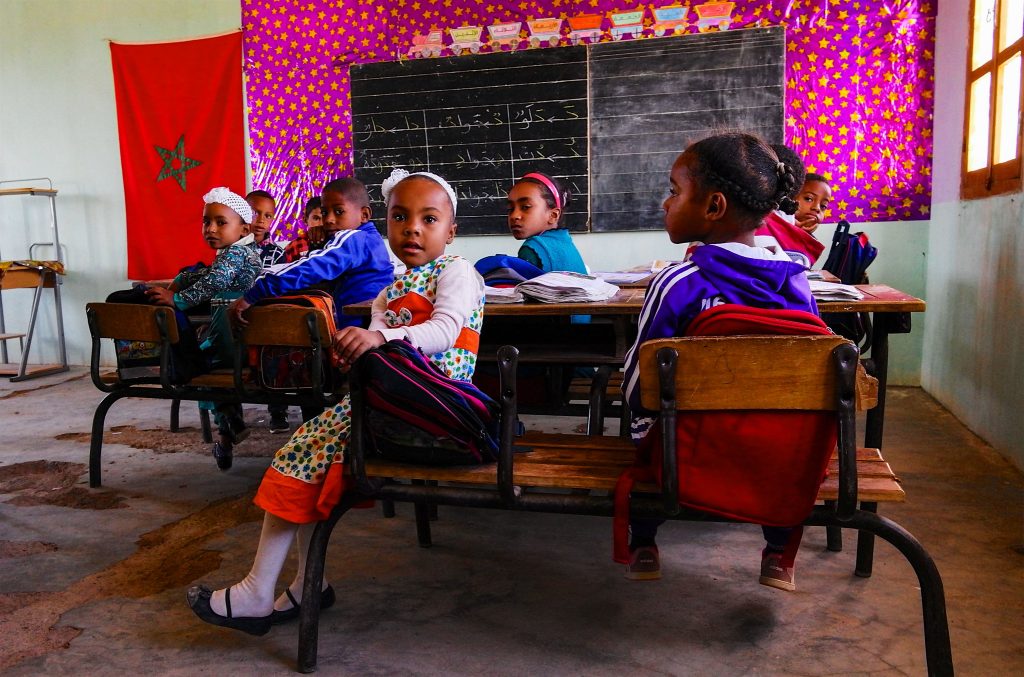
Children in a classroom in Morocco. Photo by Antonio Cinotti.

Solutions to Morocco’s Educational Challenges

Investing in Teacher Training

One of the most critical solutions to Morocco’s education challenges is investing in teacher training. The Moroccan government should provide more training opportunities for teachers to enhance their teaching skills and learn new approaches to teaching.

Additionally, the government should incentivize teachers to work in rural areas by providing them with better salaries, housing, and other benefits. This approach would help address the shortage of qualified teachers in rural areas and provide students with better access to quality education.

Legal Basis for the Solution:

According to Article 26 of the Universal Declaration of Human Rights, “Everyone has the right to education.” The right to education is also recognized in several international human rights treaties, including the International Covenant on Economic, Social, and Cultural Rights (ICESCR) and the Convention on the Rights of the Child (CRC). Both of these treaties recognize the right to education as a fundamental human right that should be accessible to everyone, regardless of gender, social class, or geographic location.

Expanding Access to Education

To increase access to education in Morocco, the government should consider implementing policies that target children from disadvantaged backgrounds. These policies may include financial assistance programs, such as scholarships or subsidies, to help families cover the cost of education.

The Moroccan government can also partner with non-governmental organizations and other stakeholders to expand access to education in rural areas. This approach could involve building new schools, providing transportation to and from school, and ensuring that schools have access to resources and materials needed to provide quality education.

Updating the Curriculum and Teaching Methods

To improve the quality of education in Morocco, the government must update the curriculum and teaching methods to align with the needs of the modern workforce. This could involve incorporating more practical skills, such as computer literacy, into the curriculum. The government should also promote project-based learning, which encourages critical thinking and problem-solving skills, rather than rote memorization.

Furthermore, the Moroccan government can collaborate with international organizations, such as UNESCO, to develop new teaching materials and curricula that are more inclusive and relevant to the needs of Moroccan students.

Closing the Gender Gap

Morocco has made significant progress in promoting girls’ education, but there is still a gender gap in enrollment and achievement. To close this gap, the government should focus on improving access to education for girls, particularly in rural areas.

The government can provide incentives for families to send their daughters to school, such as scholarships or subsidies. Additionally, the government can work with non-governmental organizations to create awareness campaigns that promote the importance of girls’ education and address cultural attitudes that prevent girls from accessing education.

International Cooperation

International cooperation is crucial in addressing Morocco’s education challenges. The Moroccan government can collaborate with international organizations, such as the World Bank and UNESCO, to secure funding for education initiatives and gain access to expertise and resources.

Additionally, the Moroccan government can learn from the experiences of other countries that have successfully addressed similar education challenges. For example, Morocco can look to neighboring countries, such as Tunisia and Algeria, that have made significant progress in improving access to education and promoting gender equality in education.

Conclusion

Morocco’s education system is facing several challenges, including the quality of education, access to education, curriculum and teaching methods, and gender inequality. While the government has made efforts to address these challenges, more needs to be done to ensure that all Moroccan children have access to quality education.

To improve the quality of education in Morocco, the government should invest in teacher training, expand access to education, update the curriculum and teaching methods, and close the gender gap in enrollment and achievement. Additionally, international cooperation is crucial in addressing these challenges, and the Moroccan government should collaborate with international organizations and learn from the experiences of other countries that have successfully addressed similar education challenges.

By addressing these challenges, Morocco can improve the prospects of its young people, promote economic growth, and build a brighter future for the country.

Bibliography

Education Challenges for Girls in Niger: A Critical Analysis

Written by Frida Brekk

Niger, a landlocked country in West Africa, faces significant challenges in providing quality education to its population, particularly girls. Despite efforts to improve education in recent years, Niger ranks among the countries with the highest gender disparity in education. This article aims to explore the educational challenges faced by girls in Niger, examining the factors contributing to the gender gap and discussing the implications for the overall development of the nation.

Students in physics class. Makalondi Secondary School, Makalondi, Tilaberri Region, Niger. Photo by GPE/Kelley Lynch

Limited access to education is one of the primary challenges for girls in Niger. According to a report by The Guardian, Niger ranks among the ten worst countries for girls to receive an education. Factors contributing to this include early marriage and pregnancy; high rates of child marriage and early pregnancy often force girls to drop out of school, as societal norms prioritize early marriage over education, distance and infrastructure as remote rural areas lack proper school infrastructure, making it difficult for girls to access educational institutions, poverty and financial barriers; economic constraints often prevent families from sending their daughters to school, as they struggle to cover basic needs and associated education costs, security concerns; instances of conflict and instability limit educational opportunities for girls, particularly in areas affected by violence and displacement.

Girls in Niger also face discrimination and unequal treatment within the education system due to gender disparity. This discrimination manifests in various forms, including social differences. Traditional gender roles and cultural norms often dictate that girls prioritize domestic duties and caregiving over education, reinforcing gender inequalities. Lack of female teachers; shortage of female teachers in Niger makes it challenging for girls to find role models and receive guidance, contributing to the gender gap in education. And instances of gender-based violence, such as sexual harassment and assault, create hostile learning environments for girls, impacting their educational participation and achievement.

Another main concern is the quality of education in Niger. Even for girls who manage to access education, the quality of schooling remains a significant concern, and there are many factors affecting the quality of education in Niger. Schools often lack basic infrastructure, teaching materials, and resources, affecting the quality of instruction and learning outcomes for both girls and boys. Inadequate resources in the education system pose a significant concern for the overall quality of education and have particular implications for girls in Niger. Gender bias in curriculum materials and teaching practices may reinforce gender stereotypes and perpetuate biases, limiting girls’ educational opportunities. Additionally, insufficient training and support for teachers, particularly in addressing gender disparities, hampers the delivery of inclusive and gender-responsive education.

The challenges girls face in accessing quality education in Niger have profound implications for individual well-being, social progress, and the country’s overall development. Addressing these challenges requires a multi-faceted approach, inclusive of policy reforms, investment in infrastructure, empowerment and awareness, and teacher training and support. To effectively promote gender equality in education, the government of Niger must prioritize policies and initiatives that address gender-based discrimination and societal barriers. Enhancing educational infrastructure, particularly in remote areas, is crucial to improving access to education for girls. Insufficient educational infrastructure in remote regions poses significant barriers. Community awareness campaigns are vital in challenging societal norms and promoting positive attitudes towards this issue. And finally, providing comprehensive training and support for teachers, focusing on gender-responsive pedagogy, can improve the quality of education and promote gender equality in schools.

By acknowledging and actively addressing the challenges mentioned above, Niger can undertake a transformative journey towards establishing an education system that is inclusive and equitable, thereby empowering girls and fostering the holistic development of the nation.

This education system entails implementing a range of effective strategies, including but not limited to policy reforms, infrastructure investments, empowerment initiatives, and teacher training programs. By adopting this comprehensive approach, Niger can strive towards an educational landscape where girls have equal access to quality education, where gender disparities are minimized, and where the potential of all individuals is harnessed to drive progress and prosperity at both the individual and societal levels.

Sources

[https://www.theguardian.com/global-development/2017/oct/11/revealed-the-10-worst-countries-for-girls-to-get-an-education-international-day-girl](https://www.theguardian.com/global-development/2017/oct/11/revealed-the-10-worst-countries-for-girls-to-get-an-education-international-day-girl “smartCard-inline”)

The Educational Crisis in Tigray: The Devastating Effects of Civil War in Northwestern Ethiopia

Written by Joan Vilalta

After enduring the hardships of the Covid-19 pandemic, which implied a range of socioeconomic challenges, including educational impoverishment due to the closure of schools, the Tigray territory in northwestern Ethiopia suffered yet another blow in November of 2020, when civil war struck the region. The consequences of the conflict between the Tigray People’s Liberation Front (TPLF) and Ethiopia’s National Defence Forces (ENDF), aided by the Eritrean military, represent one of the most devastating humanitarian crises in the world, piling on top of several longstanding crises in Ethiopia such as severe drought and acute famine. The consequences of this conflict are broad, including a critical situation regarding education. 

According to the latest UN OCHA (United Nations Office for the Coordination of Humanitarian Affairs) report on the matter, around 85% of the schools in Tigray have been partially or entirely damaged by the conflict, and some 411.000 school-age children are in dire need of essential services, which profoundly affects their educational development. The UN plans to cover the needs of 3.6 million affected children and almost 190.000 teachers by providing accelerated learning activities for those who have been out of school for more than three years and providing psychosocial and mental health support services and learning packages.[1]

The current conflict was prompted by a power struggle between the TPLF and the current Ethiopian president Abiy Ahmed. The TPLF ruled the country for over thirty years until Ahmed came to power in 2018 to dismantle the TPLF’s regime. As Ahmed became the president of the country, he managed to rearrange the political power while ostracizing the TPLF. Parallelly, Ahmed also managed to end the longstanding war with neighbouring Eritrea.

On the 4th of November 2020, the government accused the TPLF of attacking a military base near Mekelle and ordered a military intervention to address the situation while calling for the aid of Eritrean forces and Tigray’s neighbouring region’s militias. Since then, the scale of the conflict has grown exponentially, with both sides committing mass killings and other atrocities that have called the attention of the international community. Ethnic discrimination against Tigrayans has been speculated to be entangled with the motivations of this war. It should be considered that while the focus of the conflict was on Tigray, conflict consequences eventually extended to the neighbouring regions of Amhara and Afar.

In March 2022, the government agreed to an indefinite ceasefire, but the conflict resumed in August. Nevertheless, a permanent cessation of hostilities was agreed upon in November 2022. While at this moment, the situation seems to have calmed down, Ethiopia now faces the aftermath of a devastating conflict, which calls for accountability on both sides as well as amending the several crises stemming from the war, among them the educational crisis. 

One of the main reasons why the war on Tigray provoked an educational crisis was the military occupation of schools to use them as bases, accompanied by the plundering, pillaging, and looting of academic centres and the extensive structural damage suffered by the buildings. 

IDP families and children at Primaray School in Mekelle IDP center April 15, 2021. Photo by UNICEF Ethiopia.

There have been many examples of this on both sides of the conflict. For instance, the historical school of Atse Yohannes in Mekelle was used by the ENDF for half a year, Eritrean forces used a primary school in Basen, and the TPLF used an elementary school in Bissober. This, of course, prompted the closure of schools, impeding the attendance of teachers and students, and resulted in extensive damage to infrastructure and school material since the use of the school would make the school a likely confrontation scenario. In some cases, it even resulted in derogatory messages towards locals being painted on the school walls. 

According to several sources, around 2.8 million children missed out on education because of the war, and more than 2000 causalities have been reported regarding students and teachers. 

The death of teachers and principals also represents a problem since it has generated a shortage of school staff, especially in areas where access to such qualifications is reduced. Due to this shortage, teachers are now forced to have many students in each class, making monitoring students’ progress closely difficult.

Beyond the military use of schools, a range of problems regarding quality and access to education emerged from the war. Trauma and psychological duress have been rampant among students and teachers, negatively impacting their capacity to attain their learning objectives. 

Families’ financial losses provoked by the conflict, combined with extreme drought, famine, and health insecurity, have prompted students to stop learning activities to contribute to their family’s economy. Poverty has also hampered the recovery of damaged schools and the capacity to provide a salary for school staff. Teachers have also been more unable to perform their duties since they had to focus on surviving the situation.

The war on Tigray has generated an estimated 3.5 million internally displaced people, mostly women and children. Internally displaced students often found themselves in precarious situations and could not attend school. Students who moved to regions with different indigenous languages also found a barrier to school integration. In many cases, even to this day, internally displaced people and refugees from the war have sheltered themselves inside schools, the occupation of the space being an obstacle to resuming regular school activity.

According to research on the impact of armed violence on students’ educational attainment in Tigray, the school enrollment rates dropped dramatically due to conflict (almost a 10% decline in the studied areas), and educational wastage overall increased, with dropout and repetition rates at risk of rising. Moreover, the long-term impact of the educational crises is the potential lack of social capital and skills of future generations, rendering the communities of Tigray even more vulnerable.

While humanitarian aid is currently reaching the affected areas in northwestern Ethiopia, it should be noted that the mere reopening of schools without further consideration won’t be a fully effective solution. Facilities will need to be safely rebuilt, and students and teachers will have to deal with the traumatic experience of war and loss in the coming years. Tigray’s educational system was not built overnight, and recovery will not be quick either. Aid and resources such as school materials or teacher training will be crucial to restore the system.

Finally, it should be noted that this educational crisis was not entirely unavoidable. The occupation and looting of schools for military purposes are rarely justified under Ethiopian law. They can constitute a war crime and a human rights violation since it deprives children of access to education. More than that, the African Committee of Experts on the Rights and Welfare of the Child has urged African countries to ban the use of schools for military purposes or to enact specific measures to discourage it. The African Union Peace and Security Council has also called upon African countries to endorse the Safe Schools Declaration, which contains concrete protection measures. In this sense, Broken Chalk encourages the Ethiopian authorities to support such mandates, to strengthen the law and its application to protect the educational system, as well as to provide the necessary aid sociopsychological and material to affected students and school staff during the coming years to ensure they can recover and strive for the development they deserve.

BIBLIOGRAPHY

Assefa, Y., Tilwani, S. A., Moges, B. T., & Shah, M. A. (2022). The impact of armed violence on students’ educational attainment and the role of parents in resilience schooling and the education process. Heliyon, 8(12), e12192. https://doi.org/10.1016/j.heliyon.2022.e12192

Cable News Network (CNN). (2022, November 11). Tigray conflict: Fast facts. CNN. Retrieved from: https://edition.cnn.com/2022/11/11/world/tigray-war-fast-facts/index.html

Ethiopia Insight. (2022, August 14). Students’ learning in Tigray is being crippled by the war. Ethiopia Insight. Retrieved from: https://www.ethiopia-insight.com/2022/08/14/students-learning-in-tigray-is-being-crippled-by-the-war/

Human Rights Watch. (2021, May 28). Ethiopia: Tigray schools occupied, looted. Human Rights Watch. Retrieved from:  https://www.hrw.org/news/2021/05/28/ethiopia-tigray-schools-occupied-looted

Humanium. (2022, August 9). Ethnic cleansing and grave violations of children’s rights in Ethiopia’s Western Tigray region. Humanium. Retrieved from: https://www.humanium.org/en/ethnic-cleansing-and-grave-violations-of-childrens-rights-in-ethiopias-western-tigray-region/

Link Education. (2022, January 6). Impact of the Northern Ethiopian War on education. Link Education. Retrieved from: https://linkeducation.org.uk/impact-of-the-northern-ethiopian-war-on-education/

NPR. (2021, March 5). 9 things to know about the unfolding crisis in Ethiopia’s Tigray region. NPR. Retrieved from: https://www.npr.org/2021/03/05/973624991/9-things-to-know-about-the-unfolding-crisis-in-ethiopias-tigray-region


[1] UN OCHA REPORT (https://reports.unocha.org/en/country/ethiopia/card/5TCJFYzqI4/)