Educational Challenges in the Caribbean Netherlands – Italian Translation


BY Sterre Krijnen

Ogni studente conta! Nel 2011, questo slogan fu il primo tentativo dei Paesi Bassi Caraibici ed Europei di raggiungere equità educativa e aumentare la qualità dell’educazione nelle isole di Bonnaire, San Eustasio e Saba. Nonostante la qualità e l’equità siano aumentate, i Paesi Bassi Caraibici devono ancora fare i conti con degli ostacoli educativi significative nel 2023. Questo articolo esplorerà i tre ostacoli principali: la cura per gli studenti con bisogni speciali, il multilinguismo, e gli effetti della povertà.

Questo articolo analizza le tre difficoltà per capire l’accessibilità e la qualità dell’educazione nei Paesi Bassi Caraibici. Ma prima, dobbiamo capire a pieno la struttura governativa delle isole e i loro legami con i Paesi Bassi Europei, in modo da capire le barriere da abbattere e i tentativi da compiere per affrontarle. Inoltre, verrà data particolare attenzione alle procedure legislative riguardanti l’educazione e ai programmi educativi così da evidenziare le giuste procedure e spiegare il contesto in cui le difficoltà attuali continuano.

I tentativi ad-hoc per risolver l’inuguaglianza educativa

Nel 1948 Bonnaire, San Eustasio e Saba divennero parte delle Antille Olandesi, uno stato separato del Regno dei Paesi Bassi. Esse divennero nuovi governi locali. Ogni stato è governato da un consiglio esecutivo, un consiglio dell’isola e il governo nazionale Olandese. Da allora, le isole sono spesso chiamate i Paesi Bassi Caraibici o le Isole BES. (1)

Il Ministro dell’educazione, della cultura e delle scienze olandese è responsabile per l’educazione. Le scuole sulle isole fanno parte del sistema educativo olandese e sono monitorate dall’ispettorato educativo olandese. (2) Il Ministero dell’Educazione, il consiglio dell’isola e altri interessati hanno cooperato negli scorsi 12 anni per tre creare programmi legislativi, i cosiddetti “Programmi Educativi”.

I Programmi Educativi affrontano il tema dell’equità educativa tra le due parti dei Paesi Bassi. L’idea di base è che non dovrebbe essere importante se il bambino cresce nei Paesi Bassi Europei o Caraibici; le opportunità educative dovrebbero essere le stesse. (3) I programmi affrontano contesti specifici delle isole, siccome ci sono numerose differenze culturali, storiche, d’identità, linguistiche e organizzative rispetto ai Paesi Bassi Europeo. (4)

I primi due programmi trattano di tutte e tre le isole all’interno di un unico programma. Durante la stesura del primo Programma per l’Istruzione (2011-2016), il livello di istruzione di molte scuole delle isole BES non soddisfaceva gli standard europei né quelli dell’Olanda Caraibica. (5) Nel 2016, la maggior parte delle scuole ha raggiunto gli standard di qualità base. Tuttavia, alcune aree richiedevano ancora miglioramenti, che sono stati affrontati nel secondo Programma (2017-2020). (6) La valutazione di questo Programma nel 2020 mostra che le sfide principali sono l’assistenza agli studenti con bisogni speciali e il multilinguismo. (7)

Il terzo Programma per l’Istruzione, che non è ancora stata pubblicata, affronterà queste sfide. (8) Inoltre, questo Programma affronterà le sfide di ciascuna isola separatamente, dimostrando un ulteriore impegno nella definizione di politiche specifiche per il contesto, che si spera migliori l’efficacia del terzo Programma per l’Istruzione.


Educational Challenge I: Assistenza agli studenti con bisogni speciali

La prima sfida da discutere è l’assistenza agli studenti con bisogni speciali. Il diritto all’istruzione per i bambini con bisogni speciali è un diritto umano. È sancito nella Dichiarazione Universale dei Diritti Umani, dalla Convenzione dei Diritti dei Bambini e dalla Convenzione sui Diritti delle Persone con Disabilità. Quest’ultima Convenzione è stata ratificata dei Paesi Bassi Europei, ma non si applica ai Paesi Bassi Caraibici.

Una dichiarazione dei Centro di Competenza Education Cara Saba del 2021 riassume l’importanza dell’assistenza a questi studenti: “Gli studenti hanno il diritto di sentirsi incluso in un ambiente sicuro e affidabile, con un clima pedagogico strutturato che sia tollerante e incoraggiante per lo sviluppo di tutti”. (9) Attualmente, i bambini con i bisogni speciali si trovano ancora ad affrontare situazioni in cui l’istruzione come i loro coetanei o che finiscono per abbandonarla. Alcuni bambini non hanno affatto accesso all’istruzione. I bambini con un maggiore bisogni di assistenza incontrano difficoltà. (10)

Un esempio di assistenza inadeguata è il caso di Arianny, una bambina di dieci anni di Bonaire. Nel 2022, la bambina non parlante è stata al centro delle cronache per l’impossibilità di frequentare l’istruzione a Bonaire. Arianny non aveva accesso. I membri del parlamento olandese chiesero all’allora ministro dell’Istruzione, Dennis Wiersma, domande sulla sua situazione e su quella generale di Bonaire. Il ministro rispose che tutti i bambini dovrebbero avere accesso all’istruzione e sono tenuti a frequentare la scuola, nonostante le situazioni specifiche. La situazione di Arianny e le ricerche in altri rapporti ci mostrano che questa non è ancora la realtà. (11)

Perché questi problemi continuano anche dopo le due Agende per l’istruzione?

L’assistenza agli studenti nelle isole BES non è paragonabile a quella dei Paesi Bassi europei. Sebbene entrambe sperimentino problemi simili, il centro di esperti di Saba osserva che la differenza principale deriva dalle dimensioni e dalla cultura scolastica, ad esempio la mancanza di consapevolezza delle diverse esigenze degli studenti. Questo vale anche per le altre isole: i bambini con bisogni speciali continuano a seguire lo stesso programma dei loro coetanei anche se hanno bisogno di cure aggiuntive. Inoltre, gli studenti con esigenze speciali sono relativamente più numerosi a Saba che nei Paesi Bassi europei. Le possibili spiegazioni sono la mancanza di pianificazione educativa, di differenziazione in classe e di insegnanti con esigenze educative speciali. (12) Inoltre, cause non legate alla scuola influiscono sulle capacità di apprendimento dei bambini, come la povertà e la violenza domestica. (13)

Questa continua mancanza di assistenza agli studenti con bisogni speciali richiede quindi un impegno supplementare. È necessaria una rinnovata attenzione a questo problema e politiche che lo affrontino, garantendo l’accesso all’istruzione per i bambini come Arianny. Le esigenze individuali devono essere prese in considerazione per ottimizzare l’esperienza di apprendimento di studenti già vulnerabili.


Educational Challenge II: Il Multilinguismo

A causa delle diverse lingue parlate su ogni isola, la lingua dell’istruzione è stata una questione spinosa. Le sfide incontrate sono state l’imperialismo linguistico, le difficoltà di apprendimento e la difficoltà di accesso all’istruzione terziaria in olandese.

A Bonaire, la maggior parte degli abitanti parla il papiamento come lingua madre. A Saba e St. Eustasius, una varietà locale di inglese caraibico ha il sopravvento. Nonostante ciò, l’olandese era l’unica lingua ufficialmente riconosciuta fino all’inizio del secolo e quindi l’istruzione era in olandese. (14) Oggi, il papiamento e l’inglese possono essere utilizzati entrambi nell’istruzione. Questo rappresenta la realtà delle isole e il rispetto per le lingue locali, il che lo rende uno sviluppo lodevole e un allontanamento dall’imperialismo linguistico.

Tuttavia, ciò comporta anche nuove sfide educative, soprattutto per quanto riguarda i risultati dell’apprendimento e la formazione continua. A Saba e St. Eustatius, la lingua di insegnamento è l’inglese. L’olandese viene insegnato come lingua straniera. (15) A Sant’Eustachio si è passati all’inglese come lingua d’insegnamento nell’istruzione secondaria nel 2014. L’olandese ha dimostrato di influire negativamente sui risultati dell’apprendimento e sull’atteggiamento nei confronti della lingua olandese. (16) Saba ha utilizzato l’inglese come lingua di insegnamento per un periodo più lungo. Tuttavia, l’insegnamento dell’olandese solo come lingua straniera ostacola l’accesso all’istruzione terziaria. Una bassa conoscenza dell’olandese significa che gli studenti di queste isole non possono accedere a (tutti) gli istituti di istruzione terziaria dei Paesi Bassi europei.https://brokenchalk.org/educational-challenges-in-the-caribean-netherlands/ (17)  Questo è particolarmente problematico perché i Paesi Bassi caraibici non hanno università o università di scienze applicate, il che significa che gli abitanti devono spostarsi per perseguire l’istruzione terziaria. (18)  

A Bonaire, l’istruzione inizia in Papiamento – la lingua madre della maggior parte degli studenti – per i primi due anni della scuola primaria. Dopo questi anni, la lingua di insegnamento diventa l’olandese. Questo comporta dei rischi, come ha dimostrato il caso di Sant’Eustazio prima del 2014. Inoltre, può ostacolare i risultati dell’apprendimento, poiché i bambini potrebbero avere difficoltà con l’olandese.https://brokenchalk.org/educational-challenges-in-the-caribean-netherlands/ (19)

Pertanto, il multilinguismo comporta sfide specifiche per gli studenti per quanto riguarda l’accesso all’istruzione superiore e i risultati di apprendimento. È stato difficile trovare un equilibrio tra l’olandese, il papiamento e l’inglese caraibico per affrontare queste sfide. È necessario sviluppare una politica linguistica globale per ogni isola, in cui le lingue native e l’olandese ottengano un posto equilibrato all’interno del sistema educativo.


Educational Challenge III: La Povertà

Questa terza sfida educativa va al di là delle agende educative, poiché si intreccia con la situazione generale delle isole BES: la vita sulle isole è diventata sempre più costosa, e gli stipendi e il sostegno del governo non sono sufficienti a permetterla.

Per questo motivo, nel 2021 i bambini delle isole BES hanno indicato la povertà come una delle maggiori sfide della loro vita. Da allora i livelli di povertà sono rimasti elevati: 11.000 persone vivono sotto la soglia di povertà nel 2023. Si tratta di un numero estremamente elevato, considerando che la popolazione totale delle isole è di 30.000 persone. (20)  In confronto ai Paesi Bassi europei: 800.000 persone vivono in povertà su una popolazione di quasi 18 milioni. (21)

Cosa significano questi numeri per gli studenti caraibici?

Il rapporto tra l’Ombudsman olandese e l’Ombudsman dei bambini ci offre l’angosciante esempio di Shanice, una bambina di 11 anni di Bonaire. Sua madre è una badante single, che fa diversi lavori per rimanere a galla. È più spesso al lavoro che a casa. Shanice si prende cura dei suoi fratelli e sorelle più piccoli, si occupa della spesa e lava i piatti, invece di avere la possibilità di concentrarsi sugli studi. Va a scuola: le piace. Tuttavia, spesso si sente stressata a causa delle numerose responsabilità. Non riesce quindi a concentrarsi e a imparare. Allo stesso tempo, Shanice fa pressione su se stessa per imparare: vuole avere una vita diversa da quella di sua madre. (22)

Questo esempio mostra come la povertà dia ai bambini molte responsabilità e influisca negativamente sul loro apprendimento. Questo esempio non comprende tutti gli effetti negativi. Quando non si hanno abbastanza soldi, il cibo sano non è sempre una priorità, così come i libri di scuola o un buon posto per studiare. Le spese scolastiche extra potrebbero non essere pagate. Sia i genitori che i figli sono sottoposti a livelli di stress elevati, che possono portare i genitori a non essere disponibili (emotivamente) e i figli ad avere problemi di concentrazione. Tutto ciò influisce negativamente sui risultati scolastici dei bambini. (23)

Per affrontare il problema della povertà e i suoi effetti, è necessario un sostegno governativo per sollevare i bambini e i loro genitori dalla povertà. Tuttavia, le politiche governative sono una delle cause della povertà: il modello del costo della vita per l’isola BES presenta il costo della vita come più basso di quanto non sia. Le politiche vengono sviluppate sulla base di questo modello. Inoltre, questo è un argomento ricorrente per non aumentare il benessere sociale: garantire il benessere sociale demotiva le persone, che non lavoreranno più. (24) Quindi, le politiche hanno contribuito al problema della povertà.

Inoltre, gli abitanti delle isole BES non sempre hanno accesso alle stesse risorse di cui dispongono gli olandesi europei. Queste risorse sono tuttavia di grande importanza: Gli olandesi europei ne dipendono, ma gli olandesi dei Caraibi non possono nemmeno accedervi. (25) Ciò è possibile grazie allo status speciale delle isole. Il Comitato delle Nazioni Unite per l’eliminazione della discriminazione razziale ha osservato nel 2021 che tali differenze tra i Paesi Bassi europei e i Paesi Bassi caraibici sono deplorevoli, che la discriminazione dovrebbe essere combattuta e che l’uguaglianza dovrebbe essere perseguita.

Il governo olandese ha preso provvedimenti. Per i Paesi Bassi caraibici entrerà in vigore una legge che garantisce la parità di trattamento di tutti i cittadini nei Paesi Bassi. (26) La data esatta, tuttavia, non è chiara. Inoltre, il modello del costo della vita sarà adeguato nel luglio 2024. A partire da quella data, gli abitanti dei Paesi Bassi caraibici potranno colmare il divario tra la sicurezza sociale e il costo della vita che esiste attualmente. Inoltre, il governo olandese intraprende altri sforzi per affrontare la povertà, ma l’Istituto olandese per i diritti umani li giudica insufficienti. (27)

Il governo olandese sembra assumersi sempre più la responsabilità degli alti livelli di povertà nei Paesi Bassi caraibici. Uno sviluppo necessario: nonostante dichiarazioni come “Ogni studente conta!”, il governo olandese ha discriminato i cittadini caraibici olandesi. Il trattamento sfavorevole che subiscono li pone in ritardo rispetto ai loro concittadini europei.


Conclusione

La qualità dell’istruzione è aumentata in modo significativo nelle isole di Bonaire, St. Eustatius e Saba. Sono stati compiuti grandi sforzi per adattare le politiche ai contesti locali delle isole, il che è essenziale per l’equità dell’istruzione tra i Paesi Bassi europei e caraibici. Questo è lodevole e si spera che continui con la terza Agenda per l’istruzione.

Tuttavia, persistono grandi sfide educative nelle isole. I benefici e l’accesso all’istruzione sono sotto pressione. Mentre il multilinguismo riguarda tutti gli studenti, la povertà e la mancanza di cure speciali colpiscono alcuni studenti in modo sproporzionato. Inoltre, il problema della povertà e la mancanza di cure speciali mostrano chiari segni di discriminazione, che dovrebbero essere condannati e fermati. Il caso delle isole di Bonaire, St. Eustatius e Saba indica quindi la necessità di politiche che affrontino la discriminazione e di un piano globale per migliorare ulteriormente l’istruzione.


Bibliografia

Buys, Marga. (2021). Evaluatie Tweede Onderwijsagenda Caribisch Nederland 2017-2020. Eerste Kamer. https://www.eerstekamer.nl/overig/20210708/evaluatie_tweede_onderwijsagenda/document3/f=/vlkch545eltd_opgemaakt.

Den Hartog, Tobias and Laurens Kok. (2023). Op weg naar 1 miljoen armen: bij dit inkomen leef je volgens de overheid in armoede. Het Parool. https://www.parool.nl/nederland/op-weg-naar-1-miljoen-armen-bij-dit-inkomen-leef-je-volgens-de-overheid-in-armoede~b9c9b7ed/

Haringsma, Phaedra. (2022). Zo wordt ongelijkheid tussen Europees en Caribisch Nederland al jaren in stand gehouden. De Correspondent. https://decorrespondent.nl/13713/zo-wordt-ongelijkheid-tussen-europees-en-caribisch-nederland-al-jaren-in-stand-gehouden/2f84b44f-db88-0d7c-029d-9c1d00ae02b3

Inspectie van het Onderwijs. (2017). De Ontwikkeling van het Onderwijs in Caribisch Nederland 2014-2016. Onderwijsinspectie. https://www.onderwijsinspectie.nl/documenten/rapporten/2017/03/21/rapport-onderwijsontwikkelingen-caribisch-nederland-20142016

Kinderombudsman, and Nationale Ombudsman. (2023). Caribische kinderen van de rekening. Kinderombudsman. https://www.nationaleombudsman.nl/publicaties/rapporten/2022058#:~:text=Dit%20rapport%20beschrijft%20de%20knelpunten,zelf%20als%20voor%20hun%20kinderen

Kinderombudsman. (2021). Als je het ons vraagt: kinderen op de BES-eilanden. Kinderombudsman. https://www.kinderombudsman.nl/publicaties/rapport-als-je-het-ons-vraagt-onderzoek-kinderen-op-de-bes

Kloosterboer, Karin. (2013). Kind op Bonaire, St. Eustatius en Saba. UNICEF. https://content.presspage.com/uploads/688/samenvattingkindopbeslowres.pdf

Langerak, Lisa. (2021). Inclusive Special Education on Saba. Expertise Center Education Care. https://www.learningsaba.com/2021_Care_Coordinator/210614%20Project%20plan%20Inclusive%20Special%20Education%20Saba.pdf

Mijts, Eric, Ellen-Petra Kester and Nicholas Faraclas. (2014). Multilingualism and education in the Caribbean Netherlands. A community-based approach to a sustainable language education policy. The case study of St. Eustatius. NT2. https://www.nt2.nl/documenten/meertaligheid_en_onderwijs/kambel_meertaligheid_binnenwerk_eng_h5.pdf

Ministerie van Onderwijs, Cultuur en Wetenschap. (2022). Antwoord op schriftelijke vragen van de leden Van den Berg en Peters (beiden CDA) over het bericht ‘Moeder vraagt om hulp: 10-jarige Arianny kan op Bonaire niet naar school. Open Overheid. https://open.overheid.nl/documenten/ronl-b6d4ce01be3eac9fe87130ee6b9b0f08d72e664e/pdf

Nederlands Jeugdinstituut. (N.d). De invloed van armoede op schoolprestaties. Nederlands Jeugdinstituut. https://www.nji.nl/armoede/invloed-op-schoolprestaties

Netherlands Institute for Human Rights. (2023). Caribisch Nederland krijgt wetgeving gelijke behandeling. College voor de Rechten van de Mens. https://www.mensenrechten.nl/actueel/nieuws/2023/01/25/caribisch-nederland-krijgt-wetgeving-gelijke-behandeling#:~:text=Iedereen%20die%20zich%20in%20Nederland,2010%20bijzondere%20gemeentes%20van%20Nederland

Netherlands Institute for Human Rights. (2023). Report to UN Committee on economic, social and cultural human rights in the Netherlands. College voor de Rechten van de Mens. https://publicaties.mensenrechten.nl/file/5803a853-0bbe-b495-7932-3bb751e0aed4.pdf

NOS. (2023). Derde van Caribisch Nederland onder armoedegrens, pleidooi voor hoger minimumloon. NOS. https://nos.nl/artikel/2493122-derde-van-caribisch-nederland-onder-armoedegrens-pleidooi-voor-hoger-minimumloon

Polak, Anneke. (2014). Engels als instructietaal ‘ingrijpend’. Caribisch Netwerk. https://caribischnetwerk.ntr.nl/2014/06/19/engels-als-instructietaal-statia-ingrijpend/

Rijksdienst Caribisch Nederland. (N.d). Higher Education and Science. Rijksdienst Caribisch Nederland. https://english.rijksdienstcn.com/education-culture-science/higher-education-and-science

Rijksdienst Caribisch Nederland. (N.d). Onderwijs, Cultuur en Wetenschap. Rijksdienst Caribisch Nederland. https://www.rijksdienstcn.com/onderwijs-cultuur-wetenschap

Rijksdienst Caribisch Nederland. (N.d). Onderwijsagenda voor Caribisch Nederland: samen werken aan kwaliteit. Rijksdienst Caribisch Nederland. https://www.rijksdienstcn.com/binaries/rijksdienstcn-nederlands/documenten/brochures/onderwijs-cultuur/onderwijsagendas/eerste-onderwijsagenda-caribisch-nederland/index/Eerste_Onderwijsagenda_NL.pdf

Rijksdienst Caribisch Nederland. (N.d). Taal in het Onderwijs. Rijksdienst Caribisch Nederland. https://www.rijksdienstcn.com/onderwijs-cultuur-wetenschap/ouders-leerlingen/taal-in-het-onderwijs

Rijksoverheid. (N.d). Caribisch deel van het Koninkrijk. Rijksoverheid. https://www.rijksoverheid.nl/onderwerpen/caribische-deel-van-het-koninkrijk/rechtspositie-politieke-ambtsdragers-bonaire-sint-eustatius-saba

[i] Rijksoverheid. (N.d). Caribisch deel van het Koninkrijk. Rijksoverheid. https://www.rijksoverheid.nl/onderwerpen/caribische-deel-van-het-koninkrijk/rechtspositie-politieke-ambtsdragers-bonaire-sint-eustatius-saba

[ii] Rijksoverheid. (N.d.). Caribisch deel van het Koninkrijk. Rijksoverheid.

[iii] Rijksdienst Caribisch Nederland. (N.d). Onderwijs, Cultuur en Wetenschap. Rijksdienst Caribisch Nederland. https://www.rijksdienstcn.com/onderwijs-cultuur-wetenschap

[iv] Rijksdienst Caribisch Nederland. (N.d). Onderwijsagenda voor Caribisch Nederland: samen werken aan kwaliteit. Rijksdienst Caribisch Nederland. 1. https://www.rijksdienstcn.com/binaries/rijksdienstcn-nederlands/documenten/brochures/onderwijs-cultuur/onderwijsagendas/eerste-onderwijsagenda-caribisch-nederland/index/Eerste_Onderwijsagenda_NL.pdf

[v] Rijksdienst Caribisch Nederland. (N.d). Onderwijsagenda voor Caribisch Nederland: samen werken aan kwaliteit. 1.

[vi] Inspectie van het Onderwijs. (2017). De Ontwikkeling van het Onderwijs in Caribisch Nederland 2014-2016. Onderwijsinspectie. 39-41. https://www.onderwijsinspectie.nl/documenten/rapporten/2017/03/21/rapport-onderwijsontwikkelingen-caribisch-nederland-20142016

[vii] Buys, Marga. (2021). Evaluatie Tweede Onderwijsagenda Caribisch Nederland 2017-2020. Eerste Kamer. 20. https://www.eerstekamer.nl/overig/20210708/evaluatie_tweede_onderwijsagenda/document3/f=/vlkch545eltd_opgemaakt.

[viii] Buys, Marga. (2021). Evaluatie Tweede Onderwijsagenda Caribisch Nederland 2017-2020. Eerste Kamer. 22.

[ix]. Langerak, Lisa. (2021). Inclusive Special Education on Saba. Expertise Center Education Care. 2. https://www.learningsaba.com/2021_Care_Coordinator/210614%20Project%20plan%20Inclusive%20Special%20Education%20Saba.pdf

[x] Buys, Marga. (2021). Evaluatie Tweede Onderwijsagenda Caribisch Nederland 2017-2020. Eerste Kamer. 20.

[xi] Ministerie van Onderwijs, Cultuur en Wetenschap. (2022). Antwoord op schriftelijke vragen van de leden Van den Berg en Peters (beiden CDA) over het bericht ‘Moeder vraagt om hulp: 10-jarige Arianny kan op Bonaire niet naar school. Open Overheid. 2-3. https://open.overheid.nl/documenten/ronl-b6d4ce01be3eac9fe87130ee6b9b0f08d72e664e/pdf

[xii] Langerak, Lisa. (2021). Inclusive Special Education on Saba. Expertise Center Education Care. 5.

[xiii] Kinderombudsman. (2021). Als je het ons vraagt: kinderen op de BES-eilanden. Kinderombudsman. 10-11. https://www.kinderombudsman.nl/publicaties/rapport-als-je-het-ons-vraagt-onderzoek-kinderen-op-de-bes

[xiv] Mijts, Eric, Ellen-Petra Kester and Nicholas Faraclas. (2014). Multilingualism and education in the Caribbean Netherlands. A community-based approach to a sustainable language education policy. The case study of St. Eustatius. NT2. 2. https://www.nt2.nl/documenten/meertaligheid_en_onderwijs/kambel_meertaligheid_binnenwerk_eng_h5.pdf

[xv] Rijksdienst Caribisch Nederland. (N.d). Taal in het Onderwijs. Rijksdienst Caribisch Nederland. https://www.rijksdienstcn.com/onderwijs-cultuur-wetenschap/ouders-leerlingen/taal-in-het-onderwijs

[xvi] Polak, Anneke. (2014). Engels als instructietaal ‘ingrijpend’. Caribisch Netwerk. https://caribischnetwerk.ntr.nl/2014/06/19/engels-als-instructietaal-statia-ingrijpend/

[xvii] Buys, Marga. (2021). Evaluatie Tweede Onderwijsagenda Caribisch Nederland 2017-2020. Eerste Kamer. 20.

[xviii] Rijksdienst Caribisch Nederland. (N.d). Higher Education and Science. Rijksdienst Caribisch Nederland. https://english.rijksdienstcn.com/education-culture-science/higher-education-and-science

[xix] Kloosterboer, Karin. (2013). Kind op Bonaire, St. Eustatius en Saba. UNICEF. 15. https://content.presspage.com/uploads/688/samenvattingkindopbeslowres.pdf

[xx] NOS. (2023). Derde van Caribisch Nederland onder armoedegrens, pleidooi voor hoger minimumloon. NOS

https://nos.nl/artikel/2493122-derde-van-caribisch-nederland-onder-armoedegrens-pleidooi-voor-hoger-minimumloon

[xxi] Den Hartog, Tobias and Laurens Kok. (2023). Op weg naar 1 miljoen armen: bij dit inkomen leef je volgens de overheid in armoede. Het Parool.

https://www.parool.nl/nederland/op-weg-naar-1-miljoen-armen-bij-dit-inkomen-leef-je-volgens-de-overheid-in-armoede~b9c9b7ed/

[xxii] Kinderombudsman, and Nationale Ombudsman. (2023). Caribische kinderen van de rekening. Kinderombudsman. 4. https://www.nationaleombudsman.nl/publicaties/rapporten/2022058#:~:text=Dit%20rapport%20beschrijft%20de%20knelpunten,zelf%20als%20voor%20hun%20kinderen.

[xxiii] Nederlands Jeugdinstituut. (N.d). De invloed van armoede op schoolprestaties. Nederlands Jeugdinstituut. https://www.nji.nl/armoede/invloed-op-schoolprestaties

[xxiv] Haringsma, Phaedra. (2022). Zo wordt ongelijkheid tussen Europees en Caribisch Nederland al jaren in stand gehouden. De Correspondent. https://decorrespondent.nl/13713/zo-wordt-ongelijkheid-tussen-europees-en-caribisch-nederland-al-jaren-in-stand-gehouden/2f84b44f-db88-0d7c-029d-9c1d00ae02b3

[xxvi] Netherlands Institute for Human Rights. (2023). Caribisch Nederland krijgt wetgeving gelijke behandeling. College voor de Rechten van de Mens. https://www.mensenrechten.nl/actueel/nieuws/2023/01/25/caribisch-nederland-krijgt-wetgeving-gelijke-behandeling#:~:text=Iedereen%20die%20zich%20in%20Nederland,2010%20bijzondere%20gemeentes%20van%20Nederland

[xxvii] Netherlands Institute for Human Rights. (2023). Report to UN Committee on economic, social and cultural human rights in the Netherlands. College voor de Rechten van de Mens. 4-6. https://publicaties.mensenrechten.nl/file/5803a853-0bbe-b495-7932-3bb751e0aed4.pdf

Educational Challenges in Azerbaijan – Urdu Translation

Educational Challenges in Azerbaijan

آذربائیجان میں تعلیمی چیلنجز


تحریر: زینت اسدوا

مترجم: ماہ نور علی

: آذربائیجان میں غیر شفافیت: تعلیمی مشکلات کی رہنمائی

آذربائیجان، قفقاز کے علاقے میں واقع ایک ملک ہے، اور 1991 میں اپنی آزادی تک یہ سوویت یونین کے زیر حکومت تھا۔ آذربائیجان کے قدرتی وسائل کی وسعت کے باوجود، اس کا بنیادی ڈھانچہ متعدد شعبوں کو متاثر کرتا ہے، جن میں خاص طور پر تعلیمی شعبہ شامل ہے۔

اگرچہ سرکاری اسکولوں میں تعلیم مفت ہے، مگر زیادہ اعلی تعلیم کا انحصار خاندان کی مالی حالت پر ہوتا ہے۔ [1] ایک عام آذربائیجانی خاندان کی سالانہ آمدنی 4250 منات (2500$) ہے، جو کہ عام خاندانوں کے تعلیمی بجٹ کو متاثر کرتی ہے۔ نجی اساتذہ کی خدمات حاصل کرنا اور اسکول کے مواد کی ادائیگی کا خرچ ان کی استطاعت سے زیادہ ہوتا ہے۔ اعلی تعلیمی ادارے اکثر امیر پس منظر کے طلبہ کو ترجیح دیتے ہیں اور دیہی یا کم آمدنی والے خاندانوں کے طلبہ کو نظر انداز کرتے ہیں۔ [2]

جہاں تک تعلیمی نظام کے معیار کا تعلق ہے، ثانوی اسکولز طلبہ کو یونیورسٹی کے داخلہ امتحانات کے لیے مناسب تیاری فراہم کرنے میں ناکام ہیں، جس کی وجہ سے کئی طلبہ کمزور کارکردگی کی وجہ سے ان امتحانات میں ناکام ہو جاتے ہیں۔ [3] تعلیم کے اس خراب نظام کے پیش نظر، امیر پس منظر کے والدین نجی اساتذہ کی خدمات حاصل کرتے ہیں تاکہ اپنے بچوں کو معیاری تعلیم فراہم کی جا سکے۔ اس صورتحال سے فائدہ اٹھانے والے سرکاری اشرافیہ ہوتے ہیں، کیونکہ ان کے پاس اپنے بچوں کو بہتر تعلیم فراہم کرنے کے زیادہ مواقع ہوتے ہیں۔ بعض اوقات یہ بچے امریکہ، کینیڈا اور مغربی یورپی ممالک جیسے ملکوں میں بھیجے جاتے ہیں تاکہ وہ وہاں معیاری تعلیم حاصل کر سکیں۔ جو لوگ اس استطاعت سے محروم ہوتے ہیں، وہ ناکافی تعلیمی سطح کے ساتھ پیچھے رہ جاتے ہیں۔

تعلیمی مواد جیسے کتابیں، مضامین، جرنل وغیرہ تک رسائی بہت کم ہوتی ہے، خاص طور پر وہ مواد جو آذربائیجانی زبان میں ہو۔ یونیورسٹی کی لائبریریاں تعلیمی مقاصد کے لیے ضروری وسائل سے محروم ہیں اور طلبہ ان مواد کے پرانے اور آج کے دور کے لحاظ سے غیر متعلقہ ہونے کی شکایت کرتے ہیں۔

تعلیمی مواد اور وسائل کی کمی کی ایک بڑی وجہ حکومت کی جانب سے علمی تحقیق اور تراجم کے لیے ناکافی معاونت ہے۔ تعلیمی شعبے کی ترقی کے لیے بجٹ کی تجاویز اور علمی تحقیق کے لیے مالی معاونت کی کمی ملک کو ذہنی قلت میں مبتلا کر رہی ہے۔ اس کے ساتھ ساتھ اکثر اوقات ماہرین ترقی یافتہ ممالک کی طرف ہجرت کر جاتے ہیں جہاں انہیں تحقیق کے لیے بہتر مراعات فراہم کی جاتی ہیں۔

آذربائیجان میں پوسٹ گریجویٹ تعلیم کو اپنے نظام میں نمایاں تبدیلیوں کی ضرورت ہے۔ ماسٹرز کی ڈگریوں کی تعلیم کو مزید پیشہ ورانہ اور خصوصی بنانے کے لیے کافی ترقی کی ضرورت ہے۔ ایسٹ ٹینیسی اسٹیٹ یونیورسٹی کے پروفیسر ایمریٹس رچرڈ ڈی کورٹم کے مطابق، “آذربائیجان میں ماسٹرز کے طلبہ کو عام طور پر وہی کورس، وہی انسٹرکٹر، وہی کتاب، وہی لیکچر مواد، اور وہی ٹیسٹ دوبارہ لینے پڑتے ہیں جو انہوں نے انڈر گریجویٹ کے دوران لیے تھے۔” [4]

آذربائیجان میں اس وقت موجود ایک اور بڑا مسئلہ رشوت ہے۔ اگرچہ آئین میں یہ غیر قانونی ہے، لیکن آبادی کے لیے بقا کے لیے ایک معمول کا حصہ بن چکا ہے۔ عوام کو تعلیم، صحت، سرکاری خدمات، ملازمتوں اور دیگر شعبوں تک رسائی کے لیے رشوت دینا پڑتی ہے۔ ان اداروں کے سربراہان ان رشوتوں سے فائدہ اٹھاتے ہیں اور عوام کو ایسی صورتحال میں ڈالتے ہیں کہ ان کے مسائل حل کرنے کے لیے انہیں پیسے دینے پڑتے ہیں۔

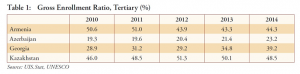
یونیسکو انسٹیٹیوٹ فار سٹیٹسٹکس کے مطابق، آذربائیجان میں دوسرے قفقاز ممالک اور وسطی ایشیائی ممالک کے مقابلے میں ثانوی (اعلیٰ) تعلیم کے داخلے کی شرح سب سے کم ہے، کیونکہ 77% آذربائیجانی جو اسکول سے فارغ التحصیل ہوتے ہیں، وہ یونیورسٹی میں داخلہ نہیں لیتے۔ یہ ممکنہ طور پر “غلط طریقے سے تشکیل دیے گئے اور انتہائی مرکزی ریاستی کوٹا مختص کرنے کے نظام” کی وجہ سے ہوتا ہے۔ [5] نیچے دیا گیا ٹیبل 1 2010 سے 2014 تک آذربائیجان، آرمینیا، جارجیا، اور قازقستان میں یونیورسٹی میں داخلے کے لیے درخواست دینے والے طلبہ کا تناسب دکھاتا ہے۔[6]

Educational Challenges in Azerbaijan

Sources:

[1] Mammadova, S., Guliyev, F., Wallwork, L. and Azimli, N., 2016. Human Capital Development in Azerbaijan. Caucasus Analytical Digest, (90), pp. 8,. Available at: <https://www.academia.edu/30431942/The_Quality_of_Education_in_Azerbaijan_Problems_and_Prospects>

[2] Mammadova, S., Guliyev, F., Wallwork, L. and Azimli, N., 2016. Human Capital Development in Azerbaijan. Caucasus Analytical Digest, (90), pp.8,. Available at: <https://www.academia.edu/30431942/The_Quality_of_Education_in_Azerbaijan_Problems_and_Prospects>

[3] Mammadova, S., Guliyev, F., Wallwork, L. and Azimli, N., 2016. Human Capital Development in Azerbaijan. Caucasus Analytical Digest, (90), pp. 7,. Available at: <https://www.academia.edu/30431942/The_Quality_of_Education_in_Azerbaijan_Problems_and_Prospects>

[4] Richard D. Kortum, “Emerging Higher Education in Azerbaijan”, Journal of Azerbaijani Studies, 12, 2009.

[5] Mammadova, S., Guliyev, F., Wallwork, L. and Azimli, N., 2016. Human Capital Development in Azerbaijan. Caucasus Analytical Digest, (90), pp. 7,. Available at: <https://www.academia.edu/30431942/The_Quality_of_Education_in_Azerbaijan_Problems_and_Prospects>

[6] Souce: Mammadova, S., Guliyev, F., Wallwork, L. and Azimli, N., 2016. Human Capital Development in Azerbaijan. Caucasus Analytical Digest, (90), pp. 8,. Available at: <https://www.academia.edu/30431942/The_Quality_of_Education_in_Azerbaijan_Problems_and_Prospects>

Cover Image by OpenClipart-Vectors from Pixabay

Ethiopia’s Education Problem: 96% of students fail final school exam 

Written by Zoë Alford

Hundreds of thousands of students are left without the opportunity for higher education due to a massive educational crisis currently facing Ethiopia. Out of the 3,106 schools administering 12th grade in 2023, 43% reported that no students had passed the Ethiopian General Secondary Education Certificate Examination (EGSECE) (Hood, 2023). This final exam is a prerequisite for university entrance and saw 96% of students failing for the second year in a row (Hood, 2023). The overwhelming majority of Ethiopia’s youth are now left with limited education opportunities and few choices for their future. While exam results are not the only measure of a country’s education system, such significant failure rates can only be symptomatic of one that is fractured and struggling.

Structural Issues:

The education system in Ethiopia is struggling to keep up with the burgeoning numbers of primary and secondary school students. Since 1990, students in primary education increased from 3 million to 20 million in 2018/19 (Tiruneh et al., 2021). With more students finishing primary school than ever before, Ethiopian pupils are continuing on into high school with limited resources and infrastructure in place to support them. Secondary enrollment has doubled in the last 10 years, going from 23% in 2011/12 to 46% in 2021/22 (Ministry of Education, 2022) This remarkable achievement has given greater access to education for children from disadvantaged backgrounds and drastically increased the number of girls in school. However, the rapid expansion of the education system has left it struggling to ensure all students are given a sound education and the resources they require (Tiruneh et al., 2021).

Poor school infrastructure, inadequate distribution of resources and outdated materials have also fueled this crisis. Combined with a system stretched thin to meet the demands of ever-increasing pupils, hundreds of thousands of children have consequentially finished primary education without fundamental skills in literacy and numeracy (Hood, 2023). These abilities are not only essential for further education but also necessary to live a life of opportunity in a modern, globalised world.

The lack of robust education combined with a burgeoning student population has also left Ethiopia without appropriately trained teachers. In the country’s teacher trainee program, many candidates have not completed the final 2 years of secondary education. Trainees often also score low when tested for their science and mathematics abilities (Assefa et al. 2021; Gebremeskel et al. 2017). This leaves a major gap in the education system for educated and well-trained teachers, creating a cycle where limited education creates poorly educated teachers, creating further inadequate education for younger students in fundamental subjects. There is also a high student-to-teacher ratio, stretching what teachers that Ethiopia does have already, thinner (Assefa et al. 2021). Ethiopia has recognized that their educational system must consider the gap between their societal goals for education and the general student learning experience (Hood, 2023).

Covid-19:

It is also important to note that the Covid-19 pandemic widened the education gap. Lockdowns in 2020 prevented more than 26 million students from learning over a period of 8 months (Araya et al., 2022). With limited online learning materials and resources, students were required to catch up on 8 months’ worth of lessons lost in just 45 days. Primary school students in 2021 had lower foundational numeracy skills and made slower progress in numeracy as the year progressed, compared to students from 2018 (Araya et al., 2022). The pandemic lockdowns also heavily affected students from rural and lower-income families, with pupils from these backgrounds having the lowest numeracy levels in their cohort (Araya et al., 2022). The pandemic therefore exacerbated the systemic problems already prevalent in Ethiopia’s education system.

Internal Conflict:

The Tigray War in northern Ethiopia also likely added to the declining exam results. Lasting from November 2020 until November 2022, the conflict caused a humanitarian crisis, human rights abuses and destruction of infrastructure, including educational institutions. The conflict affected around 1.4 million children in the region, with many parents too concerned about their children’s safety to send them to school (Belay et al., 2023). This conflict severely limited access to education, for reasons such as trauma, loss of infrastructure and population movement (Belay et al., 2023). The armed conflict in Tigray has not only impacted on educational achievement in the region but also limited education opportunities. This has been cited as another reason for the extremely low pass rate in Ethiopia in recent years (Belay et al., 2023).

Looking forward:

An overall greater financial investment in education would offer a fast-tracked solution to many of Ethiopia’s’ education systemic problems. Funding for additional, more uniform and up to date learning resources as well as improving school infrastructure would greatly increase educational quality for all students. Higher salaries, a stronger teacher training program and leadership training would encourage and upskill both current and potential teachers in Ethiopia (Tena & Motuma, 2024). Leadership training and a better trainee program can also be achieved via greater investment in university education, which has the potential to play a critical role in overcoming widespread structural issues. Investing in universities encourages innovation and improvement in curriculum, teacher training programs and capacity building within the education system (Tena & Motuma, 2024).

Greater focus on students from disadvantaged backgrounds would also ensure that Ethiopia’s most vulnerable pupils would not miss out on an education. Targeted support for low-performing students, those from low socio-economic backgrounds and students from rural areas would prevent further widening learning inequalities (Araya et al., 2022). When possible, employing technological forms of teaching would keep pupils in school who otherwise would not be able to attend, whether caused by conflict, illness or events like Covid-19. When online learning is not possible, continuing to encourage the importance of education across local communities and providing learning resources would greatly encourage students from disadvantaged backgrounds to continue their education (Araya et al., 2022). Ensuring pupils can still access education, despite conflict, pandemics or remoteness is essential to ensure such high rates of failure do not continue in the future.

Overall, Ethiopia must continue to invest and improve in their education system. This will ensure the robust functioning of not only its economy, but the right to self-determination for all Ethiopians regardless of economic background. Education has the power to reduce inequality, poverty, and it is therefore necessary to ensure that future Ethiopian generations are not left behind.

Photo by Roman Mager on Unsplash

Resources:

Araya, M., Rose, P., Sabates, R., Tiruneh, D.T., Woldeanna, T. (2022). Learning Losses during the COVID-19 Pandemic in Ethiopia: Comparing student achievement in early primary grades before school closures, and after they reopened. Rise Insight Series. Retrieved from https://riseprogramme.org/publications/learning-losses-during-covid-19-pandemic-ethiopia-comparing-student-achievement-early.html

Assefa, S., Asfaw, A., Fufa, D., Zewdie, G., Wodajo, H., Kekeba, H. & Tola, T. (2021). Status of teacher education programs in Ethiopia: Policy, curricula and resources. The Ethiopian Journal of Education, 41(1), 247-296.

Belay, F., Berhane, D., Teshale, H., Mulubrhan, G., Hagos, T., Gebremariam, H., Brhane, T., Islam, Z. (2023). The effect of war on educational institutions of Eastern Tigray zone, Tigray state, Ethiopia. International Journal of Educational Development, 102:102864. Retrieved from

https://www.sciencedirect.com/science/article/abs/pii/S0738059323001402#:~:text=Children%20did%20not%20attend%20schools,relevant%20to%20the%20war%20experiences.

Gebremeskel, H.H., Ahmed, A.Y., Getahun, D.A., Debele, M.L., Tibebu, D., Wondem, D.T. (2017). Revisiting teacher educators’ training in Ethiopia: Implications for a new approach to curriculum development. Bahir Dar Journal of Education, 17(2), 89-105.

https://www.ajol.info/index.php/bdje/article/view/249011/235474

Hood, L. (2023, November 23). Ethiopia’s education system is in crisis – now’s the time to fix it. The Conversation. Retrieved from https://theconversation.com/ethiopias-education-system-is-in-crisis-nows-the-time-to-fix-it-217817

Ministry of Education (2022). Education statistics annual abstract (ESAA). Federal Republic of Ethiopia. Retrieved from https://moe.gov.et/storage/Books/ESAA%202014%20EC%20(2021-22%20G.C)%20Final.pdf

Tena, B. & Motuma, F. (2024). Policy reforms and unresolved educational challenges in Ethiopia: Implications for the University of Education. Bahir Dar Journal of Education, 24(1), 147-167. https://dx.doi.org/10.4314/bdje.v24i1.10

Tiruneh, D., Hoddinott, J., Rolleston, C., Sabates, R., Woldehanna, T. (2021). Understanding achievement in numeracy among primary school children in Ethiopia: Evidence from Rise Ethiopia study . RISE Working Paper Series. Retrieved from https://www.researchgate.net/profile/John-Hoddinott-2/publication/359826987_Understanding_Achievement_in_Numeracy_Among_Primary_School_Children_in_Ethiopia_Evidence_from_RISE_Ethiopia_Study/links/64676983c9802f2f72ea0135/Understanding-Achievement-in-Numeracy-Among-Primary-School-Children-in-Ethiopia-Evidence-from-RISE-Ethiopia-Study.pdf

EDUCATIONAL CHALLENGES IN THE CARRIBEAN NETHERLANDS

BY Sterre Krijnen

Every student counts! In 2011, this slogan was the starting shot of the Caribbean and European Netherlands’ combined efforts to achieve educational equity and raise the quality of education on the islands of Bonaire, St. Eustatius, and Saba. Although quality and equity increased, the Caribbean Netherlands still dealt with significant educational challenges in 2023. This article will explore three main challenges: the care for students with special needs, multilingualism, and the effects of poverty.

This article analyses these three challenges to understand the accessibility and quality of education in the Caribbean Netherlands. But first, we need to go into the governance structure of the islands and their relationship with the European Netherlands to fully understand the barriers to tackling the challenges and efforts to address them. Also, the policy programs addressing education and the Education Agendas will be given special attention to show continuing good practices and to explain the context in which the current challenges continue.

Context-Specific Efforts to Overcome Education Inequity

In 1948, Bonaire, St. Eustatius and Saba became a part of the Dutch Antilles, a separate country within the Kingdom of the Netherlands. This changed in 2010: the islands became public bodies under the European Netherlands. Bonaire, St. Eustatius, and Saba are now local governments. An executive council, an island council, and the Dutch national government govern each island. Since this change, the islands have been referred to as the Caribbean Netherlands or the BES-islands.[i]

The Dutch Ministry for Education, Culture and Science is responsible for education. The schools on the islands are part of the Dutch education system and are monitored by the Netherlands’ Inspectorate of Education.[ii] The Dutch Ministry of Education, island councils and other stakeholders cooperated over the past twelve years to develop three policy programs, the Education Agendas.

The Education Agendas address educational equity between the two parts of the Netherlands. The idea is that it should not matter whether a child grows up in the European Netherlands or the Caribbean Netherlands; educational opportunities should be the same.[iii] The agendas address the specific context of the islands, as there are apparent differences from the European Netherlands in terms of culture, history, identity, language, scale, and organization.[iv]

The first two agendas address all three islands within one agenda. During the draft of the first Education Agenda (2011-2016), the level of education of many schools on the BES islands did not fulfil European nor Caribbean Dutch standards.[v] By 2016, most schools reached basic quality standards. However, particular areas still required improvement, again addressed in the second Agenda (2017-2020). [vi] The evaluation of this Agenda in 2020 shows that the main challenges are care for students with special needs and multilingualism.[vii]

While the third Education Agenda has not yet been published, it shall address these challenges.[viii] Furthermore, this agenda will address the challenges on each island separately, showing us a further commitment to context-specific policymaking, which hopefully improves the effectiveness of the third Education Agenda.

Educational Challenge I: Care for Students with Special Needs

The first challenge to discuss is the care for students with special needs. The right to education for children with special needs is a human right. It is taken up in the Universal Declaration of Human Rights, the Convention on the Rights of the Child, and the Convention on the Rights of Persons with Disabilities. While the last Convention was ratified by the European Netherlands, it does not apply to the Caribbean Netherlands.

A statement by the Expertise Centre Education Care Saba in 2021 summarizes the importance of care for these students:  “Students have the right to feel included in a safe and reliable environment with a structured pedagogical climate that is tolerant and encouraging for the development of all”.[ix] Now, children with special needs still face situations in which education is not tailored to them, meaning they do not profit from education as their peers or eventually drop out. Some children do not have access to education at all. Children with a higher need for care face difficulties.[x]

An example of inadequate care is the case of the ten-year-old Arianny on Bonaire. In 2022, the non-speaking girl was in the news as she could not attend education on Bonaire. Arianny had no access. Members of the Dutch parliament asked the then minister of Education, Dennis Wiersma, questions about her situation and the general situation on Bonaire. The minister reacted that all children should have access to education and are required to attend school, despite specific situations. The situation of Arianny and the research in other reports show us that is not yet the reality.[xi]

Why do these problems continue even after the two Education Agendas?

Student care on the BES islands is not comparable to care in the European Netherlands. While both experience similar problems, the expert centre on Saba notes that the main difference derives from scale and school culture, for example, the lack of awareness about the differing needs of students. This also applies to the other islands: children with special needs continue to follow the same program as their peers even though they need additional care. Moreover, there are relatively more students with special needs in Saba than in the European Netherlands. Possible explanations are a lack of education planning, differentiation in the classroom and special education needs teachers.[xii] Also, non-school-related causes affect children’s learning capabilities, such as poverty and domestic violence.[xiii]

This continuing lack of care for students with special needs thus asks for extra efforts. Renewed attention to this problem and policies need to tackle the problem, ensuring (continuance of) access to education for children like Arianny. Individual needs must be considered to optimize the learning experience of already vulnerable students.


Educational Challenge II: Multilingualism

Because of the different languages being spoken on each island, the language of education has been a thorny issue. Encountered challenges have been linguistic imperialism, learning challenges, and difficulty accessing tertiary education in Dutch.

On Bonaire, most inhabitants speak Papiamento as their mother tongue. On Saba and St. Eustasius, a local variety of Caribbean English has the upper hand. Despite this, Dutch was the only officially recognized language until the beginning of the century thus, education was in Dutch.[xiv]Nowadays, Papiamento and English can both be used in education. This represents the reality of the islands and a respect for local languages, making it a laudable development and a move away from linguistic imperialism.

However, it also causes new educational challenges, especially for learning results and further education. On Saba and St. Eustatius, the instruction language is English. Dutch is being taught as a foreign language.[xv] St. Eustatius switched to English as an instruction language in secondary education in 2014. Dutch proved to negatively affect learning outcomes and attitudes towards the Dutch language.[xvi] Saba has used English as the instruction language for a more extended period. However, only teaching Dutch as a foreign language hinders access to tertiary education. A low proficiency in Dutch means that students from these islands cannot access (all) tertiary education institutions in the European Netherlands.[xvii] This is especially problematic because the Caribbean Netherlands does not have any universities or universities of applied sciences, meaning inhabitants must move to pursue tertiary education.[xviii]

On Bonaire, education starts in Papiamento  – the native language of most students  – for the first two years of primary school. After these years, the instruction language became Dutch. This causes risks, as the case of St. Eustatius before 2014 showed. Furthermore, it can hinder learning outcomes as children might struggle with Dutch.[xix]

Therefore, multilingualism leads to specific challenges for students regarding access to further education and learning outcomes. It has been difficult to find a balance between Dutch, Papiamento, and Caribbean English that will tackle these challenges. A comprehensive language policy should be developed per island, where native languages and Dutch get a well-balanced place within the education system.

Educational Challenge III: Poverty

This third educational challenge goes beyond the education agendas as it intertwines with the overall situation on the BES islands: life on the islands has become increasingly expensive, and salaries and government support are insufficient to afford this.

This is why children on the BES islands noted poverty as one of the biggest challenges in their lives in 2021. And high poverty levels have continued since then: 11,000 people live below the poverty line in 2023. This is an extremely high number, considering that the islands’ total population is 30,000.[xx] In comparison to the European Netherlands: 800,000 live in poverty on a population of almost 18 million.[xxi]

What do such numbers mean for Caribbean students?

The rapport between the Dutch Ombudsman and the Children’s Ombudsman gives us the distressing example of Shanice, an 11-year-old Bonairean girl. Her mother is a single caretaker, working multiple jobs to stay afloat. She is more often at work than at home. Shanice cares for her younger brothers and sisters, looks after the groceries, and wash dishes instead of having the opportunity to focus on her studies. She goes to school: she likes it there. However, she often feels stressed because of her many responsibilities. Then, she cannot focus or learn. At the same time, Shanice pressures herself to learn: she wants to have a different life than her mom.[xxii]

This example shows how poverty gives children many responsibilities and negatively affects their learning. This example does not comprise all adverse effects. When not having enough money, healthy food is not always a priority, just like schoolbooks or having a good place to study. Extra school costs might not be paid. Parents and kids both experience high-stress levels, which might cause parents to be (emotionally) unavailable and children to have problems focusing. All negatively affect the school outcomes of children.[xxiii]

To tackle this problem of poverty and its effects, there should be governmental support to lift children and their parents from poverty. However, government policies are one of the causes of poverty: the model of living costs for the BES island presents living costs as lower than they are. Policies are developed based on this model. Moreover, this is a recurring argument for not higher social welfare: ensuring social welfare will demotivate people, and they will not work anymore.[xxiv] Hence, policies have contributed to the problem of poverty.

In addition, inhabitants of the BES islands do not always have access to the same resources European Dutch individuals have. These resources are, however, of great importance: European Dutch depend on them, but Caribbean Dutch cannot even access them.[xxv] This is possible because of the special status of the islands. The UN Committee on the Elimination of Racial Discrimination noted in 2021 that such differences between the European Netherlands and Caribbean Netherlands are deplorable, that discrimination should be fought, and that equality should be pursued.

The Dutch government has been taking steps. A law ensuring the equal treatment of all citizens in the Netherlands will come into effect for the Caribbean Netherlands.[xxvi] The exact date is, however, unclear. Furthermore, the model of living costs will be adjusted in July 2024. From that date onwards, inhabitants of the Caribbean Netherlands will be able to breach the gap between social security and living costs that exists now. In addition, the Dutch government does undertake other efforts to address poverty, but the Netherlands Institute for Human Rights judges them to be insufficient. [xxvii]

The Dutch government seems to increasingly take responsibility for the high poverty levels in the Caribbean Netherlands. A necessary development: despite statements such as ‘Every student counts!’, the Dutch government has discriminated against Caribbean Dutch citizens. The unfavourable treatment they experience puts them behind their fellow citizens in Europe.

Photo by Unseen Studio on Unsplash

Conclusion

Education quality has increased significantly on the Bonaire, St. Eustatius, and Saba islands. Great efforts have been made to tailor policies to the local contexts of the islands, which is essential for education equity between the European and Caribbean Netherlands. This is praiseworthy and will hopefully continue with the third Education Agenda.

However, great educational challenges persist on the islands. Benefits from and access to education are under pressure.  While multilingualism affects all students, poverty and the lack of special care affect some students disproportionately. Furthermore, the problem of poverty and lack of special care show clear signs of discrimination, which should be condemned and stopped. The case of the islands of Bonaire, St. Eustatius and Saba thus indicates the need for policies tackling discrimination and a comprehensive plan to improve education further.


References

[i] Rijksoverheid. (N.d). Caribisch deel van het Koninkrijk. Rijksoverheid. https://www.rijksoverheid.nl/onderwerpen/caribische-deel-van-het-koninkrijk/rechtspositie-politieke-ambtsdragers-bonaire-sint-eustatius-saba

[ii] Rijksoverheid. (N.d.). Caribisch deel van het Koninkrijk. Rijksoverheid.

[iii] Rijksdienst Caribisch Nederland. (N.d). Onderwijs, Cultuur en Wetenschap. Rijksdienst Caribisch Nederland. https://www.rijksdienstcn.com/onderwijs-cultuur-wetenschap

[iv] Rijksdienst Caribisch Nederland. (N.d). Onderwijsagenda voor Caribisch Nederland: samen werken aan kwaliteit. Rijksdienst Caribisch Nederland. 1. https://www.rijksdienstcn.com/binaries/rijksdienstcn-nederlands/documenten/brochures/onderwijs-cultuur/onderwijsagendas/eerste-onderwijsagenda-caribisch-nederland/index/Eerste_Onderwijsagenda_NL.pdf

[v] Rijksdienst Caribisch Nederland. (N.d). Onderwijsagenda voor Caribisch Nederland: samen werken aan kwaliteit. 1.

[vi] Inspectie van het Onderwijs. (2017). De Ontwikkeling van het Onderwijs in Caribisch Nederland 2014-2016. Onderwijsinspectie. 39-41. https://www.onderwijsinspectie.nl/documenten/rapporten/2017/03/21/rapport-onderwijsontwikkelingen-caribisch-nederland-20142016

[vii] Buys, Marga. (2021). Evaluatie Tweede Onderwijsagenda Caribisch Nederland 2017-2020. Eerste Kamer. 20. https://www.eerstekamer.nl/overig/20210708/evaluatie_tweede_onderwijsagenda/document3/f=/vlkch545eltd_opgemaakt.

[viii] Buys, Marga. (2021). Evaluatie Tweede Onderwijsagenda Caribisch Nederland 2017-2020. Eerste Kamer. 22.

[ix]. Langerak, Lisa. (2021). Inclusive Special Education on Saba. Expertise Center Education Care. 2. https://www.learningsaba.com/2021_Care_Coordinator/210614%20Project%20plan%20Inclusive%20Special%20Education%20Saba.pdf

[x] Buys, Marga. (2021). Evaluatie Tweede Onderwijsagenda Caribisch Nederland 2017-2020. Eerste Kamer. 20.

[xi] Ministerie van Onderwijs, Cultuur en Wetenschap. (2022). Antwoord op schriftelijke vragen van de leden Van den Berg en Peters (beiden CDA) over het bericht ‘Moeder vraagt om hulp: 10-jarige Arianny kan op Bonaire niet naar school. Open Overheid. 2-3. https://open.overheid.nl/documenten/ronl-b6d4ce01be3eac9fe87130ee6b9b0f08d72e664e/pdf

[xii] Langerak, Lisa. (2021). Inclusive Special Education on Saba. Expertise Center Education Care. 5.

[xiii] Kinderombudsman. (2021). Als je het ons vraagt: kinderen op de BES-eilanden. Kinderombudsman. 10-11. https://www.kinderombudsman.nl/publicaties/rapport-als-je-het-ons-vraagt-onderzoek-kinderen-op-de-bes

[xiv] Mijts, Eric, Ellen-Petra Kester and Nicholas Faraclas. (2014). Multilingualism and education in the Caribbean Netherlands. A community-based approach to a sustainable language education policy. The case study of St. Eustatius. NT2. 2. https://www.nt2.nl/documenten/meertaligheid_en_onderwijs/kambel_meertaligheid_binnenwerk_eng_h5.pdf

[xv] Rijksdienst Caribisch Nederland. (N.d). Taal in het Onderwijs. Rijksdienst Caribisch Nederland. https://www.rijksdienstcn.com/onderwijs-cultuur-wetenschap/ouders-leerlingen/taal-in-het-onderwijs

[xvi] Polak, Anneke. (2014). Engels als instructietaal ‘ingrijpend’. Caribisch Netwerk. https://caribischnetwerk.ntr.nl/2014/06/19/engels-als-instructietaal-statia-ingrijpend/

[xvii] Buys, Marga. (2021). Evaluatie Tweede Onderwijsagenda Caribisch Nederland 2017-2020. Eerste Kamer. 20.

[xviii] Rijksdienst Caribisch Nederland. (N.d). Higher Education and Science. Rijksdienst Caribisch Nederland. https://english.rijksdienstcn.com/education-culture-science/higher-education-and-science

[xix] Kloosterboer, Karin. (2013). Kind op Bonaire, St. Eustatius en Saba. UNICEF. 15. https://content.presspage.com/uploads/688/samenvattingkindopbeslowres.pdf

[xx] NOS. (2023). Derde van Caribisch Nederland onder armoedegrens, pleidooi voor hoger minimumloon. NOS

https://nos.nl/artikel/2493122-derde-van-caribisch-nederland-onder-armoedegrens-pleidooi-voor-hoger-minimumloon

[xxi] Den Hartog, Tobias and Laurens Kok. (2023). Op weg naar 1 miljoen armen: bij dit inkomen leef je volgens de overheid in armoede. Het Parool.

https://www.parool.nl/nederland/op-weg-naar-1-miljoen-armen-bij-dit-inkomen-leef-je-volgens-de-overheid-in-armoede~b9c9b7ed/

[xxii] Kinderombudsman, and Nationale Ombudsman. (2023). Caribische kinderen van de rekening. Kinderombudsman. 4. https://www.nationaleombudsman.nl/publicaties/rapporten/2022058#:~:text=Dit%20rapport%20beschrijft%20de%20knelpunten,zelf%20als%20voor%20hun%20kinderen.

[xxiii] Nederlands Jeugdinstituut. (N.d). De invloed van armoede op schoolprestaties. Nederlands Jeugdinstituut. https://www.nji.nl/armoede/invloed-op-schoolprestaties

[xxiv] Haringsma, Phaedra. (2022). Zo wordt ongelijkheid tussen Europees en Caribisch Nederland al jaren in stand gehouden. De Correspondent. https://decorrespondent.nl/13713/zo-wordt-ongelijkheid-tussen-europees-en-caribisch-nederland-al-jaren-in-stand-gehouden/2f84b44f-db88-0d7c-029d-9c1d00ae02b3


[xxvi] Netherlands Institute for Human Rights. (2023). Caribisch Nederland krijgt wetgeving gelijke behandeling. College voor de Rechten van de Mens. https://www.mensenrechten.nl/actueel/nieuws/2023/01/25/caribisch-nederland-krijgt-wetgeving-gelijke-behandeling#:~:text=Iedereen%20die%20zich%20in%20Nederland,2010%20bijzondere%20gemeentes%20van%20Nederland

[xxvii] Netherlands Institute for Human Rights. (2023). Report to UN Committee on economic, social and cultural human rights in the Netherlands. College voor de Rechten van de Mens. 4-6. https://publicaties.mensenrechten.nl/file/5803a853-0bbe-b495-7932-3bb751e0aed4.pdf

Ensuring Equal Access to Education: Addressing Socioeconomic Disparities in Albanian Schools 

Written by Iris Karoli 

In Albania, access to education remains unequal due to a complex interplay of social and economic factors. Despite strides since the end of communist rule, disparities persist, leaving many marginalized. Socioeconomic status, geography, ethnicity, and gender intersect to create barriers to quality education. Economic disparities hinder low-income families from affording schooling costs, while rural areas face resource and infrastructure challenges. Minority groups, like the Roma and Balkan Egyptians, encounter discrimination, and traditional gender roles limit girls’ access to education in some regions. Albania’s political nature, marked by historical transitions and ongoing reforms, also influences its education system. The country’s path from communist isolation to a multi-party democracy has seen improvements, but political instability and corruption have at times disrupted the educational progress. 

Despite primary education boasting a commendable enrolment rate of 97% and a completion rate of 107%, it doesn’t signify an absence of challenges in education accessibility. These figures underscore Albanian society’s prioritization of schooling and the significance placed on education. However, upon examining secondary education, the enrolment rate plummets to 75%, a figure significantly lower than regional averages and falling below standards set by the The Organization for Economic Co-operation and Development  (OECD) and the European Union (EU).  

Economic disparities play a significant role in worsening unequal access to education in Albania. Studies indicate that nearly 60% of the population resides in rural areas, where economic challenges are pronounced and many struggle to meet their basic needs.1 Consequently, children in these communities face unwarranted disadvantages in accessing education. The issue unfolds along two primary tracks: first, the financial constraints that hinder families from affording school-related expenses such as tuition fees, textbooks, and transportation. Despite education being free in Albania, many families still encounter financial challenges. Second, the lack of infrastructural investments in rural areas further compounds the problem, making it even more difficult for children to access educational opportunities. This dual challenge underscores the urgent need for targeted interventions aimed at alleviating economic barriers and improving infrastructure in rural communities to ensure equitable access to education for all children in Albania. 

There is a glaring absence of state aid for families facing financial difficulties in Albania. This lack of support is further exacerbated by inadequate infrastructure and the scarcity of schools, which intensifies the challenges faced by students. In many cases, children must undertake arduous journeys of 2-5 kilometres daily to reach school, particularly in remote areas where schools are often located in neighbouring villages. These journeys pose significant risks, especially during harsh winter conditions, when extreme weather and hazardous terrain, including river crossings and forest paths, increase the danger for young students. Furthermore, children are frequently placed in the same classroom regardless of their varying ages or disparities in knowledge levels. This occurs due to insufficient student numbers to form individual classes, resulting in a compromised quality of education. 

Social disparities significantly contribute to the widening of the inequality gap in Albania. While the ethnic makeup of the Albanian population comprises mainly Albanians (98.1%) and other minorities such as Greeks (0.9%) and various recognized groups including Vlach, Roma, Macedonians, Montenegrins, and Egyptians (1%), the latter face distinct challenges in accessing education despite constitutional recognition of their rights.2 Among these minorities, Roma and Egyptians are particularly marginalized, facing discrimination that permeates their educational opportunities. Economic factors exacerbate this disparity, with studies revealing that 64% of their income is allocated to basic necessities like food.3 Living in impoverished conditions, often sustained by collecting and selling recyclable materials, these minorities struggle to afford schooling for their children. Consequently, many children are not enrolled in school, as they are expected to contribute to their families’ income by assisting in street activities, further perpetuating the cycle of poverty and educational exclusion. 

The language barrier presents another significant hurdle contributing to educational disparities in Albania. While the official language is Albanian, and the country legally acknowledges and accepts the language and culture of the Roma community, educational instruction is exclusively provided in Albanian. This linguistic limitation widens the gap, particularly for Roma children who encounter difficulties learning in a language different from their own. As a result, their academic performance  often suffers. Despite this challenge, the state has yet to implement any programs or initiatives aimed at facilitating the education of these students and bridging the gap caused by language differences.  

Another issue promoting social disparities in education is the requirement for children to be registered at schools within the neighbourhood or zone where they reside. This policy poses significant challenges, particularly in densely populated urban areas like the capital city, Tirana. In Tirana, certain neighbourhoods consist primarily of social housing, trapping children from less privileged families in a cycle of disadvantage. The correlation between poverty, neighbourhood residency, and educational quality creates a self-perpetuating loop where children from economically disadvantaged backgrounds are confined to areas with limited resources and subsequently receive lower-quality education. This systemic barrier further causes social inequalities, hindering the prospects for upward mobility and perpetuating cycles of poverty in Albania’s urban centres. 

Gender inequality represents another significant factor contributing to disparities in education. While studies and data indicate minimal discrepancies between boys’ and girls’ access to education at lower levels, a substantial gender gap emerged in higher education enrolment rates since 2009. Recent statistics reveal a stark contrast, with male enrolment in higher education standing at 43%, while female enrolment lags far behind at only 18%, marking a 25% disparity between genders.4 This gap can be attributed to entrenched traditional norms in Albanian culture, which is predominantly patriarchal. Although young girls are often encouraged to complete secondary education, societal expectations dictate that their educational pursuits cease thereafter, prioritizing marriage and family formation. Consequently, many women are hindered from reaching their full potential due to these societal constraints, perpetuating the cycle of gender inequality in Albanian society. 

Albania faces the challenge of meeting Sustainable Development Goal (SDG) targets in education, with particular emphasis on improving specific areas. One major area requiring attention is increasing the percentage of young people achieving minimum proficiency in reading after lower secondary education. This involves enhancing reading programs, teacher training, and access to quality reading materials. Additionally, improving the completion rate in primary education is essential, focusing on reducing dropout rates and providing support to students at risk of discontinuing their education. Moreover, increasing participation rates in organized learning activities, such as extracurricular programs and vocational training, is crucial for fostering holistic development. Lastly, efforts to enhance proficiency in mathematics after the end of lower secondary education are needed, including curriculum improvements, teacher training, and educational resources. By addressing these specific challenges, Albania can make significant progress towards meeting its education-related SDG targets and ensuring a more inclusive and quality education system. 

In conclusion, Albania faces a complex web of challenges that contribute to inequalities in education access. Addressing these issues demands comprehensive strategies to dismantle structural barriers, challenge societal norms, and prioritize equitable education access for all. Additionally, investing in teacher training and curriculum development is essential for enhancing the quality of education and ensuring that all Albanian students have the opportunity to reach their full potential. By implementing inclusive policies, investing in infrastructure, and promoting cultural change, Albania can progress towards providing quality education to every child, regardless of background. Only through concerted efforts can Albania foster a more equitable and prosperous future for all its citizens.  


Photo by Kenny Eliason on Unsplash

References: 

Educational Challenges in Qatar – Arabic Translation

الصعوبات التعليمية في قطر


Anna Moneta بقلم آنا مونيتا

شهدت دولة قطر، التي كانت دولة خليجية متواضعة، تحولاً ملحوظاً إلى قوة اقتصادية عالمية، ويعود ذلك إلى حد كبير إلى اكتشاف احتياطيات النفط واستثمارها في منتصف القرن العشرين. شكّل الكشف عن النفط تحت رمال الصحراء القاحلة في قطر في أوائل الأربعينيات من القرن الماضي لحظة محورية قفزت بالدولة إلى موقع مهيمن في أسواق النفط والغاز الطبيعي العالمية. ويرتبط هذا الصعود الاقتصادي ارتباطاً وثيقاً بعلاقات قطر التاريخية باعتبارها محمية بريطانية، حيث تأسست رسمياً في عام 1868 مع وجود تفاعلات تعود إلى ما قبل ذلك.

لعب البريطانيون، بالاستفادة من خبرتهم الواسعة في إدارة الموارد النفطية في الخليج، دوراً حاسماً من خلال توفير الخبرة الفنية والتوجيه في مجال التنقيب عن النفط والبنية التحتية للتصدير. وقد أرسى هذا الجهد التعاوني الأساس لصناعة النفط المزدهرة في قطر، مما مكّن الدولة من الاستفادة من ثروتها المكتشفة حديثاً من الموارد. ومع ذلك، امتد تأثير الاستعمار البريطاني إلى ما هو أبعد من المجالات الاقتصادية، حيث تغلغل في النظام التعليمي في قطر. فقد دفع الوجود البريطاني، الذي شمل السلك العسكري والعمال الاستعماريين العاملين في صناعة النفط، إلى ظهور نظام تعليمي مصمم لتلبية احتياجات الأطفال القطريين والعمال الاستعماريين البريطانيين على حد سواء. وأدت هذه المبادرة التعاونية إلى إنشاء وزارة التربية والتعليم في عام 1956، مما أدى إلى تشكيل مسار البيئة التعليمية في قطر.

اليوم، تعد دولة قطر من بين أغنى دول العالم، ويعود ذلك إلى حد كبير إلى عائداتها من النفط والغاز الطبيعي. ومع ذلك، يثير إرث الاستعمار أسئلة مهمة حول التأثير الدائم على الإطار التعليمي في البلاد. بينما نستكشف التطور التاريخي لقطر وتعقيدات نظامها التعليمي، من المهم أن نتطرق إلى المخاوف المعاصرة. يؤكد البنك الدولي، على وجه الخصوص، على المشكلات المتعلقة بنتائج تنمية الطفولة المبكرة في قطر، مسلطًا الضوء على أوجه القصور في مهارات التنظيم الذاتي ومهارات القراءة والكتابة والحساب في مرحلة مبكرة بين الأطفال الصغار. وعلى الرغم من التقدم الاقتصادي، إلا أن هذه المخاوف، تشكل عواقب محتملة على المدى الطويل من خلال إعاقة نمو الدماغ المهمة، مما يضيف المزيد من التعقيد إلى سرد مسيرة قطر التاريخية والتعليمية.

النظام التعليمي في قطر

يتسم قطاع التعليم في قطر بنظام تعليمي متنوع يشمل كلاً من المدارس الحكومية التي تديرها الحكومة والمدارس الخاصة التي تقدم مناهج دراسية ولغات تعليمية مختلفة. وقد أثار انتشار المناهج الدولية في العديد من المدارس الخاصة نقاشات حول التأثير الدائم للاستعمار البريطاني على التعليم في البلاد.

تنقسم المدارس الحكومية في قطر إلى ثلاثة مراحل: المدرسة الابتدائية، وتضم الطلاب الذين تتراوح أعمارهم بين 6 و12 عاماً، والمدرسة الإعدادية، وتستوعب الطلاب الذين تتراوح أعمارهم بين 13 و15 عاماً، والمدرسة الثانوية، وتضم الطلاب الذين تتراوح أعمارهم بين 16 و18 عاماً. أما بالنسبة للأطفال الأصغر سناً، فهناك مجموعة من الخيارات بما في ذلك مراكز الحضانة للأطفال الذين تتراوح أعمارهم بين صفر إلى 3 سنوات، وروضة الأطفال للأطفال الذين تتراوح أعمارهم بين 3 إلى 5 سنوات، مما يوفر المرونة بناءً على الاحتياجات الفردية. من المهم ملاحظة أن التكاليف المرتبطة بها يمكن أن تتفاوت بشكل كبير، حيث تتراوح عادةً بين 15,000 ريال قطري و40,000 ريال قطري.

في التعليم العالي، تُصنف مؤسسات التعليم العالي في قطر إلى جامعات خاصة أو وطنية أو فروع للجامعات. تعتبر جامعة قطر، التي تأسست عام 1973، أقدم مؤسسات التعليم العالي في الدولة. تقدم الجامعة مجموعة متنوعة من البرامج في مرحلتي البكالوريوس والدراسات العليا، وتضم كليات الهندسة، والعلوم الاجتماعية، والتربية، والدراسات الإسلامية، والعلوم الإنسانية، والعلوم. إن وجود مؤسسات التعليم العالي هذه يثري البيئة التعليمية في قطر، ويساهم في النمو الأكاديمي والفكري في البلاد.

المشاكل الناتجة عن تاريخ قطر الاستعماري

يقدم الباحثون التنظيريون في مرحلة ما بعد الاستعمار، مثل هيكلينج-هدسون (2006)، رؤية نقدية يمكن من خلالها دراسة الأثر الدائم للاستعمار على أنظمة التعليم في المستعمرات السابقة. وتدور إحدى حججهم المركزية حول نقص الموارد المتعمد للتعليم من قبل القوى الاستعمارية كوسيلة لإدامة السيطرة على السكان المحليين واستغلالهم.

استلزم الوجود البريطاني في قطر إنشاء نظام تعليمي لتلبية احتياجات أبناء المواطنين القطريين والعمال البريطانيين المستعمرين على حد سواء. وقد أسس هذا النظام في وقت مبكر للمشهد التعليمي في قطر. وبالتالي، عندما شرعت الدولة في رحلة التحول الاقتصادي التي تغذيها الثروة النفطية، تأثرت أسسها التعليمية بماضيها الاستعماري.

تفترض حجة ما بعد الاستعمار المطروحة أن القوى الاستعمارية تعمدت إبقاء التعليم في مستعمراتها دون المستوى المطلوب. لم يكن هذا التكتيك مجرد إهمال بل كان استراتيجية محسوبة لاستغلال السكان المحليين. في الواقع، من خلال حرمان الشعوب المستعمرة من التعليم المناسب، تمكنت القوى الاستعمارية من الحفاظ على سيطرتها وإدامة عدم المساواة الاجتماعية والاقتصادية. وتشير الدراسة التي أجرتها منظمة التعاون الاقتصادي والتنمية في عام 2015، والتي صنفت قطر في المراتب العشر الأخيرة في مؤشرها التعليمي، إلى الآثار المترتبة على هذا النقص المتعمد في الاستثمار.

تتجلى العلاقة بين تاريخ قطر الاستعماري والصعوبات التي تواجهها في مجال التعليم عند أخذ عواقب عدم كفاية الموارد التعليمية بعين الاعتبار. ففي الوقت الذي حققت فيه قطر تقدمًا ملحوظًا في مختلف القطاعات، بما في ذلك البنية التحتية والرعاية الصحية، واجه نظامها التعليمي تفاوتًا مستمرًا من حيث الجودة وإتاحة التعليم. هذه التفاوتات هي انعكاس لنقص الموارد التاريخية للتعليم، وهي قضية يؤكد عليها منظرو ما بعد الاستعمار.

العقبات التعليمية

يشكل تصنيف منظمة التعاون الاقتصادي والتنمية لعام 2015 تذكيراً واضحاً بالتأثير الدائم لهذا النقص التاريخي في الاستثمار. إذ تخلف النظام التعليمي في قطر، على الرغم من ثراء الدولة الكبير، في التقييمات الدولية.

من التطورات الهامة في المجال التعليمي في قطر انتشار المدارس الدولية الخاصة، لا سيما في العقود الثلاثة الأخيرة. تلبي هذه المدارس احتياجات الوافدين الغربيين في المقام الأول وتقدم مناهج بلغات مثل الإنجليزية والفرنسية والألمانية. وفي حين أن هذه المؤسسات ساهمت في التنوع التعليمي في قطر، إلا أنها ساهمت أيضاً في تفاقم الفوارق. فغالبًا ما يتلقى الطلاب الملتحقون بالمدارس الدولية الخاصة ما يُعتبر تعليمًا عالي الجودة، مما يؤدي إلى عدم تكافؤ الفرص من حيث الأداء الأكاديمي والآفاق المستقبلية. وتثير هذه الفجوة التعليمية تساؤلات حول المساواة وإتاحة التعليم في نظام التعليم القطري.

ومن التحديات الأخرى التي تواجه نظام التعليم في قطر ضرورة تحقيق التوازن بين اللغتين العربية والإنجليزية. وقد ظهرت أساليب التعريب والأساليب الهجينة كحلول محتملة لهذه المعضلة اللغوية. يجادل دعاة التعريب بأن التركيز القوي على اللغة العربية أمر بالغ الأهمية للحفاظ على التراث الثقافي واللغوي. وعلى العكس من ذلك، يجادل المدافعون عن النهج الهجين بأن النموذج ثنائي اللغة، الذي يجمع بين اللغتين الإنجليزية والعربية، ضروري لتزويد الطلاب بالمهارات اللازمة للعالم المعولم مع الحفاظ على القيم الثقافية التقليدية. يعكس هذا التجاذب اللغوي تعقيدات الخوض في مسار تعليمي ما بعد الاستعمار. على الرغم من أن الحكومة القطرية نشطت في الوقت نفسه في جهودها المبذولة لبناء هوية وطنية متماسكة من خلال مناهجها الدراسية الحكومية. ولا يقتصر هذا المنهج الدراسي على نقل المعرفة في المواد الأساسية مثل الرياضيات والعلوم والفنون فحسب، بل يركز أيضًا على الدراسات الإسلامية والتاريخ واللغة العربية. وفي حين تهدف هذه الجهود إلى غرس الشعور بالفخر والهوية الوطنية في نفوس الطلاب القطريين، إلا أنها تواجه تحديات عندما يتعلق الأمر بتهيئة الطلاب للتعليم العالي والقوى العاملة. إن الحاجة إلى منهج دراسي قادر على التكيف مع المشهد العالمي المتطور مع الحفاظ على القيم الثقافية مهمة معقدة.

مخاوف البنك الدولي

أبدى البنك الدولي مخاوفه بشأن حالة تنمية الطفولة المبكرة في قطر، مسلطاً الضوء تحديداً على أوجه النقص في مهارات التنظيم الذاتي ومهارات القراءة والكتابة والحساب المبكرة بين الأطفال الصغار. وعلى الرغم من التقدم الاقتصادي الذي حققته البلاد، إلا أن هذه الفجوات التنموية تشكل عواقب طويلة المدى من خلال إعاقة نمو الدماغ الأساسي. ويعترف البنك الدولي بالأثر التحويلي المحتمل لتعزيز تنمية الطفولة المبكرة، ليس فقط في المجالات الأكاديمية، بل أيضاً في تعزيز النتائج الصحية الأفضل وتعزيز الازدهار الاقتصادي.

يقترح البنك الدولي استراتيجية شاملة ثلاثية الأركان لتعزيز تنمية الطفولة المبكرة في قطر. أولاً، يدعو البنك الدولي إلى إنشاء هيئة متعددة القطاعات في قطر لتنسيق والإشراف على تنفيذ استراتيجية شاملة لتنمية الطفولة المبكرة. ومن أولويات هذه الهيئة صياغة سياسات قوية لحماية الطفل، وخلق بيئة آمنة للأطفال الصغار، مع التأكيد على توسيع نطاق دعم الرضاعة الطبيعية والإجازة الوالدية. ثانياً، لضمان اتباع نهج أكثر شمولاً في مجال تنمية الطفولة المبكرة، يوصي البنك الدولي بتوسيع نطاق البرامج لتشمل جميع الأطفال في قطر. وينطوي هذا التوسع على زيادة كبيرة في نطاق برامج التغذية وإدخال مبادرات التعليم ما قبل الابتدائي. ويمتد التركيز ليتجاوز نطاق التغطية إلى جانب العرض ليشمل تنمية الطلب العام على برامج تنمية الطفولة المبكرة ومعالجة أوجه عدم المساواة القائمة بين مختلف الشرائح الاجتماعية والاقتصادية. وأخيرًا، يشدد البنك الدولي على ضرورة إنشاء نظام قوي لضمان الجودة في مجال تنمية الطفولة المبكرة في قطر. وينطوي ذلك على تنسيق المعايير الخاصة بالمعلمين ومقدمي الخدمات التعليمية، وضمان وجود منهج متماسك يمتد من سن صفر إلى ست سنوات، وتنفيذ آليات المراقبة. يُقترح وضع مجموعة شاملة من مؤشرات الأداء الرئيسية، مدعومة بنظام بيانات قوي، لتتبع نتائج نمو الطفل ورصد التقدم المحرز بفعالية.

الخاتمة

في الختام، تعكس رحلة التعليم في قطر تحولاً جذرياً في مسيرة التعليم في البلاد، حيث تطورت من توفير تعليم غير ملائم في البداية إلى بيئة تعليمية دقيقة متأثرة بعمق بالاستعمار التاريخي. وعلى الرغم من الخطوات الجديرة بالثناء التي قُطعت في تحسين الأداء التعليمي، إلا أن الإرث الاستعماري الدائم لا يزال قائمًا، تاركًا أثرًا لا يمحى على الإطار التعليمي في البلاد. ويكتسب هذا السرد تعقيدًا إضافيًا مع تسليط البنك الدولي الضوء على مخاوف البنك الدولي بشأن نتائج تنمية الطفولة المبكرة، مما يؤكد الحاجة الملحة لمعالجة التحديات المعاصرة.

للتعامل بفعالية مع التعقيدات الكامنة في السياق التاريخي والتعليمي في قطر، يظهر حل مقنع يتمثل في إنشاء مؤسسات تعليمية وطنية قوية. لا ينبغي أن تطمح هذه المؤسسات إلى التميز الأكاديمي فحسب، بل يجب أن تدمج أيضًا المواد ذات الصلة عالميًا في المناهج الدراسية. تكمن ضرورة الاستراتيجية في إعطاء الأولوية للنظام التعليمي الوطني في قطر على المؤسسات التعليمية الدولية، بما يضمن توافقه مع تاريخ الدولة المميز وقيمها الثقافية ومتطلباتها المعاصرة. من خلال هذا التأكيد الاستراتيجي، يمكن لدولة قطر أن تمهد الطريق لنظام تعليمي لا يحافظ على تراثها الغني فحسب، بل يزود شبابها بالمهارات والمعارف الضرورية للتعامل مع تعقيدات العالم المعاصر المعولم. إن تبني هذا النهج الانتقالي يضمن أن يصبح المشهد التعليمي في قطر منارة للحفاظ على الثقافة والجاهزية العالمية. 


المراجع:

[1] Zahlan, R. S. (2016). The creation of Qatar. Routledge.

[2] Nikaein Towfighian, S., & Adams, L. S. (2017). Early Childhood Development in Qatar. The World Bank.

[3] Hickling-Hudson, A. (2006). Cultural complexity, postcolonial perspectives, and educational change: Challenges for comparative educators. In J. Zajda, S. Majhanovich, & V. Rust (Eds.), Education and Social Justice (pp. 191-208). Springer Netherlands.

General Secretariat for Developing Planning. (2018). Qatar Second National Development Strategy 2018-2022. Retrieved from https://www.psa.gov.qa/en/knowledge/Documents/NDS2Final.pdf.

Organisation for Economic Co-operation and Development. (2015). PISA 2015 Results in Focus. Retrieved from https://www.oecd.org/pisa/pisa-2015-results-in-focus.pdf.

अफगानिस्तान में शैक्षिक चुनौतियां

माटिल्डे रिबैटी द्वारा लिखित

अफगानिस्तान के दुर्गम और सांस्कृतिक रूप से विविध परिदृश्य में, शिक्षा हमेशा दृढ़ता, संकल्प और आशा के धागों से बुनी एक जटिल संरचना रही है। दशकों के संघर्ष, राजनीतिक उथल-पुथल, और आर्थिक अस्थिरता के बावजूद, ज्ञान की तलाश अफगान लोगों के दिलों में संभावनाओं की एक ज्योति प्रज्वलित करती रहती है। हालाँकि, अफगानिस्तान में शिक्षा की राह कई चुनौतियों से भरी हुई है, जो इसे साकार करने में गंभीर बाधाएँ उत्पन्न करती हैं।
इस लेख में, हम उन गहन शैक्षिक चुनौतियों पर प्रकाश डालते हैं जिन्होंने अफगानिस्तान को त्रस्त किया है, उन प्रणालीगत मुद्दों पर प्रकाश डालते हुए जिन्होंने प्रगति में बाधा डाली है और देश के भविष्य के लिए दूरगामी परिणामों की जांच की है।
शैक्षिक परिदृश्य की जटिलताओं को समझकर, हम अफगान छात्रों के लिए एक उज्जवल भविष्य की दिशा में मार्ग प्रशस्त करने के लिए आवश्यक संभावित समाधानों और हस्तक्षेपों को उजागर कर सकते हैं।

अनस्प्लैश पर वानमान उथमानियाह द्वारा ली गई तस्वीर

ऐतिहासिक पृष्ठभूमि
अफगानिस्तान में शिक्षा का इतिहास देश की समृद्ध सांस्कृतिक विरासत और सदियों से इसके संघर्षों के साथ गहराई से जुड़ा हुआ है। शिक्षा को लंबे समय से अफगान समाज की आधारशिला के रूप में महत्व दिया गया है, प्रारंभिक रिकॉर्ड 11वीं शताब्दी तक शैक्षणिक संस्थानों के अस्तित्व का संकेत देते हैं। इस्लामी स्कूल, जिन्हें मदरसों के रूप में जाना जाता है, ने धार्मिक अध्ययन और अरबी भाषा पढ़ाने में महत्वपूर्ण भूमिका निभाई। 20वीं शताब्दी के दौरान, आधुनिकीकरण और सुधारों की एक लहर ने एक औपचारिक शिक्षा प्रणाली स्थापित करने की मांग की, जिसमें धर्मनिरपेक्ष स्कूलों और विश्वविद्यालयों की शुरुआत की गई।[1] हालाँकि, सोवियत आक्रमण, गृह युद्ध और तालिबान शासन सहित दशकों के संघर्ष ने शैक्षिक परिदृश्य को गंभीर रूप से बाधित कर दिया। स्कूलों को नष्ट कर दिया गया, शिक्षकों को विस्थापित कर दिया गया और शिक्षा तक पहुंच सीमित हो गई, विशेष रूप से लड़कियों के लिए।[2]
शैक्षिक कठिनाइयाँ

लैंगिक विषमता
जैसा कि ऊपर उल्लेख किया गया है, अफगानिस्तान में शिक्षा क्षेत्र के सामने सबसे अधिक दबाव वाली चुनौतियों में से एक व्यापक लैंगिक असमानता है। सांस्कृतिक मानदंडों और गहरी सामाजिक बाधाओं के कारण लड़कियों को स्कूलों से बाहर कर दिया गया है, जिससे उन्हें शिक्षा की परिवर्तनकारी शक्ति तक पहुंच से वंचित कर दिया गया है।[3]

अफगानिस्तान में तालिबान शासन के दौरान, जो 1996 से 2001 तक चला, लड़कियों के लिए शिक्षा तक पहुंच गंभीर रूप से प्रतिबंधित थी और कई मामलों में, पूरी तरह से इनकार कर दिया गया था। तालिबान ने इस्लामी कानून की एक सख्त व्याख्या लागू की, जिसमें लड़कियों की शिक्षा को लक्षित करने वाली दमनकारी नीतियों की एक श्रृंखला लागू की गई। लड़कियों को स्कूलों में जाने से मना किया गया था, और लड़कियों के लिए शैक्षणिक संस्थानों को व्यवस्थित रूप से बंद कर दिया गया था या अन्य उपयोगों के लिए पुनर्निर्मित किया गया था। शिक्षा से वंचित होने से लड़कियां अपने मौलिक अधिकारों से वंचित हो गईं और निरक्षरता और उनके भविष्य के लिए सीमित अवसरों का एक चक्र बना रहा। तालिबान की प्रतिबंधात्मक नीतियों ने औपचारिक स्कूली शिक्षा को प्रभावित किया और व्यावसायिक प्रशिक्षण और उच्च शिक्षा तक महिलाओं की पहुंच को सीमित कर दिया। तालिबान शासन के दौरान लड़कियों की शिक्षा पर इन प्रतिबंधों का हानिकारक प्रभाव सभी अफगान बच्चों के लिए शैक्षिक अवसरों और लैंगिक समानता सुनिश्चित करने के लिए चल रहे प्रयासों की तत्काल आवश्यकता को रेखांकित करता है।[4]

तालिबान शासन के पतन के बाद, लड़कियों की शिक्षा में सुधार करने में महत्वपूर्ण प्रगति हुई है। एक नई सरकार की स्थापना और अंतर्राष्ट्रीय संगठनों के समर्थन से लैंगिक समानता को बढ़ावा देने और शिक्षा तक पहुंच बढ़ाने के लिए एक ठोस प्रयास किया गया है। जो स्कूल पहले बंद कर दिए गए थे या नष्ट कर दिए गए थे, उन्हें फिर से खोल दिया गया है और देश भर में नए शैक्षणिक संस्थान स्थापित किए गए हैं। कई पहलों ने लड़कियों के नामांकन और प्रतिधारण दर को बढ़ाने, सुरक्षित सीखने का वातावरण सुनिश्चित करने और संसाधन और बुनियादी ढांचा प्रदान करने पर ध्यान केंद्रित किया है। गैर सरकारी संगठनों और अंतर्राष्ट्रीय भागीदारों के सहयोग से, अफगान सरकार ने लड़कियों की शिक्षा में बाधा डालने वाली सांस्कृतिक बाधाओं और भेदभावपूर्ण प्रथाओं को दूर करने के लिए नीतियों को लागू किया है। इसके परिणामस्वरूप, लाखों लड़कियों को स्कूल जाने, उच्च शिक्षा प्राप्त करने और अपने क्षितिज को व्यापक बनाने का अवसर मिला है। तालिबान शासन के पतन के बाद से अफगानिस्तान में लड़कियों के लिए शिक्षा तक बेहतर पहुंच महिलाओं को सशक्त बनाने, लैंगिक समानता बढ़ाने और देश के सामाजिक और आर्थिक विकास को बढ़ावा देने की दिशा में एक महत्वपूर्ण कदम है।[5]

हालाँकि, तालिबान के अधिग्रहण के बाद अफगानिस्तान में लड़कियों के लिए वर्तमान स्थिति गहरी चिंता और अनिश्चितता का विषय है। तालिबान की सत्ता में वापसी ने लड़कियों की शिक्षा में कड़ी मेहनत से प्राप्त लाभ के संभावित रोलबैक के बारे में आशंकाओं को बढ़ा दिया है। जबकि तालिबान नेतृत्व ने संकेत देते हुए बयान दिए हैं कि वे इस्लामी कानून की अपनी व्याख्या के ढांचे के भीतर लड़कियों को शिक्षा प्राप्त करने की अनुमति देंगे, इसे किस हद तक बरकरार रखा जाएगा, यह अनिश्चित है। विभिन्न क्षेत्रों की रिपोर्टों से संकेत मिलता है कि लड़कियों को शिक्षा में बाधाओं का सामना करना पड़ता है, स्कूलों के बंद होने या इस्लामी शिक्षा केंद्रों में परिवर्तित होने की रिपोर्ट के साथ। इसके अतिरिक्त, महिला छात्रों की सुरक्षा के बारे में चिंताएं हैं, क्योंकि तालिबान का पिछला शासन महिलाओं के अधिकारों और शिक्षा पर प्रतिबंधों के लिए कुख्यात था। अंतर्राष्ट्रीय समुदाय, स्थानीय कार्यकर्ताओं और संगठनों के साथ, स्थिति की बारीकी से निगरानी कर रहा है और लड़कियों के शिक्षा के अधिकारों की रक्षा की वकालत कर रहा है, जो पहले से ही काफी प्रतिबंधित है।[6]

गरीबी से जुड़े मुद्दे

इसके अलावा, गरीबी और सीमित संसाधन अफगानिस्तान में शैक्षिक चुनौतियों को और बढ़ा देते हैं। अपर्याप्त धन, बुनियादी ढांचे की कमी और अपर्याप्त शिक्षक प्रशिक्षण प्रदान की जाने वाली शिक्षा की गुणवत्ता में बाधा डालते हैं। कई स्कूल भीड़भाड़ वाली कक्षाओं में काम करते हैं, जिनमें बुनियादी सुविधाओं और सीखने की सामग्री की कमी होती है। इसके अतिरिक्त, बाल श्रम की व्यापक व्यापकता और बच्चों को अपने परिवार की आय में योगदान करने की आवश्यकता शिक्षा तक उनकी पहुंच को और बाधित करती है।

गुणवत्तापूर्ण स्कूलों और शैक्षिक संसाधनों तक सीमित पहुंच एक महत्वपूर्ण बाधा है जिसका सामना गरीब समुदायों को करना पड़ता है। कई परिवार अपने बच्चों की शिक्षा में निवेश करने की तो बात ही छोड़िए, जरूरतों को पूरा करने के लिए संघर्ष करते हैं। नतीजतन, बाल श्रम और प्रारंभिक विवाह अक्सर स्कूली शिक्षा के विकल्प बन जाते हैं। इसके अतिरिक्त, देश के कुछ क्षेत्रों में व्यापक असुरक्षा और संघर्ष से शैक्षिक सुविधाओं को खतरा है और उपस्थिति को हतोत्साहित किया जाता है। ये चुनौतियां उच्च निरक्षरता दर में योगदान करती हैं और गरीबी के चक्र को बनाए रखती हैं, जिससे सामाजिक-आर्थिक उन्नति के अवसर सीमित हो जाते हैं। अफगानिस्तान में गरीबी से संबंधित अकादमिक चुनौतियों का समाधान करने के लिए एक व्यापक दृष्टिकोण की आवश्यकता है जिसमें लक्षित हस्तक्षेप, शिक्षा में निवेश में वृद्धि और कमजोर समुदायों को सामाजिक सहायता का प्रावधान शामिल है।[7]

अंत में, अफगानिस्तान में लैंगिक असमानता और गरीबी से संबंधित शैक्षिक चुनौतियां गहराई से जुड़ी हुई हैं और एक अधिक न्यायसंगत और समृद्ध समाज प्राप्त करने में महत्वपूर्ण बाधाएं पैदा करती हैं। गरीबी और लैंगिक भेदभाव का प्रतिच्छेदन एक दुष्चक्र को कायम रखता है जहाँ गरीब पृष्ठभूमि की लड़कियों और महिलाओं को गुणवत्तापूर्ण शिक्षा तक पहुँचने में कई बाधाओं का सामना करना पड़ता है। ये चुनौतियां न केवल उनके व्यक्तिगत विकास में बाधा डालती हैं बल्कि राष्ट्र की समग्र प्रगति और विकास को भी बाधित करती हैं। इन चुनौतियों से निपटने के प्रयासों के लिए एक समग्र दृष्टिकोण की आवश्यकता होती है जो गरीबी, लैंगिक असमानता और शैक्षिक बाधाओं से एक साथ निपटता है। समावेशी और सुलभ शिक्षा में निवेश करके, लड़कियों और महिलाओं को सशक्त बनाकर और हाशिए पर पड़े समुदायों को सामाजिक-आर्थिक सहायता प्रदान करके, अफगानिस्तान अपने सभी नागरिकों के लिए एक उज्जवल भविष्य को बढ़ावा देते हुए गरीबी और लैंगिक असमानता के चक्र को तोड़ सकता है। ठोस और निरंतर प्रयासों के माध्यम से, अफगानिस्तान इन चुनौतियों को दूर कर सकता है और यह सुनिश्चित कर सकता है कि लिंग या सामाजिक-आर्थिक पृष्ठभूमि की परवाह किए बिना प्रत्येक बच्चे को गुणवत्तापूर्ण शिक्षा प्राप्त करने और अपनी क्षमता को पूरा करने का समान अवसर मिले। 

संदर्भ सूची

बैज़ा, वाई. (2013). अफगानिस्तान में शिक्षा: 1901 से विकास, प्रभाव और विरासत. रूटलेज.

ख्वाजामीर, एम. (2016). अफगानिस्तान में शिक्षा का इतिहास और समस्याएं. SHS वेब ऑफ कॉन्फ्रेंस (वॉल्यूम 26, पृष्ठ 01124). EDP साइंसेज.

मशवानी, एच. यू. (2017). अफगानिस्तान में महिला शिक्षा: अवसर और चुनौतियां. इंटरनेशनल जर्नल फॉर इनोवेटिव रिसर्च इन मल्टीडिसिप्लिनरी फील्ड, 3(11).

अहमद, एस. (2012). तालिबान और पाकिस्तान तथा अफगानिस्तान में लड़कियों की शिक्षा – स्वात जिला पर एक केस स्टडी के साथ.

अल्वी-अज़ीज़, एच. (2008). पोस्ट-तालिबान अफगानिस्तान में महिलाओं की शिक्षा पर एक प्रगति रिपोर्ट. इंटरनेशनल जर्नल ऑफ लाइफलॉन्ग एजुकेशन, 27(2), 169-178.

अमीरी, आर., और जैक्सन, ए. (2021). तालिबान के दृष्टिकोण और नीतियां शिक्षा के प्रति. ODI सेंटर फॉर द स्टडी ऑफ आर्म्ड ग्रुप्स.

ओचिलोव, ए. ओ., और नजीबुल्लाह, ई. (2021, अप्रैल). अफगानिस्तान में गरीबी कैसे कम करें. ई-कॉन्फ्रेंस ग्लोब (पृष्ठ 114-117).

एल. कॉक्स (2023). तालिबान का अफगानिस्तान में महिलाओं के अधिकारों का उन्मूलन. https://brokenchalk.org/talibans-wicked-abolition-of-womens-rights-in-afghanistan/, 26 जून 2023 को देखा गया।


[1] ख्वाजामीर, एम. (2016). अफगानिस्तान में शिक्षा का इतिहास और समस्याएं. SHS वेब ऑफ कॉन्फ्रेंस (वॉल्यूम 26, पृष्ठ 01124). EDP साइंसेज।

[2] बैज़ा, वाई. (2013). अफगानिस्तान में शिक्षा: 1901 से विकास, प्रभाव और विरासत. रूटलेज।

[3] मशवानी, एच. यू. (2017). अफगानिस्तान में महिला शिक्षा: अवसर और चुनौतियां. इंटरनेशनल जर्नल फॉर इनोवेटिव रिसर्च इन मल्टीडिसिप्लिनरी फील्ड, 3(11)।

[4] अहमद, एस. (2012). तालिबान और पाकिस्तान तथा अफगानिस्तान में लड़कियों की शिक्षा – स्वात जिला पर एक केस स्टडी के साथ।

[5] अल्वी-अज़ीज़, एच. (2008). पोस्ट-तालिबान अफगानिस्तान में महिलाओं की शिक्षा पर एक प्रगति रिपोर्ट. इंटरनेशनल जर्नल ऑफ लाइफलॉन्ग एजुकेशन, 27(2), 169-178।

[6] एल. कॉक्स (2023). तालिबान का अफगानिस्तान में महिलाओं के अधिकारों का उन्मूलन. https://brokenchalk.org/talibans-wicked-abolition-of-womens-rights-in-afghanistan/, 26 जून 2023 को देखा गया।

[7] ओचिलोव, ए. ओ., और नजीबुल्लाह, ई. (2021, अप्रैल). अफगानिस्तान में गरीबी कैसे कम करें. ई-कॉन्फ्रेंस ग्लोब (पृष्ठ 114-117)।

Onderwijsuitdagingen in Indonesië

Geschreven door Leticia Cox, Vertaald door Shoshanah Gerstenbluth

Een derde van de Indonesische bevolking bestaat uit kinderen – dat zijn ongeveer 85 miljoen jonge mensen, waarmee Indonesië het op drie na grootste kinderbestand ter wereld heeft. Onderwijs voorziet de mensheid van informatie, kennis, vaardigheden en ethiek en helpt ons onze verantwoordelijkheden tegenover de samenleving, familie en natie te begrijpen, te respecteren en na te leven. Bovendien stelt onderwijs ons in staat vooruitgang te boeken.

Onderwijs is een levenspad waarmee men leert en kennis deelt met anderen. “Onderwijs is de grote motor van persoonlijke ontwikkeling. Het is door onderwijs dat de dochter van een boer arts kan worden, de zoon van een mijnwerker het hoofd van de mijn, en het kind van landarbeiders de president van een grote natie,” aldus de voormalige Zuid-Afrikaanse president Nelson Mandela.

In Indonesië, zoals in veel delen van de wereld, zijn kinderen verplicht twaalf jaar onderwijs te volgen. Dit bestaat uit basisonderwijs (klas 1-6), lager secundair onderwijs (klas 7-9), hoger secundair onderwijs (klas 10-12) en eventueel hoger onderwijs. Jongeren kunnen kiezen tussen openbare, niet-sektarische scholen, beheerd door het Ministerie van Nationaal Onderwijs (Kemdiknas), en religieuze (islamitische, christelijke, katholieke of boeddhistische) scholen, die semi-particulier of particulier gefinancierd worden en onder het beheer van het Ministerie van Religieuze Zaken vallen.

Meer dan twee jaar na de COVID-19-pandemie worstelen zowel studenten als docenten in Indonesië en de rest van de wereld nog steeds met een ernstige leercrisis. Een rapport uit juni 2022 van UNICEF, UNESCO, de Wereldbank en anderen onthult dat naar schatting 70 procent van de 10-jarigen wereldwijd niet in staat is om een eenvoudige tekst te begrijpen, tegenover 57 procent vóór de pandemie.

Foto van Ed Us via Unsplash

De nasleep van COVID-19.

Al vóór de COVID-19-pandemie presteerde het Indonesische onderwijssysteem onder de verwachtingen van het curriculum, met aanzienlijke verschillen in prestaties tussen geslachten, regio’s, kinderen met en zonder handicap, en andere gemarginaliseerde groepen. De meeste geteste leerlingen presteerden twee niveaus onder hun eigen klasniveau. Zo bleek dat leerlingen van groep 5 gemiddeld op het leesniveau van groep 3 zaten.

Onderzoek en veldonderzoeken wijzen uit dat een van de oorzaken hiervan een gebrek aan duidelijke leerdoelen vóór aanvang van onderwijsactiviteiten was. Zonder helderheid over de te bereiken doelstellingen hadden studenten en docenten onvoldoende richting binnen het leerproces. In sommige regio’s is er zelfs een toename in het aantal basisschoolleerlingen dat niet kan lezen bij aanvang van de schoolloopbaan.

De massale sluiting van scholen en het verlies van banen als gevolg van COVID-19 hebben deze situatie verergerd. Lagere prestaties komen sterker naar voren bij kwetsbare kinderen, waaronder kinderen uit gezinnen met lage inkomens, kinderen met een handicap en kinderen uit onderontwikkelde gebieden, die het grootste risico lopen om buiten het onderwijs te vallen.

Zelfs vóór de pandemie waren kinderhuwelijken al een probleem in sommige armere regio’s. Er zijn aanwijzingen dat het aantal kinderhuwelijken tijdens de pandemie toenam, omdat gezinnen met lage inkomens probeerden hun economische lasten te verlichten.

Kinderarbeid wordt nu vaker thuis of ter ondersteuning van het huishoudelijk inkomen verricht, bijvoorbeeld in de landbouw en visserij, omdat lockdown-maatregelen de kansen op werk verder beperkten.

Ook Indonesische kinderen met een handicap staan voor grote uitdagingen. Onderzoek heeft aangetoond dat de handicap van kinderen of hun ouders van invloed is op hun leerproces en op de kans dat ze naar school terugkeren.

Slechte onderwijsvoorzieningen en infrastructuur

Slechte voorzieningen in het onderwijs en daarboven de kwaliteit van de infrastructuur vormen een groot deel van de onderwijsuitdagingen in Indonesië. Ongeveer 75 procent van de Indonesische scholen ligt in rampgevoelige gebieden. Indonesië, dat bijna 800.000 vierkante mijl beslaat, is kwetsbaar voor aardbevingen, tsunami’s, harde wind, vulkaanuitbarstingen, aardverschuivingen en overstromingen.

Ongelijke toegang tot internet en verschillen in de bevoegdheid van leerkrachten en de kwaliteit van het onderwijs vormen eveneens grote uitdagingen bij de implementatie van afstandsonderwijs. Leren op afstand, vooral voor jonge kinderen en gezien de variatie in digitale toegang binnen het land, versterkt de ongelijkheid onder gemarginaliseerde kinderen.

Lage kwaliteit van leerkrachten

Een belangrijke oorzaak van de lage onderwijskwaliteit in Indonesië is de beperkte vaardigheid van de leerkrachten, wat vaak het gevolg is van het selectieproces. In plaats van een selectie gebaseerd op professionele onderwijzers, is het aanwervingsproces vaak gericht op het voldoen aan eisen van de ambtelijke sector.

Veel leerkrachten missen de professionaliteit om hun taken uit te voeren zoals omschreven in Artikel 39 van Wet nr. 20 van 2003: lessen plannen, uitvoeren, leerresultaten beoordelen, mentorschap en opleiding geven, onderzoek verrichten en bijdragen aan de gemeenschap.

Bij de aanwerving van leerkrachten binnen het overheidsapparaat worden doorgaans geen hoge eisen gesteld aan de didactische vaardigheden die een professionele leerkracht nodig heeft.

In een recent onderzoek scoorden docenten in het onderwijssysteem die de ‘Teacher Competency Test’ (UKG) aflegden, die hun vaardigheden in lesgeven en vakkennis test, vaak lager dan de minimale norm. Het onderzoek wijst verder uit dat een aanzienlijk aantal docenten niet voldoet aan de door de overheid gestelde normen qua opleiding: dit betreft 64,09% in het lager secundair onderwijs, 61,5% in het hoger secundair onderwijs, en 10,14% in het beroepsonderwijs.

Het leraarschap vraagt om complexe vaardigheden en een sterke motivatie om studenten te begeleiden. Tegelijkertijd ligt binnen het aanwervingsproces de nadruk op nationalisme en algemene kennis, niet op onderwijsvaardigheden.

Aankomende leerkrachten die bij de selectie van essentiële competenties het hoogst scoren, maken een schriftelijke toets over de inhoud van de vakken en lesmanagement, terwijl de professionele competentie als leerkracht niet beoordeeld wordt. In het algemeen kan de huidige aanwervingsprocedure in het ambtenarenproces niet de meest vaardige leerkrachten selecteren – de nadruk ligt op nationalisme en algemene kennis in plaats van op didactiek en passie.

In het onderwijs is een “roeping” essentieel voor een leraar: een sterke motivatie om kennis over te dragen en het potentieel van studenten te ontwikkelen. Zonder deze roeping is het moeilijk om een goede leerkracht te zijn.

Geschreven door Leticia Cox, Vertaald door Shoshanah Gerstenbluth

Verwijzingen

https://ijble.com/index.php/journal/article/view/64/71

https://www.unicef.org/eap/media/9326/file/Sit An – Indonesia case study.pdf

https://www.unicef.org/indonesia/education-and-adolescents

https://www.intechopen.com/chapters/81594

https://jakartaglobe.id/news/poor-quality-of-education-casts-shadow-on-indonesias-future-job-market

Foto omslag door Husniati Salma via Unsplash

Educational Challenges in the U.S. Virgin Islands

Written by Aoibhínn Kiely

Introduction

The U.S. Virgin Islands are situated in the Caribbean Sea, located some 64 to 80 kilometres east of Puerto Rico. The region consists of three larger islands, St. Croix, St. Thomas and St. John, and approximately 50 smaller cays and islets, amassing a total area of 133 square miles. Due to the inviting climate, the U.S. Virgin Islands attracts a large number of tourists each year, however tourism is one of the region’s only economic resources, and financial aid and funding is provided by the United States. The region is at risk for hurricanes, with an average of 5 passing the region yearly, and in September of 2017 the territory sustained extreme damage from a barrage of two Category 5 hurricanes within the span of two weeks. Irma and Maria together destroyed virtually all crops of St Croix and an estimated 90% of buildings in the territory were destroyed or severely damaged.  

Education in the U.S. Virgin Islands is compulsory and government-run schools operate for free. The Virgin Islands Department of Education runs 21 elementary schools, six middle schools and six high schools between two school districts spread between the three main islands. The territory also sports one university, The University of the Virgin Islands, a public liberal arts based university.  However, a great number of students attend private schools, and most of the families who relocate to the U.S. Virgin Islands opt to send their children to private or religious affiliated schools, who also charge a tuition fee. Educational challenges in the U.S. Virgin Islands are characterised by poor funding, staff shortages, and struggling infrastructure, causing huge barriers to adequate education for the working class population of the islands.  

Unsafe working (and learning) conditions  

The vast majority of those who relocate to the U.S. Virgin Islands will decide to send their children to a private school to receive their education. With the Peter Gruber International Academy, situated on St. Thomas, requiring annual tuition ranging from $13,150 to $21,000 excluding materials and accreditation fees, it is starkly obvious that this option is not for everyone. However, given the state of current affairs in public schools, there is no doubt as to why parents would go out of pocket to avoid their children attending the region’s public schools. In September 2023, teachers across St. Croix walked out of their classrooms in protest, claiming that the conditions they are expected to work in are untenable and entirely unsafe. The protesting teachers mention not only the long-standing issues of underfunding for the schools, but also sweltering temperatures that have to be endured in classrooms, many of which have no clean drinking water. This region, famous for its balmy temperatures, has schools operating without air conditioning. The response to this protest has been to implement schedule adjustments, enforcing earlier dismissal and shortened class periods for the schools on St. Croix. In effect, poor funding has caused policy makers to opt for less schooling hours as opposed to providing adequate equipment to the schools. 

Teachers are not the only individuals enraged by these conditions, as students took to the streets in protest of the unsafe conditions they are expected to learn and grow under. Students from two historically rivalling highschools put their differences aside as they called for immediate action from leaders. Devastating heat and lack of air conditioning were only the tip of the iceberg for these students, as placards being held high mentioned termites, mould, leaking ceilings, and other structural ailments concerned with the physical school buildings. Further prompting the action was the stark lack of funding for equipment and maintenance workers. School facilities in the U.S. Virgin Islands have sustained damage not only from the hurricanes in 2017, but also many in the 90s and less severe instances in 2021 and 2022. As a result the infrastructure must constantly be repaired and seen to, which these students believe is not being upheld on the side of maintenance due to exceedingly poor funding. One of the schools in which the students came from, Educational Complex High School, is used as a hurricane shelter, which the students reiterated, poor maintenance is not only an educational disadvantage but a genuine health and safety hazard for those living on the island. The students stood in unison demanding answers to where the large budgets dedicated to the Department of Education have been going, and hoping together that their action will spare future students on St. Croix from the conditions they have to currently endure.  

Where have all the teachers gone? 

Dr. Dionne Wells-Hedrington, commissioner of the Virgin Islands Department of Education cannot stress enough the risk that classrooms will not be filled when the 2023/2024 school year begins. With learning deficiencies in the region presenting themselves as a challenge at present, the 127 teachers reaching retirement age represent a looming loss to the educational system on the islands and a concerning prospect for the students. The school year 2022/2023 saw 33 teachers separate themselves from the department, expanding the 43 pre-existing teaching vacancies in the region. The strategy being employed by the department in an attempt to tackle this growing issue that has been used for years, to try to recruit teachers from outside the territory to fill the gaps. The Department has been driven to launch a special appeal to recruit degree holders and retired teachers to fill substitute teacher positions. The situation remains dire however with Wells-Hedrington informing lawmakers last year that nearly 200 teachers and support staff retired or resigned from the already struggling public school education system between June 2022 and August 2022. Furthermore, the number of non-certified professionals working in the public schools on the Islands far outnumber those certified, with only 228 certified professionals in comparison to 610 non-certified professionals.  Emmanuella Perez-Cassius, the Board of Educations Vice Chairwoman, is adamant that educators need to receive higher pay, consistent curriculum mandates and better working conditions.  

A storm of mental distress 

The Board of Educations Vice Chairwoman further remarked that schools are sorely lacking formal trauma and mental health alert systems for children who need aid with serious issues. The Islands align with national data, indicating that children in America are in the midst of a mental health crisis. St. Croix Foundation reported in 2021 that 22.5% of middle schoolers had “seriously considered suicide” and 33.5% of high school students “felt so sad or hopeless almost every day for two or more weeks that they stopped doing some usual activities”. As this data was collected in the aftermath of the aforementioned hurricanes, it was seen as a cry for help and a call to action for the community of the Islands, with special emphasis on the education system to support children struggling in the region.  

In July 2023 Perez-Cassius made it clear that schools are not up to date with critical information that can protect children from a mental health crisis. As a result she called for direct and ongoing communication between the Department of Education and Department of Health, as well as other organisations concerning treatments, school services, and awareness for students with escalating mental health concerns. The Vice Chairwoman additionally called for the implementation of training on trauma based interventions and approaches. Studies have suggested that students on the islands experience PTSD at a significantly higher level than the general population, and a lack of intervention from the education system is an unfortunate shortfall that devastatingly lets students, and teachers alike, down.  

Leadership for change  

Although there is no absence of challenges faced by those pursuing education through the system in the U.S. Virgin Islands, these very individuals have shown resilience and perseverance time and time again in the face of challenges. The bravery of the protesting teachers and the voices of strong leaders such as Perez-Cassius and Dr.  Wells-Hedrington are not going unseen and unheard as attention is being drawn to these areas of concern. Furthermore, the children in the region have stepped up and shown that they will no longer allow for unsafe conditions to be tolerated. These students have shown responsibility and dedication in a way that no child should ever have to. Their passion and drive through their protests and their demands of lawmakers have made waves in their communities and it will be impossible for those in power to ignore their rightly placed rage.  After the terror of Irma and Maria the people of the U.S. Virgin Islands have worked hard to rebuild themselves and their education system, demonstrations of strength that will stand to the region with any hope.  

Featured image by “Back to school/ Picture by MChe Lee via Unsplash 


References 


Poor quality education in South Africa

Written by Natacha Daniel

“South Africa has one of the most unequal school systems in the world. Children in the top 200 schools achieve more distinctions in mathematics than children in the next 6,600 schools combined. The playing field must be levelled,” said Sheila Mohamed, Executive Director of Amnesty International South Africa.

South Africa, a diverse and promising country, is at a crossroads in its educational environment. Despite progress towards educational equality and accessibility, a dark cloud looms over the nation’s schools: a problem of inadequate educational quality. In this article, we will look at three crucial aspects of the South African education system that contribute to poor teaching and learning: poor time management, insufficient attention to text, and shockingly low levels of teacher subject knowledge. This article uncovers a harsh reality: South African teachers and schools lag well behind their notably poorer regional neigbours. 

Education in South Africa

According to The Economist’s 2017 League Table of Education Systems, South Africa ranks 75th out of 76 countries. According to the most recent figures, 27% of pupils who have completed six years of schooling are unable to read.

Only 37% of children who enter school pass their matriculation test, and only 4% go on to complete postsecondary education and receive a degree (The Economist, 2017). According to the Department of Higher Education and Training, 2.8 million residents between the ages of 18 and

24 are unemployed, not enrolled in an educational institution, and are not getting training (Gater & Isaacs, 2012). 

South Africa, according to the Centre for Education Policy Development (2017), has a high-cost, low-performance education system that fails to contrast favourably with education systems in other developing nations. As a considerable proportion of students reside in rural regions with inadequate conditions, both students and the government incur significant financial burdens (ExpatCapeTown.com, 2016). Local governments are seeking to balance the scales. According to UNICEF (2017), South Africa spends a greater proportion of its GDP1 on education than any other African country. Nonetheless, no meaningful improvement in the country’s education difficulties can be seen. According to Govender (2017), 18 South African schools had 0% success rates in the 2016 national senior certificate examinations.

The HIV AIDS Impact on Education

Although HIV Aids has had a world known impact in many countries, great emphasis is placed here in South Africa. Notably South Africa’s education system has had first-hand experience of the detrimental effects of HIV, through the reduction of able, qualified teachers and its continued disruption on the education of many young pupil’s lives. It goes without saying that without continued support and assistance from actors South Africa will see a further delay in its social and economic development. Key issues to be identified is as follows:  

The HIV/AIDS epidemic specifically in South Africa continues to harm educational development; and there is a decline in the supply of educational services due to teacher fatalities and absenteeism. 

Significant medical along with additional costs are being imposed on the educational system for medical care and death benefits for infected teachers, in addition to recruiting and training replacements for teachers lost to AIDS, according to studies in many countries, including Kenya, Malawi, Nigeria, Zambia, and Zimbabwe. The number of school-aged children is decreasing because of HIV Aids. Children who are born with the virus seldom survive long enough to attend school. Orphaned children are frequently neglected and are less likely to attend school than non-orphaned youngsters (cited in Constitution of South Africa, no date). 

The consequences of HIV/AIDS have an adverse effect on the quality of education.  Infected teachers are frequently absent or too unwell to deliver adequate teaching. Substitute educators could fail to possess the necessary expertise or credentials to replace certified teachers. Hence why it is unwise for the government to continue treating HIV/AIDS as a non-serious issue and divert its funding in the fight against the HIV/AIDS epidemic as a result the quality of education is declining notoriously especially towards government schools (Statistics South Africa, no date). 

According to the Medical Research Council, there was an immediate increase of HIV Aids between 1993 and 2000. One potential explanation is that people were distracted by the political turmoil.  HIV Aids was spreading as the South African people and the world’s media concentrated on the country’s political and socio-economic upheavals. Although the outcomes of these political reforms were favourable, the pandemic did not receive the attention it required. It is feasible that a quick response will limit the impact of the outbreak. According to the president of the Medical Research Council, AIDS killed around 336,000 South Africans between the mid2000s and the mid-2006s (Avert, no date). 

Apartheid’s Impact on Education in South Africa

During the apartheid, spanning from 1948 to 1994, and arguably persisting in nuanced forms today, the South African government enforced a discriminatory system that continues to cast a long shadow over the country’s education system. The impact of apartheid on education, particularly for black pupils, has been profound and enduring. Scholars contend that while overt segregation policies may have formally ended, the remnants of this system persist in more subtle, systemic inequalities. This lingering influence raises questions about the true extent of transformation in South Africa’s educational landscape. This section of the study discusses the major characteristics of apartheid’s influence on South African education.

Education Under Apartheid

The educational landscape in South Africa was marred by racial segregation during the apartheid era. The Bantu Education Act of 1953 entrenched a system of stark inequality for Black South Africans. In contrast to their White peers, Black students were subjected to an inferior education, characterised by meagre resources and underqualified instructors.

Apartheid systematically limited access to quality education for non-White South Africans. Black students oftentimes were taught in their native languages, and the curriculum aimed at channelling them into low-wage occupations, thereby perpetuating socioeconomic disparities.

These disparities created a stark contrast between White and Black schools. While White schools enjoyed increased government spending, improved infrastructure, and well-qualified teachers, whilst on the other hand Black schools suffered from overpopulation, insufficient resources, and deteriorating infrastructure. This inequality prompted significant resistance, with students, teachers, and community leaders staging protests, notably during the 1976 Soweto Uprising.

The enduring effects of apartheid on education are still evident today, as educational disparities persist. The government is actively addressing these historical injustices by striving to provide more equitable educational opportunities for all South Africans. Apartheid’s lingering effects may still be seen in modern South Africa, presenting a complicated legacy in the field of education. Permeating educational disparities exist, posing a problem that the government is working to address to rectify past injustices and provide more egalitarian opportunities for all.

The dedication to building a more equitable education system demonstrates a determined attempt to address apartheid’s lingering impacts, recognising the necessity for comprehensive and long-term approaches that transcend historical inequalities. As South Africa continues its path towards educational equity, the determination to remove gaps remains a critical component of the country’s commitment to a more inclusive and just future. 

Policy recommendations

Among the intricate tapestry of difficulties plaguing South Africa’s education system, it is imperative to recognise that an exhaustive and nuanced strategy is required for effective reform. This strategic approach demands a thorough analysis of certain aspects, such as skill development, to identify specific areas of intervention. The next policy suggestions, for example, will examine the national skills development strategy controlled by SETA (sector education and training authority). These proposals aim to effect significant improvements by taking a focused position on recognised challenges, building an inclusive and efficient educational landscape that overcomes past imbalances in South Africa’s learning institutions.

Enhancing Skills Development Strategy for Improved Education:

In the pursuit of elevating the national skills development strategy, particularly the industrial training program currently under the oversight of SETA (Sector Education and Training Authority), the aim is to optimise its efficacy. The primary goal is to foster a heightened level of competitiveness within the business sector and enhance the overall efficiency of the state. Regrettably, the current performance of SETAs falls short of the government’s articulated mission, prompting imminent reforms in the coming year or two. The recommended reforms are poised to rejuvenate and align the skills development strategy with the nation’s objectives for a more robust and competitive educational landscape.

Quality Improvement and Development Strategy in South Africa:

South Africa’s pursuit of an impartial and high-quality education system demands an aggressive strategy centred on continuous improvement and development (Department of Basic Education, 2021). Multiple groups and organisations contribute to this effort, displaying a deliberate effort to minimise educational challenges. The Department of Basic Education’s Curriculum Evaluation Policy Statements (CAPS) provide a comprehensive framework for curriculum creation and evaluation.

In addition, efforts like those made by the South African Institute of Distance Education (SAIDE) actively contribute to improving the quality of education (SAIDE, 2021). SAIDE’s emphasis on new distant education approaches corresponds with the larger objective of improving educational accessibility and inclusion. Adherence to international standards is a vital component of this strategy. The South African Qualifications Authority (SAQA) aligns educational degrees with worldwide benchmarks, increasing global competitiveness and the legitimacy of South Africa’s education system (SAQA, 2021).

In a ground-breaking move, the government is set to allocate a substantial R12.5 billion investment over the next five years to spearhead a transformative education program aimed at redressing the enduring impact of apartheid on the educational landscape.

The initiative involves the identification of five thousand underperforming schools situated in remote areas, serving as a direct response to the legacy of apartheid. Substantial resources, including libraries, laboratories, and teaching materials, will be allocated to these schools. Additionally, educators will benefit from targeted support through education development programs and dedicated development teams, as outlined by Hoogeveen and OzIer (2004).

The pedagogical approach within these schools will prioritise the acquisition of vital content and academic skills, with a keen focus on imparting crucial literacy and numeracy skills to learners. Importantly, the progress of both learners and their respective schools will undergo regular monitoring and assessment, reflecting a commitment to ensuring sustained improvement and accountability in tackling the prevailing challenges in South Africa’s education system.

In a significant development, government funding for the Higher Education (HE) system in South Africa has witnessed a remarkable doubling since 1996. The restructuring of these institutions is strategically aligned to enhance the country’s capacity to educate and train a workforce characterised by both skills’ excellence and global competitiveness, meeting internationally accepted standards of quality. The paramount focus is on expanding access to the education system.

The South African Qualifications Authority is mandated with the mission “to ensure the development and implementation of a national qualifications framework.” This framework plays a pivotal role in fostering the comprehensive development of each learner and contributing to the social and economic advancement of the nation. The framework operates as a set of principles and guidelines facilitating the registration of learner achievements, promoting national recognition of acquired skills and knowledge, and encouraging a seamless, lifelong learning system.

Outlined in the South African Qualifications Authority Act (No. 58 of 1995), the objectives of the National Qualifications Framework encompass the creation of an integrated national framework for learning achievements, facilitating access to and mobility within education, training, and career paths, enhancing the overall quality of education and training, accelerating redress for past unfair discrimination, and contributing to the holistic personal development of each learner and the broader socio-economic development of the nation.

To reach these objectives, the South African Qualifications Authority commits to establishing a national learners’ records database, overseeing the quality assurance process, and developing a regulatory framework for the standard-setting process. Aligned with the strategic plan for Higher Education, there is an envisioned increase in enrolment from 15% to 20% of school leavers within 15 years. Notably, the plan outlines a shift in enrolment patterns within five years, with declines in humanities and rises in Business and Commerce, as well as Science, Engineering, and Technology.

Closing remarks 

Ultimately, South Africa’s effort to confront the fundamental educational difficulties formed by its historical context, particularly the persisting effect of apartheid, demonstrates a commitment to transformative reform. The strategic goals and policies addressed here are part of a larger effort to create a more inclusive, equitable, and high-quality education system. South Africa’s commitment to accessible, high-quality education for all remains steadfast as it navigates the complexity of this educational landscape.

While obstacles remain, the coordinated investments and reforms demonstrate a resilience that reflects the country’s commitment to developing an informed, competent, and internationally competitive population. South Africa’s education system is a dynamic environment that represents a continuing conversation between past injustices and the aim of a future in which every learner can prosper regardless of their colour or native language.

As the country develops in its own way, it is critical to constantly analyse and adjust policies, drawing inspiration from successful tactics, promoting cooperation, and ensuring that the educational journey corresponds with the changing demands of South Africa’s varied and dynamic community. The goal of this collaborative initiative is to pave the way for a future in which education serves as a beacon of empowerment, breaking down barriers and unlocking the full potential of every student.

REFERENCES

Cover Image by Trevor Samson / World Bank via Flickr

  • Avert. (No date.). South Africa HIV statistics. Available from: www.avert.org/safricastats.htm  (Accessed date: 19th November 2023).
  • Alison. (No date). “The Looming Gap in the Education Sector in SA.” Available from:
  • https://alison.com/blog/loominggapintheeducationsectorinsa (Accessed 19th November 2023).
  • Bhorat, H. (2004) The development challenge in post-apartheid South African education. In: L. Chisholm (ed.) Changing education and social change in post-apartheid South Africa. 
  • Cape Town: HSRC Press and London: Zed Books
Bhorat, H. and Hodge, J. (1999)
  • Decomposing shifts in labor demand in South Africa. The South African Journal of Economics 67(3): 348 – 380. 
  • Education and Training Unit. s.a. Government programmes and policies: education policies: school fees. Available from: http://www.etu.org.za/toolbox/docs/government/ schoolfees.html (Accessed 19th November 2023).
  • Gater, R. & Isaacs, D. 2012. Spending on school infrastructure does matter. GroundUp, 25 May. Available from: https://www.groundup.org.za/article/spending-school- infrastructure-does- matter/ (Accessed 19th November 2023). 
  • Gater, R. & Isaacs, D. 2012. Spending on school infrastructure does matter. GroundUp, 25 May. Available from: https://www.groundup.org.za/article/spending-school- infrastructure-does- matter/. Accessed 19th November 2023). 
  • Govender, P. 2017. Matric results 2016: 18 schools obtain 0% pass rate. Mail & Guardian, 5 January. Available at https://mg.co.za/article/2017-01-05-matric-results-2016-18-%20schoolsobtain-0-pass-rate ( Accessed 19th November 2023).
  • Kingdon, G. and Knight, J. (2005) Unemployment in South Africa: Causes, Problems and Policies. Paper presented at the conference, ‘The South African Economy Under Democracy: A 10 Year Review of Economic Policies”, Stellenbosch.
  • Hosking, S. (2001) Rates of return to education in South Africa, 1960 – 1996. Paper presented at the DPRU conference, 200l.
  • Hoogeveen and OzIer (2004) Not separate, not equal: Poverty and inequality in post-apartheid South Africa. World Bank, working paper.
  • Motala, S., & Dieltiens, V. (2009). Education in South Africa: A System in Crisis. Pretoria: Human Sciences Research Council.
  • Posel, D. and Casale, D. (2001) Gender Aggregates: Women Subsistence Farmers Affect the Unemployment Count. Agenda, 49: 82 – 88.
  • Poswell, L. (2002) The Post-Apartheid South African Labour Market: A Status Report’. Development Policy Research Unit, University of Cape Town.
  • Republic of South Africa. (1953). Bantu Education Act, No. 47 of 1953. Government Gazette, 378(5029).
  • Saul, J. (2002). The Crisis in South African Schools: An Analysis of the Wastage in the South African School System. Pretoria: Human Sciences Research Council.
  • Schultz, T.P., and Mwabu, G. (1998) Labour unions and the distribution of wages and employment in South Africa. Industrial and Labour Relations, 51(4).
  • Simkins, C. (2001) South Africa’s stock of human capital. Econometric Research Southern Africa, Working Paper, Department of Economics, University of Witwatersrand.
  • Statistics South Africa (2005) Labour Force Survey, September 2000 to March 2005: Historical Series of Revised Estimates. Statistical Release P021O, Embargoed until September 2005.
  • South African Human Rights Commission. (2021). “Education Rights Charter: Part 2.” Available at
  • https://www.sahrc.org.za/home/21/files/SAHRC%20Education%20Rights%20Charter_Part2.pdf (Accessed 19 November 2023).
  • South Africa. Centre for Education Policy Development. 2017. Challenges facing education in South Africa. Pretoria: Department of Education. Available at http://www.cepd. org.za/files/pictures/The%20 Challenges%20Facing%20Education%20Interview %20Nov%2009.pdf (Accessed 19th November 2023). 
  • South Africa. 1996. The Constitution of the Republic of South Africa. Available from:https://www.justice.gov.za/legislation/constitution/SAConstitutionwebeng.pdf (Accessed 19th November 2023). 
  • South Africa. 1997. South African Schools Act of 1996. Pretoria: Government Printer. Available from: https://www.gdead missions.gov.za/Content/Files/SchoolsAct.pdf. (Accessed 19th November 2023). 
  • United Nations Children’s Fund (UNICEF). 2017. Overview: education and adolescent development. UNICEF South Africa. Available at https://www.unicef.org/southafrica/education_344.html (Accessed 19th November 2023).