CHANGAMOTO ZA ELIMU NCHINI ETHIOPIA

Imeandikwa Na Joseph Kamanga

Ilitafsiriwa Na Faith Galgalo

Ethiopia ni nchi katika Afrika Mashariki yenye idadi ya watu zaidi ya milioni 100. Nchi hii imepiga hatua kubwa katika kupanua upatikanaji wa elimu katika miongo ya hivi karibuni. Hata hivyo, licha ya juhudi hizi, mfumo wa elimu nchini Ethiopia unakabiliwa na changamoto kadhaa ambazo zimezuia uwezo wake wa kutoa elimu bora kwa wanafunzi wote. Katika makala hii, tutachunguza baadhi ya changamoto kuu zinazokumba mfumo wa elimu nchini Ethiopia.


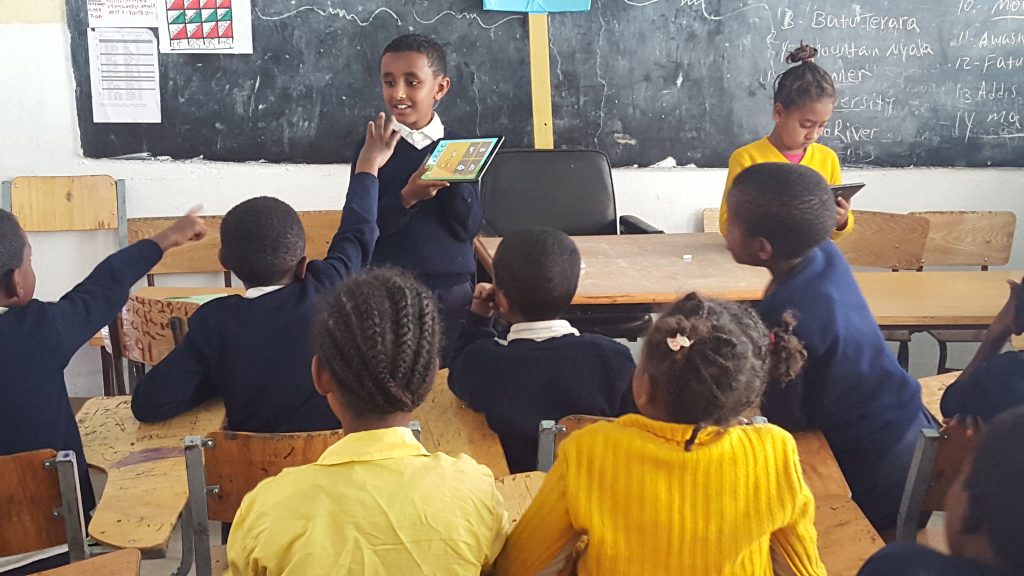
Watoto wanaohusika na programu na vidonge. Picha na Beyond Access.

UPATIKANAJI WA ELIMU

Upatikanaji wa elimu ni changamoto kubwa nchini Ethiopia, hasa katika maeneo ya vijijini. Ingawa nchi imepiga hatua kubwa katika kupanua upatikanaji wa elimu, ambapo kiwango cha uandikishaji wa shule za msingi kimeongezeka kutoka 20% mwaka 1991 hadi zaidi ya 90% katika miaka ya hivi karibuni, bado kuna changamoto katika maeneo ya vijijini. Shule nyingi katika maeneo haya hukosa ufadhili wa kutosha, zina uhaba wa walimu, na mara nyingi wanafunzi hulazimika kusafiri umbali mrefu ili kufika shuleni.

Ili kukabiliana na changamoto hii, serikali ya Ethiopia imeanzisha sera mbalimbali za kupanua upatikanaji wa elimu katika maeneo ya vijijini. Kwa mfano, serikali imeanzisha programu za kujenga shule zaidi vijijini, kugawa vitabu vya kiada bure kwa wanafunzi, na kutoa chakula shuleni kwa wanafunzi.

Kutokuweza Kurekebisha Mtaala

Watafiti katika uwanja wa mahitaji maalum na elimu jumuishi wanapokuwa wakitetea haki ya watoto wenye mahitaji maalum ya kupata elimu, mtaala unaopaswa kupitishwa unapaswa kuwa jumuishi kwa kubainisha mahitaji ya msingi kwa wanafunzi wote. Mahitaji maalum ya kielimu, kijamii, kihisia, na kimwili ya wanafunzi yatashughulikiwa iwapo watunzi wa mtaala watazingatia watoto wenye ulemavu wakati wa kubuni na kuendeleza mtaala. Marekebisho ya mtaala hayawanufaishi tu wanafunzi wenye ulemavu bali pia huchangia katika kujifunza kwa mafanikio kwa wanafunzi wote katika kupata ujuzi wa muktadha.

Kwa wanafunzi wengi wenye ulemavu na hata kwa wasio na ulemavu, ufunguo wa mafanikio darasani unategemea upatikanaji wa marekebisho, mazingira rafiki, na mabadiliko sahihi katika ufundishaji na shughuli nyingine za darasani. Hata hivyo, matokeo ya utafiti yanaonyesha kuwa katika baadhi ya matukio, mtaala unapatikana kuwa mgumu kubadilika, hasa katika suala la muundo na usimamizi wa ratiba za masomo. Kwa mfano, mara nyingi ratiba za masomo hazizingatii mahitaji ya watoto wenye ulemavu. Katika hali bora, mtoto mwenye mahitaji maalum anaweza kuhitaji muda zaidi kukamilisha kazi ile ile ambayo inaweza kufanywa kwa haraka na mtu asiye na ulemavu.

Kutokana na changamoto hizo, watoto wenye ulemavu hawapati elimu bora. Hali hii inaashiria ukubwa wa matatizo yaliyojikita ndani ya taasisi zetu za mafunzo. Walimu hawajafundishwa ipasavyo ili waweze kufundisha wanafunzi wenye uwezo na asili tofauti. Uwezo wa kusoma maandishi ya Braille na kutumia lugha ya alama haukuwa wa kutosha, na hakukuwa na mpango madhubuti wa kuwajengea ujuzi walimu walioko kazini. Hata walimu waliopitia mafunzo ya mahitaji maalum na elimu jumuishi hawakuwa wamepewa ujuzi wa kutosha wa kutumia Braille na lugha ya alama.

Mafunzo bora ya walimu ni moja ya nguzo kuu za elimu jumuishi yenye ubora. Hata hivyo, mafunzo ya walimu yanakabiliwa na changamoto za msingi katika kuwawezesha kufundisha watoto kulingana na mahitaji yao maalum. Kutokana na hili, mafunzo duni ya walimu na uhaba wa walimu waliofunzwa ipasavyo vimechangia katika utoaji wa elimu duni kwa watoto wenye ulemavu. Ingawa kuna walimu wachache waliomaliza masomo katika mahitaji maalum na elimu jumuishi, mafunzo waliyopitia hayakuwapa weledi wa kutosha katika ufundishaji.

Lugha

Ethiopia, ikiwa taifa lenye lugha nyingi, inakabiliwa na changamoto nyingi za mawasiliano ambazo huathiri moja kwa moja mfumo wa elimu na mtaala kwa ujumla. Sera ya elimu inaonekana kuwa imefungwa katika itikadi ya siasa za kikabila, ambazo zilianzishwa rasmi mwaka wa 1991 kwa msaada wa katiba ya Ethiopia baada ya TPLF kushika madaraka.

Sera hii mpya ilitarajia mfumo wa elimu ambao ungewafanya wanafunzi kuwa na ujuzi wa lugha nyingi, lakini lugha za kienyeji zingetolewa tu kwa msingi wa mapendekezo ya wazazi. Sera hiyo inasema kuwa lugha ya Kiingereza inapaswa kufundishwa kuanzia Darasa la 1, huku Lugha ya Kazi ya Shirikisho la Ethiopia, kama vile Kiamhari, ikitolewa tu baada ya Darasa la 3 na kwa msingi wa mapendekezo ya wazazi.

Licha ya hatua hizi za kushughulikia changamoto ya lugha, majimbo ya kikanda yameendelea kuwa na mamlaka ya kuamua ni lugha gani wanafunzi wanapaswa kutumia shuleni. Hata hivyo, baada ya Darasa la 9, lugha ya kufundishia itakuwa Kiingereza pekee. Hili limeidhinishwa na Wizara ya Elimu ya Shirikisho.

Katika maendeleo yanayohusiana, Baraza la Mawaziri lilipitisha uamuzi unaoaminika kutoa uhuru zaidi kwa vyuo vikuu kwa kuwaruhusu kujipatia mapato yao wenyewe na kutoa huduma mbalimbali kwa umma.
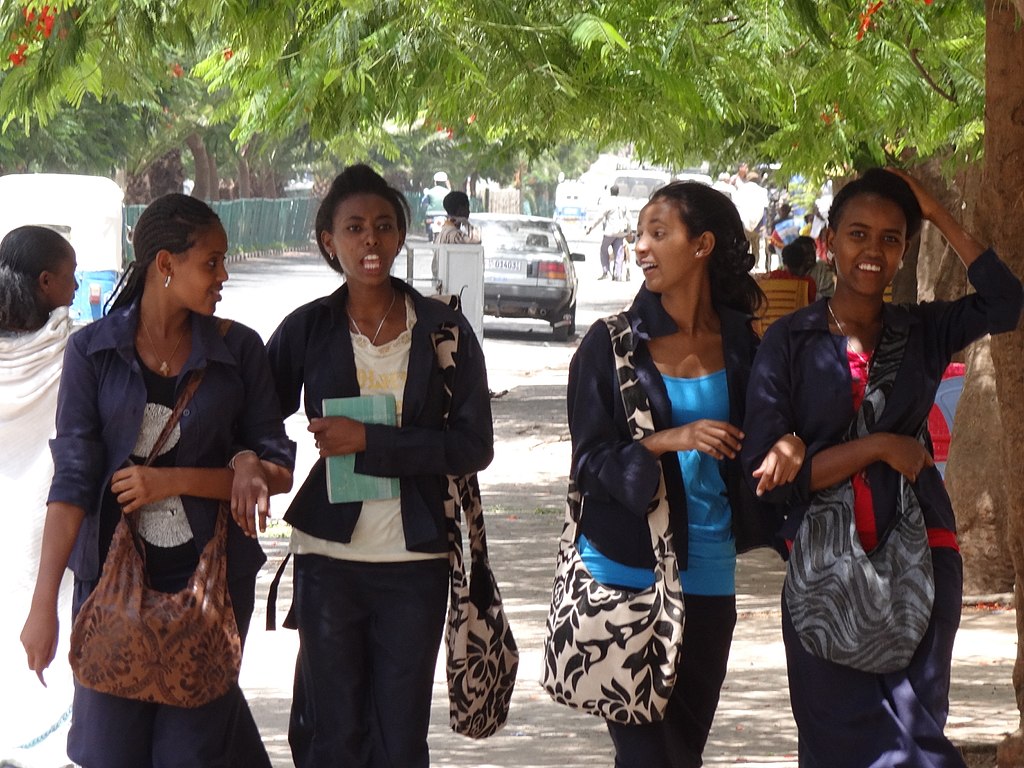
Wanafunzi Wa kike wa Oung Kwenye Boulevard-Axum (Aksum) – Ethiopia. Picha Na Adam Jones.

Kutojua kwa wadau kuhusu haki ya watoto kupata elimu

Kama inavyoaminika, wadau wa elimu ni wazazi, watoto walioko shuleni, walimu, wakuu wa shule na wasimamizi, wataalamu, na maafisa katika mfumo wa elimu. Hata hivyo, kuna tofauti kubwa miongoni mwa wadau wa elimu kuhusu haki ya watoto wenye ulemavu kupata elimu. Wengine wa wadau hawa hawaelewi kikamilifu haki ya watoto kupata elimu. Kutopatikana kwa Ofisi ya Elimu yenyewe, mgawo mdogo wa bajeti, na ukosefu wa wakalimani wa lugha ya alama mashuleni ni ushahidi wa kiwango ambacho mfumo wa elimu haujatambua haki ya watoto wenye ulemavu kupata elimu.
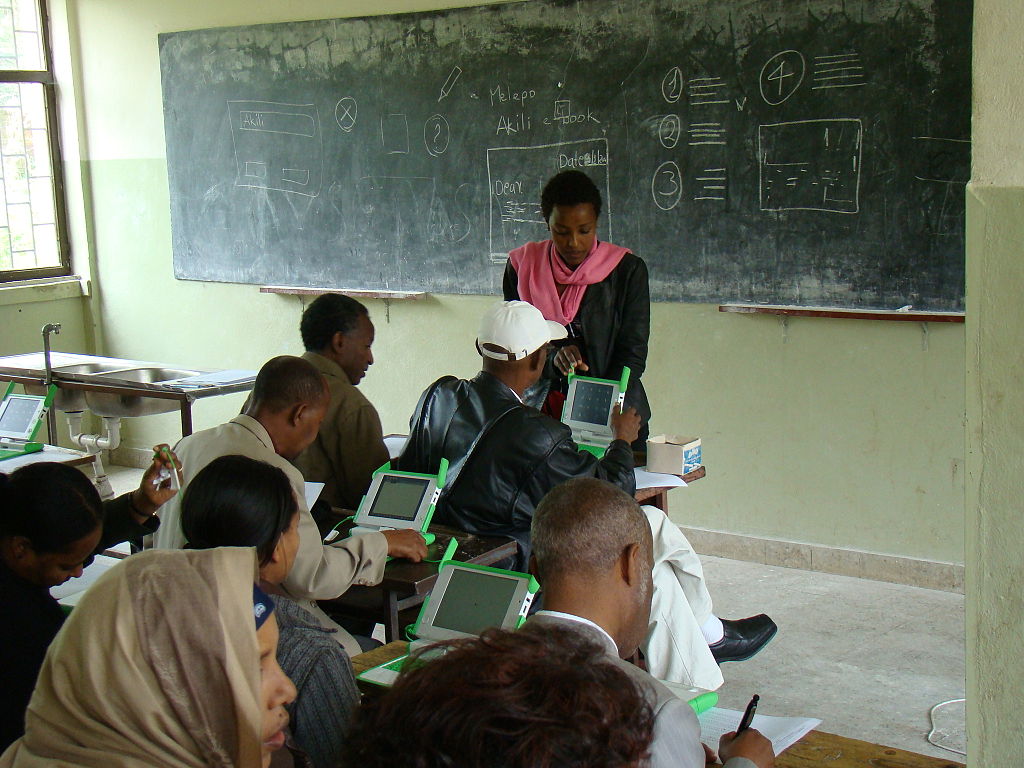
Wanafunzi wa mafunzo ya ualimu juu ya matumizi ya teknolojia. Picha na One Laptop per Child.

Ubora wa Elimu

Changamoto nyingine kubwa inayoikumba sekta ya elimu nchini Ethiopia ni ubora wa elimu. Ingawa nchi imepiga hatua kubwa katika kupanua fursa za elimu, ubora wa elimu bado uko chini, hasa katika maeneo ya vijijini. Wanafunzi nchini Ethiopia mara nyingi hukabiliana na changamoto katika kusoma na kufanya hesabu za msingi, na mfumo wa elimu umekuwa ukikosolewa kwa kutegemea sana kuhifadhi maudhui bila ubunifu.

Ili kukabiliana na changamoto hii, serikali ya Ethiopia imeanzisha sera zinazolenga kuboresha ubora wa elimu. Kwa mfano, serikali imeanzisha sera za kuboresha mafunzo na maendeleo ya kitaaluma kwa walimu, kukuza matumizi ya teknolojia katika elimu, na kuboresha mitaala.

Hata hivyo, juhudi hizi zimekumbwa na changamoto kama vile ukosefu wa rasilimali na miundombinu inayohitajika kuunga mkono mipango hii.

Pengo la Miundombinu

Pengo la miundombinu ni changamoto nyingine kubwa inayoikumba mfumo wa elimu nchini Ethiopia. Zaidi ya 85% ya Waethiopia wanaishi vijijini ambako miundombinu bado haijaimarishwa vizuri. Kwa sababu hii, makazi ya watu yameenea kwa umbali mkubwa, shule ziko mbali, na jiografia ya maeneo haya imejaa vikwazo. Njia kutoka nyumbani hadi shuleni ni za miinuko na zenye miteremko mikali. Kutokana na hali hii, watoto wenye ulemavu wa viungo na kuona wanakabiliwa na changamoto kubwa, si tu ya kufika shuleni bali pia ya kushiriki kikamilifu katika shughuli za shule pamoja na wenzao wasio na ulemavu.

Miundombinu pamoja na njia za kufikia madarasa, ofisi, mwongozo wa wanafunzi, na huduma za ushauri ni changamoto kwa wanafunzi wenye ulemavu, kiasi cha kuwafanya wasihudhurie shule wala kushiriki ipasavyo katika mchakato wa kujifunza. Mazingira yenye vizuizi vichache yanaweza kusaidia kufanikisha ujumuishaji wa watoto wenye ulemavu. Kinyume na hilo, hata hivyo, njia nyingi ni za miinuko, miteremko, na zina mabonde. Kupita kwenye njia hizi ni kazi ngumu kwa wanafunzi wenye ulemavu wa viungo na kuona, jambo ambalo lilidhihirika wazi kwa washiriki wengi wa vikundi vya majadiliano ya kijamii (FGD).

Shule nyingi nchini Ethiopia hazina miundombinu ya msingi kama vile madarasa, maktaba, na vyoo. Pengo hili la miundombinu linaathiri kwa kiasi kikubwa ubora wa elimu, ambapo msongamano wa wanafunzi darasani na uhaba wa vifaa vinavyohitajika unazuia uwezo wa wanafunzi kujifunza ipasavyo.

Wahusika katika sekta ya elimu wamebainisha kuwa majengo mengi ya shule za kawaida hayakujengwa kwa kuzingatia mahitaji ya watu wenye ulemavu. Kama ilivyoonyeshwa wazi katika matokeo ya utafiti, miundombinu duni pamoja na njia za kufikia madarasa, ofisi, mwongozo wa wanafunzi, na huduma za ushauri zimewazuia wanafunzi wenye ulemavu kuhudhuria shule na kushiriki kikamilifu katika mchakato wa kujifunza. Shule za msingi kwa ujumla zina maeneo yenye milima na mabonde mengi, jambo ambalo limekuwa changamoto kubwa kwa ujumuishaji wa watoto wenye ulemavu wa kutembea. Kwa hivyo, hali inayoonekana ni kwamba utoaji wa miundombinu unakuwa changamoto kubwa kwa wale wanaotekeleza sera hizo.

Ili kukabiliana na changamoto hii, serikali ya Ethiopia imeanzisha sera zinazolenga kuboresha miundombinu mashuleni. Kwa mfano, serikali imeanzisha programu za kujenga shule zaidi, kukarabati shule zilizopo, na kutoa miundombinu ya msingi kama vile vyoo na maji shuleni. Hata hivyo, maendeleo ya miundombinu nchini Ethiopia yanakabiliwa na changamoto kama vile rasilimali chache na ufadhili wa kutosha kwa ajili ya maendeleo ya miundombinu.

Pengo la Miundombinu

Pengo la miundombinu ni changamoto nyingine kubwa inayokabili mfumo wa elimu nchini Ethiopia. Zaidi ya 85% ya Waethiopia wanaishi vijijini ambako miundombinu bado haijajengwa ipasavyo. Matokeo yake, nyumba zimetawanyika, shule ziko mbali, na jiografia ina vikwazo vingi. Njia kutoka nyumbani hadi shuleni ni za milima na miinuko. Kutokana na hali hii, watoto wenye ulemavu wa viungo na uoni wamekumbana na changamoto kubwa, hasa ya kufika shuleni na, hata zaidi, kushiriki kikamilifu katika shughuli za shule pamoja na watoto wasio na ulemavu.

Miundombinu ya shule, pamoja na njia za kuingia madarasani, ofisi za walimu, na sehemu za ushauri, zinawakwamisha wanafunzi wenye ulemavu kufika shuleni na kushiriki kikamilifu katika mchakato wa kujifunza. Mazingira yasiyo na vikwazo yanaweza kusaidia kujumuishwa kwa watoto wenye ulemavu. Hata hivyo, kinyume chake, njia nyingi ni za milima, miinuko, na hatari kwa wanafunzi wenye ulemavu wa viungo na uoni. Wengi wa washiriki wa mazungumzo ya vikundi (FGD) walikubaliana kwamba kuvuka njia hizo ni kazi ngumu kwa wanafunzi wenye ulemavu wa kimwili na wa kuona.

Shule nyingi nchini Ethiopia zinakosa miundombinu ya msingi kama madarasa, maktaba, na vyoo. Pengo hili la miundombinu linaathiri sana ubora wa elimu, ambapo madarasa yaliyojaa kupita kiasi na ukosefu wa vifaa vya msingi huathiri uwezo wa wanafunzi kujifunza.

Wafanyakazi wa sekta ya elimu walieleza kuwa majengo mengi ya shule za kawaida hayajajengwa kwa kuzingatia mahitaji ya watu wenye ulemavu. Kama ilivyoonyeshwa katika utafiti, miundombinu duni pamoja na njia za kuingia madarasani, ofisi za walimu, na sehemu za ushauri vimewazuia wanafunzi wenye ulemavu kwenda shule na kushiriki kikamilifu katika mchakato wa kujifunza. Shule za msingi hasa zina miundombinu isiyofaa, na hivyo kujumuishwa kwa watoto wenye ulemavu wa viungo linakuwa jambo gumu. Matokeo yake, changamoto kubwa kwa wale wanaotekeleza sera hizi ni jinsi ya kuboresha miundombinu.

Ili kukabiliana na changamoto hii, serikali ya Ethiopia imeanzisha sera zinazolenga kuboresha miundombinu ya shule, kama vile kujenga shule mpya, kukarabati shule zilizopo, na kutoa miundombinu ya msingi kama vyoo na maji safi shuleni. Hata hivyo, maendeleo ya miundombinu nchini Ethiopia yanakabiliwa na changamoto kama vile uhaba wa rasilimali na ukosefu wa ufadhili wa kutosha kwa maendeleo ya miundombinu.

Uhaba wa Walimu wa Elimu Maalum

Walimu waliopata mafunzo ya elimu maalum wanaweza kusaidia kutekeleza ujumuishaji wa watoto wenye ulemavu. Ili kufanya hivyo, idadi yao inapaswa kuwa ya kutosha ili kutoa msaada wa kitaaluma kwa walimu wa elimu ya jumla na wanafunzi wenye ulemavu. Hata hivyo, kinyume chake, nchi haijaweza kuwafunza walimu wa elimu maalum na ujumuishi kwa kiwango cha kutosha ili kukidhi mahitaji yaliyopo.

Uhaba wa walimu wenye mafunzo ya elimu maalum na ujumuishi ni moja ya changamoto kubwa zinazokwamisha utekelezaji wa elimu jumuishi. Ili kuhakikisha ujumuishaji wa watoto wenye ulemavu, walimu wa elimu ya jumla wanapaswa kupata mafunzo maalum au kusaidiwa na walimu wa elimu maalum darasani.

Katika jamii za vijijini, familia nyingi zina majukumu mbalimbali ya kiuchumi. Kila mtu katika familia ana kazi yake – mmoja anachunga mifugo, mwingine analima, mwingine anakusanya kuni, na mwingine anachota maji. Katika mazingira haya, kutafuta shule yenye madarasa maalum, kumpeleka mtoto mwenye ulemavu huko, na kumrudisha nyumbani kila siku ni kazi isiyo na mwenyewe. Kwa hivyo, uamuzi mgumu unaochukuliwa na familia nyingi ni kumficha mtoto mwenye ulemavu nyumbani.

Katika miji, ingawa kuna shule nyingi za kibiashara, gharama ya kuwaajiri walimu wa elimu maalum ni kubwa. Kwa kuwa kutowasajili watoto wenye ulemavu kunaweza kuwa na athari za kisheria, baadhi ya shule huwajumuisha lakini huwaacha bila msaada wowote maalum.

Ili kukabiliana na changamoto hii, serikali ya Ethiopia imeanzisha sera za kuongeza idadi ya walimu wenye mafunzo maalum. Hii ni pamoja na kuajiri walimu zaidi, kutoa mafunzo na maendeleo ya kitaaluma kwa walimu, pamoja na kuboresha mishahara na mazingira yao ya kazi.

Hitimisho

Kwa kumalizia, Ethiopia inakabiliwa na changamoto kubwa katika sekta ya elimu, ikiwa ni pamoja na upatikanaji mdogo wa elimu, ubora wa elimu duni, pengo la miundombinu, uhaba wa walimu, na mtaala usio wa kisasa. Ingawa serikali imeanzisha sera za kukabiliana na changamoto hizi, bado kunahitajika juhudi za pamoja ili kuboresha mfumo wa elimu nchini.

Hii inaweza kujumuisha uwekezaji zaidi katika elimu, mafunzo na msaada bora kwa walimu, maendeleo ya miundombinu, na kuunda mtaala wa kisasa unaoendana na mahitaji ya wanafunzi na uchumi wa taifa.

Ripoti za Wizara ya Elimu ya Ethiopia zinaonyesha kuwa kundi lililoathirika zaidi katika mfumo wa elimu ni watoto wenye ulemavu, ambao wengi wao bado hawana fursa ya kupata elimu. Hata wale walio na fursa ya kusoma hukutana na mazingira yasiyo rafiki kwao.

Kwa hivyo, ili kuhakikisha ujumuishaji wa kweli, ni muhimu kutambua vikwazo vinavyowakabili watoto wenye ulemavu na kupendekeza suluhisho madhubuti. Kwa kushughulikia changamoto hizi, Ethiopia inaweza kuimarisha ubora wa elimu kwa raia wake wote na kuboresha maendeleo ya kijamii na kiuchumi ya nchi.

References:

United Nations Development Programme (2019) Ethiopia: Education. Retrieved from http://www.et.undp.org/content/ethiopia/en/home/countryinfo.html

World Bank (2021) Education in Ethiopia Retrieved from https://www.worldbank.org/en/country/ethiopia/brief/education-in-ethiopia

GEBEYEHU, A. M. (2017). Quality of Education in Ethiopia: From the Perspective of Learners, Teachers and Parents. Journal of Education and Practice, 8(10), 76-85.

World Bank (2018) Ethiopia Education Sector Development Program V: 2015-2020. Retrieved from http://documents.worldbank.org/curated/en/180601551693773672/Ethiopia-Education-Sector-Development-Program-V-2015-2020

Ethiopian Ministry of Education (2015) Education Sector Development Plan V: 2015-2020. Retrieved from https://www.moe.gov.et/web/guest/-/education-sector-development-plan-v-2015-2020

African Development Bank Group (2018). Ethiopia Country Strategy Paper 2016-2020. Retrieved from https://www.afdb.org/en/documents/document/ethiopia-country-strategy-paper-2016-2020-106665

International Labour Organization (2016) Youth Employment in Ethiopia: An Overview. Retrieved from https://www.ilo.org/wcmsp5/groups/public/—ed_emp/documents/publication/wcms_528826.pdf

The World Factbook (2021) Ethiopia retrieved from https://www.cia.gov/the-world-factbook/countries/ethiopia/

Tessema, W. K. (2019). The Ethiopian Education System: Current Trends and Future Directions. International Journal of Innovative Research and Development, 8(12), 76-84.

Mohammed, A. (2018). Challenges and Prospects of Education in Ethiopia: A Literature Review. Journal of Education and Practice, 9(1), 21-26


इरिट्रिया में शैक्षिक चुनौतियांः ऐतिहासिक संदर्भ और वर्तमान मुद्दों को नेविगेट करना

जोसेफ कामंगा द्वारा लिखित

शिक्षा व्यक्तियों और समाज के भविष्य को आकार देने में महत्वपूर्ण भूमिका निभाती है। एक जटिल इतिहास और प्रगति की प्रबल इच्छा वाले देश इरिट्रिया के मामले में, शैक्षिक परिदृश्य अतीत से विरासत में मिली चुनौतियों और इसकी शिक्षा प्रणाली द्वारा सामना किए जाने वाले समकालीन मुद्दों दोनों को दर्शाता है। ऐतिहासिक संदर्भ और वर्तमान चुनौतियों का परीक्षण करके, हम उन बाधाओं की व्यापक समझ प्राप्त करते हैं जिन्हें इरिट्रिया को अपनी आबादी के लिए न्यायसंगत और गुणवत्तापूर्ण शिक्षा सुनिश्चित करने के लिए दूर करना चाहिए।

बच्चे कक्षा में जाने का इंतजार कर रहे हैं। मेरहावी147 द्वारा फोटो

ऐतिहासिक पृष्ठभूमि

इरिट्रिया की शिक्षा प्रणाली समय के साथ विकसित हुई है, जो इसके औपनिवेशिक इतिहास और स्वतंत्रता के लिए संघर्ष से गहराई से प्रभावित है। 19वीं सदी के अंत और 20वीं सदी की शुरुआत में इतालवी औपनिवेशिक शासन के तहत, शिक्षा कुछ विशेषाधिकार प्राप्त लोगों तक ही सीमित थी, जिसका मुख्य उद्देश्य औपनिवेशिक प्रशासन के हितों की सेवा करना था। इस दृष्टिकोण ने एरिट्रिया के अधिकांश लोगों को गुणवत्तापूर्ण शिक्षा तक पहुँच से बाहर कर दिया, जिससे असमानताएँ बनी रहीं।

द्वितीय विश्व युद्ध के बाद, इरिट्रिया ब्रिटिश प्रशासन के अधीन आ गया और बाद में 1952 में इथियोपिया के साथ संघबद्ध हो गया। इस अवधि के दौरान, शिक्षा के अवसर सीमित रहे और व्यापक आबादी के लिए काफी हद तक दुर्गम रहे। हालाँकि, इरिट्रियन पीपुल्स लिबरेशन फ्रंट (ई. पी. एल. एफ.) के नेतृत्व में स्वतंत्रता के लिए सशस्त्र संघर्ष ने महत्वपूर्ण बदलाव लाए। ई. पी. एल. एफ. ने भूमिगत स्कूलों की स्थापना की, जिन्हें “माहोट” के नाम से जाना जाता है, जो इरिट्रिया की पहचान, संस्कृति और भाषा के संरक्षण पर केंद्रित थे। इस आंदोलन ने एक अधिक समावेशी और सांस्कृतिक रूप से प्रासंगिक शिक्षा प्रणाली की नींव रखी।

मौजूदा चुनौतियां

शिक्षा के लिए असमान पहुंच

इरिट्रिया में सबसे अधिक दबाव वाली चुनौतियों में से एक शिक्षा तक असमान पहुंच है। भौगोलिक कारक विशेष रूप से दूरदराज के और ग्रामीण क्षेत्रों में महत्वपूर्ण बाधाएं पैदा करते हैं। सीमित बुनियादी ढांचा और परिवहन स्कूलों की स्थापना और रखरखाव में बाधा डालते हैं, जिससे बच्चों के लिए शिक्षा प्राप्त करना मुश्किल हो जाता है। उदाहरण के लिए, देश के पश्चिमी भाग में स्थित गश बरका क्षेत्र में, स्कूलों की कमी और छात्रों को स्कूल जाने के लिए लंबी दूरी की यात्रा करनी पड़ती है, जो कई बच्चों को नियमित रूप से कक्षाओं में जाने से रोकती है। इसी तरह, दक्षिणी क्षेत्र में, खानाबदोश समुदायों के बच्चों को उनकी अस्थायी जीवन शैली और उनके प्रवासी मार्गों में शैक्षिक सुविधाओं के अभाव के कारण औपचारिक शिक्षा प्राप्त करने में कठिनाइयों का सामना करना पड़ता है।

आर्थिक बाधाएं और किफायती

आर्थिक कारक शिक्षा प्रणाली में चुनौतियों को और बढ़ा देते हैं। गरीबी, विशेष रूप से ग्रामीण क्षेत्रों में प्रचलित, परिवारों के लिए वर्दी, किताबें और परिवहन लागत जैसे स्कूल से संबंधित खर्चों को वहन करना चुनौतीपूर्ण बनाता है। वित्तीय बोझ शिक्षा तक पहुंच को प्रतिबंधित करता है, कमजोर आबादी को असमान रूप से प्रभावित करता है और गरीबी और असमानता के चक्र को बनाए रखता है। उदाहरण के लिए, अंसेबा क्षेत्र में, गरीब परिवार आवश्यक शैक्षिक खर्चों को पूरा करने के लिए संघर्ष करते हैं, जिससे कम आय वाले पृष्ठभूमि के बच्चों में स्कूल छोड़ने की दर अधिक हो जाती है। इसी तरह, असमारा जैसे शहरी क्षेत्रों में, उच्च जीवन लागत परिवारों के लिए शिक्षा के लिए पर्याप्त संसाधन आवंटित करना मुश्किल बनाती है, जिससे गुणवत्तापूर्ण स्कूली शिक्षा तक पहुंच बाधित होती है।

लैंगिक असमानताएँ

इरिट्रिया को शिक्षा तक पहुंच में लैंगिक असमानताओं का सामना करना पड़ता है। गहरे जड़ वाले सांस्कृतिक मानदंड और अपेक्षाएं अक्सर लड़कियों की तुलना में लड़कों की शिक्षा को प्राथमिकता देती हैं, जिससे लड़कियों के लिए नामांकन दर कम हो जाती है। जल्दी शादी और घरेलू जिम्मेदारियां लड़कियों के शैक्षिक अवसरों को सीमित करती हैं। कुछ क्षेत्रों में प्रारंभिक विवाह प्रचलित है, जैसे कि देबब क्षेत्र, और लड़कियों को अक्सर कम उम्र में स्कूल छोड़ने के लिए मजबूर किया जाता है, जिससे उनकी शैक्षिक उन्नति में बाधा आती है। इसके अलावा, पारंपरिक लिंग भूमिकाओं की सामाजिक धारणाएं लड़कियों के सीमित शैक्षिक और कैरियर के अवसरों में योगदान करती हैं, उनकी पूरी क्षमता को बाधित करती हैं और शिक्षा में लैंगिक समानता प्राप्त करने के प्रयासों को कमजोर करती हैं।

अस्मारा में कैथोलिक कैथेड्रल का मठ एक बड़े स्कूल की मेजबानी करता है। डेविड स्टेनली द्वारा फोटो
शिक्षा की गुणवत्ता

 इरिट्रिया में शिक्षा की गुणवत्ता एक महत्वपूर्ण चिंता का विषय है। योग्य शिक्षकों की अपर्याप्त संख्या, विशेष रूप से ग्रामीण क्षेत्रों में, अपर्याप्त सीखने के अनुभवों में योगदान करती है। शिक्षकों के व्यावसायिक विकास के अवसरों की कमी गुणवत्तापूर्ण निर्देश देने की उनकी क्षमता को और बाधित करती है। पाठ्यपुस्तकों, शिक्षण सामग्री और उचित बुनियादी ढांचे जैसे आवश्यक संसाधनों की अनुपस्थिति भी समग्र शिक्षण वातावरण को प्रभावित करती है। उदाहरण के लिए, मैकेल क्षेत्र में, भीड़भाड़ वाली कक्षाएं और प्रशिक्षित शिक्षकों की कमी शिक्षा की गुणवत्ता से समझौता करती है और छात्रों के सीखने के परिणामों में बाधा डालती है।

उच्च शिक्षा तक सीमित पहुंच

इरिट्रिया में उच्च शिक्षा तक पहुंच सीमित है। विश्वविद्यालयों की कमी और अत्यधिक प्रतिस्पर्धी प्रवेश प्रक्रियाएँ उन छात्रों की संख्या को सीमित करती हैं जो तृतीयक शिक्षा प्राप्त कर सकते हैं। यह सीमा एक कुशल कार्यबल के विकास को बाधित करती है और ज्ञान-आधारित अर्थव्यवस्था की दिशा में देश की प्रगति को बाधित करती है। उदाहरण के लिए, मध्य क्षेत्र में, जहां राजधानी शहर अस्मारा स्थित है, विश्वविद्यालयों में कुछ उपलब्ध स्थान उच्च शिक्षा की मांग करने वाले योग्य छात्रों की बढ़ती संख्या को समायोजित नहीं कर सकते हैं, जिससे तृतीयक शिक्षा के अवसरों की मांग और आपूर्ति के बीच एक महत्वपूर्ण अंतर पैदा हो जाता है।

निष्कर्ष

इरिट्रिया में शैक्षिक चुनौतियां ऐतिहासिक कारकों में गहराई से निहित हैं और वर्तमान मुद्दों से जटिल हैं। असमान पहुंच, आर्थिक बाधाएं, लैंगिक असमानताएं, शिक्षा की खराब गुणवत्ता और उच्च शिक्षा तक सीमित पहुंच देश की शिक्षा प्रणाली के विकास और प्रगति में बाधा बनी हुई है। इन चुनौतियों पर तत्काल ध्यान देने और व्यापक समाधान की आवश्यकता है। अंतर्निहित कारणों को संबोधित करके, बुनियादी ढांचे में निवेश करके, लैंगिक समानता को बढ़ावा देकर और शिक्षा की गुणवत्ता में सुधार करके, इरिट्रिया एक अधिक समावेशी और प्रभावी शिक्षा प्रणाली का मार्ग प्रशस्त कर सकता है जो अपने नागरिकों को सशक्त बनाता है और देश के दीर्घकालिक विकास लक्ष्यों का समर्थन करता है।


संदर्भ

संयुक्त राष्ट्र विकास कार्यक्रम (यूएनडीपी)-इरिट्रियाः शिक्षा क्षेत्र की समीक्षाः https://www.er.undp.org/content/eritrea/en/home/library/powerty/education-sector-review.html
संयुक्त राष्ट्र बाल कोष (यूनिसेफ)- https://www.unicef.org/eritrea/education
विश्व बैंक-इरिट्रिया में शिक्षाः https://www.worldbank.org/en/country/eritrea/publication/education-in-eritrea
संयुक्त राष्ट्र शैक्षिक, वैज्ञानिक और सांस्कृतिक संगठन (यूनेस्को)- इरिट्रियाः https://en.unesco.org/countries/eritrea
ह्यूमन राइट्स वॉच-इरिट्रियाः https://www.hrw.org/africa/eritrea

Educational Challenges in Burundi

Written by Joseph Kamanga

Introduction

Burundi, a small landlocked country in East Africa with a population of over 11 million people, has been plagued by political instability and violence throughout its history. These challenges have severely impacted the country’s education system, hindering progress and development. While some improvements have been made in recent years to enhance access to education, Burundi continues to face several critical challenges, including substandard school infrastructure, limited access to education, low quality of education, and high dropout rates. Addressing these issues requires a collaborative effort involving the government, donors, and civil society to implement sustainable solutions.

Students are eagerly waiting for the completion of their new school in Mabayi, Burundi. Photo by United Nations Development Programme.

Substandard School Infrastructure

One of the primary obstacles affecting education in Burundi is the substandard condition of school infrastructure. Many schools lack the necessary facilities and resources, impeding effective teaching and learning. The critical problems associated with school infrastructure in Burundi include:

Lack of classrooms:

 A significant number of schools in Burundi suffer from a shortage of classrooms, resulting in overcrowding. Students often have to sit on the floor or study outside, hampering their ability to learn and concentrate.

Insufficient number of teachers:

In 2017, Burundi had only 40,000 teachers for a population of over 11 million, resulting in an alarming student-to-teacher ratio. The lack of teachers compromises the quality of education as individual attention to students becomes challenging.

Shortage of textbooks and learning materials:

Access to textbooks and learning materials is limited, with only 50% of students having access to these resources in 2017. This scarcity hampers students’ ability to actively participate in class and complete their assignments effectively.

Inadequate water and sanitation facilities:

Approximately 50% of schools lack proper water and sanitation facilities, depriving students of clean water and hygienic toilets. This lack of basic amenities contributes to the spread of diseases, making it difficult for students to attend school regularly.

Insufficient electricity:

Only 30% of schools in Burundi have access to electricity, restricting the use of electronic devices and hindering the integration of technology in teaching and learning practices.

Deteriorating school buildings:

Approximately 30% of schools in Burundi require urgent repairs, rendering them unsafe and unsuitable for students. Dilapidated infrastructure adds to the challenges faced by both students and teachers.

Limited Access to Education

Access to education in rural areas of Burundi is significantly limited due to various factors:

Poverty:

Poverty is a significant barrier preventing families from sending their children to school, even when educational institutions are available. The inability to afford school fees and related expenses hampers children’s access to education.

Distance:

The geographical remoteness of rural areas in Burundi makes it challenging for children to access schools, resulting in limited educational opportunities.

Gender discrimination:

Girls, particularly in rural areas, face gender-based barriers to education. Cultural beliefs often dictate that girls should prioritize household responsibilities, impeding their access to formal education. Additionally, the lack of adequate sanitation facilities specifically designed for girls discourages their attendance.

The combined effect of poverty, distance, and gender discrimination has led to an estimated 600,000 girls in Burundi not attending school during the 2017-2018 academic year.

Low Quality of Education

The issue of low quality of education in Burundi encompasses various factors that contribute to a substandard learning experience for students. These factors can be attributed to the lack of resources, inadequate teacher training, outdated curriculum, and insufficient focus on student-centred learning approaches as follows:

Insufficient focus on student-centred learning: A student-centred approach to education emphasizes active participation, collaboration, and critical thinking. However, the traditional teaching methods employed in Burundi often prioritize rote memorization and passive learning. Shifting towards student-centred approaches, such as project-based learning, inquiry-based learning, and interactive teaching methods, can foster a deeper understanding of concepts and improve students’ ability to apply knowledge in practical situations.

The quality of education in Burundi is generally low, attributed to several factors:

Lack of qualified teachers:

A considerable number of teachers in Burundi need to be qualified or adequately trained. Moreover, the low salaries offered to qualified teachers often discourage highly skilled individuals from pursuing a career in education. As a result, the quality of instruction suffers. The quality of education is closely linked to the competence and skills of teachers. In Burundi, there is a need to invest in comprehensive teacher training programs that focus on pedagogical techniques, subject knowledge, and classroom management. Without proper training, teachers may rely on outdated teaching methods or struggle to effectively engage students in the learning process. Ongoing professional development opportunities can help teachers stay updated with best practices and enhance their instructional strategies.

Poor quality textbooks:

Many textbooks in Burundi are outdated or inaccurate, failing to provide up-to-date and accurate information to students. This hinders their ability to acquire knowledge effectively.

Outdated Curriculum:

The curriculum used in Burundi’s education system may suffer from outdated content, limited relevance to real-world contexts, and a lack of alignment with modern educational standards. Updating the curriculum to reflect current knowledge and skills required in the job market is crucial. A contemporary curriculum should promote critical thinking, problem-solving, creativity, and digital literacy, equipping students with the competencies necessary for future success.

Insufficient resources:

Many schools in Burundi need more essential resources, such as textbooks, learning materials, and technological equipment. Without access to up-to-date and relevant resources, students may struggle to grasp concepts and engage in meaningful learning. Insufficient resources also limit teachers’ ability to deliver comprehensive lessons and provide students with hands-on experiences that enhance their understanding of subjects.

High dropout rates:

Burundi experiences alarmingly high dropout rates among girls and children from disadvantaged backgrounds. Factors contributing to these high dropout rates include:

a. Poverty: Economic constraints force many families to prioritize immediate needs over education, making it difficult for children to continue their studies.

b. Early marriage: The prevalence of early marriage in Burundi prevents girls from pursuing education beyond a certain age. Early marriage often leads to the discontinuation of their schooling.

c. The need to work: Many children in Burundi are compelled to work to support their families, leaving them with no time or opportunity to attend school.

Addressing these complex challenges requires a multifaceted approach involving various stakeholders.

The Charlemagne School in Burundi. Photo by Bernd Weisbrod

Challenges faced by Children with disability

Children with disabilities face significant challenges in accessing quality education in Burundi. The educational system in the country often lacks the necessary infrastructure, resources, and inclusive policies to accommodate their diverse needs. Here are some key challenges faced by children with disabilities in Burundi’s education system:

Inadequate infrastructure and facilities:

Many schools in Burundi lack the necessary infrastructure and facilities to support children with disabilities. This includes wheelchair-accessible ramps, adapted classrooms, and accessible toilets. The physical barriers in schools make it difficult for children with mobility impairments to navigate the campus and fully participate in educational activities.

Limited availability of specialized support:

Specialized support services, such as trained teachers, therapists, and assistive devices, are scarce for children with disabilities in Burundi. These children often require individualized attention and tailored instructional approaches to address their specific learning needs. The need for more trained professionals and appropriate assistive technology hampers their educational progress.

Discrimination and stigma:

Children with disabilities in Burundi often face discrimination and stigma within their communities and schools. This can create psychological barriers affecting their self-esteem, confidence, and willingness to engage in learning. Negative attitudes and misconceptions about disability can lead to exclusion and social isolation.

Limited awareness and understanding:

There is a lack of awareness and understanding among educators, parents, and the wider community about disabilities and inclusive education. This can result in a failure to recognize and accommodate the diverse learning needs of children with disabilities. Promoting awareness campaigns and training teachers and stakeholders to foster an inclusive and supportive learning environment is crucial.

Inaccessible curriculum and teaching methods:

Burundi’s curriculum and teaching methods often do not consider the diverse learning styles and needs of children with disabilities. The instructional materials and assessments may not be adapted to cater to their specific requirements, hindering their full participation in the educational process. Adapting the curriculum and employing inclusive teaching strategies can help ensure that children with disabilities receive an equitable education.

Interventions to Improve Burundi’s Education System

To enhance the education system in Burundi, the following vital interventions are necessary:

Teacher Training and Professional Development:

To improve the quality of education in Burundi, a strong emphasis should be placed on teacher training and professional development programs. The government, in collaboration with educational institutions and international partners, should establish comprehensive training programs to enhance teachers’ skills and pedagogical techniques. Ongoing professional development opportunities should be provided to ensure that teachers are equipped with the latest teaching methodologies and subject knowledge. By investing in the professional growth of teachers, the overall quality of education in Burundi can be significantly improved.

Promoting Inclusive Education:

Another critical aspect of enhancing the education system in Burundi is promoting inclusive education. Efforts should be made to ensure that children with disabilities, those from marginalized communities, and those with special learning needs have equal access to education. This requires developing inclusive policies, providing necessary support services and resources, and effectively training teachers to cater to diverse learning needs. Inclusive education not only fosters a sense of equality and social cohesion but also maximizes the potential of all children, contributing to the nation’s overall development.

Enhancing Parent and Community Involvement:

To create a holistic and supportive learning environment, it is essential to enhance the involvement of parents and the wider community in education. Establishing partnerships between schools, parents, and community organizations can facilitate collaborative efforts in promoting education. This can involve initiatives such as parent-teacher associations, community outreach programs, and awareness campaigns on the importance of education. Engaging parents and the community can contribute to increased school attendance, reduced dropout rates, and improved educational outcomes for children in Burundi.

Integration of Technology in Education:

Integrating technology in education can revolutionize the learning experience for students in Burundi. Access to computers, internet connectivity, and digital learning resources can enhance teaching and learning methods, promote interactive and self-directed learning, and foster digital literacy skills. The government should prioritize initiatives to provide schools with the necessary technological infrastructure and ensure that teachers receive adequate training to utilize technology in their classrooms effectively. By embracing technology, Burundi can bridge the digital divide and equip its students with the skills needed for the modern world.

Monitoring and Evaluation:

A robust monitoring and evaluation system should be established to assess the progress and impact of education initiatives in Burundi. Regular assessments of school infrastructure, teacher quality, student performance, and dropout rates are essential to identify areas of improvement and make informed policy decisions. Additionally, collecting data on gender disparities, educational equity, and access to education can help design targeted interventions. Monitoring and evaluation provide the necessary feedback loop to ensure that efforts to enhance the education system in Burundi are effective and sustainable.

Violence has affected the infraestructure of schools in the country. Photo by EU/ECHO/Anouk Delafortrie

Investing in school infrastructure:

The government should prioritize investments in the construction and rehabilitation of schools. Adequate classrooms, furniture, and facilities are essential for creating a conducive learning environment.

Expanding access to education:

Efforts should be made to improve access to education, particularly in rural areas. This can be achieved by constructing additional schools, recruiting and training more qualified teachers, and providing transportation subsidies to ensure students can reach schools despite the distance.

Improving the quality of education:

The government must focus on improving the quality of education by enhancing teacher training programs and attracting skilled educators. Additionally, ensuring the availability of updated textbooks, learning materials, and technological resources is crucial for fostering a quality learning environment.

Reducing dropout rates:

To address the high dropout rates, comprehensive strategies must be implemented. This includes targeted interventions to alleviate poverty, awareness campaigns to discourage early marriages, and initiatives to provide financial assistance to families struggling with school fees.

Addressing these challenges for children with a disability requires a concerted effort from the government, educators, families, and civil society organizations. The following interventions can help improve educational opportunities for children with disabilities:

Inclusive policies and legislation:

The government should establish and enforce inclusive education policies that protect the rights of children with disabilities and ensure their access to quality education. This includes promoting inclusive practices, providing reasonable accommodations, and eliminating school discrimination.

Training and professional development:

Teachers and education professionals need specialized training on inclusive education and strategies to support children with disabilities. This training should focus on adapting teaching methods, creating accessible learning materials, and using assistive technology effectively.

Provision of support services:

Adequate resources should be allocated to provide necessary support services, such as speech therapy, occupational therapy, and psychological support, to children with disabilities. This includes recruiting and training specialized professionals who can work directly with these children.

Infrastructure and accessibility:

Schools should be equipped with appropriate infrastructure and facilities to ensure accessibility for children with disabilities. This involves constructing wheelchair ramps, installing accessible toilets, and adapting classrooms to accommodate different types of disabilities.

Awareness and community engagement:

Conducting awareness campaigns to combat stigma, raise awareness about disabilities, and promote the importance of inclusive education is essential. Engaging parents, communities, and local organizations in educating children with disabilities can help foster an inclusive and supportive environment.

By addressing these challenges and implementing inclusive practices, Burundi can create a more inclusive education system that ensures equal educational opportunities for all children, including those with disabilities.

Conclusion

Burundi’s education system faces significant challenges, including substandard school infrastructure, limited access to education, low quality of education, and high dropout rates. These issues have profound implications for the country’s development and the well-being of its population. However, these challenges can be overcome with the joint efforts of the government, donors, and civil society. By investing in school infrastructure, expanding access to education, improving the quality of instruction, and implementing strategies to reduce dropout rates, Burundi can pave the way for a brighter future, ensuring that all children have equal opportunities to access quality education.


References:

United Nations Educational, Scientific and Cultural Organization (UNESCO). (2018). Education for All Global Monitoring Report: Education Progress and Challenges in Burundi. Retrieved from https://unesdoc.unesco.org/ark:/48223/pf0000246736

World Bank. (2020). Burundi Education Sector Analysis: Challenges and Opportunities for System Improvement. Retrieved from https://openknowledge.worldbank.org/handle/10986/33776

UNICEF. (2019). Education in Emergencies Annual Report 2019 – Burundi. Retrieved from https://www.unicef.org/burundi/reports/education-emergencies-annual-report-2019

Human Rights Watch. (2017). Burundi: Girls’ Education under Threat. Retrieved from https://www.hrw.org/news/2017/09/07/burundi-girls-education-under-threat

Save the Children. (2020). Education in Burundi: Challenges and Opportunities. Retrieved from https://resourcecentre.savethechildren.net/node/18701/pdf/education_in_burundi.pdf

Plan International. (2019). Education in Burundi: Challenges and Solutions. Retrieved from https://plan-international.org/publications/education-burundi-challenges-and-solutions

Handicap International. (2018). Education for All in Burundi: Study on Inclusive Education. Retrieved from https://www.hi-us.org/wp-content/uploads/2018/08/education-for-all-in-burundi-study-on-inclusive-education.pdf

Burundi Ministry of Education. (2019). Strategic Plan for Education and Vocational Training 2018-2027. Retrieved from http://www.men.estburundi.org/plan-strategique

African Development Bank Group. (2017). Burundi Country Strategy Paper 2017-2021. Retrieved from https://www.afdb.org/fileadmin/uploads/afdb/Documents/Project-and-Operations/Burundi_-_CSP_2017-2021_With_CAADP.pdf

The New Humanitarian. (2020). Burundi’s Education System Faces Multiple Crises. Retrieved from https://www.thenewhumanitarian.org/analysis/2020/01/20/burundi-education-crisis-challenges

2022 Enlargement Package: European Commission Assesses Reforms in the Western Balkans and Turkey, Recommends Candidate Status for Bosnia and Herzegovina

Written by Joseph Kamanga

The European Commission has adopted its 2022 Enlargement Package, which evaluates the progress made by the Western Balkans and Turkey on their path toward EU membership. The Commission recommends granting candidate status to Bosnia and Herzegovina, contingent upon their implementation of measures to strengthen democracy, uphold the rule of law, combat corruption, and safeguard media freedom.

State of the EU: MEPs debate about the EU’s most immediate challenges. Photo by European Parliament

The Commission highlights the significance of EU enlargement as a long-term investment in peace and stability. Montenegro needs to address rule of law concerns, while Serbia should establish a government committed to EU reforms. Albania and North Macedonia must intensify their efforts in upholding the rule of law, combating corruption, and fighting organized crime.

Kosovo should enhance democracy and combat corruption, while Serbia and Kosovo are expected to engage in constructive dialogue to normalize their relations. Turkey needs to address concerns regarding democracy, the rule of law, and fundamental rights, while respecting the sovereignty of EU member states.

The Council will now assess the Commission’s recommendations and decide on the subsequent actions to be taken.

Educational Challenges in Eritrea: Navigating Historical Context and Current Issues

Written by Joseph Kamanga

Education plays a pivotal role in shaping the future of individuals and societies. In the case of Eritrea, a country with a complex history and a strong desire for progress, the educational landscape reflects both the challenges inherited from the past and the contemporary issues faced by its education system. By examining the historical context and the current challenges, we gain a comprehensive understanding of the obstacles that Eritrea must overcome to ensure equitable and quality education for its population.

Children waiting to go to class. Photo by Merhawi147

Historical Background

Eritrea’s educational system has evolved over time, deeply influenced by its colonial history and the struggle for independence. Under Italian colonial rule in the late 19th and early 20th centuries, education was limited to a privileged few, primarily aimed at serving the interests of the colonial administration. This approach excluded the majority of Eritreans from accessing quality education, perpetuating inequities.

After World War II, Eritrea came under British administration and later federated with Ethiopia in 1952. During this period, educational opportunities remained limited and largely inaccessible to the broader population. However, the armed struggle for independence led by the Eritrean People’s Liberation Front (EPLF) brought about significant changes. The EPLF established underground schools, known as “ma’htot,” which focused on preserving Eritrean identity, culture, and language. This movement laid the foundation for a more inclusive and culturally relevant education system.

Current Challenges

Inequitable Access to Education

One of the most pressing challenges in Eritrea is inequitable access to education. Geographical factors pose significant barriers, particularly in remote and rural areas. Limited infrastructure and transportation hinder the establishment and maintenance of schools, making it difficult for children to access education. For example, in the Gash Barka region, located in the western part of the country, the lack of schools and the long distances students have to travel to get to school prevent many children from attending classes regularly. Similarly, in the Southern region, children from nomadic communities face difficulties in accessing formal education due to their transient lifestyle and the absence of educational facilities in their migratory routes.

Economic Constraints and Affordability

Economic factors further exacerbate the challenges in the education system. Poverty, particularly prevalent in rural areas, makes it challenging for families to afford school-related expenses such as uniforms, books, and transportation costs. The financial burden restricts access to education, disproportionately affecting vulnerable populations and perpetuating cycles of poverty and inequality. For instance, in the Anseba region, impoverished families struggle to cover essential educational expenses, leading to higher dropout rates among children from low-income backgrounds. Similarly, in urban areas such as Asmara, high living costs make it difficult for families to allocate sufficient resources for education, hindering access to quality schooling.

Gender Disparities

Eritrea faces gender disparities in access to education. Deep-rooted cultural norms and expectations often prioritize boys’ education over girls’, leading to lower enrollment rates for girls. Early marriage and assigned domestic responsibilities limit girls’ educational opportunities. Early marriage is prevalent in some areas, such as the Debub region, and girls are often forced to drop out of school at a young age, hindering their educational advancement. Furthermore, societal perceptions of traditional gender roles contribute to girls’ limited educational and career opportunities, constraining their full potential and undermining efforts to achieve gender equality in education.

The cloister of the Catholic Cathedral in Asmara hosts a large school. Photo by David Stanley.
Quality of Education

The quality of education in Eritrea is a significant concern. Insufficient numbers of qualified teachers, especially in rural areas, contribute to inadequate learning experiences. Teachers’ lack of professional development opportunities further hampers their ability to deliver quality instruction. The absence of essential resources such as textbooks, learning materials, and proper infrastructure also impacts the overall learning environment. In the Maekel region, for example, overcrowded classrooms and a shortage of trained teachers compromise the quality of education and hinder students’ learning outcomes.

Limited Access to Higher Education

Access to higher education is limited in Eritrea. The scarcity of universities and highly competitive admission processes restrict the number of students who can pursue tertiary education. This limitation impedes the development of a skilled workforce and hampers the country’s progress towards a knowledge-based economy. For instance, in the Central region, where the capital city Asmara is located, the few available spots in universities cannot accommodate the growing number of qualified students seeking higher education, leading to a significant gap between the demand and supply of tertiary education opportunities.

Conclusion

The educational challenges in Eritrea are deeply rooted in historical factors and compounded by current issues. Inequitable access, economic constraints, gender disparities, poor quality of education, and limited access to higher education continue to hinder the development and progress of the country’s education system. These challenges require urgent attention and comprehensive solutions. By addressing the underlying causes, investing in infrastructure, promoting gender equality, and improving the quality of education, Eritrea can pave the way for a more inclusive and effective education system that empowers its citizens and supports the country’s long-term development goals.

References

United Nations Development Programme (UNDP) – Eritrea: Education Sector Review: https://www.er.undp.org/content/eritrea/en/home/library/poverty/education-sector-review.html

United Nations Children’s Fund (UNICEF) – https://www.unicef.org/eritrea/education

World Bank – Education in Eritrea: https://www.worldbank.org/en/country/eritrea/publication/education-in-eritrea 

United Nations Educational, Scientific and Cultural Organization (UNESCO) – Eritrea: https://en.unesco.org/countries/eritrea Human Rights Watch – Eritrea: https://www.hrw.org/africa/eritrea

Educational Challenges in Ethiopia

Written by Joseph Kamanga

Ethiopia is a country in East Africa with a population of over 100 million people. The country has made significant progress in expanding access to education over the past few decades. However, despite these efforts, the education system in Ethiopia faces several challenges, which have hindered its ability to provide quality education to all students. In this article, we will explore some of the major challenges facing the education system in Ethiopia.

Children engaging with apps and tablets. Photo by Beyond Access.

Access to Education

Access to education is a major challenge in Ethiopia, particularly in rural areas. The country has made significant progress in expanding access to education, with primary school enrollment rates increasing from 20% in 1991 to over 90% in recent years. However, access to education remains limited in rural areas, where schools are often underfunded and understaffed, and students may have to travel long distances to attend school.

To address this challenge, the Ethiopian government has introduced policies aimed at expanding access to education in rural areas. For example, the government has introduced programs to build more schools in rural areas, provide free textbooks to students, and provide school meals to students.

Inflexibility of the curriculum

As researchers in the field of special needs and inclusive education advocate the rights of children with special needs to education, the curriculum that should be adopted should be inclusive by specifying minimum requirements for all learners. The special educational, social, emotional, and physical needs of learners will be addressed if the curriculum developers consider children with disability  during its design and development. Curriculum adaptations do not only benefit students with disabilities, but also facilitate successful learning for all learners in acquiring mastery of context. For many students with disabilities and for many without the key to success in the classroom lies in having appropriate adaptations, accommodations and modifications made to the instruction and other classroom activities.

However, research findings show that in some instances, curriculum is further found to be inflexible, especially with regard to the design and management of timetables. For instance, the timetables most often do not take care of Children with disability yet. In ideal situations, a child with special needs might need more time to accomplish the same assignment that can be done by a non- disabled person.

Children with disability could not receive quality education. This in turn indicates the extent to which our training institutions have deep-rooted problems . Teachers were not well trained in such way that they could teach those students who have a different ability and background. Being proficient in Braille and sign language were not sufficient and organized for in-service trainees. Even those teachers who have trained in special needs and inclusive education were not well equipped in skills of Braille and sign.

Quality training is one of basic ingredients for quality inclusive education. However, teachers’ training has basic problems in educating children according to their specific needs. Children with disability were not receiving quality education. For this, poor teachers’ training and shortage of trained teachers reciprocally have contributed to the delivery of poor quality education for Children with Disability. Though there were few teachers who have been graduated  in special needs and inclusive education, the training in which they have passed did not enable them to be efficient in teaching.

Language

Ethiopia being a multilingual nation faces many challenges in terms of communication which directly affects the education system and curriculum at large. The educational policy seems to be snared in the ideology of ethnic politics that was formally introduced in 1991, with the support of Ethiopian’s constitution after TPLF took power.

This new policy envisaged an education system that made students multilingual but the local languages are to be offered only on the basis of parental preference. The policy states that English language is to be offered from Grade 1 while Ethiopia’s Federal Working Language, like Amharic , is only to be offered after grade 3 and based on the preferences of parents.

Despite the above measures on the language barrier, regional  states have retained power in dictating what language students should use in schools. However after Grade 9 the medium will be strictly English. This has been authorized by the Federal Ministry of Education. In related development, the council of Ministers passed a decision that is believed to make universities more autonomous by authorizing and generating their own income and provide multi-faceted service to the public.

Young Women Students on the Boulevard – Axum (Aksum) – Ethiopia. Photo by Adam Jones.

Ignorance of stakeholders about children’s right to education

As it is believed, stakeholders of education are parents, children in schools, teachers, school principals and supervisors, experts, and officers in the education system. However, there is such discrepancy among stakeholders of education regarding the right of children with disability to education. Whereas, others stakeholders could not recognize the right of children to education fully. The inaccessibility of Education Bureau itself, insufficient budget allocation and unavailability sign language interpreters in schools could be evidence to the extent to which the education system was ignorant of the right of children with disability to education.

Quality of Education

Another major challenge facing the education system in Ethiopia is the quality of education. While the country has made significant progress in expanding access to education, the quality of education remains low, particularly in rural areas. Students in Ethiopia often struggle with basic literacy and numeracy skills, and the country’s education system has been criticized for being rote-based and lacking in creativity.

To address this challenge, the Ethiopian government has introduced policies aimed at improving the quality of education. For example, the government has introduced policies aimed at improving the training and professional development of teachers, promoting the use of technology in education, and improving the curriculum.

However, these efforts have faced challenges, including a lack of resources and infrastructure to support these initiatives.

Infrastructure Gap

The infrastructure gap is another significant challenge facing the education system in Ethiopia. More than 85% of Ethiopians live in rural areas where the infrastructure is not yet well constructed. As a result, houses are dispersed, schools are far-flung, and the topography is full of blockages. Pathways from home to schools are cliffy. With all these, children with motor and visual disabilities particularly have encountered difficulty primarily to go school to the worst to integrate themselves with non-disabled children in school activities.

Infrastructure together with pathways to classroom, offices, guidance, and counselors challenged students with disabilities not to come to school and not to have active participation in the learning process as well. Less restricted environment could enhance the realization of inclusion of Children with Disability. To the opposite of the above fact, however, most pathways are cliffy, ridge and sloppy. To jump such ways was a difficult task  for students with physical and visual disabilities as most of the participants of FGD were of the same mind.

Many schools in Ethiopia lack basic infrastructure, such as classrooms, libraries, and toilets. This infrastructure gap can have a significant impact on the quality of education, with overcrowded classrooms and inadequate facilities hindering students’ ability to learn.

Personnel in the education system pointed out that buildings in most mainstream schools were not constructed with people with disabilities in mind. As it was clearly indicated in the findings, the poor infrastructure together with pathways to classroom, offices, guidance, and counselors, challenged students with disabilities not to come to school and not to have active participation in the learning process as well. Entirely, the primary schools had full of up and down topography, the inclusion of children with mobility impairment had been at its challenge. As a result, the observable fact was that provision of infrastructure seems challenging for the implementers.

To address this challenge, the Ethiopian government has introduced policies aimed at improving the infrastructure in schools. For example, the government has introduced programs to build more schools, renovate existing schools, and provide basic infrastructure, such as toilets and water supply, to schools. However, infrastructure development in Ethiopia faces challenges, including limited resources and inadequate funding for infrastructure development.

Shortage of teachers in special needs education

Teachers, who are trained in special needs, could facilitate the implementation of inclusion of children with disability. To do this, their number should be enough to provide professional support for general education teachers and students with disabilities themselves. However, to contrary, the country is not able to train special needs and inclusive education teachers adequately to meet the demand. Factors that hindered the implementation of inclusive education were the inadequacy of teachers who have trained in special needs and inclusive education. To ensure the realization of inclusion of children with disability, either the general education teachers should have training or special needs and inclusive education teachers should assist them in the classroom.

Ethiopians are agrarians; there is job allotment among householders. As a result, the one looks after the cattle, the other harvests, still the other collects firewood, even the other may fetch water. With all these, hunting schools that have special classes, taking and returning the child with disabilities to these schools subsequently, is  a task that might have no owner . Therefore, the only harsh choice was to hide their child with disability at home.

In the towns, though there are abundant commercial schools, since hiring special needs and inclusive education teachers is costly, and not to enroll children with disability has legal impeachment, they enroll the children with disability and ‘dump’ them without any special support in their compounds. Significantly, the insufficient number of teachers of special needs and inclusive education has hampered the integration of children with disability in to the regular schools.

The shortage of trained and qualified teachers is another significant challenge facing the education system in Ethiopia. The country has a shortage of teachers, particularly in rural areas, where many teachers are untrained and lack the necessary qualifications to teach effectively.

To address this challenge, the Ethiopian government has introduced policies aimed at increasing the number of trained teachers in the country. For example, the government has introduced policies aimed at recruiting more teachers, providing training and professional development for teachers, and improving the salaries and working conditions of teachers.

Teacher training students on technology use. Photo by One Laptop per Child.

Family income/poverty

Most Ethiopians are weak in their income to educate their children. According to previous research done as per the references, the economic factor  could be another factor to educate their children and mostly children with disability in the regular school. Most parents of children in every family member in Ethiopian rural areas have economic engagement. For instance, some are shepherds, some others are farmers, still others collect firewood, and there are also others who accomplish home activities. However, when disability happens to one of those family members, he/she will be dependent on the rest to get daily food. With all this, taking that disabled child to school would be another burden to the family. Then, the choice of the family had to be either to sit the child at home or give for charity organization.

Since disability is a common and heart-breaking phenomenon, it further impoverishes families in need. As a result, not only lack of awareness and the negative attitude of the family, but living from hand-to-mouth caused the society as a whole to hinder children with disability from being included in regular school.

Curriculum Development

The curriculum is a crucial aspect of the education system and plays a significant role in shaping the learning outcomes of students. However, the Ethiopian curriculum has faced criticisms for being outdated, rigid, and lacking relevance to the needs of students and the country’s economy.

To address this challenge, based on the report from ENA, a state owned media, the council of ministers did see undesirable shortcomings of the ongoing system and believed that it did not encourage indigenous knowledge, did not encourage innovation and technology. Thus the Ethiopian government has introduced policies aimed at revising and updating the curriculum. On this not the prime minister of that time Hon. Abiy Ahmed’s cabinet believed that the new curriculum and training policy will bring about changes in terms of addressing the problems from the old system.

The government has introduced a new curriculum framework that emphasizes competency-based education, problem-solving, and critical thinking skills. This new curriculum policy introduced a 6-2-4 system, six years in elementary education, two years of junior school education and four years of high school education.

The new curriculum framework also emphasizes the development of vocational and entrepreneurial skills, which are seen as critical to addressing the country’s unemployment challenges. However, the implementation of the new curriculum framework has faced challenges, including a lack of resources and infrastructure to support the new approach.

Lack of guideline to implement inclusive education

Beyond doubt, teachers and schools at grassroots level, and education heads at the top together require guidelines to let them see how to implement inclusive education. However, issuing the document was not a simple task for Ethiopian education system. One of inclusive policy documents is having prepared a guideline of inclusive education to implement it effectively. Subsequently, if no guideline which leads how to implement inclusive education, the process would be subjected to personal interpretation. The above evidence indicates the extent to which experts and school supervisors were not clear about guideline and strategic plan. The strategic plan may help the education system to check and balance the goal that they were supposed to achieve with the plan that they had already scheduled. If the country had guideline of inclusive education, it would help stakeholders of education to demystify the wrong perception that the stakeholders possessed and would give them clear direction about the implementation of inclusive education.

Ethiopia is one of the multi-ethnic nations in Africa. As a result, the country is exercising multilingual curriculum. No matter how the country has multi-ethnic groups, issuing guidelines of inclusive education would not be costly when it is compared with the benefits that it could bring quality, equity and social justice in our education system. More than its cost, lack of commitment among political leaders has also delayed the endorsement of inclusive guidelines. Although the  country had designed strategic plan of special needs and inclusive education system in 2006 and 2012, this was meant for the purpose of country relief, unfortunately it did not work for all the regions.

Inadequate provision of adapted school materials

Despite measures to adopt an inclusive education policy for all groups, school directors were not willing to include children with disability in the regular schools with reason of shortage of adapted materials. From the previous studies done, it is not only lack of awareness that prevailed among school administration but also shortage of adapted teaching material for students with disabilities. Hence, education experts and school supervisors in common remarked poor provision of special needs equipment as a main challenge to implement inclusion.

Further, The Ministry  of Education and Regional Education Bureaus did not develop a mechanism which could enable them to monitor the schools that have/have not registered a child with disability. At the same time, the bureaus have budget insufficiency. As a result, they could not facilitate even those few schools with slate and stylus, Braille, paper, Braille textbooks, hearing aids, sign language books, wheelchairs and other adapted and modified materials with explanation of budgetary problems. As a result, insufficient provision of adapted school materials has been identified as one of challenges of inclusion of children with disability in to the regular schools. Owing to this fact, students with visual impairment were obliged to learn with no Braille. School supervision reports also tell as the group was attending lessons by listening. Children with hearing impairment had also school attendance with their physical presence

Conclusion

In conclusion, Ethiopia faces significant challenges in its education system, including limited access to education, low quality of education, infrastructure gaps, teacher shortages, and outdated curriculum. While the government has introduced policies aimed at addressing these challenges, there is a need for more concerted efforts to improve the education system in the country. This could include increased investment in education, improved teacher training and support, better infrastructure development, and more relevant and up-to-date curriculum development.

As the reports of the Ministry of Education of Ethiopia, more people affected in the educational system of the country are children with disability who have no access to education yet. Even the majority of those children with disability, who had access to education, were in a fuzzy educational setting. With this, the mode of education to educate children with disability is not marked out clearly. As a result, the education system has faced challenges  to achieve EFA. To ensure inclusion, therefore, identifying the barriers and suggest panacea has a paramount importance to reverse the situation. Theoretically, ecology of human development guided the study to investigate challenges that Ethiopia faced to implement inclusive education.  By addressing these challenges, Ethiopia can work towards providing quality education to all its citizens and improving its socio-economic prospects.

References:

United Nations Development Programme (2019). Ethiopia: Education. Retrieved from http://www.et.undp.org/content/ethiopia/en/home/countryinfo.html

World Bank (2021). Education in Ethiopia. Retrieved from https://www.worldbank.org/en/country/ethiopia/brief/education-in-ethiopia

GEBEYEHU, A. M. (2017). Quality of Education in Ethiopia: From the Perspective of Learners, Teachers and Parents. Journal of Education and Practice, 8(10), 76-85.

World Bank (2018). Ethiopia Education Sector Development Program V: 2015-2020. Retrieved from http://documents.worldbank.org/curated/en/180601551693773672/Ethiopia-Education-Sector-Development-Program-V-2015-2020

Ethiopian Ministry of Education (2015). Education Sector Development Plan V: 2015-2020. Retrieved from https://www.moe.gov.et/web/guest/-/education-sector-development-plan-v-2015-2020

African Development Bank Group (2018). Ethiopia Country Strategy Paper 2016-2020. Retrieved from https://www.afdb.org/en/documents/document/ethiopia-country-strategy-paper-2016-2020-106665

International Labour Organization (2016). Youth Employment in Ethiopia: An Overview. Retrieved from https://www.ilo.org/wcmsp5/groups/public/—ed_emp/documents/publication/wcms_528826.pdf

The World Factbook (2021). Ethiopia. Retrieved from https://www.cia.gov/the-world-factbook/countries/ethiopia/

Tessema, W. K. (2019). The Ethiopian Education System: Current Trends and Future Directions. International Journal of Innovative Research and Development, 8(12), 76-84.

Mohammed, A. (2018). Challenges and Prospects of Education in Ethiopia: A Literature Review. Journal of Education and Practice, 9(1), 21-26

Educational Challenges in Kazakhstan

Written by Joseph Kamanga

Introduction

Kazakhstan, a country in Central Asia, is facing significant educational challenges that hinder its progress toward a thriving and inclusive educational system. These challenges have far-reaching consequences, impacting student outcomes, workforce readiness, and overall socioeconomic development. In this article, we will explore and analyze the key challenges faced by the Kazakhstani educational system and shed light on the obstacles that need to be addressed to ensure a brighter future for the country’s students (Akhmedjanova 2018).

Unequal Access to Quality Education

The unequal access to quality education across different regions of Kazakhstan remains a major challenge. Disparities in infrastructure, resources, and qualified teachers persist, particularly in rural and remote areas. This inequality perpetuates social and economic disparities, hindering overall development and opportunities for students in these regions.

Outdated Curricula and Teaching Methods

The presence of outdated curricula and traditional teaching methods poses a significant obstacle to the Kazakhstani education system. Rote memorization and a lack of emphasis on critical thinking, problem-solving, and practical application of knowledge hinder the development of essential skills required for the modern workforce. The curriculum also needs to be updated to align with the demands of the 21st century. (Mukhametzhanova 2019)

Digital Divide and Technological Challenges:

The digital divide and technological challenges in Kazakhstan’s educational system pose significant obstacles to equitable access to quality education. The availability and accessibility of digital infrastructure, internet connectivity, and digital devices vary across different regions, with rural and remote areas facing greater disparities. This digital divide hampers students’ ability to benefit from online learning resources, digital tools, and educational technologies. Additionally, limited digital literacy skills among teachers and students further exacerbate the challenge. Addressing the digital divide and providing adequate technological support and training to educators and students is crucial to ensure inclusive and effective education in Kazakhstan (Hauge 2019).

UN Women in Kazakhstan launched a new project to strengthen STEM (Science, Technology, Engineering, and Mathematics). Photo by UN Women.

Shortage of Qualified Teachers

The shortage of qualified teachers in Kazakhstan is a pressing challenge that affects the quality of education. High turnover rates, low salaries, and limited professional development opportunities contribute to difficulties in attracting and retaining highly skilled educators. This shortage leads to larger class sizes, limited individualized attention, and a decline in the overall instructional quality. (OECD 2018)

Insufficient Focus on Vocational Education

The lack of emphasis on vocational education opportunities is another challenge faced by the Kazakhstani educational system. The current system primarily prioritizes academic degrees, neglecting the importance of practical skills training. As a result, there is a shortage of skilled workers in various industries, hindering economic growth and diversification. (Tanirbergenova 2017)

Inclusion of Marginalized and Disadvantaged Groups:

The educational system in Kazakhstan faces the challenge of ensuring the inclusion of marginalized and disadvantaged groups. This challenge encompasses various groups, including children from low-income families, ethnic minority groups, children in remote areas, girls, and children with special educational needs. These groups often encounter barriers that hinder their access to quality education and limit their educational opportunities.

One aspect of this challenge is the limited resources available to support the education of marginalized and disadvantaged groups. Low-income families may struggle to afford educational materials, uniforms, and transportation costs, which can impede their children’s ability to attend school regularly and participate fully in the educational process. Additionally, schools in remote areas may lack sufficient infrastructure, resources, and qualified teachers, further exacerbating educational disparities for children in these regions.

Language barriers also pose a significant challenge for certain marginalized groups, particularly ethnic minority children. Kazakhstan is a diverse country with various ethnic groups, each with its own language and cultural heritage. However, the educational system predominantly operates in Kazakh or Russian, which can create barriers for non-native speakers. Limited access to education in their mother tongue can affect these children’s ability to fully understand and engage with the curriculum, potentially leading to lower educational outcomes.

Cultural biases and discriminatory practices can further hinder the inclusion of marginalized groups in the educational system. Girls, for example, may face traditional gender roles and expectations that prioritize their domestic duties over their education. This can result in lower school enrollment rates and limited educational opportunities for girls, impacting their long-term prospects and perpetuating gender inequalities. Similarly, children with special educational needs may encounter stigmatization, inadequate support, and a lack of inclusive educational settings that cater to their specific needs.

Inadequate Funding and Research

Insufficient funding for education, coupled with limited research opportunities, creates obstacles to progress. Inadequate financial resources hamper infrastructure development, access to learning materials, and the implementation of necessary reforms. Moreover, the lack of research funding limits innovation, knowledge creation, and evidence-based decision-making within the education system. (Rakhmatullayeva 2020)

Conclusion

Recognizing and addressing the educational challenges in Kazakhstan is crucial for the country’s sustainable development and the well-being of its citizens. Unequal access to quality education, outdated curricula, shortage of qualified teachers, insufficient focus on vocational education, and inadequate funding and research are significant hurdles that need to be overcome. By implementing comprehensive reforms, increasing investments in education, prioritizing teacher training and retention, modernizing curricula, expanding vocational education opportunities, and allocating adequate funding for research, Kazakhstan can pave the way for a brighter future. These efforts will empower Kazakhstan’s students to thrive in an ever-evolving world and contribute to the country’s sustainable development.

References:

Akhmedjanova, G. (2018). Challenges facing the education system in Kazakhstan. Journal of Education and Vocational Research, 9(2), 57-62.

Mukhametzhanova, Z. (2019). Outdated Curricula and Teaching Methods in Kazakhstan: Challenges and Solutions. International Journal of Educational Development, 75, 102178.

Rakhmatullayeva, G. (2020). Teacher shortage in Kazakhstan: Causes and solutions. International Journal of Educational Development, 64, 115-120.

Tanirbergenova, A., & Kupeshova, G. (2017). The challenge of vocational education in Kazakhstan. European Journal of Social Sciences Education and Research, 9(2), 37-43.

OECD. (2018). Education in Kazakhstan: Moving towards 2030.

Hauge, T. E., & Prieto, L. P. (2019). Digital inequalities in Kazakhstan: Exploring socio-economic disparities in internet use. Information, Communication & Society, 22(7), 988-1005.

Educational Challenges in Libya

Written by Joseph Kamanga

Introduction

Libya is a North African country with a turbulent history of political instability and armed conflicts. Education is a fundamental pillar of any nation’s development, and overcoming these challenges is crucial for fostering a brighter future for Libya’s citizens.

Historical Context of Libya’s Education System

To understand the current state of education in Libya, it is essential to consider its historical context. During the rule of Colonel Muammar Gaddafi, the education system primarily focused on ideological indoctrination rather than academic excellence. This approach neglected critical thinking and innovation, resulting in an education system that failed to equip students with the necessary skills for personal and professional growth.

Historical Context of Libya’s Education System

Under Colonel Muammar Gaddafi’s rule, the curriculum promoted the regime’s propaganda and political agenda, neglecting critical thinking, innovation, and academic rigour. As a result, students lacked the necessary skills to thrive in a rapidly changing world and contribute to the nation’s development.

Impact of Political Instability and Armed Conflicts

The political instability and armed conflicts that ensued after the Arab Spring in 2011 severely impacted Libya’s education system. Educational institutions became targets of violence, leading to damaged infrastructure and disrupted learning environments. Many schools and universities were forced to close, and students and teachers were displaced. Consequently, educational progress was hindered, resulting in high dropout rates and limited access to education, particularly for vulnerable populations.

Inadequate Infrastructure and Resources

Decades of neglect and underinvestment have left Libya’s educational infrastructure in dire conditions. Many schools lack sufficient classrooms, face overcrowding, and lack basic amenities like electricity, water, and sanitation facilities. Dilapidated buildings and insufficient resources create an unsuitable learning environment for students. Furthermore, there is a shortage of educational resources, including textbooks, teaching materials, and modern technology, limiting students’ access to quality education.

Teacher Shortage

Libya’s ongoing turmoil and economic challenges have triggered a significant brain drain, with highly educated professionals and skilled teachers leaving the country in search of better opportunities and security. This exodus has resulted in a severe shortage of qualified teachers, with many classrooms staffed by inexperienced or underqualified individuals. The lack of well-trained and experienced educators compromises the quality of education and impedes the development of students’ intellectual capacities.

Gender Inequality in Education

Gender inequality remains a persistent challenge in Libya’s education system. Although efforts have been made to promote gender parity, cultural and societal norms continue to pose obstacles. Girls face multiple barriers to accessing education, including early marriage, gender-based violence, and conservative attitudes towards women’s education. Many families prioritize boys’ education over girls’, perpetuating gender disparities. Addressing these challenges requires targeted interventions, such as awareness campaigns, community engagement, and policies that promote and protect girls’ right to education. Empowering girls through education enhances their prospects and contributes to societal development and gender equality.

Challenges faced by Children with Disability in Libya

Disabled children in Libya face significant challenges in accessing quality education and experiencing inclusive learning environments. This section will explore the educational challenges specific to disabled children in Libya and discuss potential strategies to address these issues.

Limited Access to Inclusive Education:

One of the primary challenges for disabled children in Libya is the limited access to inclusive education. Many schools lack the necessary infrastructure, resources, and trained personnel to accommodate students with disabilities. As a result, disabled children often face barriers to entry, preventing them from accessing education on an equal basis with their non-disabled peers.

Discrimination and Stigma:

Discrimination and stigma against disabled individuals persist in Libyan society, leading to exclusion and marginalization. Negative attitudes and misconceptions about disabilities contribute to a lack of acceptance and understanding within educational settings. Disabled children may face social barriers, prejudice, and bullying, further hindering their educational experiences and well-being.

Inadequate Teacher Training:

The lack of specialized training for teachers to cater to the diverse needs of disabled students is a significant challenge. Teachers often lack the knowledge and skills to adapt teaching methodologies, provide appropriate accommodations, and employ assistive technologies to facilitate inclusive learning. Consequently, disabled children may not receive the individualized support and reasonable adjustments necessary for their educational success.

Limited Availability of Support Services:

Support services, such as speech therapy, occupational therapy, and psychological support, are limited in Libya. Disabled children require these services to enhance their communication skills, motor development, and emotional well-being. The scarcity of these services hampers the holistic development of disabled students and impedes their educational progress.

Inaccessible Physical Infrastructure:

Many educational institutions in Libya lack accessible physical infrastructure, making it difficult for disabled children to navigate school premises independently. The absence of ramps, elevators, accessible toilets, and sensory-friendly classrooms creates barriers to mobility, participation, and overall engagement in the learning process.

Limited Availability of Assistive Technologies:

The availability of assistive technologies, such as hearing aids, Braille devices, and screen readers, is limited in Libya. These technologies are crucial in enabling disabled children to access information, communicate effectively, and participate fully in educational activities. The lack of access to these technologies significantly hinders the educational opportunities of disabled students.

Inadequate Policy Framework:

The absence of a comprehensive policy framework addressing the educational needs of disabled children contributes to the challenges they face. Clear policies and guidelines are essential to ensure inclusive education, promote anti-discrimination measures, allocate resources, and enforce accountability at all levels of the education system.

Educational workshop. Photo by Saleh Deryag

Strategies to Address the Challenges:

Curriculum Reforms and Quality Assurance

Revitalizing the curriculum is vital for modernizing Libya’s education system and equipping students with the skills needed for the 21st century. Curriculum reforms should emphasize practical and vocational training, fostering creativity, critical thinking, problem-solving, and digital literacy. Updating the curriculum to align with global educational standards and labour market demands can enhance students’ employability and entrepreneurial skills. Additionally, establishing a robust quality assurance framework to monitor and evaluate educational institutions will ensure that students receive a high standard of education. Regular assessments, teacher training, and accreditation mechanisms can promote accountability and quality in the education system.

Promoting Access to Education

Expanding access to education is crucial for addressing disparities in educational opportunities. Particular attention should be given to marginalized and remote areas with limited access to quality education. Investing in developing educational infrastructure in these regions, including schools, libraries, and educational centres, is essential. Additionally, providing financial assistance, scholarships, and grants to students from disadvantaged backgrounds can help mitigate financial barriers that hinder access to education. Promoting inclusive policies that ensure access for children with disabilities and those from displaced or refugee backgrounds is also crucial in fostering a more equitable education system.

Strengthening Technical and Vocational Education and Training (TVET)

Promoting technical and vocational education and training (TVET) is essential for equipping students with practical skills aligned with the job market’s needs. Collaboration between educational institutions, private sector industries, and government entities can help design and implement relevant TVET programs. Providing students with opportunities for internships, apprenticeships, and hands-on training can bridge the gap between education and employment. Moreover, promoting entrepreneurship and innovation within the TVET framework can foster economic growth and self-employment opportunities.

Enhancing Teacher Training and Professional Development

Addressing the teacher shortage and improving the quality of education requires a focus on teacher training and professional development. Providing pre-service and in-service training programs can enhance teachers’ pedagogical skills, content knowledge, and classroom management abilities. Additionally, mentoring programs, peer-to-peer learning, and continuous professional development opportunities can support teachers’ growth and keep them updated with modern teaching methodologies and technology. Recognizing and incentivizing the teaching profession through competitive salaries and career advancement opportunities can also attract and retain qualified educators.

Addressing Socio-Economic Disparities in Education

Socio-economic disparities significantly impact access to quality education in Libya. Children from disadvantaged backgrounds face numerous challenges, including poverty, limited resources, and lack of educational support. To address these disparities, targeted interventions are necessary, including implementing inclusive education policies, providing comprehensive support services, offering school feeding programs, and investing in early childhood education. Collaboration with local communities, NGOs, and international organizations can contribute to creating a more equitable educational landscape.

Leveraging Technology for Educational Advancement

Integrating technology in education can overcome geographical barriers, enhance learning outcomes, and provide access to various educational resources. Investing in digital infrastructure, such as internet connectivity and computer labs, can enable the integration of e-learning initiatives through digital tools and platforms in classrooms.

Developing Inclusive Education Policies: Libya should develop and implement inclusive education policies that emphasize the rights of disabled children to access quality education on an equal basis with their peers. These policies should promote inclusive practices, reasonable accommodations, and the integration of disabled students into mainstream schools.

Providing Teacher Training and Professional Development: Invest in specialized training programs to enhance teachers’ knowledge and skills in catering to the needs of disabled students. Training should focus on inclusive teaching methodologies, assessment techniques, and assistive technologies.

Improving Infrastructure and Accessibility: Upgrade existing educational facilities to ensure accessibility for disabled children. This includes providing ramps, elevators, accessible toilets, and sensory-friendly learning spaces. New constructions should follow universal design principles to ensure inclusivity from the outset.

Strengthening Support Services: Increase the availability of support services such as speech therapy, occupational therapy, and psychological support within educational institutions. This includes training and employing specialists to provide individualized support to disabled students.

Promoting Awareness and Sensitization:

Conduct awareness campaigns to challenge societal stereotypes, reduce discrimination, and promote inclusivity. These campaigns can target schools, communities, and the media, raising awareness about the rights and abilities of disabled children and fostering a more inclusive mindset.

Enhancing Collaboration and Partnerships:

Promote collaboration between government bodies, non-governmental organizations (NGOs), and disability rights organizations to address the educational challenges faced by disabled children. This collaboration can help in resource mobilization, sharing best practices, and advocating for the rights of disabled children within the education sector.

Integrating Assistive Technologies:

Invest in the procurement and distribution of assistive technologies to enable disabled children to access educational materials and participate fully in learning activities. Collaborate with technology providers and organizations to ensure assistive devices and software availability and affordability.

Monitoring and Evaluation:

Establish mechanisms for monitoring and evaluating the progress of inclusive education initiatives for disabled children. Regular assessments can help identify gaps, measure the effectiveness of interventions, and inform policy development and implementation.

International Support and Cooperation:

Seek international support and cooperation to address the educational challenges faced by disabled children in Libya. Collaborate with international organizations and donor agencies to access funding, expertise, and resources for implementing inclusive education programs.

Conclusion:

Addressing the educational challenges faced by both the non-disabled and disabled children in Libya requires a comprehensive approach that encompasses policy reforms, teacher training, infrastructure improvements, support services, awareness campaigns, and collaboration among stakeholders. Efforts towards inclusive education not only benefit disabled children but also contribute to the overall development and inclusivity of Libyan society as a whole. By prioritizing inclusive education and fostering an enabling environment, Libya can ensure disabled children have equal opportunities to access quality education, realize their potential, and actively participate in society.

References

Elzawi, A., & Fadel, K. (2020). Challenges facing education in Libya: An analysis of the educational system during and after the revolution. Journal of Education and Practice, 11(6), 1-9.

UNICEF. (2019). Education in Libya: Situation analysis and strategic framework. Retrieved from https://www.unicef.org/libya/reports/education-libya-situation-analysis-and-strategic-framework

Alaedeen, E. (2017). Education for children with disabilities in Libya: Policy, legislation, and challenges. International Journal of Inclusive Education, 21(4), 392-404.

Mundy, K., & Sharpe, A. (2016). Education and state-building in Libya: Between restoration and revolution. Compare: A Journal of Comparative and International Education, 46(6), 868-891.

European Union External Action. (2019). Education in Libya. Retrieved from https://eeas.europa.eu/sites/default/files/education_in_libya_final.pdf

Abdelsalam, R., & Keshavarz, M. (2021). Educational development in post-revolution Libya: A critical analysis of challenges and prospects. Journal of Education and Training Studies, 9(2), 11-26.

Save the Children. (2018). Barriers to education for children in Libya. Retrieved from https://www.savethechildren.org.uk/content/dam/gb/reports/emergency-education/barriers-to-education-in-libya.pdf

Human Rights Watch. (2019). Libya: Armed groups target civilians. Retrieved from https://www.hrw.org/news/2019/09/17/libya-armed-groups-target-civilians

United Nations Support Mission in Libya (UNSMIL). (2017). UNSMIL Human Rights Report on Civilian Casualties – January to June 2017. Retrieved from https://unsmil.unmissions.org/sites/default/files/human_rights_report_on_civilian_casualties_january-june_2017_-_en.pdf

Disability Rights International (DRI). (2018). Making education a reality for children with disabilities in Libya. Retrieved from https://www.disabilityrightsintl.org/wp-content/uploads/2018/06/DRI-Report-Libya-FINAL.pdf

UNESCO. (2019). Education for people with disabilities in the Arab region: A regional overview. Retrieved from https://unesdoc.unesco.org/ark:/48223/pf0000370379

Human Rights Watch. (2016). Education barriers for children with disabilities in Lebanon. Retrieved from https://www.hrw.org/report/2016/11/15/i-just-want-be-able-learn/barriers-education-children-disabilities-lebanon

World Health Organization (WHO). (2020). Assistive technology. Retrieved from https://www.who.int/news-room/fact-sheets/detail/assistive-technology

United Nations Convention on the Rights of Persons with Disabilities (UNCRPD). (2006). Retrieved from https://www.un.org/development/desa/disabilities/convention-on-the-rights-of-persons-with-disabilities.html